
Ask an AI tool which accountant, plumber or software platform to choose and you get one tidy paragraph. It reads like a single opinion, but it rarely comes from one place. Behind it sit several searches, a pile of retrieved pages and what the model learned in training, condensed into a few sentences.
That blending step is the part of generative engine optimisation most guides skip. This guide explains how a generative engine gathers sources and stitches them into one answer, why breadth and consistency of presence matter as much as any one page, and how off-site signals shape what the summary says about you. If you want the basics first, start with what GEO is and how it works.
In short: A generative engine answers by splitting a question into several searches, retrieving passages from many sources and writing one combined answer. Facts that several sources agree on are stated with confidence; facts found in one place are hedged or dropped. Being present, accurate and consistent across many sources matters as much as one excellent page.
What makes a search engine generative?
A traditional search engine returns a ranked list and leaves the reader to compare. A generative engine reads the sources for the reader and writes a new answer. The researchers who coined the term describe generative engines as systems that gather information from multiple sources and condense it into a single response using a language model.
That changes what winning means. There is no position one inside a paragraph. You are either part of the blend or you are not, and the engine decides which of your details make it through and how they are worded. GEO is the work of making sure the blend includes you and describes you correctly. It builds on SEO and AEO rather than replacing them, as AEO vs GEO vs SEO explains.
How does a generative engine gather its sources?
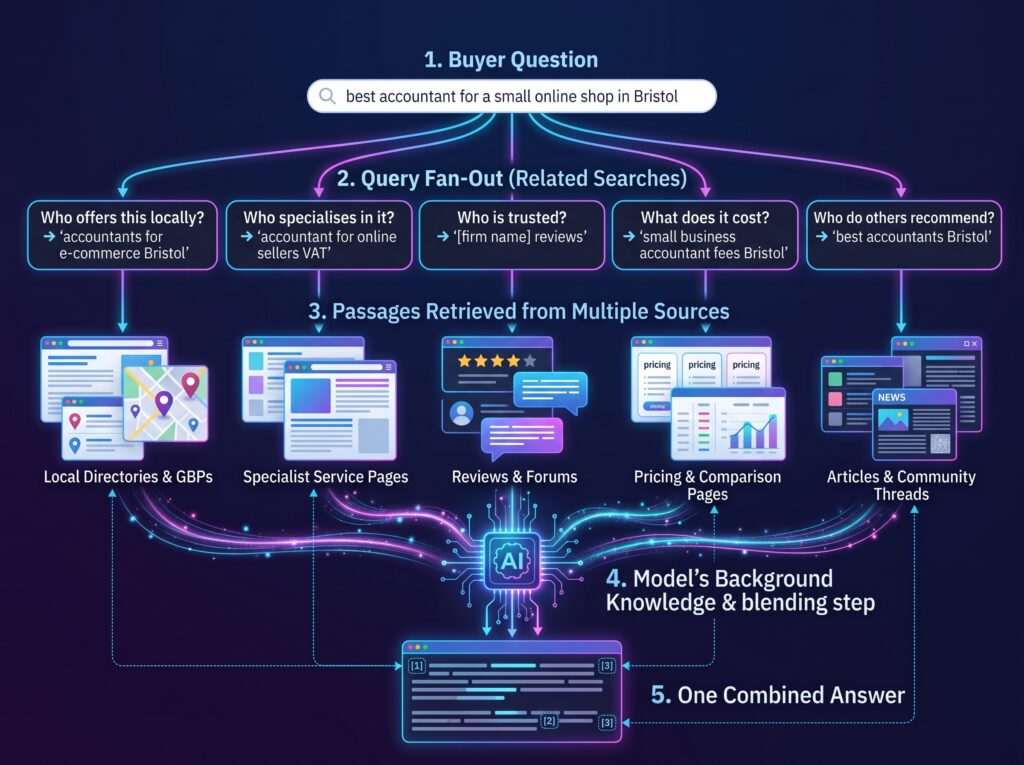
Each tool differs, but most follow a similar pattern when they search the web.
- It works out what the question needs. “Best accountant for a small online shop in Bristol” carries a location, a type of business and an implied budget.
- It fans out into related searches. Google says AI Overviews and AI Mode may use a query fan-out technique, issuing several related searches across subtopics and data sources to build one response.
- It retrieves passages, not just pages. From each search it pulls the most relevant sections, from your site, review platforms, directories, articles or forums.
- It adds what it already knows. The model’s training gives it background knowledge, which may be months or years out of date.
- It writes one answer and picks a few citations. The sources it links to are usually a subset of the sources it read.
Because each step differs between tools, the same question can produce different shortlists. Our guide on why you appear in one AI tool but not another explains where those differences come from.
Here is how fan-out might split one buyer’s question (an illustration of the pattern, not a log from any tool).
| Sub-question | Example search | Sources likely to answer it |
|---|---|---|
| Who offers this locally? | “accountants for e-commerce Bristol” | Service pages, Google Business Profiles, local directories |
| Who specialises in it? | “accountant for online sellers VAT” | Specialist service pages, guides, industry articles |
| Who is trusted? | “[firm name] reviews” | Review platforms, forums, case studies |
| What does it cost? | “small business accountant fees Bristol” | Pricing pages, comparison articles, forum threads |
| Who do others recommend? | “best accountants Bristol” | List articles, local press, community threads |
One page can answer one or two of those sub-questions, but not all five. That is the first reason breadth matters.
How are many sources blended into a single answer?
Next, the engine has to turn overlapping and sometimes conflicting passages into a few confident sentences.
- Agreement raises confidence. When several independent sources say the same thing, such as your location, your specialism or how quickly you respond, the engine can state it plainly.
- Single-source claims get hedged or dropped. A claim that appears only on your own site may be softened, attributed to you, or left out.
- Gaps get filled by whoever covers them. If no source links you to a sub-question, a competitor who is covered fills that part of the answer.
- Compression favours clear statements. The engine condenses many passages into a line or two. Short, specific sentences survive; vague ones do not.
- Conflicts create errors. When sources disagree, the engine may pick one, merge them or guess.
That last point is where misrepresentation starts. An old listing with your former address, or a story about a service you no longer offer, can end up in the answer. Our guide to defending your brand against AI hallucinations covers how to find and correct those errors.
| What the engine finds | What tends to happen in the answer |
|---|---|
| The same fact on your site and several independent sources | Stated plainly, often with a citation |
| A fact that appears only on your own site | Hedged, attributed to you, or left out |
| Conflicting versions across sources | Hedged, merged into something inaccurate, or dropped |
| Nothing about you for a sub-question | That part of the answer goes to someone else |
| Recent, specific reviews that mention a strength | The strength appears in the description of you |
Why does breadth of presence matter as much as any single page?
Fan-out means the engine asks several questions on the buyer’s behalf, and blending means it trusts what it can confirm. Together they reward businesses that show up accurately in many of the places those searches reach.
Breadth is not the same as volume. Twenty thin directory listings add little. What helps is a credible presence in each type of source the engine draws on: your site, the main review platforms for your sector, directories that confirm your details, and articles where others mention you. Each answers a different sub-question and backs up the others.
This is the difference between being found and being chosen. Our guide to GEO and being found versus being chosen sets out why AI tools favour businesses with evidence beyond their own website, and most of the signals AI tools use to judge trust live off your site.
Why does consistency decide how accurately you are represented?
Blending magnifies inconsistency. A person reading three slightly different descriptions of your business can usually tell which is current. A generative engine merges them, and the result can match none of them.
Consistency starts with the basics: the same business name, address, phone number, services and description everywhere you appear. It extends to how you describe what you do. If your website says “bespoke kitchens”, a directory says “kitchen showroom” and your social profile says “home improvements”, the engine has three businesses to reconcile. Improving entity recognition in LLMs explains how to give AI tools one clear version of your business.
Old content matters too. Retired service pages, outdated price lists and stale listings can still be retrieved long after you have moved on. Update or redirect them, and keep your key pages current; our guide to content freshness and AI visibility explains why recency helps.
How do off-site signals feed the summary?
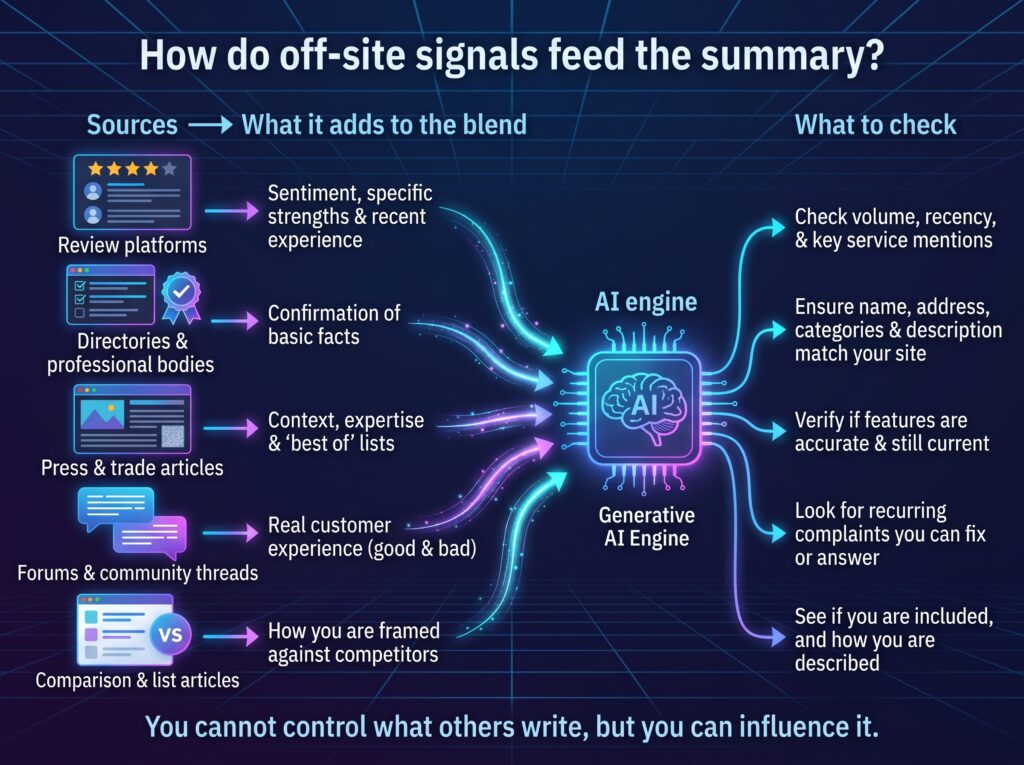
Off-site sources do more than confirm you exist. They supply much of the language used to describe you.
| Source type | What it adds to the blend | What to check |
|---|---|---|
| Review platforms | Sentiment, specific strengths and recent experience | Volume, recency, and whether reviews mention the services you want to be known for |
| Directories and professional bodies | Confirmation of basic facts | Name, address, categories and description match your site |
| Press and trade articles | Context, expertise and inclusion in “best of” lists | Whether what is said is accurate and still current |
| Forums and community threads | Real customer experience, good and bad | Recurring complaints you can fix or answer |
| Comparison and list articles | How you are framed against competitors | Whether you are included, and how you are described |
You cannot control what others write, but you can influence it. Correct the listings you own, ask customers for reviews that mention specific work, respond to criticism in public, and give journalists and partners accurate information. Earning new coverage is a discipline of its own; the starting point is knowing which sources the engines already use, and an AI citation audit shows exactly that.
What does this mean for the pages on your own site?
Your website is still the anchor of the blend: usually the most complete and current source about you, and the one an engine can use to settle conflicts, if it says things clearly.
- Write passages that survive compression. Lead each section with a direct, specific answer the engine can lift. How to structure content for AI search shows the pattern.
- Cover the sub-questions. Fan-out searches for pricing, process, areas served, comparisons and proof. Pages that answer those questions give the engine something of yours for each part of the answer.
- Use the words buyers use. Match the language of real prompts, which you can collect by finding the exact prompts your customers ask AI.
- Keep facts in text. Prices, areas, opening hours and specialisms shown only in images or PDFs are easy for engines to miss.
How do you measure how the blend describes you?
Because answers are assembled fresh each time, one check tells you little. A single ChatGPT check can mislead you; you need a fixed set of prompts, run several times across several tools.
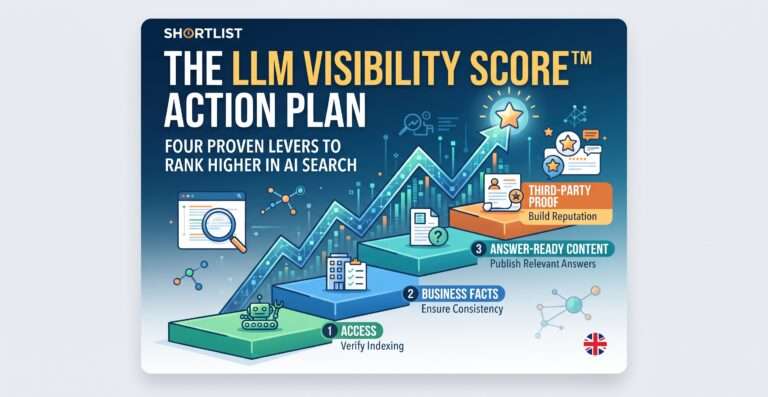
For each prompt, record whether you are mentioned, recommended or cited, how you are described, and which sources are linked. The first gives you a rate to track, which is how the LLM Visibility Score™ works. The second shows whether the blend is accurate. The third shows which sources feed the answer, and so where to focus.
A worked example: a kitchen fitter in Nottingham
Consider a family-run firm in Nottingham that designs and fits bespoke kitchens (an illustrative example, not a named client).
The baseline. For “bespoke kitchen fitter in Nottingham”, AI tools name two competitors and a national chain. When asked about the firm directly, they describe it as “a kitchen showroom offering budget units”. That wording comes from an old directory listing and a news story from before the firm changed direction. Its website mentions bespoke work mainly in photo captions.
The fixes. The firm updates its directory listings and Google Business Profile so every one carries the same name, categories and description. It publishes a text page on bespoke kitchens covering process, typical prices, lead times and areas served. It asks recent customers to mention the type of kitchen in their reviews, and a worktop supplier adds the firm to its list of approved installers.
After three monthly re-tests. Three of the four AI tools tested now describe the firm as a bespoke kitchen specialist, and it is named for “bespoke kitchen fitter in Nottingham” in most runs on two of them. The old “budget units” wording has gone. One tool still hedges on price because few sources mention it, so that is the next gap to close.
Common mistakes
- Treating GEO as one page’s job. One great page cannot answer every sub-question an engine asks.
- Chasing listing volume. Many thin or inconsistent listings add conflict, not confidence.
- Leaving old descriptions live. Outdated listings and pages keep feeding the blend.
- Ignoring what others say. Reviews, forums and articles shape the summary whether you engage with them or not.
Frequently asked questions
What is generative engine optimisation in simple terms?
It is the work of making sure AI tools include your business when they write an answer, and describe it accurately. Because those tools blend many sources into one response, GEO covers your own pages and the wider web: reviews, directories, articles and anywhere else the engine might read about you.
How does a generative engine decide which sources to use?
It runs several searches related to the question, then pulls the passages that best answer each part. Relevance, clarity, credibility and agreement with other sources all appear to matter. No tool publishes its exact criteria, so the practical aim is to be clearly and consistently present wherever those searches are likely to reach.
What is query fan-out?
Query fan-out is when an AI tool splits one question into several related searches, covering subtopics such as location, price, reviews and specialism, then combines the results. Google says AI Overviews and AI Mode may use it. It means one buyer question can draw on many different pages and sources.
Why does AI describe my business differently from my website?
Because your website is only one of its sources. If directories, old articles or reviews describe you differently, the engine may blend those versions together or favour the one repeated most often. Bringing every listing and profile into line with your current description is usually the fastest way to correct it.
Can one strong page get my business into AI answers?
It helps, but rarely on its own. A strong page can answer one or two parts of a question, while the engine also searches for reviews, prices, comparisons and recommendations from others. Businesses that appear consistently across those sources give the engine more to confirm, so they are included more often.
How many sources does an AI answer draw on?
It varies by tool and question, and the tools do not publish a figure. Answers can draw on more sources than they visibly cite, because the engine may read several pages for each sub-question and link to only a few. Treat the citations you see as a sample of its sources, not the full list.
Do off-site mentions matter more than my own website?
They do different jobs. Your website is the most complete and current statement of your facts, and engines can use it to settle details. Off-site mentions confirm those facts and add independent opinion. A business with a strong site and no outside evidence, or the reverse, usually loses to one that has both.
Can I control what third-party sites say about my business?
Not directly, but you can influence much of it. Keep listings you own accurate, ask happy customers for specific reviews, reply to criticism publicly and politely, and give journalists and partners correct information. Where a site states something false, ask for a correction, since engines may keep repeating it until it changes.
What happens when sources disagree about my business?
The engine has to reconcile them. It may choose the version repeated most often, hedge, merge details into something inaccurate, or leave the point out. That is how outdated addresses, old prices and retired services end up in AI answers. Finding and fixing the conflicting sources is the most dependable fix.
Is generative engine optimisation different from SEO?
Yes, though they overlap. SEO helps your pages get crawled, indexed and ranked, which matters because many AI tools retrieve from search indexes. GEO focuses on the answer the engine writes: whether you are included, how you are described and which sources support that description, on and off your own website.
How can I see which sources AI tools use about my business?
Run your key prompts in tools that show citations, such as Perplexity, ChatGPT with search and Google’s AI features, and note every source linked. Repeat the runs, because citations change. An AI citation audit does this systematically and shows which sources shape your description and which ones need correcting.
How long does GEO take to change how AI describes my business?
Fixing listings and key pages can change descriptions once the engines re-read those sources, which may take weeks. Being named more often tends to follow over a few months, as reviews and mentions accumulate. Many businesses see early gains within 30 to 60 days, with measurable improvement targeted within 90 days.
See how AI tools blend your business into their answers
To find out which sources AI tools draw on when they describe your business, and where the blend gets you wrong, book a discovery call. We’ll test your key prompts in ChatGPT, Gemini, Perplexity, Claude and Copilot, and trace the sources behind each answer. You can also read how our Generative Engine Optimisation service works, or see where it fits within the Shortlist System™.