Being named by ChatGPT feels like a win. A customer asks for a recommendation, your business comes up, and it seems like the AI is on your side. But there is a quieter question hiding underneath that moment, and it is the one that actually decides how much AI search is worth to you: did the AI use your website as the source, or did it just repeat your name from somewhere else?
Those are two very different situations, and most businesses cannot tell them apart because they have never looked closely. A citation audit is how you look closely. It separates the flattering surface, that your name appears, from the thing that builds durable visibility, that your own content is trusted enough to be quoted.
This guide explains what an AI citation audit is, how to run one, and, most usefully, what it tends to reveal once you do. Some of those findings are uncomfortable. Nearly all of them point to a fix you can act on. By the end you will know how to tell whether AI is genuinely relying on you, or simply mentioning you in passing while it quotes someone else.
What an AI citation audit actually is
An AI citation audit is a structured check of whether, and how often, AI tools use your website as a cited source when they answer questions your customers ask.
When an AI answers a question, it draws on information and, on many platforms, it shows where that information came from. Those shown sources are citations. A citation audit works through a set of real buyer questions, looks at the sources each AI platform gives, and records whether your site is among them. It does the same for the sites that are winning citations instead of you, so you can see who the AI trusts and why.
This sits close to a broader AI visibility audit, which measures where you appear across AI answers in general. If you have not read it yet, our guide to running an AI visibility audit is the natural companion to this one. The visibility audit asks whether you show up at all. The citation audit narrows in on a sharper question: when you do show up, is it because your content earned the spot, or because someone else’s did the work for you.
That narrower focus is what makes it valuable. Appearing in answers is good. Being the source those answers are built on is far stronger, because it means the AI treats your pages as reliable, and reliability is what keeps you in answers over time.
Citations versus mentions, and why the gap matters
The single most important idea in this whole exercise is the difference between a mention and a citation, so it is worth being precise about it.
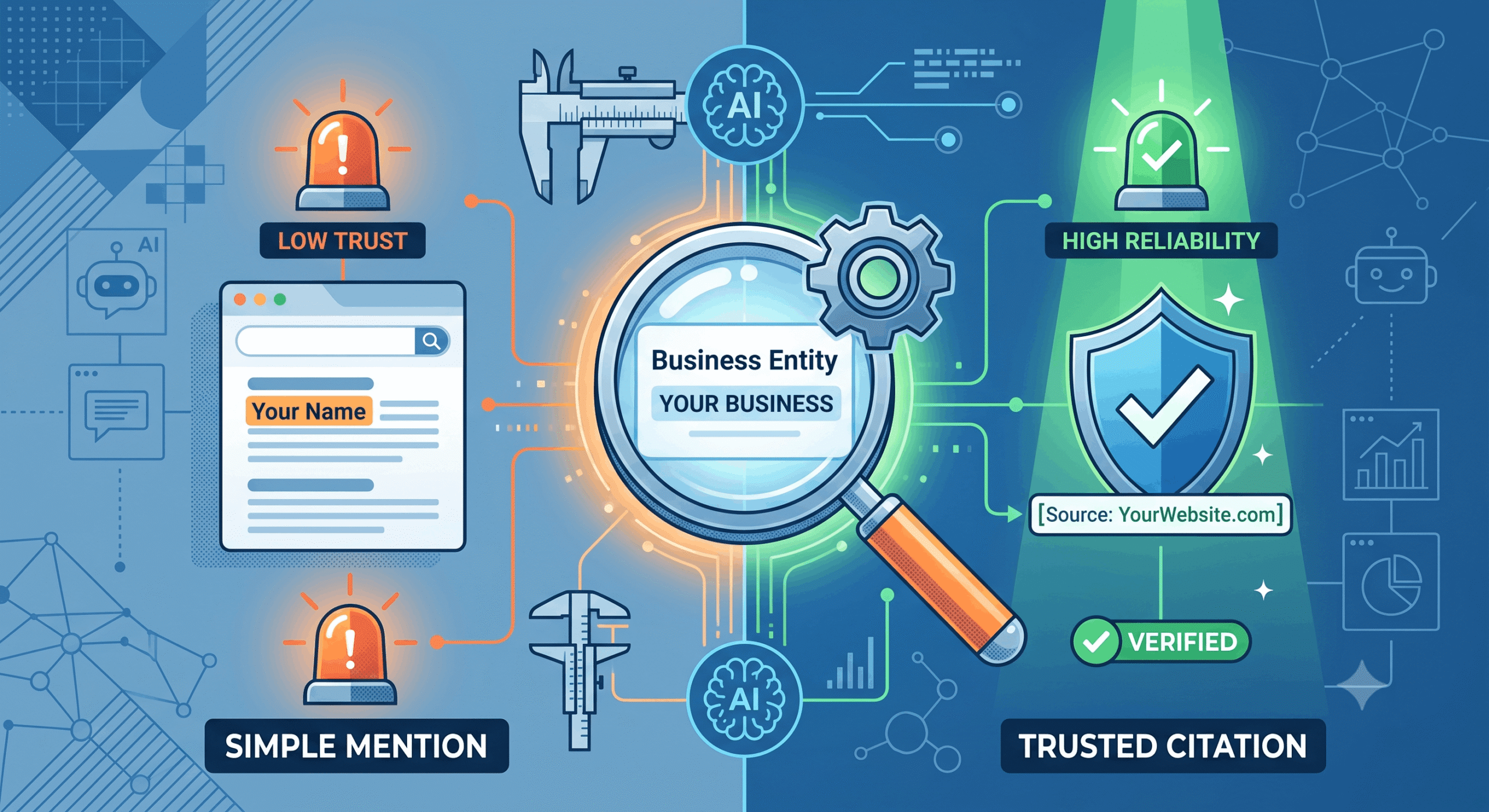
A mention is when the AI names your business in its answer without pointing to your website as the source. Your name is in the text, but the information behind it came from a directory, a review site, a news piece, or the model’s general knowledge. It is good for awareness, and it means your brand has some presence, but it is not under your control and it does not send anyone to you.
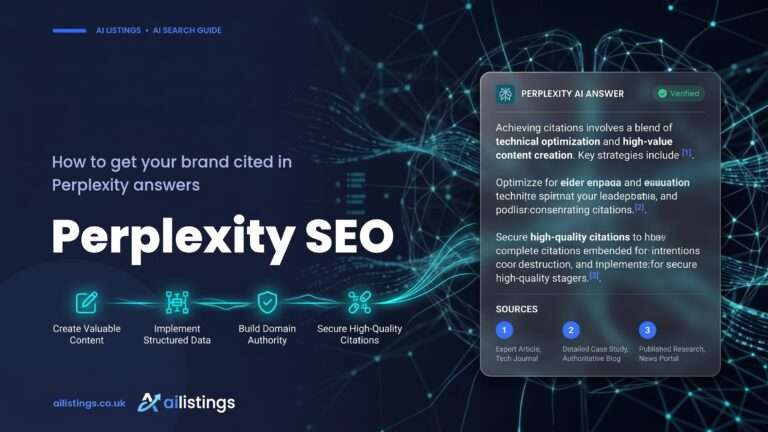
A citation is when the AI uses your page as the source and shows it as such, usually with a link. That is a much stronger position. It means your content was clear enough, relevant enough and trusted enough to be the thing the answer was built on. Citations can send real traffic, and they signal to the AI that your site is a dependable source to return to.
A mention puts your name in the answer. A citation makes your page the source behind it.
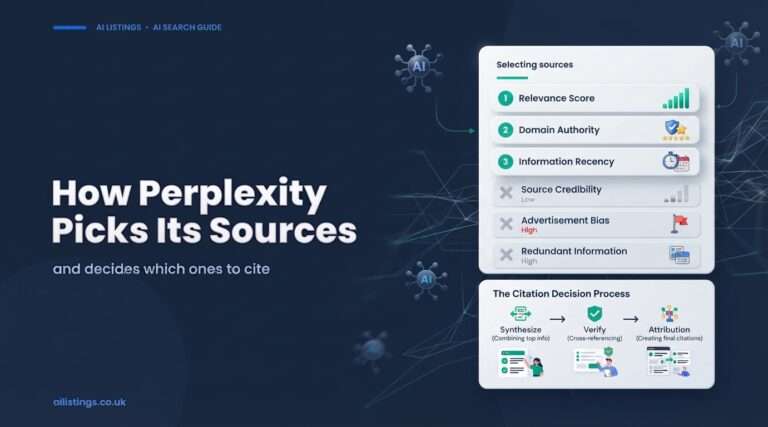
This distinction maps neatly onto an idea we cover in being found versus being chosen in GEO. A mention is a form of being found. A citation is closer to being chosen, because the AI has actively decided your page is worth relying on. The whole point of a citation audit is to measure how often you are chosen, not just found.
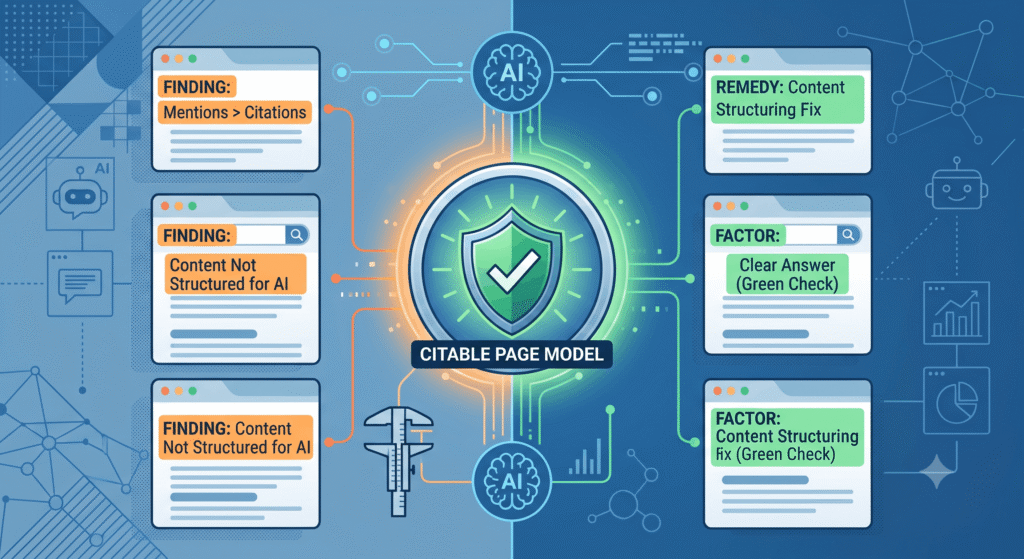
Here is the pattern that catches most businesses out. They are mentioned reasonably often, which feels reassuring, but they are rarely cited. That gap is not a small detail. It usually means the AI knows you exist but does not rate your website highly enough to quote it, and that is a fixable content and trust problem rather than a fact of life.
Why citations matter more than they used to
For years, the goal of search was a ranking. You wanted to be near the top of the page so people would click. AI answers changed the shape of that goal. When a tool gives a direct answer and lists a handful of sources, the sources it cites are the new front page. Being one of them is the modern equivalent of ranking well, and being left out is the modern equivalent of page two.
There is a traffic angle too. On platforms that show citations, people do click through to sources when they want to go deeper or make contact. If your competitor is cited and you are not, they get that click and you do not, even if your name was mentioned in the same answer. We looked at the wider version of this problem in why you do not appear in AI results while competitors do, and citations are often the specific mechanism behind it.
There is also a trust angle that compounds over time. AI systems tend to return to sources they have used before and found reliable. Earning citations is not just a one-off win, it builds a position that gets easier to hold. Missing them works the other way, quietly locking you out of answers your competitors come to own.
What a citation audit checks
A thorough audit looks at more than a simple yes or no on whether you are cited. It builds a picture across a few dimensions, and each one tells you something different.
- Citation presence. Across your set of buyer questions, how often is your site cited at all?
- Citation share. When you are cited, how do you compare with the other sources shown? Are you the main source or a minor one?
- Which pages. Exactly which of your pages get cited, and which never do, even when they cover the question well?
- Which sources beat you. When you are not cited, who is? A rival’s blog, a directory, a review platform, or a third-party page about you?
- Accuracy. When the AI does cite or describe you, does it get the facts right?
Together these turn a vague sense of “we show up sometimes” into something you can measure and improve. If you want to attach a number to it and track it over time, our post on what an LLM Visibility Score is and how it is measured shows how to fold citation data into a single figure you can watch move.
How to run an AI citation audit, step by step
You can do a solid citation audit yourself with free accounts and a spreadsheet. The method matters more than any tool. Here is the sequence.
- List your buyer prompts. Write the real questions customers ask, in natural language rather than keywords. Cover discovery questions, comparison questions, and direct questions about your business. Fifteen to thirty is a good range.
- Use the platforms that show sources. Citations are only visible where the platform reveals them. Perplexity shows sources clearly, Google’s AI results list them, and ChatGPT and Copilot show them when they search the web. Focus your audit where sources are on display.
- Record cited, mentioned or absent. For each prompt on each platform, note whether your site is cited as a source, whether you are only mentioned in the text, or whether you are absent. Do the same for competitors.
- Find which of your pages get cited. Where you are cited, write down the exact page. Patterns appear quickly. Often one or two pages do all the work and the rest never feature.
- Diagnose why. For the questions where you are not cited, look at the page that should have been the source and ask what is missing. This is where the real learning is, and we come back to it below.
- Prioritise the fixes. Turn the findings into a short, ordered list. Start with the changes that are quick and likely to win citations you are currently missing.
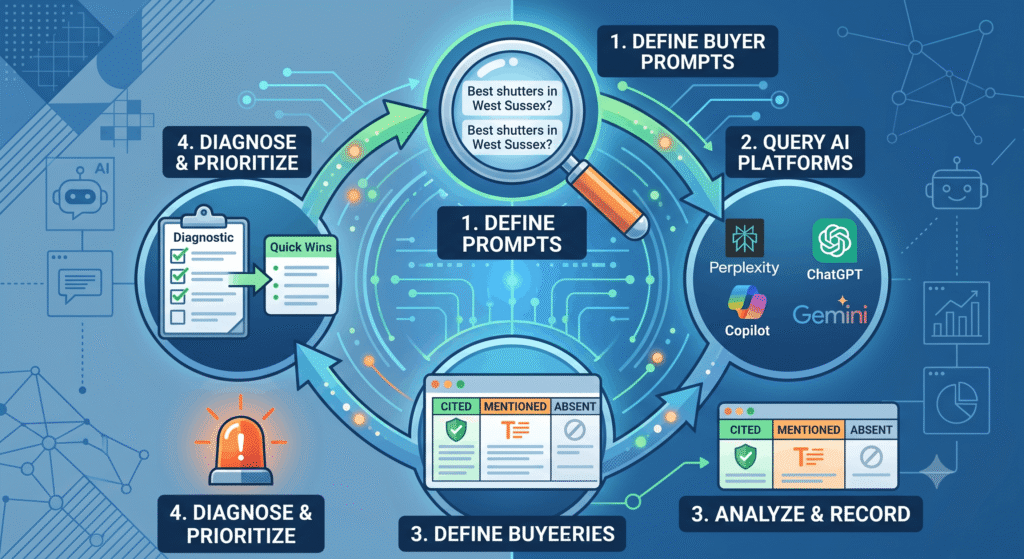
The audit runs in a simple loop, from listing questions to a prioritised set of fixes.
Run each prompt a couple of times rather than once, because AI answers vary between runs and a single check can mislead. If you have already done a general visibility audit, you can reuse the same prompt list here and simply add the citation columns. The connection to answer engines runs throughout, and our guide to answer engine optimisation gives the wider context for why sources are treated the way they are.
What a citation audit reveals
This is where the exercise earns its keep. The results of a citation audit tend to fall into a handful of recurring patterns, and each one carries a clear instruction about what to do next.
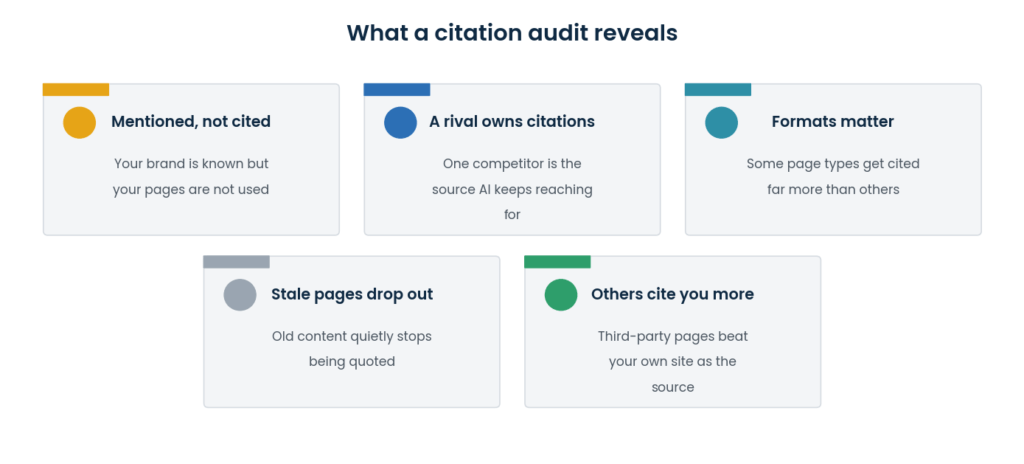
Most citation audits surface a familiar set of findings, and each points to a specific fix.
You are mentioned but almost never cited
This is the most common finding, and the most useful. Your brand is known to the AI, but your pages are not the ones it quotes. It nearly always means your content is not structured for extraction. The information an AI wants is present but buried, phrased for a human skim-reader rather than stated plainly. Our guide to structuring content so AI systems can extract and use it is the direct fix, and this finding is usually the fastest win in the whole audit.
One competitor owns the citations
Sometimes a single rival is cited again and again across your questions. That consistency is rarely luck. They have usually built the content and trust signals that make them the safe source to quote. Studying their cited pages tells you exactly what the AI rewards in your category. We unpacked this pattern in why some businesses appear repeatedly in AI answers, and a citation audit is where you catch it happening to you specifically.
Some page types get cited far more than others
You will often see that certain formats win citations while others never do. Clear, question-led pages and well-organised guides tend to get quoted. Thin service pages and marketing-heavy copy tend not to. That tells you which format to lean into for the questions you want to own.
Stale pages quietly stop being quoted
A page that was cited months ago can drop out as fresher sources appear. If you spot pages that used to feature and no longer do, freshness is likely the cause, and a considered update can win the citation back without building anything new.
Other sites cite you more than your own site does
Occasionally the audit shows that the AI mentions you based on third-party pages, directories or reviews, while your own website barely features as a source. That points to strong off-site presence and weak on-site content. It is a good position to build from, because your brand signals are working, and it usually comes down to strengthening how your own pages are written and how clearly your business is described. Our post on improving entity recognition in LLMs helps close that gap.
Why some pages get cited and others do not
Once you have your findings, it helps to understand the factors that push a page towards being cited. These are the things to check on any page you want the AI to trust.
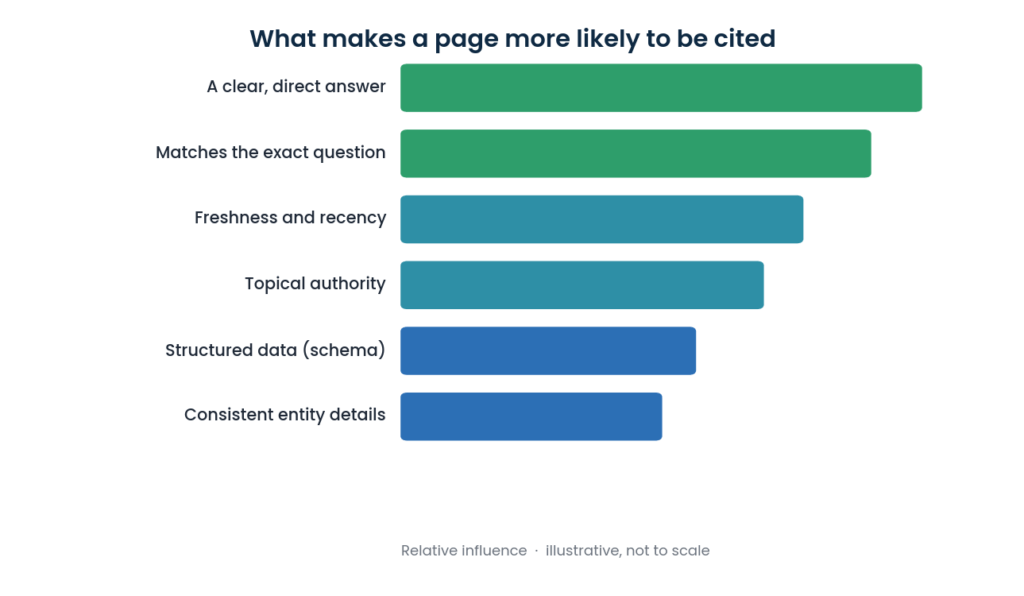
The factors that make a page citable, roughly in order of how much they tend to matter.
A clear, direct answer. AI systems favour pages that answer the question plainly and early. A page that makes the reader hunt for the answer is a page that is hard to quote.
Matching the exact question. A page that speaks to the real phrasing of a buyer’s question, rather than a keyword, is far more likely to be pulled as the source. This is why building your audit around real questions matters so much.
Freshness. Recent, maintained content tends to be preferred over pages that have sat untouched for years, especially for questions where the answer can change.
Topical authority. Sites that cover a subject in depth and consistently are treated as safer sources than sites that mention it once. Depth builds trust.
Structured data and clear signals. Schema and clean, machine-readable pages help an AI understand and use your content. It is also worth checking whether you have an llms.txt file, which we cover in what llms.txt is, as it gives AI systems guidance on how to use your content.
Consistent trust signals. Reviews, consistent listings and reputable mentions all raise your standing as a source. We break these down in trust signals for AI recommendations, and they sit behind a lot of citation decisions.
A quick worked example
To make this concrete, picture a plantation shutters company in West Sussex running a small citation audit. They pick ten questions, from who fits plantation shutters in the area to how much shutters cost, and check them on Perplexity and Google’s AI results.
The first thing they notice is that their name comes up in about half the answers, which feels encouraging. Then they look at the sources. On the cost questions, the cited pages belong to two national competitors and a home improvement magazine, not them. On the local questions, a directory and a review site are cited, and their own website appears as a source only once, for a question about a specific shutter material where they happen to have a detailed page.
That single cited page is the clue. It is clear, it answers one question directly, and it reads like a straight reply rather than a sales pitch. The pages that fail to get cited are their main service pages, which are heavy on persuasion and light on plain answers. The competitor who owns the cost citations has a simple, well-organised pricing guide.
The fix writes itself. Build clear, question-led pages for the cost and local questions, in the same plain style as the one page that already works, and the citations that are currently going elsewhere become winnable. None of this required a tool. It required looking at the sources instead of stopping at the mention.
What to do if your citations are weak
A weak set of citation results is not a reason to worry, it is a to-do list. The steps are consistent, whatever your specific findings.
Start with the pages that should be cited but are not, and make them answer their question plainly and early. This is almost always the highest-value change. Then bring your entity details into line across the web, so the AI can connect your business to its services and location with confidence. Strengthen your trust signals, particularly reviews and consistent listings, since these sit behind a lot of citation decisions. Finally, keep the pages that matter fresh, so they are not quietly replaced by newer sources.
Do those four things and citations tend to follow, because you are giving the AI exactly what it looks for in a source. If you want the wider view of how these pieces combine into being recommended rather than just mentioned, our guide to how to get your business recommended by ChatGPT pulls them together.
Common mistakes when auditing citations
A few errors take the value out of a citation audit, and they are easy to avoid once you know them.
Treating a mention as a citation. The whole point is the difference between the two. If you count mentions as citations, you will conclude everything is fine while your competitor quietly owns the sources.
Auditing only the platforms that flatter you. Check across several source-showing platforms. Being cited on one and absent on the others is a common and important finding you would miss otherwise.
Checking once. Answers vary between runs. Run each prompt a few times so you record the pattern rather than a single result.
Stopping at the finding. An audit that lists problems but never diagnoses them leaves you guessing. Always look at the page that should have been cited and work out what it is missing.
Ignoring accuracy. If the AI describes you incorrectly, note it. Getting cited for the wrong facts can be worse than not being cited, and correcting the record is part of the job. Our guide to how businesses get recommended by AI covers how accurate, consistent information feeds better recommendations.
Frequently asked questions
What is the difference between an AI citation and an AI mention?
A mention is when an AI names your business in its answer without using your website as the source. A citation is when the AI uses your page as the source and shows it, usually with a link. Citations are the stronger signal, because they mean your content was trusted enough to build the answer on.
Which platforms should I check for citations?
Focus on the ones that show their sources: Perplexity, Google’s AI results, and ChatGPT and Copilot when they search the web. Citations are only visible where the platform reveals them, so these are where a citation audit does its work.
How is a citation audit different from a visibility audit?
A visibility audit measures whether you appear in AI answers at all. A citation audit narrows in on whether your own pages are used as the source when you do appear. They pair well together, and you can reuse the same prompt list for both. Start with the visibility audit if you have not run one yet.
How often should I run a citation audit?
Quarterly suits most businesses, with a lighter monthly check of your most important questions. Citations shift as content and competitors change, so the value comes from watching the trend rather than taking a single snapshot.
My competitor is always cited. Can I change that?
Usually, yes. Consistent citation almost always comes from clearer content, stronger topical depth and better trust signals, all of which you can build. Study their cited pages, then make yours a better answer to the same question.
Turning the audit into results
A citation audit replaces a comfortable assumption with an honest picture. Instead of feeling reassured because your name came up, you know whether the AI actually relies on you, which of your pages earn that trust, and who is winning the citations you are missing. That clarity is what makes the fixes obvious.
Start small. Take ten of your most important questions, check them on two source-showing platforms, and record cited, mentioned or absent for you and one competitor. Even that quick pass will tell you whether you have a citation problem hiding behind a healthy-looking set of mentions.
If you would rather have this done properly, with the diagnosis and the fix list handled for you, that is what our AI optimisation services are for. Book a discovery call and we will show you exactly where you are cited, where you are only mentioned, and what it would take to become the source AI reaches for.