“When will we start showing up in ChatGPT?” is the first question almost every business asks before signing up for AI visibility work, and it deserves a straight answer. Some changes show within weeks. Some take a full quarter. A few depend on things nobody controls, such as when an AI company releases a new model.
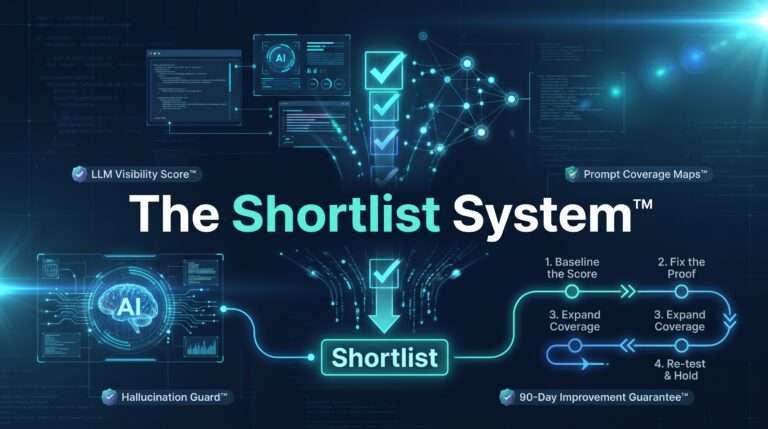
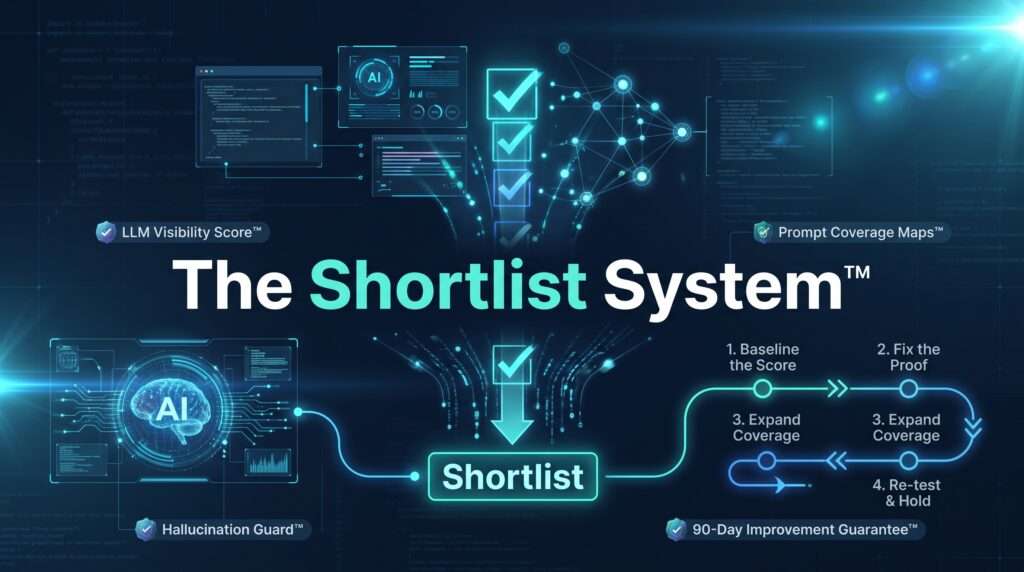
This post sets out a realistic month-by-month picture of the first 90 days: what happens, what you should see, what you should not expect yet, and how to judge whether the work is on track. It is the timeline behind the Shortlist System™ and its 90-Day Improvement Guarantee™, written so you know exactly what you are signing up to.
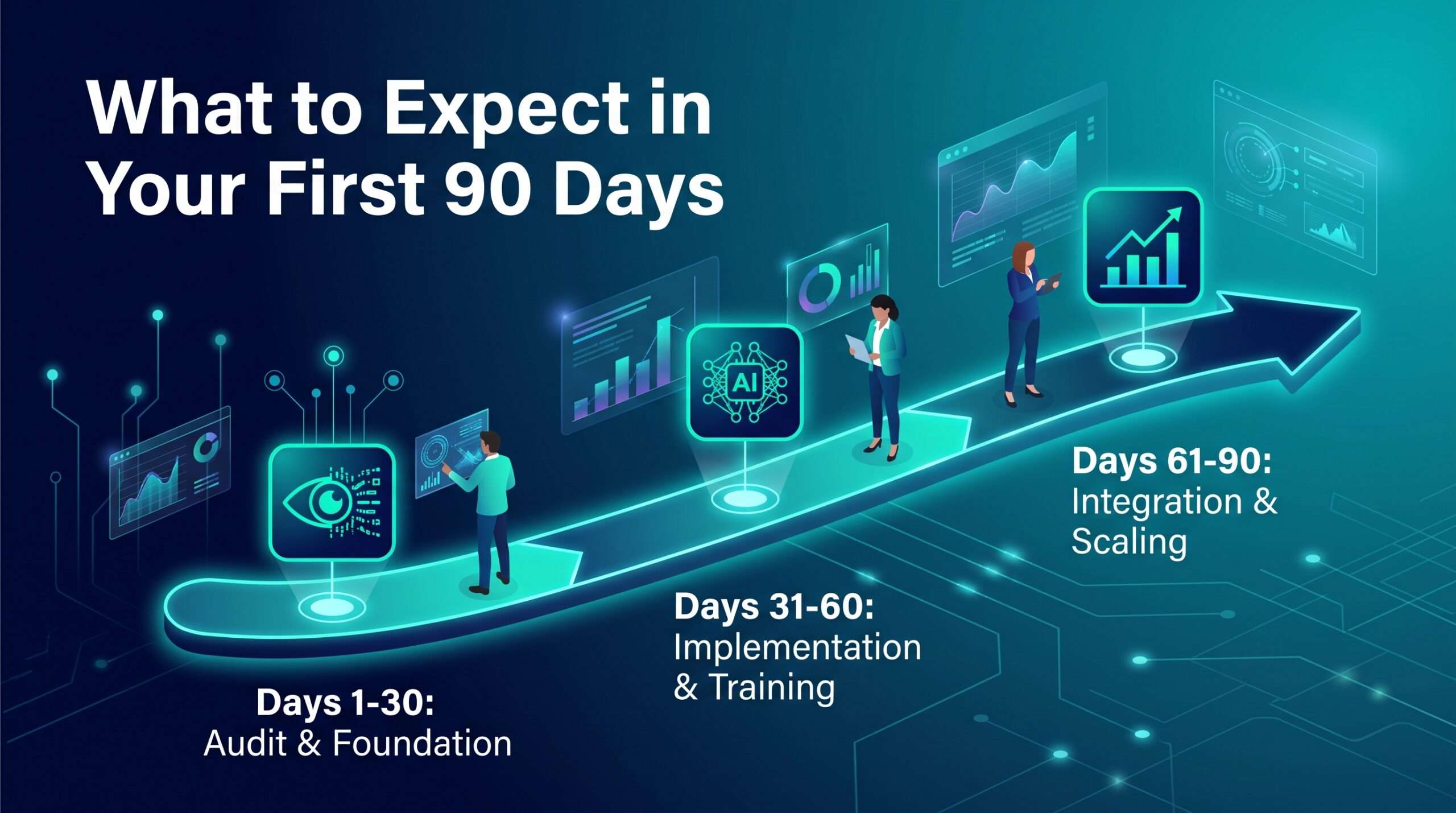
In short: In the first 30 days, fixes go in and AI tools re-fetch your pages, so their descriptions of you become more accurate. By day 60, new answer-ready pages start appearing for prompts you used to miss. By day 90, reviews and mentions have built up, and three re-tests show a trend you can judge against your baseline.
Why does AI visibility take weeks, not days?
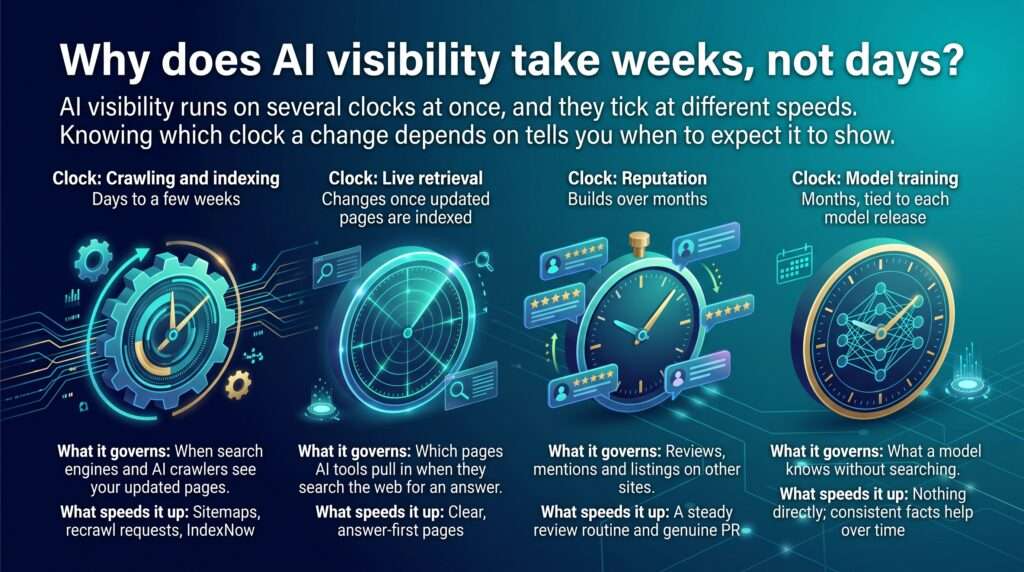
AI visibility runs on several clocks at once, and they tick at different speeds. Knowing which clock a change depends on tells you when to expect it to show.
| Clock | What it governs | Typical pace | What speeds it up |
|---|---|---|---|
| Crawling and indexing | When search engines and AI crawlers see your updated pages | Days to a few weeks | Sitemaps, recrawl requests, IndexNow |
| Live retrieval | Which pages AI tools pull in when they search the web for an answer | Changes once updated pages are indexed | Clear, answer-first pages |
| Reputation | Reviews, mentions and listings on other sites | Builds over months | A steady review routine and genuine PR |
| Model training | What a model knows without searching | Months, tied to each model release | Nothing directly; consistent facts help over time |
Google says a recrawl can take anywhere from a few days to a few weeks after you ask it to recrawl your URLs. Bing and several other search engines accept instant change notifications through the IndexNow protocol, which shortens that wait for Copilot and the tools that draw on Bing. Training data is slower still. As we explain in how ChatGPT chooses which businesses to recommend, what a model learned in training only changes when it is retrained, so the early wins come from live search.
Before day one: setting the baseline
Every 90-day plan starts with a fixed measuring stick. Without one, nobody can say whether anything improved.
- A prompt set. A fixed list of real buyer questions, from discovery through to decision. Finding the exact prompts your customers ask AI explains where these come from.
- A baseline score. Each prompt is run several times on each major AI tool, giving your starting LLM Visibility Score™.
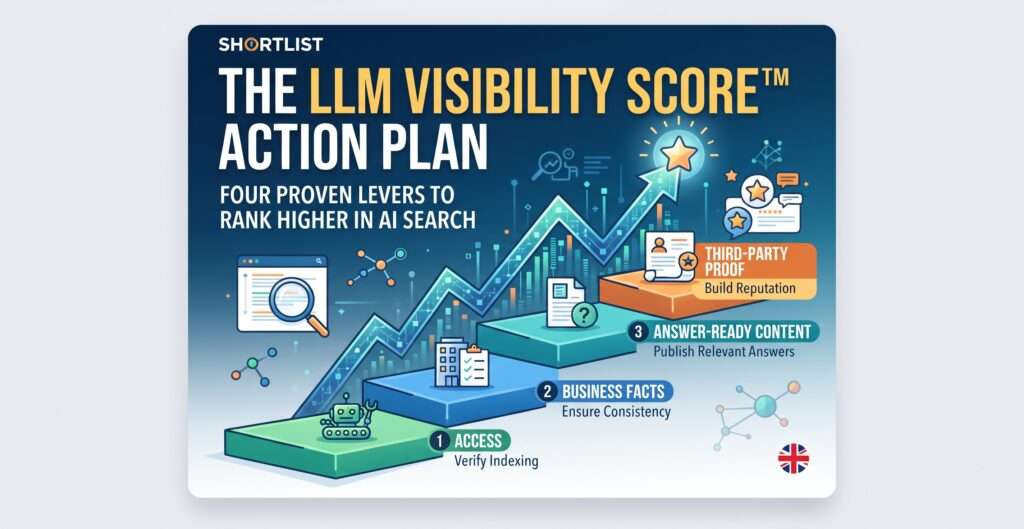
- An audit of the signals behind it. Crawl access, business facts, content gaps and third-party proof are rated, so the work starts with the weakest. How to run an AI visibility audit shows what this covers.
- An agreed target. The score movement both sides will judge the work against at day 90.
This normally takes the first week or two. It is not glamorous, but it is the step that makes everything after it provable.
Days 1 to 30: fixes go in and pages are re-fetched
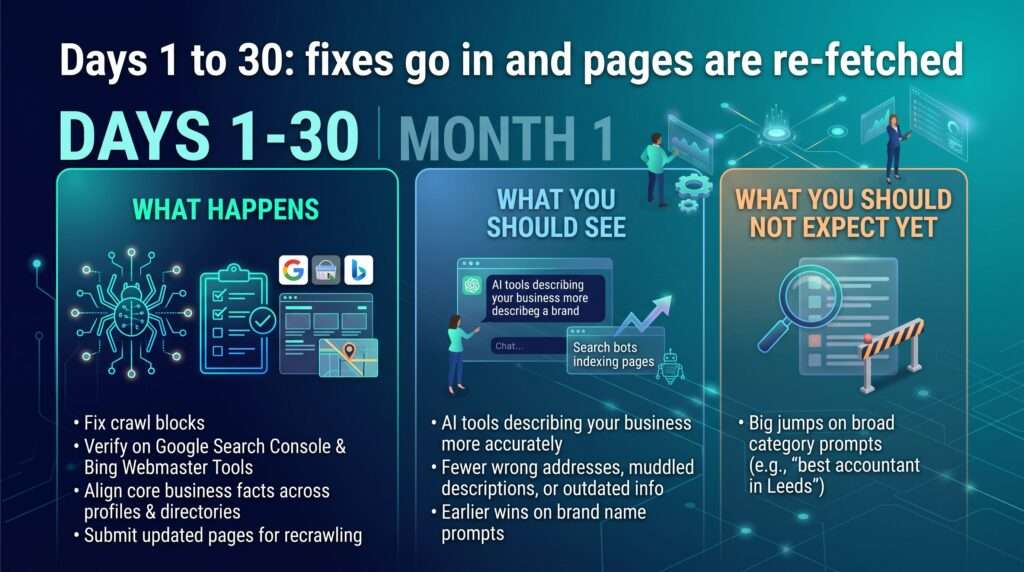
The first month is mostly foundation work. It is the least visible part to you and the most important part for the result.
What happens. Crawl blocks are removed, the site is verified in Google Search Console and Bing Webmaster Tools, and core business facts are made consistent across your website, Google Business Profile, social profiles and the directories that matter. Our guide to improving entity recognition in LLMs covers this clean-up in detail. Updated pages are then submitted for recrawling.
What you should see. The first re-test, at around day 30, usually shows AI tools describing you more accurately, with fewer wrong addresses, outdated services or muddled descriptions. Brand prompts, where people ask about you by name, tend to improve first.
One exception is worth knowing. If your site had never been verified with Bing, fixing that can lift Copilot visibility quickly, because Copilot draws on the Bing index and your pages were simply missing from it.
What you should not expect yet. Big jumps on category prompts such as “best accountant in Leeds”. Those depend on content and proof that are only just being built.
Days 31 to 60: answer coverage builds
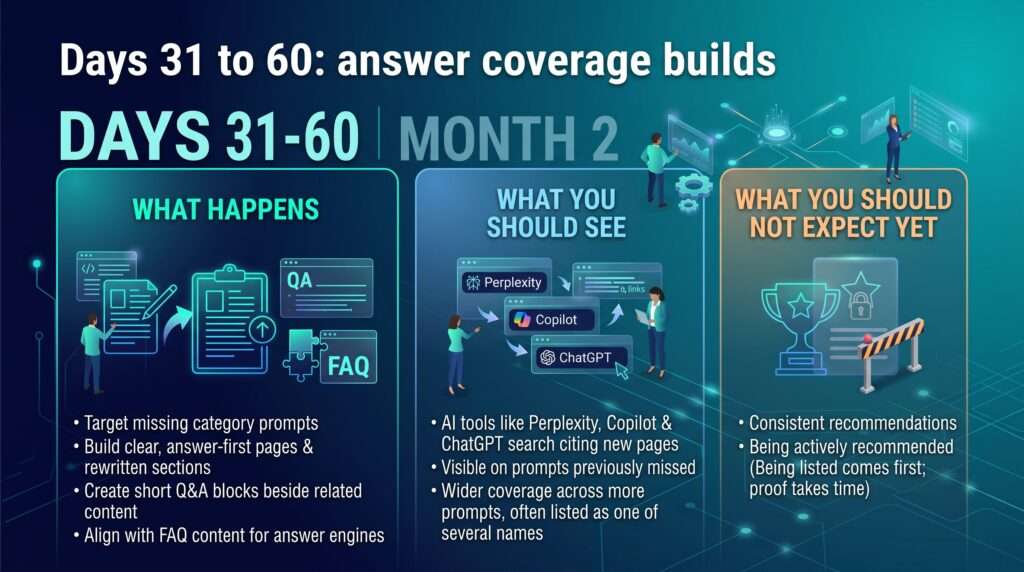
What happens. With the facts settled, the work moves to the category prompts where you are missing. Each one gets a clear, answer-first page or a rewritten section of an existing page, built around the questions buyers actually ask. Short question-and-answer blocks sit beside the content they relate to, following the approach in how to write FAQ content for answer engines.
What you should see. At the day-60 re-test, tools that search the web live, such as Perplexity, Copilot and ChatGPT search, start citing the new pages for some of the prompts you used to miss. Coverage widens before it deepens, so expect to appear on more prompts at first, often as one of several names.
What you should not expect yet. Consistent recommendations. Being listed comes first. Being the business AI tools actively recommend usually follows once independent proof has built up.
Days 61 to 90: proof accumulates and the trend becomes readable
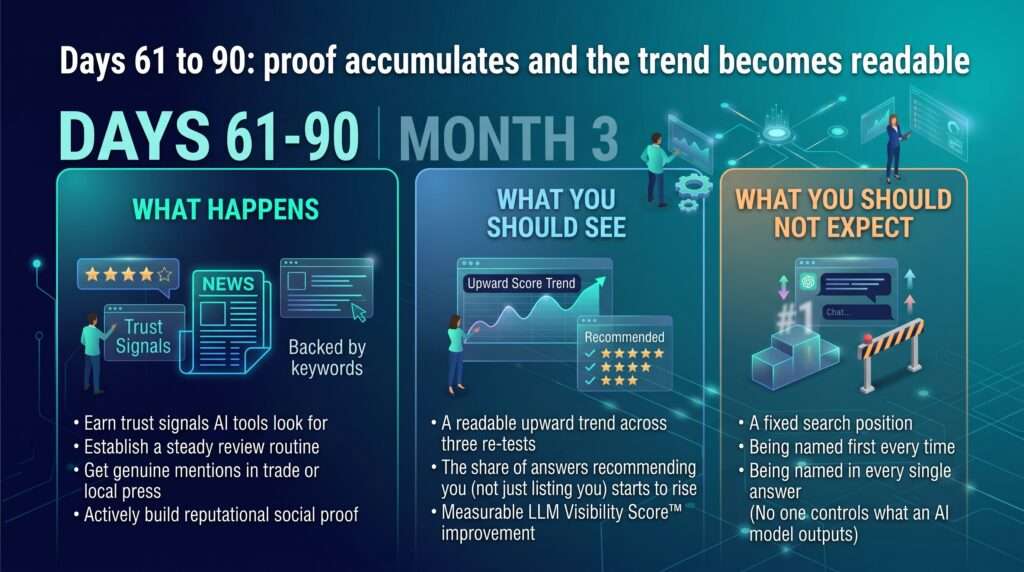
What happens. Reviews, mentions and listings run on the slowest clock, so work on them starts early and keeps going. By the third month, a steady review routine and a handful of genuine mentions in trade or local press start to show in what AI tools say about you. Most of the trust signals AI tools look for are earned in this phase.
What you should see. By day 90 you have three re-tests against the same prompts, which is enough to see a trend rather than noise. The share of answers that recommend you, rather than simply list you, should start to rise. Many businesses see early gains within 30 to 60 days, with measurable score improvement targeted within 90.
What you should not expect. A fixed position. No one controls what an AI model outputs, so nobody can honestly promise you will be named first, or named in every answer.
What does the 90-Day Improvement Guarantee™ cover?
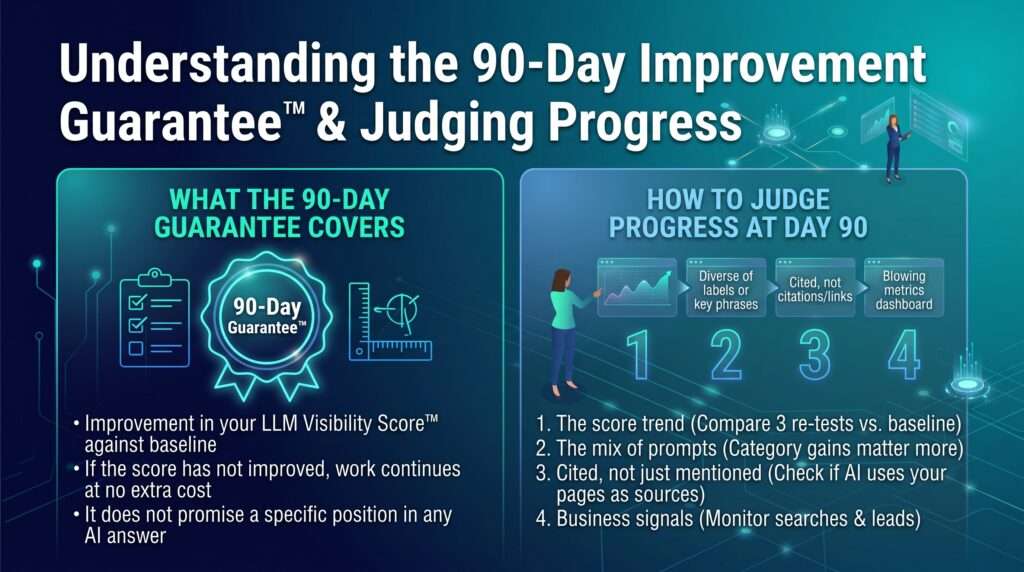
The guarantee is built around what can honestly be promised. It is a commitment to measurable movement, not to a ranking.
- It covers improvement in your LLM Visibility Score™ against the baseline and prompt set agreed at the start.
- If the score has not improved within 90 days, the work continues at no extra cost until it does.
- It does not promise a specific position in any AI answer, because no one can.
That is why the baseline matters so much. A guarantee is only as fair as the measurement behind it, so the same prompts are re-run in the same way every month.
How to judge progress at day 90
Look at four things, in this order:
- The score trend. Compare all three re-tests with the baseline. One good or bad month is noise; the direction across three is the signal. A single ChatGPT check misleads you, so judge the full re-tests rather than spot checks.
- The mix of prompts. Gains on category prompts matter more than gains on brand prompts, because category prompts are where new customers find you.
- Cited, not just mentioned. Check whether AI tools now use your pages as sources. An AI citation audit shows the difference and why it matters.
- Business signals. Watch branded searches, direct visits and enquiries that mention ChatGPT or another AI tool. Our guide to how AI visibility helps generate leads covers what to track.
Warning signs in the first 90 days
- No baseline. If work starts before a score is measured, nobody can prove what changed.
- A promise of “number one in ChatGPT”. No one controls model output, so treat this as a red flag.
- A prompt set that keeps changing. New prompts every month make the reports impossible to compare.
- Screenshots instead of rates. One answer on one day is not evidence either way.
- Content before facts. Publishing lots of new pages while your business details still disagree across the web wastes the first month.
A worked example: an IT support company in Birmingham
Here is how the first 90 days might look for an IT support company in Birmingham (an illustrative example, not a named client).
Week one. The baseline uses 25 buyer prompts, run three times on five AI tools. The company is named in 12% of answers, mostly when people ask about it by name. Its trading name differs between its website and its directory listings, and its service area is described three different ways.
Day 30. Names, service areas and service descriptions now match everywhere, and the site is verified in Bing Webmaster Tools for the first time. The re-test shows accurate descriptions across all five tools and the first appearances on Copilot. The score moves to 15%.
Day 60. Five answer-ready pages go live for prompts such as “IT support for small businesses in Birmingham” and “how much does managed IT support cost”. Perplexity and ChatGPT search begin citing two of them. The score reaches 19%.
Day 90. A review request after each completed project adds a steady stream of recent reviews, and a local business publication features the company in a roundup. More answers now recommend the company rather than simply listing it. The score stands at 23%, nearly double the baseline, and most of the gain sits in category prompts.
What happens after day 90?
Ninety days is where a trend becomes readable, not where the work ends. Models change, competitors keep working, and pages age. After the first quarter, the focus shifts to holding gains and widening coverage: refreshing key pages, because content freshness boosts AI search visibility, adding prompts at agreed points, and keeping reviews and mentions coming in.
You can see how this has played out for real businesses in our case studies.
Frequently asked questions
How long does AI visibility take to work?
Most businesses see early gains within 30 to 60 days, usually in how accurately AI tools describe them, with measurable score improvement targeted within 90 days. Category prompts and consistent recommendations take longer, because new pages need to be found and independent reviews and mentions need time to build up.
What happens in the first 30 days of AI visibility work?
The foundations are fixed. Crawl blocks are removed, the site is verified with Google and Bing, and business facts are made consistent across your website and profiles. Updated pages are submitted for recrawling. The first re-test usually shows more accurate descriptions and better results on prompts that mention you by name.
Why don’t AI visibility results show immediately?
Because changes depend on several slow clocks. Search engines need days to weeks to recrawl updated pages, reviews and mentions build up over months, and what a model learned in training only changes when the model is retrained. Early gains come from live search, which reacts once your pages are re-indexed.
When will my business start appearing in ChatGPT?
For prompts that trigger a live web search, often within the first two months, once updated pages are indexed and cited. For answers ChatGPT gives from its training data, it can take much longer, because that knowledge only updates with new model releases. Nobody can honestly promise a specific date or position.
What does the 90-Day Improvement Guarantee™ cover?
It covers measurable improvement in your LLM Visibility Score™ against the baseline and prompt set agreed at the start. If the score has not improved within 90 days, the work continues at no extra cost until it does. It does not promise a specific position in any AI answer, because no one controls model output.
What should I see at the day-60 re-test?
Tools that search the web live, such as Perplexity, Copilot and ChatGPT search, should start citing some of the new answer-ready pages for prompts you previously missed. Expect to appear on more prompts, often as one of several names, before AI tools recommend you consistently. Recommendations usually follow once reviews and mentions build up.
How do I know if AI visibility work is on track?
Compare three monthly re-tests with your baseline, using the same prompts each time. Look for a rising trend, gains on category prompts rather than just brand prompts, more answers citing your pages, and business signals such as branded searches and enquiries that mention an AI tool.
Can AI visibility work be faster than 90 days?
Some parts can. Fixing crawl access, Bing verification or wrong business details can improve accuracy and Copilot visibility within weeks. But reviews, mentions and wider prompt coverage build over months, and model training updates on its own schedule. Ninety days is the shortest window in which a trend becomes reliable.
What if my score drops during the first 90 days?
A dip in one re-test is often noise, because AI answers vary between runs and models are updated. Look at which platform and which prompts fell before reacting. If the drop persists across re-tests, it usually points to a specific cause, such as a blocked crawler or a competitor’s new content.
Do I need to do anything during the first 90 days?
A little. You will usually need to approve fact changes, give access to your Google Business Profile and webmaster tools, share details for answer-ready pages such as pricing ranges, and ask happy customers for reviews. The review routine matters most, because only you can ask your customers.
What happens after the first 90 days?
The focus moves from building to holding. Key pages are refreshed, new prompts are added at agreed points, reviews and mentions keep building, and monthly re-tests continue. AI models and competitors keep changing, so visibility that is not maintained tends to fade over the following months.
How is AI visibility progress reported?
Each monthly report should show your current LLM Visibility Score™ and the change since the last re-test, a breakdown by platform, the prompts you now appear in and those you still miss, and what is being worked on next. Rates across several runs matter more than screenshots of single answers.
Start your first 90 days
The first step is always a baseline. Book a discovery call and we will run your key prompts across the major AI tools, show you your starting score, and set out what the first month would fix. You will know what to expect before any work begins.