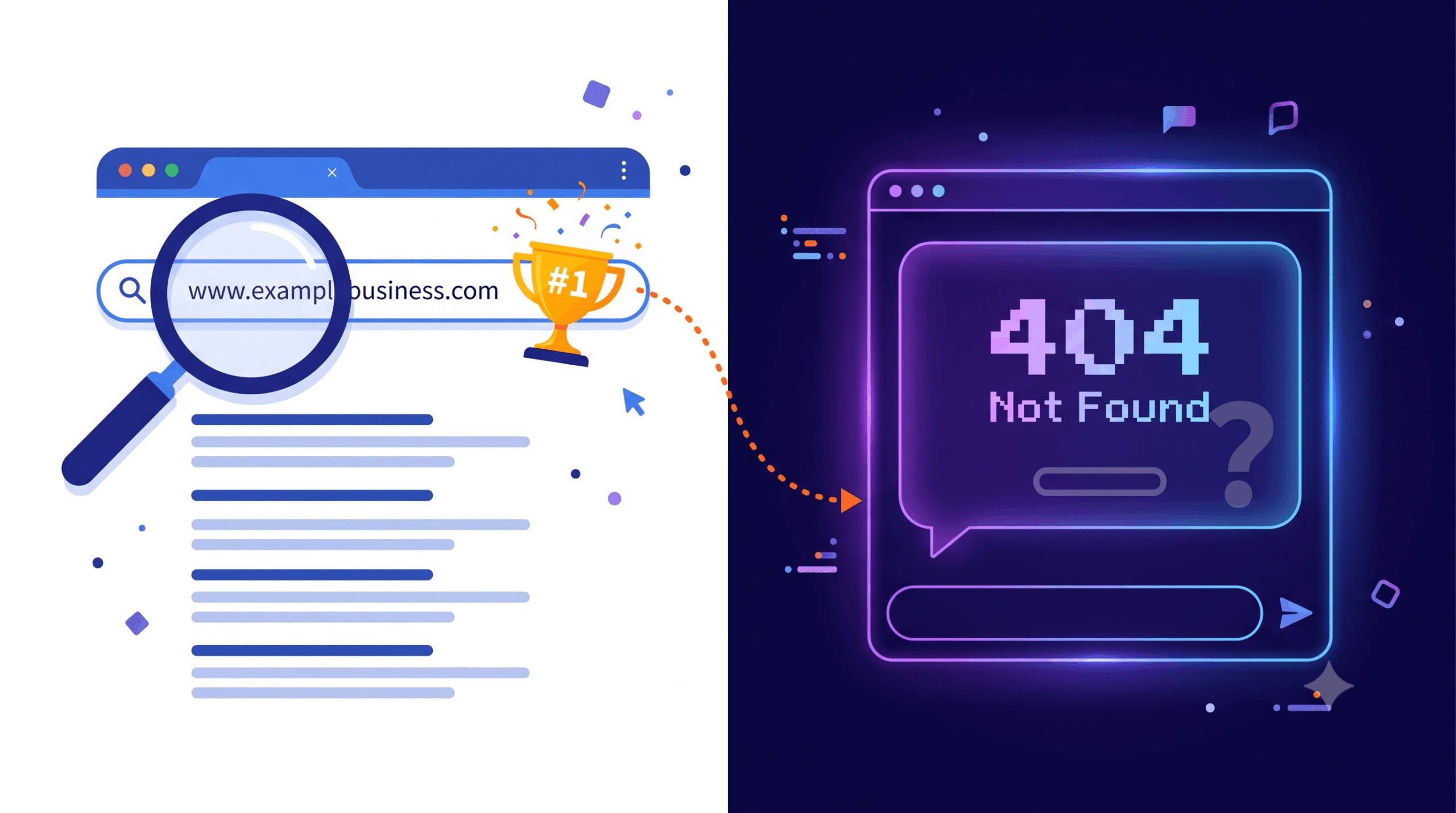
You can rank first on Google and still be completely invisible when a customer asks ChatGPT for a recommendation.
That gap catches a lot of business owners off guard. They have spent years earning their rankings, their site pulls in traffic, and then a customer tells them, “I asked ChatGPT who to use and your name never came up.” The rankings are real. The problem is that the question is no longer being asked on Google alone.
The only way to know where you stand is to look. Not to guess, not to assume the SEO work carries over, but to actually run the prompts your customers run and record what the AI says back. That process has a name. It is an AI visibility audit, and it is quickly becoming the first thing any serious business should do before spending money on content or optimisation.
This guide walks through the whole thing, step by step. By the end you will know exactly which prompts to test, which platforms to check, how to score what you find, and how to turn the results into a short list of fixes that actually move the needle. You do not need expensive software to start. You need a method, an afternoon, and a willingness to see the real picture.
What an AI visibility audit actually is
An AI visibility audit is a structured check of how often, and how well, your business appears when people ask AI tools the kind of questions that lead to a sale.
Think of it as a health check. You take a set of real buyer questions, put them to the main AI platforms, and record three things: whether your business shows up at all, whether it is recommended or just mentioned in passing, and whether the AI links to you as a source. You do the same for your competitors, so you have something to compare against. Then you look at the signals behind those results to work out why the answers came out the way they did.
It helps to be clear about what this is not. It is not a traditional SEO audit. An SEO audit looks at rankings, crawlability, backlinks and page speed. Useful work, but it measures your position on a results page. An AI visibility audit measures whether you appear inside the answer itself, which is a different question with different causes. If you want the wider context on why that distinction matters, our guide to what AI visibility is sets out the full picture. This audit is the practical, hands-on version of that idea.
It is also not the same as a one-off search. Typing your name into ChatGPT once and seeing it appear tells you almost nothing. AI answers vary from one run to the next, they change by platform, and they depend heavily on how the question is phrased. A proper audit accounts for that variation instead of drawing a conclusion from a single lucky result.
The three inputs to an audit feed one process, which produces a clear set of outputs.
Why you cannot skip this
Search behaviour has shifted, and it has shifted faster for high-intent questions than for casual ones. When someone wants to be entertained, they still browse. When someone wants to hire, buy or decide, they increasingly ask an AI tool for a shortlist and trust what comes back.
That is the exact moment your visibility matters most. If a customer asks for the best option in your area and your business is not in the answer, you are not losing a ranking position, you are missing the decision entirely. There is no page two to climb back from. The answer is given, and the customer moves on.
Most businesses have no idea whether this is happening to them, because they have never checked. They assume that because they rank on Google, they must be showing up in AI answers too. That assumption is often wrong, and our post on why you do not appear in AI results while competitors do explains the reasons in detail. The short version is that AI systems weigh signals differently from Google, so strong search rankings do not automatically carry across.
The wider truth is that the old playbook has quietly stopped being enough on its own. We made that case in why traditional SEO is no longer enough. An audit is how you find out, in concrete terms, how big the gap is for your own business rather than as a general trend.
What you need before you start
You do not need much, and everything here is free to gather. Setting these four things up properly is what separates a useful audit from a vague one.
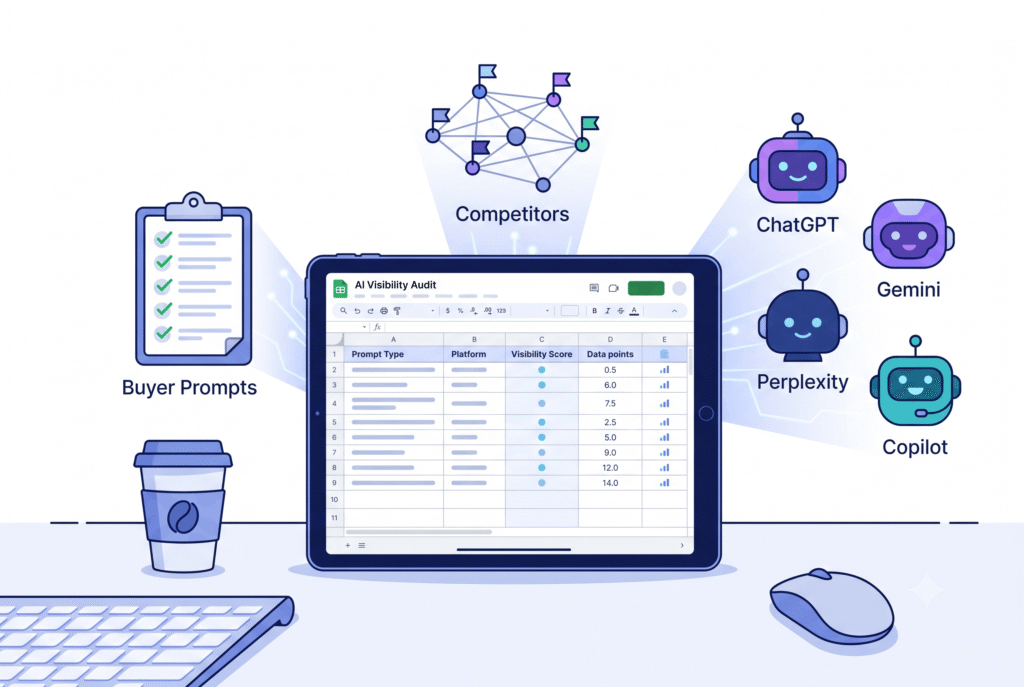
A list of buyer prompts. These are the real questions your customers ask, phrased the way they would phrase them to an AI, not the keywords you would target on Google. We will build this list properly in step one.
Access to the main AI platforms. A free account on each is enough to begin. You want ChatGPT, Google’s AI Overviews and Gemini, Perplexity, and Microsoft Copilot. Between them, these cover where most AI answers are happening.
A short competitor list. Pick three to five businesses you genuinely compete with for the same customers. You will run the same prompts for them, which gives your own results meaning. Appearing in two out of ten answers sounds poor until you learn your closest rival appears in zero.
A simple scoring sheet. A spreadsheet with a row per prompt and columns for each platform does the job. You are recording what you see so you can compare, spot patterns, and measure change when you audit again later.
One habit to set now: run every prompt in a fresh, logged-out session, and turn off any personalisation or memory features. AI tools tailor answers to your history, and if you are signed in and have been researching your own business, the tool will happily show you your own name. That is a flattering result and a false one. You want to see what a stranger sees.
Step 1: Build your prompt list
This is the most important step, and the one people rush. The quality of your entire audit depends on testing the right questions.
Start by thinking about intent rather than keywords. In traditional search, someone might type “plumber Milton Keynes”. In an AI tool, the same person asks a full question: “Who is a reliable plumber in Milton Keynes for a bathroom job?” The phrasing is longer, more natural, and often more specific about the situation. Your prompt list should reflect that. If you want to go deeper on the relationship between the two, we cover how keywords drive both Google and AI search in a separate post.
Aim for a spread across the buyer journey. A good list has three types of prompt:
- Discovery prompts, where the person does not know you yet. “What are the best driving schools in Belfast?” or “Who offers plantation shutters in West Sussex?”
- Comparison prompts, where they are weighing options. “How do I choose between chauffeur companies for an airport transfer?” or “What should I look for in a window installer?”
- Direct prompts, where they name you. “Is [your business] any good?” or “What do people say about [your business]?”
Discovery prompts tell you whether you are on the shortlist at all. Comparison prompts tell you whether you are framed as a strong choice. Direct prompts tell you what the AI already believes about you, which can be revealing and occasionally alarming.
Write between fifteen and thirty prompts. Fewer than that and you are drawing conclusions from too little. Many more and the audit becomes a chore you never repeat. Cover your core services, your main locations, and the questions that come up most often in real sales conversations. If a customer has asked you something over the phone, it belongs on the list.
Step 2: Choose the platforms to test
Not every AI platform behaves the same way, and appearing strongly in one tells you little about the others. You want a reading across the main ones so you understand the full spread.
ChatGPT is where a large share of people now go for recommendations, so it carries a lot of weight. Test it with and without its browsing behaviour where you can, as answers can differ.
Google AI Overviews and Gemini matter because they sit inside the search habit people already have. An AI Overview appears above the traditional results for many queries, which means it can absorb the attention that used to go to your ranking.
Perplexity is worth checking because it leans heavily on citations and shows its sources clearly. That makes it excellent for the citation part of your audit, since you can see plainly whether you are being used as a source or ignored.
Microsoft Copilot reaches people through Windows and the wider Microsoft ecosystem, and its answers can differ from the others in useful ways.
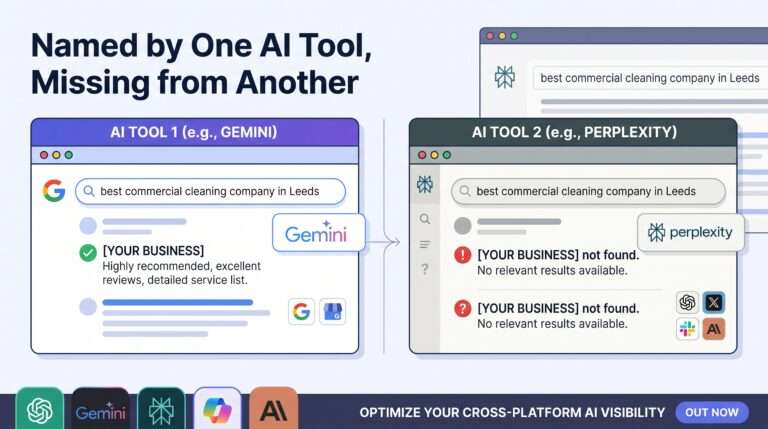
Record each platform separately. A common and important finding is that a business shows up well on one platform and not at all on another. That pattern points to specific causes, and you would miss it entirely if you blended everything into a single score.
Record every prompt against every platform. The pattern across the grid is where the insight lives.
Step 3: Run the prompts and record what you see
Now you work through the list. For each prompt, on each platform, you record what happened. Keep it simple and consistent, because consistency is what makes the results comparable.
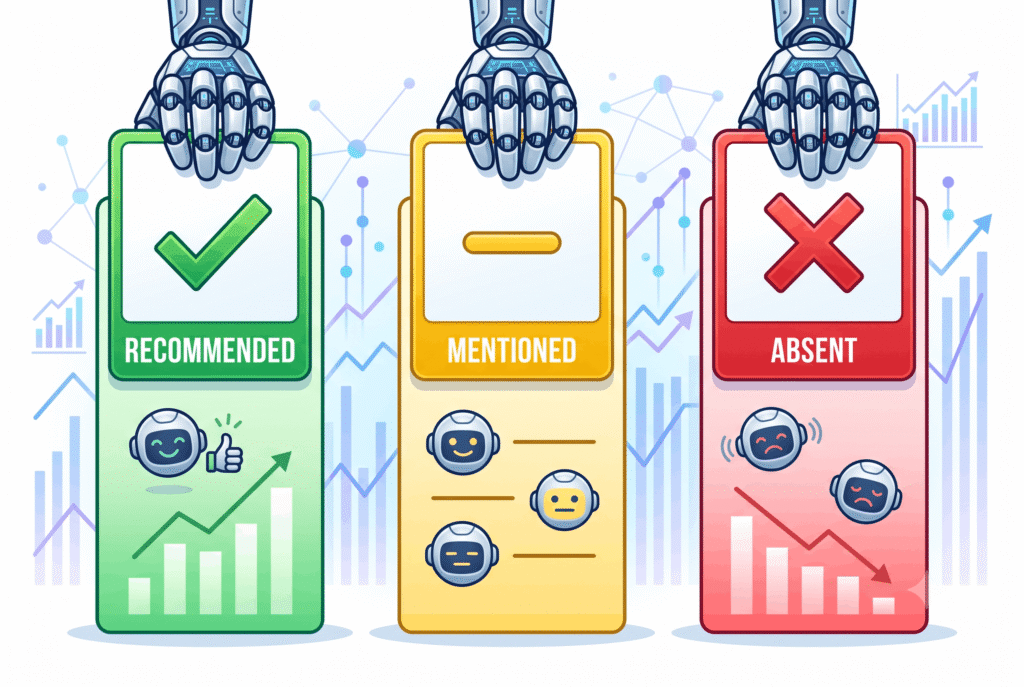
Use three states for your own business in every answer:
- Recommended. You are named as a suggested option, ideally with something positive said about you.
- Mentioned. You appear, but only in passing, or in a list where you are clearly not the focus.
- Absent. You do not appear at all.
Do the same for each competitor. It takes longer, but this is where the value is. Your own numbers only mean something next to theirs.
Because AI answers vary, run each prompt two or three times rather than once, and note the pattern. If you appear in one run out of three, that is genuinely different from appearing in all three, and it tells you your presence is fragile rather than absent. This variation is normal and is one reason a single check is so misleading.
When you tally the results, you are effectively building a rough visibility score: how often you appear, in what role, across how many platforms. That number is the headline of your audit. It is also the thing you will measure again in three months to prove whether your work is paying off. We explain the fuller version of this measurement in our post on what an LLM Visibility Score is and how it is measured, which is worth reading if you want to formalise the scoring beyond a simple tally.
Resist the urge to judge as you go. Just record. The analysis comes next, and it is far cleaner when your data is honest rather than shaped by what you hoped to find.
Step 4: Check whether you are cited or just talked about
There is a difference between an AI mentioning your business and an AI citing your website as a source, and the difference matters more than most people realise.
When an AI names you, that is good for awareness. When an AI cites your page as where it got its information, that is a much stronger signal. It means your content was clear enough and trusted enough to be used as the source of the answer. On platforms that show citations, such as Perplexity and Google’s AI results, you can see this directly. Look at whether your domain appears in the list of sources, and if so, which pages.
This part of the audit often exposes a specific weakness. A business might be mentioned reasonably often, yet almost never cited, which usually means the AI knows the brand exists but does not find the website useful enough to quote. That is a content problem, and it is fixable. Most of the time it comes down to how the pages are written and structured. Our guide to structuring content so AI systems can extract and use it covers exactly what to change, but for the audit, all you need to do right now is record the gap between how often you are mentioned and how often you are cited. A wide gap is a clear signal about where to focus.
Step 5: Audit the signals behind your visibility
Up to this point you have measured outcomes. Now you work out the causes, because the results you recorded did not happen by accident. AI systems decide what to say about you based on a set of signals, and each one is worth checking.
Content clarity and structure. Open your key service pages and read them as an AI would. Are the answers to common questions stated plainly and early, or buried in long paragraphs? Content written to impress a human skim-reader often fails an AI that is looking for a clean, quotable passage. This is the single most common fixable cause of poor citation.
Entity clarity. AI systems need to understand that your business is a real, specific organisation connected to particular services and places. If your name, location and services are stated inconsistently across the web, the AI struggles to build a confident picture of you. This is what we mean by entity recognition, and our post on improving entity recognition in LLMs explains how to strengthen it. In the audit, check that your business is described the same way everywhere it appears.
Trust signals. AI tools lean towards sources that look reliable, which includes reviews, consistent listings, and mentions on other reputable sites. Weak or inconsistent trust signals hold businesses back even when their content is good. We break these down in trust signals for AI recommendations. For now, note whether your reviews, directory listings and off-site mentions are strong and consistent, or thin and scattered.
Technical signals. Check the machine-readable basics. Is your structured data in place so AI can parse who you are and what you offer? Do you have a clear, accessible site that crawlers can read? It is also worth checking whether you have an llms.txt file, a newer file that tells AI systems how to use your content, which we cover in what llms.txt is.
For each of these four areas, give yourself an honest rating: strong, patchy or weak. That rating tells you where the causes of your results are hiding, and it stops you from fixing the wrong thing.
Rate each of the four signal areas honestly. The weak ones are usually where your results are being decided.
Step 6: Benchmark against your competitors
You gathered competitor data in step three. Now you use it.
Line up your visibility against theirs, prompt by prompt and platform by platform. The goal is not to feel good or bad, it is to find the specific places where a rival appears and you do not. Those gaps are your opportunities, because they show you where the AI is already comfortable recommending someone in your category. Getting into that answer is usually easier than creating demand from nothing.
Pay attention to any competitor who shows up again and again across many prompts. That consistency is rarely luck. It usually means they have built the signals from step five to a level the AI trusts, and studying what they do differently is one of the most useful things you can take from an audit. We looked at this pattern specifically in why some businesses appear repeatedly in AI answers, and the audit is where you see it happening in your own market rather than in the abstract.
Note the reverse too. If there are prompts where nobody in your category appears strongly, that is open ground. Being the first business to earn a clear, citable presence for those questions can put you well ahead.
Step 7: Turn findings into a prioritised action list
An audit that ends in a spreadsheet nobody acts on is wasted effort. The final step is to convert what you found into a short, ordered list of things to do.

Sort your findings by two factors: how much difference a fix would make, and how much effort it takes. The quick, high-impact items go first. In most audits, a few obvious ones stand out:
- If you are mentioned but rarely cited, improving the structure of your key pages is usually the fastest win.
- If your entity details are inconsistent, tidying up your listings and making your name, location and services consistent everywhere is straightforward and pays off across every platform.
- If a competitor dominates a set of prompts you care about, that points to a specific content and presence gap you can plan against.
Keep the list short. Five to eight priorities you will actually complete beat a list of forty you will not. If you want a ready-made starting point, our AI visibility checklist for small businesses pairs well with your audit findings and helps you sequence the work.
Plot each finding by impact and effort. The high-impact, low-effort corner is where you start.
How often should you run an audit
An AI visibility audit is not a one-time job, because the thing it measures keeps moving. AI platforms update, competitors improve, and your own content changes. A single audit is a snapshot, and its real value comes from comparison over time.
For most businesses, a full audit every quarter is a sensible rhythm. That is often enough to catch changes and prove progress, without becoming a burden. Between full audits, a lighter monthly check of your most important five or six prompts keeps you alert to any sudden drop. The first audit is the hardest because you are building the prompt list and the scoring sheet from scratch. Every audit after that is mostly repetition, which makes it quick.
Keep your old scoring sheets. The trend line is the point. Watching your visibility climb from two answers out of ten to seven out of ten over two quarters is the clearest proof that the work is paying off, and it is far more persuasive to a sceptical owner than any promise.
Common mistakes to avoid
A few errors turn up again and again, and each one quietly undermines the result.
Testing while signed in. As covered earlier, personalised answers show you your own name and give a false read. Always use a fresh, logged-out session.
Using keyword phrases instead of real questions. AI answers respond to natural questions. Feeding an AI your Google keyword list produces stilted prompts that no real customer would type, and the results will not reflect reality.
Checking once and stopping. A single run per prompt ignores the variation in AI answers. Run each prompt a few times and record the pattern.
Ignoring competitors. Your own numbers are close to meaningless without a benchmark. Skipping the competitor rows is the most common way to end up with an audit you cannot interpret.
Auditing outcomes but never the signals. If you record where you appear but never check why, you are left guessing at fixes. Step five is what makes the audit actionable.
Frequently asked questions
What is an AI visibility audit?
It is a structured check of how often, and how well, your business appears when people ask AI tools the questions that lead to a purchase. You test a set of real buyer prompts across the main AI platforms, record whether you are recommended, mentioned or absent, compare against competitors, and examine the signals behind the results.
How is it different from an SEO audit?
An SEO audit measures your position on a search results page, looking at rankings, links and technical health. An AI visibility audit measures whether you appear inside the AI’s answer itself. The causes are different, so strong search rankings do not guarantee strong AI visibility.
Which AI platforms should I check?
Start with ChatGPT, Google AI Overviews and Gemini, Perplexity, and Microsoft Copilot. These cover where most AI answers are being given. Record each one separately, because a business often performs well on one and poorly on another.
How often should I run one?
A full audit each quarter suits most businesses, with a lighter monthly check of your most important prompts in between. The value comes from comparing results over time, so keep every scoring sheet.
Can I do it myself, or do I need a tool?
You can absolutely do a solid audit yourself with a free account on each platform and a simple spreadsheet. Tools help at scale and add consistency, but the method matters more than the software. If you would rather have it done thoroughly and interpreted for you, that is what AI optimisation services exist for.
Where to go from here
An AI visibility audit turns a vague worry into a clear picture. Instead of wondering whether customers are finding you in AI answers, you know exactly where you appear, where you do not, and why. That knowledge is worth more than any amount of guessing, because it tells you precisely where to spend your time and money.
Run your first audit this week, even a small one. Pick ten prompts, test them across the main platforms, note where you land against a couple of competitors, and rate your four signals. That single afternoon will tell you more about your real position in AI search than months of assumptions.
If you would like a professional audit that goes deeper, benchmarks you properly, and comes back with a clear plan rather than a spreadsheet, we can help. Book a discovery call and we will show you exactly where your business stands in AI answers, and what it would take to be the one that gets recommended.