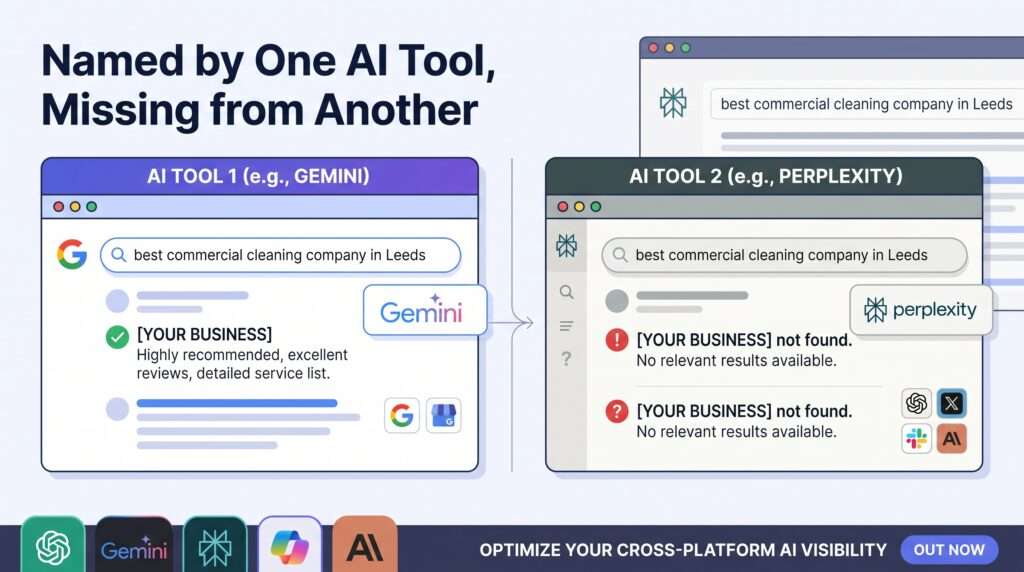
A low LLM Visibility Score™ is not bad news. It is a map. It tells you that AI tools are passing you over, on which platforms and for which questions. What it does not tell you on its own is what to change, or in what order, so many businesses respond by doing a little of everything and then wonder why the number barely moves.
This post is the action plan. If you need the definition first, start with what an LLM Visibility Score is and how it is measured. Here we cover the levers that actually move the score, the order to pull them in, how to read a low result, and what a realistic climb looks like.
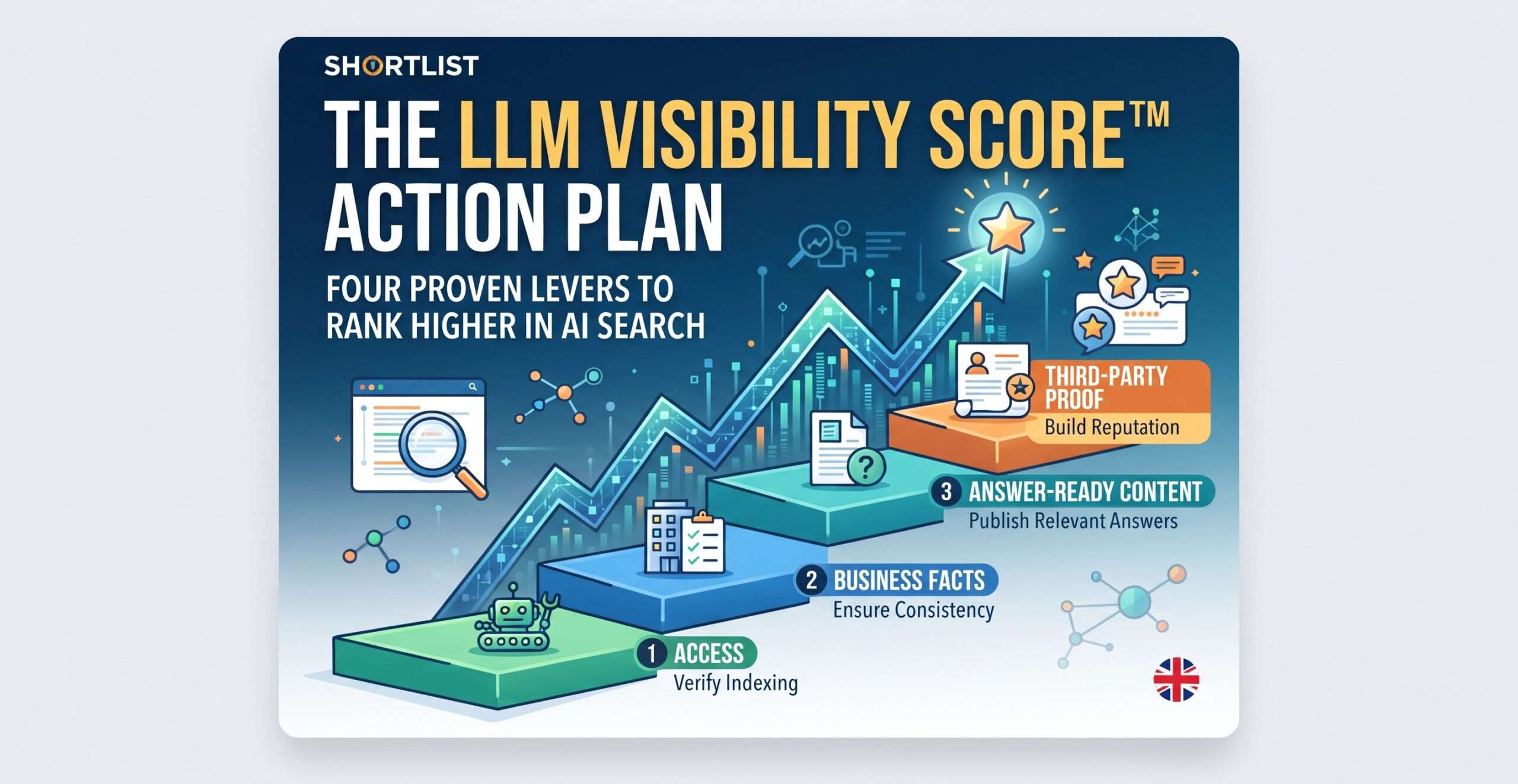
In short: To improve your LLM Visibility Score™, work in a fixed order. Confirm AI tools can reach your pages, make your business facts consistent and verifiable, publish answer-ready pages for the prompts where you are missing, then build genuine third-party proof. Re-test monthly against the same prompts and judge the trend, not a single run.
What actually moves an LLM Visibility Score™?
The score records three things for every answer in your prompt set: whether you appear, whether you are recommended or only mentioned, and whether you are described accurately. Every useful change works on at least one of those three. If a change touches none of them, it will not move the number, however busy it keeps you.
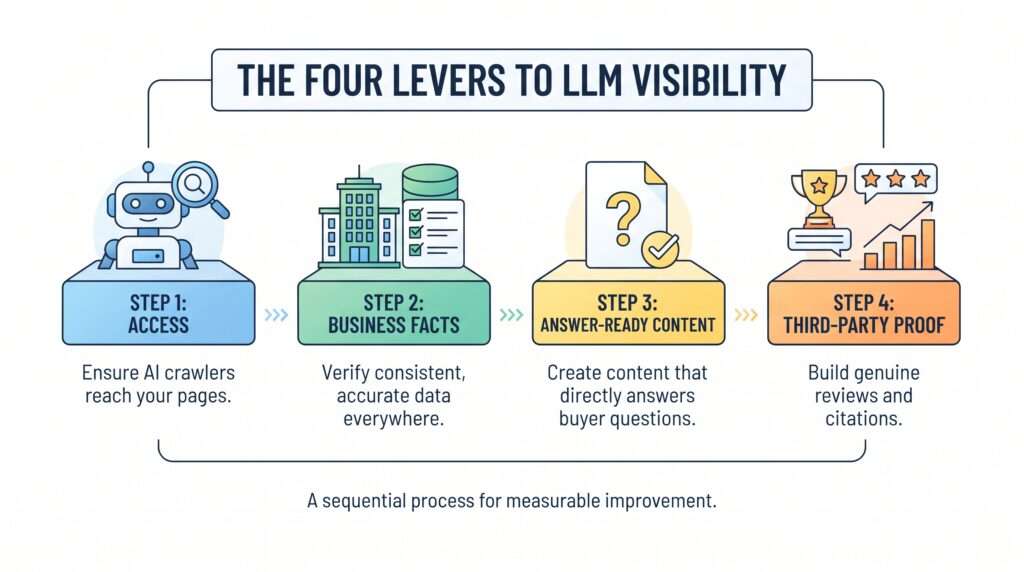
Four levers do almost all of the work:
| Lever | What it fixes | What it moves | How quickly it tends to show |
|---|---|---|---|
| Access | AI tools that cannot fetch or index your pages | Whether you appear at all on live-search tools | Weeks, once pages are re-crawled |
| Business facts | Contradictions about who you are, what you do and where | Accuracy, and appearance on cautious tools | Often the first visible lift |
| Answer-ready content | Buyer prompts you have no page for | Appearance across more prompts | One to three months, as new pages are found and cited |
| Third-party proof | Claims that only you make | Being recommended rather than just mentioned | Builds steadily over months |
The order matters as much as the levers. It mirrors the AI visibility stack: each layer only pays off when the one beneath it is sound. New content built on contradictory facts gets cited less, and reviews do little for a business the tools cannot reach.
How to read a low score before you change anything
A single number hides the detail you need. Before you touch the site, break the score down three ways.
By run, not by screenshot. AI answers vary each time, so the score is a rate across several runs. A drop from one check to the next is often noise. A single ChatGPT check misleads you in exactly this way, so judge the score across a full re-test.
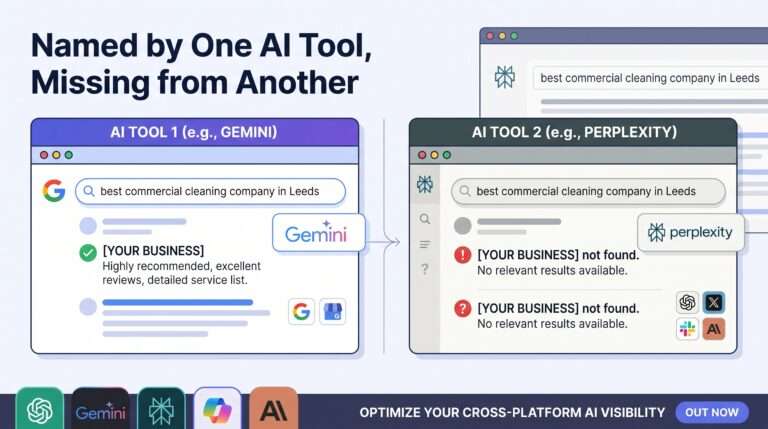
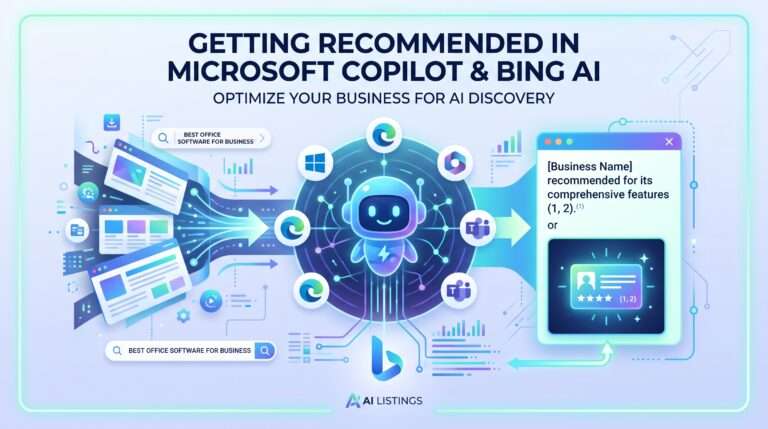
By platform. Being strong on Gemini and absent from Perplexity points to a different cause than being absent everywhere. Our guide to why you appear in one AI tool but not another explains how each tool sources its answers. If Copilot is the only gap, the cause is usually Bing, which we cover in Microsoft Copilot SEO.
By prompt type. Split your prompts into brand questions, where people ask about you by name, and category questions, where they ask who to use. The pattern tells you where to start:
| What you see | What it usually means | Where to start |
|---|---|---|
| Named on brand prompts, absent on category prompts | AI tools know you exist but do not connect you to the need | Answer-ready content |
| Named, but described wrongly | Conflicting facts across the web | Business facts |
| Absent on one platform only | That tool’s source is not reaching your pages | Access for that platform |
| Mentioned in lists, rarely recommended | Too little independent backing | Third-party proof |
| Absent almost everywhere | AI tools cannot verify you as described | Access, then business facts |
Read the descriptions as well as the counts. If tools name you with the wrong services or an old address, fix that before anything else. A wrong description can cost you the sale even when you are named, a risk we cover in how to defend your brand against AI hallucinations.
Step 1: make sure AI tools can reach your pages
Access is the floor. If a tool’s crawler is blocked, nothing else you do will show up in its live answers. Check your robots file and any firewall or bot-management rules for blocks on Googlebot, Bingbot, OAI-SearchBot, PerplexityBot and Claude-SearchBot. Broad rules written to stop AI training often catch the search crawlers too.
Then check indexing. Google’s guidance on its generative AI features is clear that a page must be indexed and eligible to show with a snippet before it can appear in AI Overviews or AI Mode. For Copilot, the equivalent is Bing’s index, so verify your site in Bing Webmaster Tools if you have not already.
Step 2: make your business facts consistent and verifiable
This is usually where the first real lift comes from. AI tools are reluctant to recommend a business when the web disagrees about it. If your site says one thing, your Google Business Profile another and an old directory a third, a cautious tool will name a competitor it can confirm instead.
Pick one version of each core fact and use it everywhere:
- Your business name, written the way customers see it on your signage, invoices and website
- A one-line description of what you do and who you do it for
- Service names, worded the same on every page and profile
- Address, service area and contact details
- Founding year and key people, where you publish them
Google’s own guidelines for representing your business ask for the same thing: a name that matches how the business is known in the real world, with no extra keywords added. The same discipline helps every AI tool, not just Google’s. Our guide to improving entity recognition in LLMs walks through the profiles worth checking first.
Once the facts agree, mark them up. Organisation or LocalBusiness schema that matches your visible details, with links to your official profiles, removes the last bit of doubt. Schema markup for AI search covers which types matter. Schema that contradicts the page does the opposite, so fix the facts first and mark them up second.
Step 3: publish answer-ready pages for the prompts you miss
With the facts settled, turn to the category prompts where you scored zero. Each one is a question a buyer asks on the way to choosing, and you have no page that answers it.
Start by grouping the missed prompts by intent. Five phrasings of “who repairs commercial roofs in Leeds” are one need, so they deserve one strong page, not five thin ones. If your prompt set is still guesswork, finding the exact prompts your customers ask AI shows where real questions come from.
Then write each page so it can be answered from:
- State the answer in the first sentence or two, then explain
- Use headings that say what each section answers
- Include the specifics a buyer needs: what is included, where you work, and typical costs or timescales where you can share them
- Keep one topic per page, so a tool can tell what the page is for
How to structure content for AI search goes into the detail. Prioritise the prompts closest to a purchase first, such as comparison and “best provider near me” questions, because those are the answers that turn into enquiries.
Step 4: build genuine third-party proof
The last lever moves you from mentioned to recommended. AI tools are more comfortable naming a business when other sources say the same good things about it. That evidence comes from places you do not fully control, which is why it takes longest to build.
- Reviews. Recent, specific reviews on Google and the platforms your sector uses. Steady and current beats a large, old pile.
- Mentions. Coverage in trade press, local news and industry roundups that describe what you do accurately.
- Listings. Accurate entries in the directories and associations that matter in your field.
- Evidence. Case studies with real numbers, published where others can reference them.
Keep it genuine. Bought reviews and planted mentions carry real risk, and they rarely survive scrutiny. Our guide to trust signals for AI recommendations covers how to build this evidence steadily.
What does a realistic climb look like?
Most scores do not rise in a straight line. In a typical engagement, change arrives in this order:
- Accuracy improves first. Once the facts agree and pages are re-crawled, tools start describing you correctly, and brand prompts become reliable.
- Category prompts follow. As new answer-ready pages are found, you begin to appear on live-search tools such as Perplexity, ChatGPT search and Copilot for questions you previously missed.
- Recommendations come last. The share of answers that actively recommend you, rather than list you, rises as reviews and mentions build up.
Expect plateaus, and occasionally a dip after a model update. Judge progress on the trend across three monthly re-tests, not on any single month. It also helps to compare your score with your closest competitors on the same prompts. In a narrow local category, a leader may appear in most answers; in a broad one, even the strongest brands appear far less often.
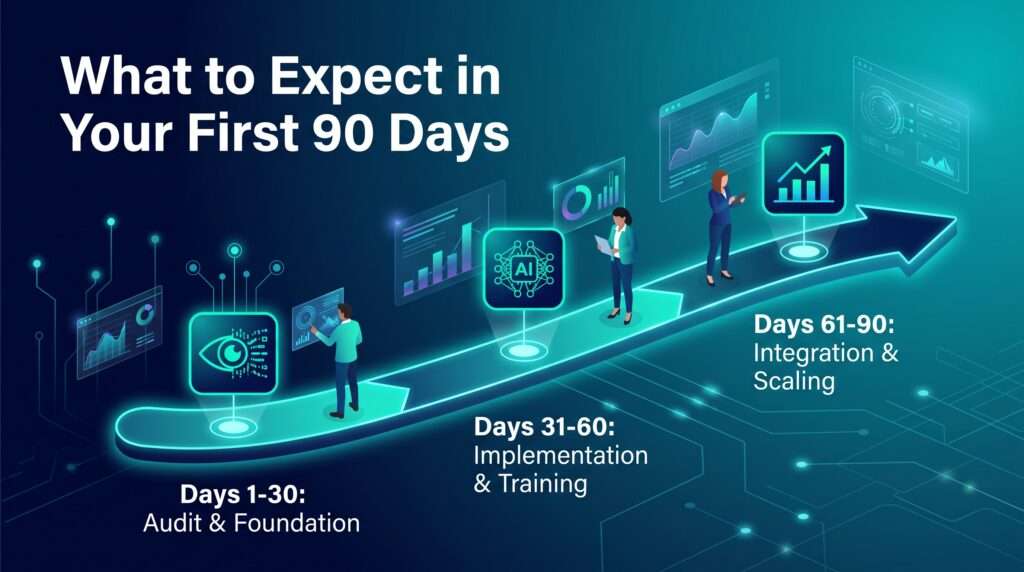
Many businesses see early gains within 30 to 60 days, with a measurable lift targeted within 90. That is the window the Shortlist System™ is built around, with monthly re-testing to show what has moved. Once the score climbs, keep it there by updating key pages regularly, because content freshness affects AI visibility long after the original work is done.
A worked example: a family law firm in Bristol
Here is how the order plays out for a typical family law firm in Bristol (an illustrative example, not a named client).
Its baseline uses 20 buyer prompts, run three times on five AI tools: 300 answers in all. The firm is named in 21 of them, a score of 7%. Almost every mention comes from brand prompts. On category prompts such as “best divorce solicitor in Bristol” it barely appears, and it is missing from Copilot entirely.
The breakdown points to the order. The Copilot gap traces back to a site that was never verified in Bing Webmaster Tools. Two directories still list an old office address, and the site describes the same service as “divorce”, “separation” and “family breakdown” on different pages. All of that is fixed in the first month.
The next re-test shows the firm described accurately on every platform and appearing on Copilot for brand prompts. In month two it publishes four answer-ready pages covering the category prompts it missed, including typical costs and timescales. By month three, a steady flow of new reviews and a mention in a regional business roundup start to turn mentions into recommendations.
Over the quarter the score rises to around 20%. More importantly, most of the new appearances come from category prompts, the ones that bring in new clients.
Changes that rarely move the score
- Rewriting title tags and meta descriptions on their own. They help search listings, but they do not change what AI tools can verify about you.
- Publishing a page for every phrasing of a question. Five thin pages on one need dilute each other. Google’s guidance also treats pages mass-produced to manipulate results as spam.
- Buying or planting mentions. The same guidance says inauthentic mentions are less helpful than they look, and they put your reputation at risk.
- Adding schema that disagrees with the page. Markup only helps when it matches what a visitor can see.
- Changing the prompt set between re-tests. New prompts make the comparison meaningless. Add prompts at agreed points, not every month.
- Reacting to a single run. One bad answer is noise. Wait for the full re-test before changing course.
Frequently asked questions
How do I improve my LLM Visibility Score™?
Work in order. Confirm AI tools can crawl and index your pages, make your business facts consistent everywhere, publish answer-ready pages for the buyer prompts where you are missing, then build genuine reviews and mentions. Re-test against the same prompts every month and judge the trend across several runs, not one check.
What is a good LLM Visibility Score™?
There is no universal benchmark, because scores depend on how many businesses compete for the same prompts. In a narrow local category, a leader may appear in most answers, while in a broad one even strong brands appear less often. Compare yourself with close competitors on the same prompts and watch your trend.
Why is my LLM Visibility Score™ low?
Usually for one of four reasons: AI tools cannot reach your pages, your business facts disagree across the web, you have no pages answering the questions buyers ask, or few independent sources back you up. Breaking the score down by platform and prompt type shows which reason applies to you.
How long does it take to improve an LLM Visibility Score™?
Many businesses see early gains within 30 to 60 days, often from fixing inconsistent facts, with a measurable lift targeted within 90 days. Content and reviews take longer to show, because pages need to be found and cited, and independent proof builds up over months rather than weeks.
Should I fix content or reviews first?
Neither. Fix access and business facts first. New content built on contradictory details gets cited less, and reviews help little if AI tools cannot verify who you are. Once your facts agree everywhere, publish answer-ready content, then build reviews and mentions to move from being mentioned to being recommended.
Will publishing more content raise my score?
Only if it answers prompts you are currently missing. One clear page per buyer need beats several thin pages covering the same question in different words. Volume on its own rarely moves the score, and mass-produced pages made to manipulate results can count against you under Google’s spam policies.
Do reviews affect my LLM Visibility Score™?
Yes, mainly the share of answers that recommend you rather than simply list you. AI tools are more confident naming a business that recent, specific reviews and independent mentions back up. Steady new reviews on the platforms your sector uses matter more than a large number of old ones.
Why did my score drop when I changed nothing?
AI answers vary between runs, models are updated, and competitors keep working, so scores move even when your site does not. Check whether the drop holds across a full re-test before reacting. If it does, look at which platform and which prompts fell, because that usually points to the cause.
Does schema markup improve an LLM Visibility Score™?
It can help, but only when it matches the facts on the page. Organisation or LocalBusiness schema that agrees with your visible details and links to your official profiles removes doubt about who you are. Schema that contradicts your page, or describes facts you have not fixed, does little good.
Can I improve my score on one AI tool only?
Yes, because each tool draws on different sources. If you are missing only from Copilot, the fix is usually Bing indexing. If Perplexity skips you, independent mentions tend to matter most. Fixing your business facts helps every platform at once, so start there before targeting a single tool.
How often should I re-test my LLM Visibility Score™?
Monthly suits most businesses. Use the same prompt set each time, run every prompt several times on each platform while logged out, and record the results in the same format. Testing more often mostly captures random variation, while testing less often makes it harder to tell which change worked.
Can I improve my score without an agency?
Yes. The levers are open to anyone: fix crawl access, tidy your business facts, answer the questions buyers ask, and earn genuine reviews. An agency mainly adds a consistent prompt set, repeated testing across platforms and the experience to spot which lever is holding you back the most.
Get your score and a plan
The fastest way to know which lever to pull is to measure first. If you want your current LLM Visibility Score™ broken down by platform and prompt, with the fixes set out in order, request your free visibility score. You can also see how this work fits into our wider AI visibility optimisation services, or read how the method runs end to end in Inside the Shortlist System.