How Content Freshness Boosts Your AI Search Visibility
Two pages can say almost the same thing, yet an AI will happily cite one and quietly ignore the other. Often the difference is age. One was updated this year; the other has sat untouched since 2022. Content freshness in AI search has become a real factor in which sources an AI chooses to trust and repeat, and it is one many businesses overlook entirely. If your content is good but stale, you may be losing citations to fresher rivals for no better reason than a date. This guide explains why recency matters to AI, how it judges freshness, what to update first, and how to do it honestly, because a shortcut many people try does not work.
The reason this matters more than it used to comes down to how AI answers questions now. Most AI answers are not pulled straight from a fixed memory. They are assembled from live web pages the AI fetches at the moment you ask, and when it goes looking for the best sources, how recent a page is has become one of the things it weighs. A current page is treated as more likely to be right; a stale one, as more likely to be out of date, and so less safe to rely on.
Here we will cover why freshness works as a citation signal, the specific ways AI detects it, which content to prioritise for updates, how often to refresh, and the honest truth that simply changing the date does nothing. It is practical throughout, and aimed at any business that publishes content it wants AI to keep using.
Why freshness works as a citation signal
To use freshness well, it helps to understand why AI cares about it at all. The answer lies in how modern AI search actually works, and once you see it, the rest follows naturally.
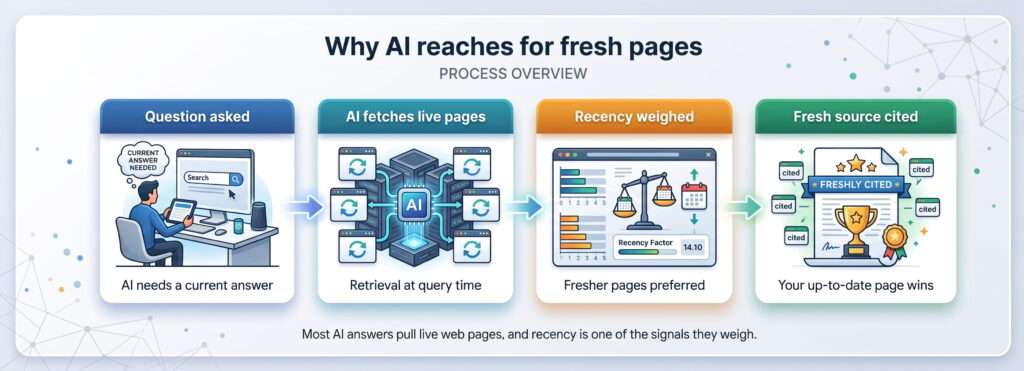
Most AI answers fetch live pages at query time, and recency is one signal they weigh.
When you ask most AI tools a question, they retrieve relevant web pages there and then and build an answer from them. This live retrieval is why they can discuss recent events at all. And when the AI is choosing between sources, recency acts as a proxy for reliability: a page updated recently is more likely to reflect the current state of things, while an old one risks being outdated. Faced with two similar pages, the AI leans towards the fresher one, because the cost of repeating stale information is a wrong answer.
The effect is measurable. Studies through 2026 have found that a large share of the content AI cites is strikingly recent, often only a few months old, and that a page tends to lose much of its citation pull within a year or so of being published unless it is refreshed. This is why freshness now belongs in your AI visibility stack alongside good content and structure: it is not the whole story, but it is a real factor in whether your genuinely useful content keeps getting used.
It is worth being clear that freshness is one signal among several, not a magic lever. It works together with quality, authority and structure, not instead of them. A fresh but thin page will not beat an authoritative one on reputation alone. But between two comparable sources, recency often tips the balance, and that is a balance you can influence.
How AI judges whether your content is current
AI does not simply know how fresh your content is; it infers it from signals in and around your pages. Knowing what those signals are tells you how to make your genuine currency visible.

AI infers freshness from several signals. Make your genuine currency easy to read.
Published and modified dates are the most direct: the timestamps in your page, both visible and in the metadata. Date markup reinforces them, and marking up your articles with the schema.org Article type, including an honest modified date, tells machines cleanly when the content genuinely changed. In-text date references help too: phrases that anchor the content to a time, such as noting figures are current as of this year, give clear temporal cues.
Two subtler signals matter as well. The recency of the sources you cite is one: an article referencing current data reads as current, while one leaning on years-old references reads as dated, whatever its own timestamp says. And crawl frequency is another: pages that are active and linked tend to be revisited more often, so their fresh state is noticed sooner. All of this works best when your content is also cleanly structured for AI, so the freshness signals are easy to read alongside the substance.
The honest truth: changing the date does nothing
Here is the most important warning in this guide, because it is the shortcut almost everyone reaches for and it simply does not work. Swapping the year in your title from last year to this, or nudging the modified date forward, while changing nothing else, does not make your content fresh in any way that counts.
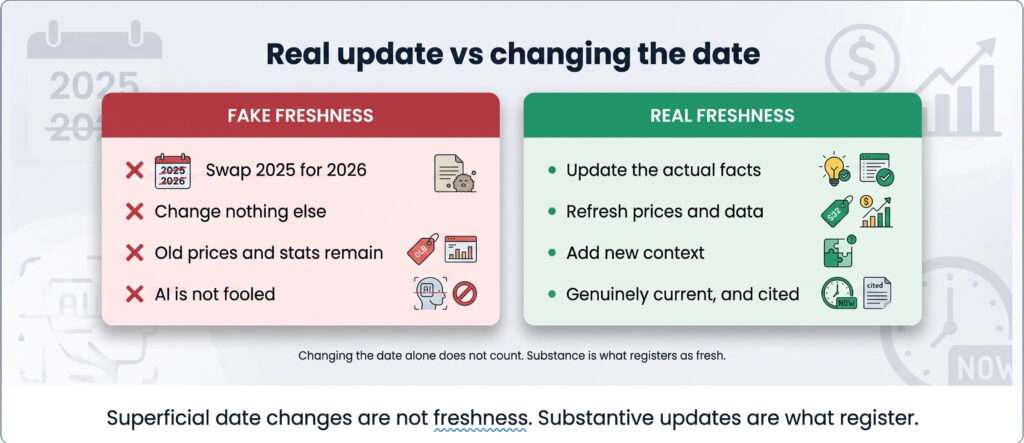
Superficial date changes are not freshness. Substantive updates are what register.
AI systems, and Google, look past the label to the substance. If your page claims to be current but still lists last year’s prices, old statistics and outdated advice, the mismatch is detectable, and dressing up stale content as fresh can read as manipulative rather than helpful. What registers as genuine freshness is substantive change: updating the actual facts, refreshing the figures, revising the guidance, adding new context. The date should follow a real update, not stand in for one.
This is good news, really, because it rewards doing the honest thing. Genuinely keeping your content accurate and current is exactly what both your readers and the AI want, and it aligns with Google’s guidance on helpful, people-first content, which is about serving people well rather than gaming signals. Update the substance and the freshness takes care of itself. Fake it, and you gain nothing and risk looking worse.
What to refresh first
You cannot update everything constantly, and you should not try. The trick is to spend your effort where freshness matters most, which depends entirely on the kind of content.
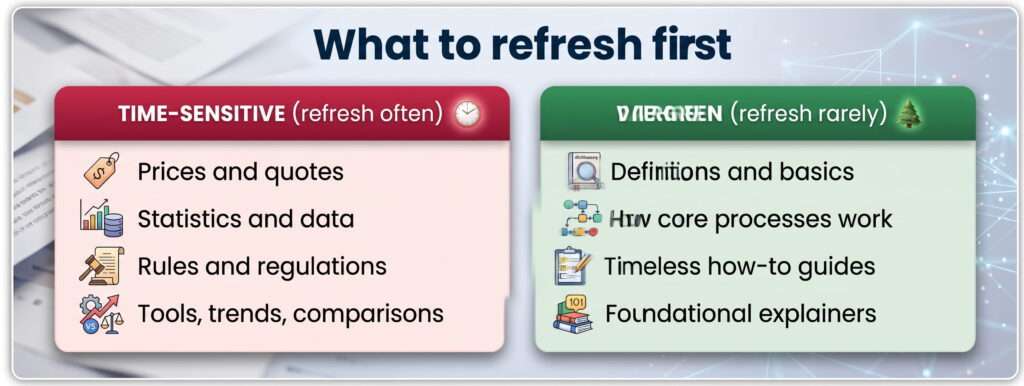
Refresh time-sensitive content often. Leave genuinely evergreen content alone.
Time-sensitive content needs regular attention. Anything involving prices, quotes, statistics, rules, regulations, tools, trends or comparisons dates quickly, and AI is especially wary of stale information on exactly these topics, because being out of date here means being wrong. For queries about current costs or current rules, recency strongly influences which source the AI trusts, so this is where refreshing pays off most.
Evergreen content, by contrast, needs far less. Definitions, explanations of how core things work, and timeless how-to guides do not go out of date in the same way, and an older page can still be cited happily for a question like what something means. Constantly tinkering with genuinely evergreen content for the sake of a fresh date is wasted effort, and can even disrupt something that was working. Refresh what genuinely changes; leave alone what genuinely does not.
How often to update
A natural question follows: how often should you refresh? There is no single answer, because it depends on how fast the subject itself changes, but a simple principle guides it.
Match your update cadence to the pace of the topic. Content about fast-moving things, prices, regulations, anything with figures, benefits from being reviewed and refreshed regularly, perhaps every few months, so it never drifts far from current. Content about slower-moving things needs updating only when something actually changes. The point is not to update on a rigid schedule for its own sake, but to make sure that when a fact in your content changes in the real world, it changes on your page soon after. A page that is always accurate is, by definition, always fresh where it matters.
A light, regular review habit works better than occasional big overhauls. Glancing over your key time-sensitive pages every so often to check nothing has gone out of date keeps them reliably current with little effort, and stops them slipping quietly into staleness. This is the sort of ongoing maintenance that a periodic AI visibility audit can flag, by surfacing which pages have aged and are no longer being cited.
Freshness matters more on some surfaces than others
One useful nuance: freshness does not carry equal weight everywhere. Because AI tools differ in how they work, they differ in how much they lean on recency.
Tools that fetch live web pages at the moment you ask tend to be the most recency-sensitive, because they are actively pulling in current information and comparing it. Tools that lean more heavily on their trained knowledge are a little less so, though the trend across the board is towards live retrieval, which makes freshness matter more over time, not less. The practical takeaway is not to optimise separately for each tool, but to recognise that keeping your content current helps you most on exactly the surfaces that are growing fastest.
Query type shifts the weight too. For a question about what something means, an older page can still be cited comfortably. For a question about the best option this year, or the current cost of something, recency becomes close to decisive. So the more time-bound the questions your customers ask, the more freshness will do for you.
Common mistakes
A few habits either waste freshness effort or undermine it. They are easy to correct.
Only changing the date. Nudging the year or modified date without updating the content does nothing and can look manipulative. Freshness means substantive change.
Letting time-sensitive facts rot. Leaving prices, statistics and rules to go stale is where staleness costs you most citations. Prioritise these for regular updates.
Fiddling with evergreen content. Constantly rewriting genuinely timeless pages for a fresh date wastes effort. Update what changes, not what does not.
Citing outdated sources. Relying on years-old references makes even a recent page read as dated. Cite current data to signal currency.
Hiding real updates. Genuinely refreshing content but giving AI no clear signal of it wastes the work. Make honest modified dates and schema markup visible so the update is noticed.
A worked example: a heating installer
A heating installer had written a genuinely useful guide to a government boiler grant scheme, and for a while it did well, bringing in enquiries and being cited when people asked AI about the grants. Then, quietly, it stopped. The guide was still there, still well written, but AI had begun favouring other sources, and the installer could not see why.
The reason was that the guide had gone out of date without anyone noticing. Grant schemes change, and the eligibility rules and figures in the guide were now a year or two behind the current ones. To an AI answering a question about the grants available now, a page describing last year’s rules was not just old, it was potentially wrong, and so a risky source to cite. Fresher pages with the current details had taken its place. The content had not got worse; the world had moved on and the page had not. It was exactly the kind of time-sensitive topic where recency decides which source gets recommended by AI.
The fix was a proper update, not a cosmetic one. The installer revised the actual eligibility rules and figures to match the current scheme, added a note that the information was current as of this year, and set an honest modified date with clean markup so the genuine update was clear. It also made a habit of reviewing the guide whenever the scheme changed. Within a few weeks the AI was citing it again, because it was once more the accurate, current answer. The lesson was simple: the page had not needed to be better written, only to be brought up to date and shown to be current, which is the essence of becoming the answer on a time-sensitive topic.
The heating installer story is a common one, and its quiet nature is the danger. Nothing dramatic happened. No page was deleted, no ranking was penalised. The guide simply aged out of usefulness while everything looked fine on the surface. That is how staleness usually costs a business: not in a sudden drop anyone notices, but in a slow fading from the answers, unremarked, until someone thinks to check.
Frequently asked questions
Does content freshness really affect AI visibility?
Yes, especially for time-sensitive topics. Because most AI answers pull live web pages and weigh recency as a signal of reliability, fresher content tends to be cited more often than comparable stale content. It is one factor among several, but a real one, particularly where being out of date means being wrong.
How does AI know how fresh my content is?
It infers freshness from signals: published and modified dates, date markup such as schema, in-text references to the current period, the recency of the sources you cite, and how often the page is crawled. Making your genuine currency visible through these signals helps AI recognise it.
Can I just change the date to look fresh?
No. Changing the year or modified date without updating the content does not work and can look manipulative. AI and Google look at the substance, so a page claiming to be current while listing outdated facts gives itself away. Real, substantive updates are what register as freshness.
What should I update first?
Prioritise time-sensitive content: prices, statistics, rules, regulations, tools and comparisons, which date quickly and where AI is most wary of stale information. Genuinely evergreen content, like definitions and timeless guides, needs updating far less often and can be left alone until something actually changes.
How often should I refresh my content?
Match the cadence to how fast the topic changes. Fast-moving, figure-heavy content benefits from a review every few months; slow-moving content needs updating only when something genuinely changes. The aim is that when a fact changes in the real world, it changes on your page soon after.
Keep your content current, keep getting cited
Content freshness has become a genuine factor in AI search, because AI leans on recency as a sign that a source can be trusted. Good content that has been left to go stale can quietly lose its citations to fresher rivals, and the fix is neither difficult nor dishonest: keep the content that matters genuinely up to date, and make that currency visible. Freshness is not a trick; it is simply the ongoing accuracy your readers deserve anyway.
Start by identifying your handful of most time-sensitive pages, the ones with prices, figures or rules, and checking they are still accurate. Update the substance where it has drifted, set honest dates, and make a habit of a quick review whenever the underlying facts change. That alone will keep your best content fresh, cited and working, while the shortcut of merely changing the date will keep achieving nothing.
If you would like help keeping your content fresh and cited in AI answers, that is part of our AI optimisation services, and it works hand in hand with monitoring which of your pages AI actually uses through an AI citation audit. Book a discovery call and we will help you keep your content current and visible.