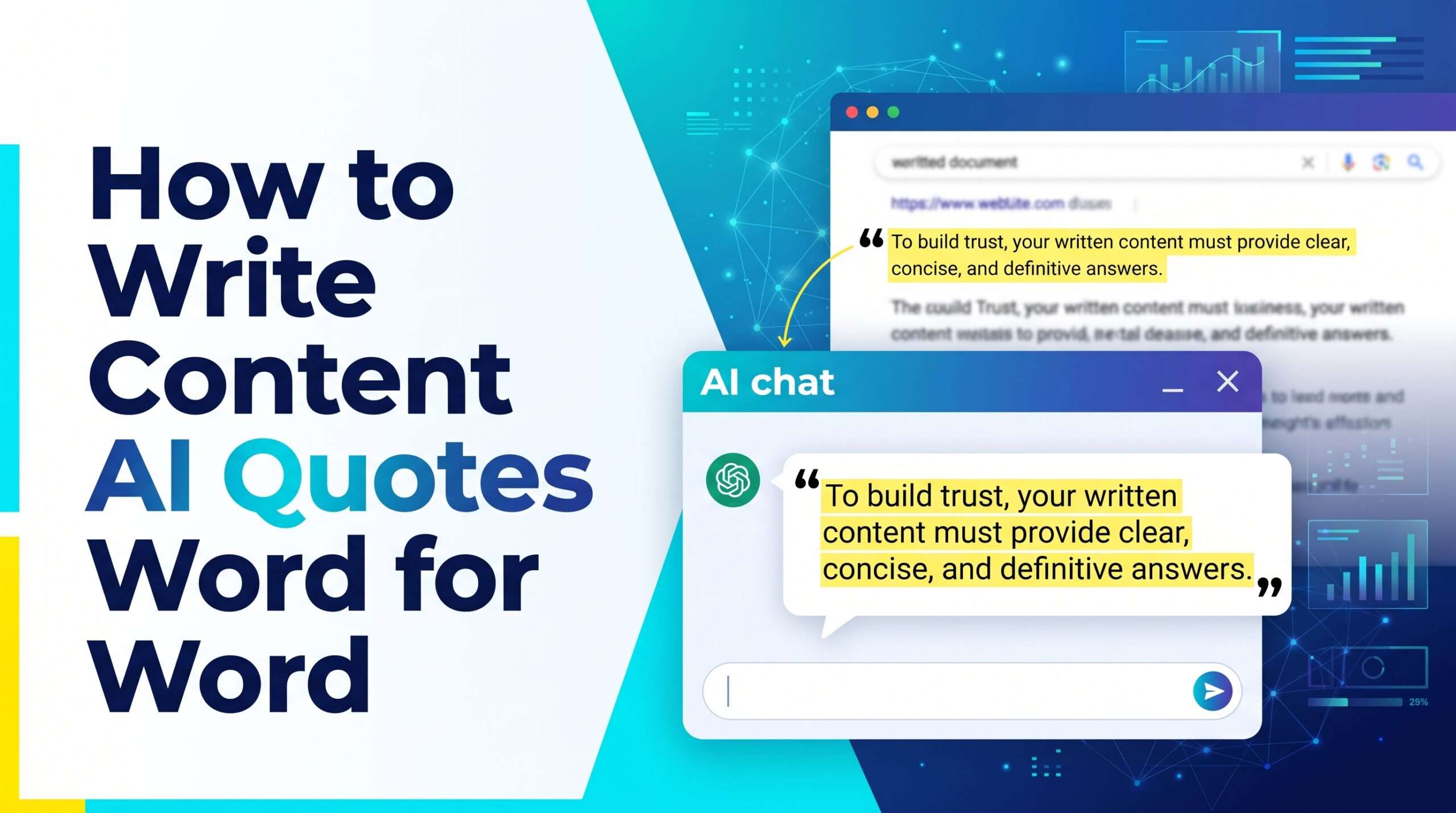
When an answer engine uses your page, it rarely takes the whole thing. It lifts a sentence or two, sometimes word for word, and places them inside its own answer. If those sentences make sense on their own, they travel intact, often with a link back to you. If they lean on the paragraph before them, they get paraphrased, blended with a competitor’s wording, or skipped.
That is the craft at the heart of answer engine optimisation: writing passages an AI tool can quote without editing. This guide works at sentence and paragraph level. For page layout and headings, see how to structure content for AI search; for question-and-answer blocks, see how to write FAQ content for answer engines. Here we cover the wording itself, with before and after examples from a services page.
In short: AI tools quote passages that stand on their own. Put the answer in the first sentence, name the subject instead of saying “it” or “we”, keep one idea per paragraph, define terms in a single clean sentence, and include specific, checkable details. Write for a busy reader first; the same clarity is what makes a passage quotable.
Why do answer engines quote some sentences and not others?
Answer engines build replies from passages, not whole pages. When a tool such as Perplexity, ChatGPT search or Google’s AI Mode searches the web, it retrieves a handful of pages, picks out the sections that answer the question, and writes its reply from those. Our guide to how Perplexity chooses its sources and citations shows this clearly, because Perplexity places a numbered link beside each sentence it relies on.
A passage gets quoted, rather than reworded, when lifting it is the safest option. That happens when the sentence already answers the question, makes sense without its neighbours, and contains nothing the tool would need to correct or soften. The more editing a passage needs, the more likely the tool is to rewrite it in its own words or take the answer from someone else.
None of this means writing for machines. Google has said plainly that you do not need to write in a special way just for its AI features. The habits that let a person understand a passage in one read are the same habits that let an answer engine repeat it accurately.
The five tests of a quotable passage
Run any important sentence on your site through these five tests. The examples come from a fictional heating company.
| Test | Fails the test | Passes the test |
|---|---|---|
| Stands alone | “As mentioned above, this is our most popular option.” | “Our annual boiler service is the option most customers choose.” |
| Answer comes first | “There are many factors to weigh, but in most cases a new boiler takes a day.” | “Most boiler replacements take one day to fit.” |
| Names its subject | “It covers all parts and labour.” | “The Gold Cover plan includes all parts and labour.” |
| Specific and checkable | “We cover a wide area across the region.” | “We fit boilers across Greater Manchester, including Stockport, Bolton and Salford.” |
| Neutral in tone | “We are the leading, most trusted heating experts around.” | “All our engineers are Gas Safe registered, and every installation comes with a written guarantee.” |
Each test removes a reason for an answer engine to edit you. Pass all five and a sentence can be lifted exactly as written.
Put the answer in the first sentence
Journalists call this the inverted pyramid: the conclusion first, then the detail, then the background. Nielsen Norman Group’s guidance on writing for the web recommends the same structure for online readers, because people scan and many stop after the opening lines. Answer engines behave like the most impatient scanner of all.
In practice, every section should open with a sentence that answers the question its heading asks. Supporting detail follows. Context and caveats come last.
| Before | After |
|---|---|
| “Choosing a new boiler can feel overwhelming, and there are lots of things to think about, from the size of your home to how much hot water you use. That is why our engineers always visit first. For most three-bedroom homes, a combi boiler is the right choice.” | “For most three-bedroom homes, a combi boiler is the right choice. It heats water on demand, so you need no hot water tank. Our engineers confirm the right size during a free home visit, based on the number of bathrooms and how much hot water you use.” |
The answer moved from the last sentence to the first. Nothing else had to change for the opening line to work as a stand-alone quote.
Make every paragraph self-contained
Answer engines lift paragraphs out of order. A paragraph that depends on the one before it breaks when it travels.
- Repeat the noun. Write “the annual service” rather than “it” at the start of a paragraph, even if it feels repetitive.
- Drop backward references. Phrases such as “as mentioned above” or “this option” point to text the reader of a quote will never see.
- Keep one idea per paragraph. Two to four sentences on a single point are easier to lift than a long paragraph that changes subject halfway through.
- Name the business where it matters. “We offer next-day call-outs” loses its meaning in a quote. A sentence that names your business keeps it.
Using your business name inside key sentences also helps AI tools connect each claim to the right company. Naming yourself and your services the same way on every page is part of improving entity recognition in LLMs.
Write definitions an AI can lift in one sentence
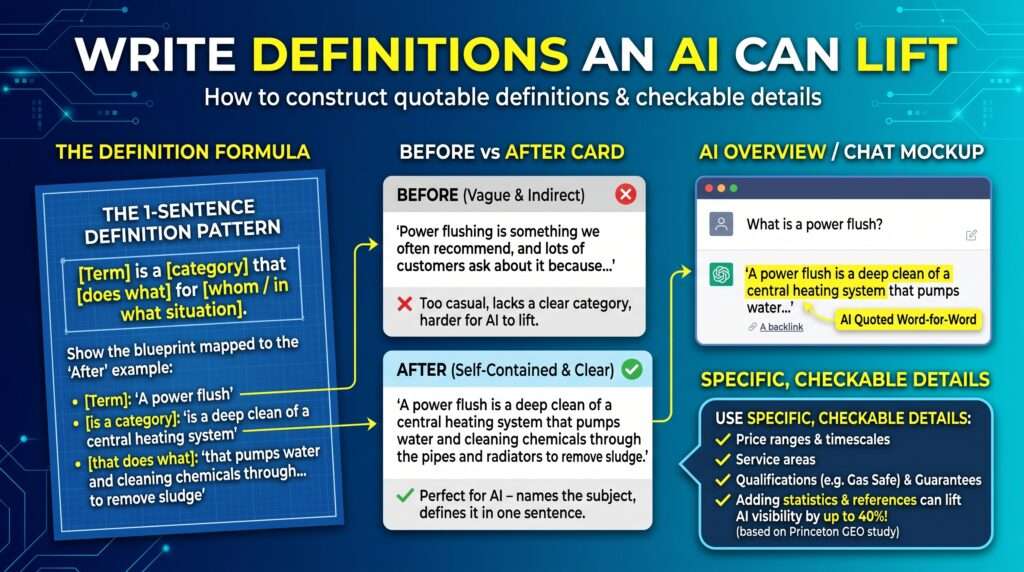
When buyers ask “what is” questions, answer engines look for a single sentence that defines the term. The most quotable pattern is simple: the term, what kind of thing it is, and what makes it different.
Pattern: [Term] is a [category] that [does what] for [whom, or in what situation].
| Before | After |
|---|---|
| “Power flushing is something we often recommend, and lots of customers ask about it because their radiators have cold spots.” | “A power flush is a deep clean of a central heating system that pumps water and cleaning chemicals through the pipes and radiators to remove sludge. It is usually recommended when radiators have cold spots or a new boiler is being fitted.” |
Put the definition the first time the term appears, not halfway down the page. If you use a term of your own, such as a named service plan, define it the same way every time you use it.
Use specific, checkable details
Vague claims give an answer engine nothing to quote. Specific ones give it something it can repeat with confidence. Price ranges, timescales, service areas, qualifications, guarantees and named standards are all details a buyer wants and a tool can cite.
Research supports this. In a study of generative engine optimisation by a team led from Princeton University, adding relevant statistics, quotations and references to sources lifted how visibly a page featured in AI-generated answers by up to around 40%. Simply stuffing in keywords did little.
Two rules keep this honest. Only publish figures you can stand behind, and keep them current. An out-of-date price quoted word for word by an AI tool is worse than no price at all, a problem we cover in how to defend your brand against AI hallucinations.
Phrase it the way buyers ask
A quote fits an answer more easily when it uses the buyer’s own words. If customers ask “how much does a new boiler cost”, a sentence that starts “A new boiler typically costs” lines up with the question far better than one about “investing in your heating system”.
Build your wording from real questions. Finding the exact prompts your customers ask AI shows where to find them: sales calls, enquiry emails, reviews and the follow-up questions AI tools suggest. Then reuse that vocabulary in your opening sentences.
A worked example: rewriting a services page
Here is the approach applied to the boiler installation page of a fictional Manchester heating company we will call Northside Heating (an illustrative example, not a real client). Three passages carry most of the page’s buying questions: what the service is, what it costs and where it is available.
| Passage | Before | After |
|---|---|---|
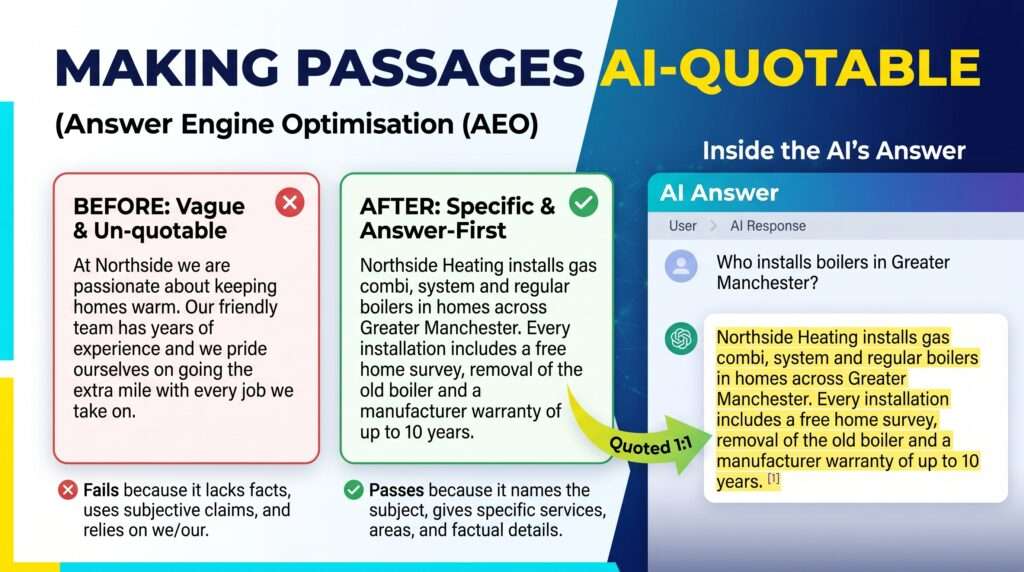
| What the service is | “At Northside we are passionate about keeping homes warm. Our friendly team has years of experience and we pride ourselves on going the extra mile with every job we take on.” | “Northside Heating installs gas combi, system and regular boilers in homes across Greater Manchester. Every installation includes a free home survey, removal of the old boiler and a manufacturer warranty of up to 10 years.” |
| Cost | “Prices vary depending on lots of factors, so it is best to get in touch for a quote tailored to you.” | “A new combi boiler installed by Northside Heating typically costs between £2,200 and £3,200, including fitting and removal of the old boiler. The final price depends on the boiler model and whether pipework needs moving.” |
| Area covered | “We cover Manchester and the surrounding areas.” | “Northside Heating covers Greater Manchester, including the city centre, Stockport, Salford, Bolton, Trafford and Oldham. Same-week installations are usually available within these areas.” |
None of the rewritten passages relies on the text around it. Each opens with the answer, names the business, and gives details a buyer can act on. Any one of them could appear in an AI answer word for word and still be accurate.
Notice what was cut as well. Phrases such as “passionate”, “friendly team” and “going the extra mile” give a tool nothing to quote, because they say nothing a buyer could check.
How passage-level writing fits with AEO and SEO
Passage-level writing is one layer of answer engine optimisation, not the whole of it. Page structure decides whether a tool can find the right section, FAQ blocks answer the short follow-up questions, and trust signals from other sites decide whether a tool is confident enough to quote you at all. For the bigger picture of how this differs from traditional search, SEO vs AEO explains the shift from ranking pages to becoming the answer.
The overlap is large, which is good news. Clear, specific, answer-first writing tends to help search rankings, conversions and AI citations at the same time. Our guide to getting recommended by Claude shows how a small business with one well-written page can out-cite a larger brand, because Claude weighs individual passages rather than whole websites.
How to check whether AI tools quote you
- Pick five to ten prompts your rewritten pages should answer.
- Run each one several times in Perplexity, ChatGPT search, Google AI Mode and Copilot while logged out.
- Compare the answers with your page. Look for sentences lifted word for word, sentences paraphrased from yours, and answers that cite a competitor instead.
- Note where a tool paraphrased you badly or got a detail wrong. That usually points to a passage that still leans on its neighbours.
For a fuller method, an AI citation audit shows how to track which pages AI tools use as sources over time.
Common mistakes
- Saving the answer for the end. A conclusion in the last sentence of a paragraph is the hardest part for a tool to lift.
- Starting paragraphs with “it”, “this” or “we”. Pronouns lose their meaning once a passage is quoted on its own.
- Using different names for the same service. If one page says “power flush” and another says “system cleanse”, tools struggle to connect them.
- Leaning on adjectives instead of facts. Words such as “trusted” and “leading” cannot be checked, so they are rarely quoted.
- Breaking content into fragments. Self-contained does not mean tiny. A passage needs enough detail to be useful, usually two to four sentences.
- Letting figures go stale. A price or timescale quoted word for word must still be true when the quote appears, which is one reason content freshness matters for AI visibility.
Frequently asked questions
What does it mean for AI to quote content word for word?
It means an answer engine lifts a sentence or passage from your page and uses it in its reply without rewording it, often with a link to your page. It happens most when the passage already answers the question clearly, makes sense on its own and contains specific details the tool can trust.
How do I write content for answer engines?
Open each section with a sentence that answers the question in its heading. Keep each paragraph to one idea, name the subject instead of using pronouns, define terms in a single sentence, and include specific details such as prices, timescales and areas. Write for a busy reader first; that clarity is what makes passages quotable.
Is writing for answer engines different from writing for SEO?
Mostly it is the same good writing with a sharper focus on individual passages. SEO rewards pages that rank; answer engines reward passages they can lift. Answer-first, specific, self-contained writing tends to help both, which is why Google says you do not need to write in a special way just for its AI features.
How long should a quotable passage be?
Usually one to four sentences. The opening sentence should answer the question on its own, and the next two or three should add the detail a buyer needs. Passages much shorter than that tend to lack substance, while long ones that change subject partway through are harder to lift cleanly.
Do I need to rewrite my whole website for AEO?
No. Start with the pages that answer buying questions: core services, pricing, areas covered and comparisons. Rewrite the opening sentence of each section and any paragraph that relies on the one before it. Most pages need targeted edits to a few key passages rather than a complete rewrite.
Why does AI paraphrase my content instead of quoting it?
Usually because the passage needs editing to work on its own. Common causes are an answer buried at the end, pronouns that point elsewhere, promotional wording the tool will not repeat, or missing detail. Fix those, and a tool can lift the sentence as written rather than rewording it.
Do statistics help content get cited by AI?
Relevant, accurate statistics can help. Research on generative engine optimisation found that adding statistics, quotations and source references lifted visibility in AI answers by up to around 40%. The figures must be true and current, though, because an outdated number quoted word for word can mislead your buyers.
Should I use my business name in body copy?
Yes, in the sentences that carry key claims. “We offer next-day call-outs” loses its meaning when quoted alone, while a sentence that names your business keeps it. You do not need your name in every sentence, but the ones most likely to be quoted should say who they are about.
How is this different from writing FAQ content?
FAQ writing covers short question-and-answer blocks. Passage-level writing covers the main body copy of a page: service descriptions, pricing sections and explanations. Both use answer-first sentences, but body copy also needs self-contained paragraphs and clean definitions, because answer engines quote from the whole page, not only the FAQ section.
How can I tell if AI tools are quoting my pages?
Run the questions your pages answer in Perplexity, ChatGPT search, Google AI Mode and Copilot, several times each, while logged out. Compare the answers with your wording and check the cited sources. Perplexity is the easiest place to start, because it links a source beside each sentence it uses.
Does schema markup make content more quotable?
Not on its own. Schema helps machines understand what a page is about and who published it, but answer engines quote the visible text. A clear, specific sentence without schema is more quotable than a vague one with it. Use schema to support well-written passages, not to replace them.
Can answer engine optimisation guarantee my content gets quoted?
No. Nobody controls what an AI tool outputs, and answers vary between runs. What good passage-level writing does is remove the reasons a tool would skip or rewrite you. Over repeated tests, that tends to show as more citations and more accurate descriptions of your business.
Get your pages quote-ready
If you want your key pages rewritten so AI tools can quote them accurately, our answer engine optimisation service covers passage-level rewriting alongside structure, FAQs and schema. Book a discovery call and we will show you which of your passages AI tools are skipping, and why.