
You cannot show up in AI answers for questions you never knew people were asking. That sounds obvious, yet it is the reason a lot of businesses pour effort into content that AI tools never surface. They optimised for a list of keywords, but customers are not typing keywords into ChatGPT. They are asking full, messy, human questions, and those questions are the thing that actually decides whether you appear.
Finding those questions has become its own skill. It is close to keyword research, but not the same, and treating them as identical is where the effort goes wrong. Prompt research is about uncovering the real prompts your customers put to AI, in their own words, so you can build content that answers them and earn a place in the response.
This guide walks through what prompt research is, why prompts differ from keywords, and, step by step, how to find the ones your customers really use. It finishes with a simple way to organise what you find so it turns into pages rather than a spreadsheet you never open again.
What prompt research actually is
Prompt research is the process of discovering the questions people ask AI tools when they are looking for a business, product or answer like yours, and mapping those questions to the content that should satisfy them.
A prompt is simply the thing a person types or says to an AI. Unlike a search query, it tends to be a complete question, full of context about who they are and what they need. When someone asks ChatGPT or Gemini for help choosing a service, the wording they use is the prompt, and the businesses that appear in the answer are usually the ones whose content lines up with that wording and intent.
Prompt research and keyword research overlap, and it helps to understand where. We covered the relationship in detail in how keywords drive both Google and AI search. The short version is that keywords still matter as the building blocks, but prompts are the finished questions those blocks form, and AI answers respond to the finished question.
Why prompts are different from keywords
The difference is not cosmetic. It changes what content you need and how you write it.
A keyword is a fragment, stripped of context. “Shutters West Sussex” tells you a topic and a place, but nothing about the person or their situation. A prompt is the whole question, and it carries all the context the keyword left out: who they are, what they are trying to do, and any constraints they have.
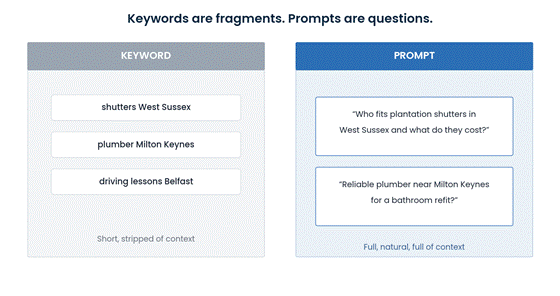
A keyword is a fragment. A prompt is the full question, complete with context.
That extra context is exactly what AI systems use to decide which businesses to name. Two people might both be interested in the keyword “plumber Milton Keynes”, but one asks for an emergency call-out and the other asks who is best for a bathroom refit. Those are different prompts with different best answers, and content built only around the keyword serves neither of them well.
This is why a keyword list, on its own, is a weak starting point for AI visibility. It tells you the topics, but it hides the questions. Prompt research puts the questions back.
Why prompt research matters now
AI answers reward content that matches the real question closely. When a tool builds an answer, it looks for sources that speak directly to what was asked, in language that lines up with how it was asked. This is the heart of answer engine optimisation, and it rewards businesses that have done the work of understanding the actual prompts rather than guessing at them.
There is also a discovery shift underneath all this. More customers now start with a question to an AI tool rather than a search box, as we explored in how customers find businesses through AI search. If your content is not built around the questions they ask at that first step, you are absent from the very moment they are forming a shortlist.
Done well, prompt research also saves you from wasted content. Instead of writing pages nobody asks for, you write the answers to questions people are actively putting to AI. That is a far better use of time, and it tends to produce content that earns its place quickly.
There is a competitive edge in it too. Most businesses in any given market are still optimising for keywords and have not thought about prompts at all. The ones who map the real questions first tend to fill the obvious gaps before anyone else does, and once a business becomes the reliable answer to a question, it is hard to displace. Prompt research is how you get there ahead of the field.
The anatomy of a buyer prompt
Before you go looking for prompts, it helps to know what one is made of. Most buyer prompts bundle four things into a single natural question.
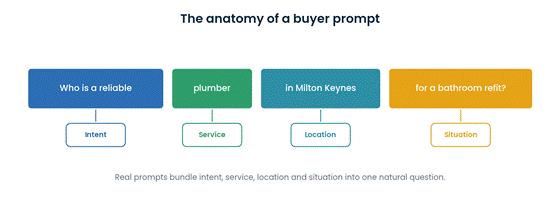
A real prompt usually carries intent, service, location and situation in one line.
Intent. What the person is trying to do. Are they discovering options, comparing them, checking whether you are any good, or ready to act?
Service or need. The specific thing they want, which is usually narrower than your whole offering.
Location or context. Where they are, or the setting the answer has to fit.
Situation or constraint. The detail that shapes the right answer, such as a budget, a deadline or a particular type of job.
Once you can see these parts, you start to notice that a single topic hides many distinct prompts. That realisation is the whole point, because each of those prompts is a chance to appear, and each needs content that speaks to it.
The four types of buyer prompt
Prompts fall into four broad types, matching the stages a buyer moves through. A healthy set of content answers all four, not just the last one.
Discovery prompts. The person does not know you yet and is looking for options. “Who offers plantation shutters in West Sussex?” These decide whether you make the shortlist at all.
Comparison prompts. They are weighing options against each other. “What should I look for when choosing a window installer?” These decide how you are framed against rivals.
Validation prompts. They are checking whether you can be trusted. “Is this company any good?” or “what do people say about them?” These lean on reviews and reputation.
Decision prompts. They are close to acting and want specifics. “How much does it cost?” or “how do I book?” These map neatly onto the buyer journey we set out in how customers become customers through AI search, and missing them means losing people at the last step.
How to find the prompts your customers actually ask
You do not need to guess. The prompts already exist in places you can look. Here are the most reliable sources, in the order I would work through them.
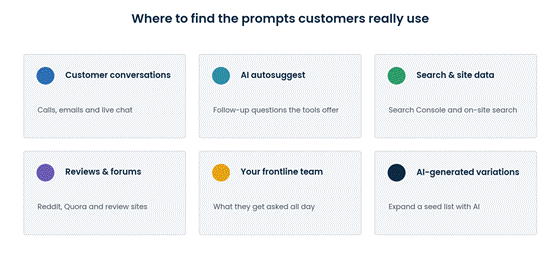
Six practical places to find the questions customers really ask.
- Mine your customer conversations. Your sales calls, emails and live chat are full of the exact questions people ask before they buy. Read through recent ones and write down the questions in the customer’s own words. This is the richest source, because it is real demand rather than a guess.
- Ask the AI tools themselves. Put a starting question into ChatGPT, Gemini or Perplexity and watch the follow-up questions and related prompts they suggest. These reveal how the tools expect a conversation to unfold, and each suggestion is a prompt worth covering.
- Use your search and site data. Queries from Google Search Console and your on-site search box show the language people already use to find you, and a search-listening tool like AnswerThePublic surfaces the autocomplete questions people type around your topic. Longer, question-shaped queries are prompts in waiting, and they hint at what people will ask an AI next.
- Read reviews and forums. Reviews, and communities like Reddit and Quora, are where people ask real questions in plain language. They surface the worries and specifics that polished marketing tends to skip, and those specifics make excellent prompts.
- Ask your frontline team. Whoever answers the phone or greets customers hears the same questions every day. A short conversation with them will hand you a list of prompts you would never find in a keyword tool.
- Expand with AI. Once you have a seed list from the sources above, ask an AI tool to generate natural variations of each prompt. This fills in phrasings you had not thought of, as long as you keep the ones that sound like a real customer and discard the ones that do not.
Work through these and you will quickly have more prompts than you can act on at once, which is a good problem. The next step is organising them so the important ones rise to the top.
A worked example: a Belfast chauffeur company
To see how this comes together, take a chauffeur and executive transport company in Belfast. They start by reading their last month of enquiries and quickly notice the same questions recurring, phrased in ways their website never uses.
Customers do not ask for executive transport. They ask who does airport runs to Dublin at short notice, whether a company can cover a wedding for the day, and how far in advance they need to book for a corporate event. Each of these is a distinct prompt, with its own intent and situation, and the company had a single generic services page trying to cover all of them at once.
They sort the questions into the four stages. Discovery: who offers chauffeur services in Belfast. Comparison: a chauffeur versus a regular taxi for an airport transfer. Validation: are they reliable for an early flight. Decision: how much a Dublin airport run costs and how to book. Laid out this way, the gaps are obvious. They answer the decision questions reasonably well on their booking page, but they have almost nothing for the discovery and comparison prompts that decide whether they make the shortlist in the first place.
The plan writes itself. A clear page answering the airport-run questions, another comparing a chauffeur and a taxi for airport transfers, and a short, honest reliability page built around real reviews. None of it came from a keyword tool. It came from reading what customers actually asked, in the words they used.
Organising prompts into a coverage map
A long list of prompts is not much use until it is organised. The simplest way to do that is a coverage map: a grid that shows your topics down one side and the stages of the buyer journey across the top, so you can see at a glance where you answer questions well and where you have gaps.
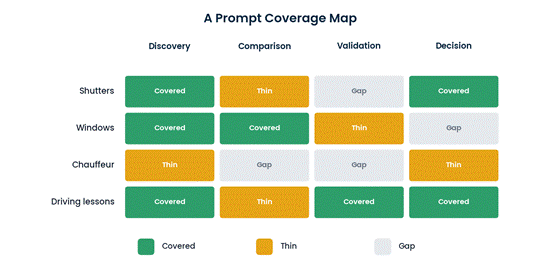
A coverage map shows, at a glance, which questions you answer and where the gaps are.
Group your prompts by topic, then sort each one into discovery, comparison, validation or decision. Mark each cell as covered, thin or a gap, based on whether you have content that genuinely answers those prompts. The gaps are your priorities, because they are questions customers are asking that you currently have no answer for.
This map also gives you something to measure. As you fill the gaps and check whether you start appearing for those prompts, you can track your progress over time. If you want to attach a number to it, our guide to what an LLM Visibility Score is and how it is measured shows how coverage feeds into a figure you can watch improve.
Turning prompts into content that gets used
Finding prompts is only half the job. The other half is answering them in a way AI tools can actually use.
For each priority prompt, the aim is a clear, direct answer near the top of the page, phrased in language close to the question itself. Content built to impress a skim-reader often fails here, because the answer is buried. Our guide to structuring content so AI systems can extract and use it covers exactly how to shape a page so it can be lifted into an answer.
Group related prompts onto the same page where it makes sense, rather than spreading thin content across many pages. A single, thorough page that answers a cluster of related questions tends to become the source an AI reaches for, which is the goal we set out in how to become the answer in AI search.
Keep the customer’s wording. If people ask about cost, use the word cost, not a polished alternative. Matching the real phrasing is one of the simplest ways to line your content up with the prompts you found.
How prompt research feeds your audits
Prompt research is not a one-off task that ends when the pages are written. The prompt list you build here is the same list you use to check your visibility. In running an AI visibility audit, the prompts are exactly what you test across the AI platforms to see where you appear.
They also drive your citation audit, where you check whether your pages are used as the source for those prompts. In other words, the work you do here pays off three times over: it shapes your content, it powers your audits, and it gives you a clear list to measure against. That is why prompt research sits at the front of any serious AI visibility effort.
Common mistakes in prompt research
A few habits quietly undermine the work, and they are easy to avoid.
Using keywords and calling them prompts. If your list is full of two-word fragments, you have done keyword research, not prompt research. Write the full questions.
Only covering decision prompts. It is tempting to focus on ready-to-buy questions, but if you ignore discovery and comparison prompts, you never make the shortlist in the first place.
Inventing prompts from your own head. The way you describe your service is rarely how customers describe their need. Ground the list in real conversations, reviews and data, not assumptions.
Cleaning up the language. Customers ask messy, specific questions. If you tidy them into marketing language, you lose the exact phrasing that would have matched the prompt.
Finding prompts and stopping. A list is not the outcome. Content that answers the prompts is. Always take the map through to pages.
Making prompt research a habit
Prompt research works best as a habit rather than a one-off project. Customer questions change as your services, prices and market shift, and new prompts appear all the time. A light, regular rhythm keeps your list current without much effort.
A simple approach is to spend twenty minutes a month capturing new questions. Skim the last few weeks of enquiries and live chats, note anything you have not seen before, and check whether the AI tools have started suggesting new follow-up questions in your area. Add the new prompts to your coverage map and see whether they land in a gap.
Once or twice a year, do a fuller pass. Revisit the whole map, retire prompts that no longer come up, and re-sort anything that has shifted stage. This is also a natural moment to re-run your visibility and citation audits against the updated list, so your measurement keeps pace with the questions people are actually asking.
Kept up this way, prompt research quietly compounds. Each cycle sharpens your content, closes another gap, and gives you a clearer picture of where you stand, which is exactly what makes it worth building into your routine rather than treating as a task you finish once.
Frequently asked questions
What is the difference between a prompt and a keyword?
A keyword is a short fragment of a search, such as “shutters West Sussex”. A prompt is the full, natural question a person asks an AI, such as who fits plantation shutters in West Sussex and what they cost. Prompts carry context that keywords strip out, and AI answers respond to that context.
Where do I find the prompts customers use?
Start with your own customer conversations, then use AI tools’ suggested follow-up questions, your Search Console and site search data, reviews and forums, and your frontline team. Finally, expand your seed list with AI-generated variations, keeping only the ones that sound like a real customer.
How many prompts do I need?
Enough to cover your core topics across all four buyer stages, which for most businesses means a few dozen to start. Quality matters more than quantity. A focused set of real questions beats a long list of invented ones.
Is prompt research just keyword research with extra steps?
No. They overlap, but keyword research gives you topics while prompt research gives you the actual questions, in the customer’s words, along with their intent and context. That difference changes what content you build and how you write it.
How often should I refresh my prompt list?
Review it every few months, and whenever your services or market change. New questions appear as products, prices and customer concerns shift, so a prompt list is something you maintain rather than finish.
Where to start
Prompt research turns AI visibility from guesswork into something you can plan. Once you know the real questions customers ask, you know what to write, where your gaps are, and what to measure. It is the groundwork that makes everything else more effective.
Begin this week with one source. Read your last twenty customer enquiries and write down every question in the customer’s own words. Sort them into discovery, comparison, validation and decision. That single pass will show you, immediately, which questions you answer well and which you have been ignoring. If you would like this done thoroughly, with a full prompt map and the content plan to match, that is part of our AI optimisation services. Book a discovery call and we will map the questions your customers are asking AI, and show you where you are missing from the answers.