
People do not want to search anymore. They want to ask.
Type a question into Google, ChatGPT, or Perplexity today and increasingly you get a single, direct answer rather than ten blue links to sort through yourself. Ask Siri or Alexa a question and you get a spoken response, full stop. No list. No clicking. No comparing.
This shift has a name. Answer engines are the AI-powered tools built to satisfy this exact expectation: ask a question, get the answer, move on. And the discipline built to make sure your business is the answer they give is Answer Engine Optimisation, or AEO.
This guide explains exactly what AEO means, how it differs from the closely related discipline of GEO, and what UK businesses can do today to start being the answer rather than the link nobody clicks.
What Is AEO? The Definition
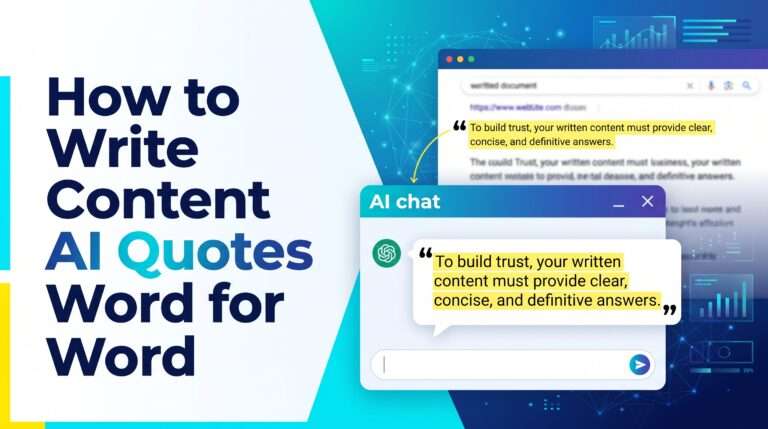
Answer Engine Optimisation (AEO) is the practice of structuring content so that it can be extracted and surfaced as a direct, standalone answer by AI-powered search systems.
The key word is direct. AEO is specifically concerned with the kind of response you would hear from a voice assistant, see in a Google AI Overview, or read as a single confident sentence at the top of an AI chat response. It is narrower and more specific than the broader discipline of Generative Engine Optimisation, which we covered in detail in our previous guide.
Here is the precise distinction. Traditional SEO targets ranked positions in search results pages. GEO targets citations across the full range of generative AI platforms, covering everything from a detailed AI-synthesised answer to a brand mention within a longer response. AEO is the most specific of the three. It targets the moment your content becomes the answer itself: extracted cleanly, stated directly, with no further reading required.
In practice, these three disciplines overlap significantly, and that overlap is intentional. The same structural habits that make your content extractable as a direct answer also make it more citable by generative engines and more likely to rank well in traditional search. But each discipline asks a slightly different question. SEO asks: will this page rank? GEO asks: will this content be cited in an AI-generated response? AEO asks: can this specific passage become the answer, word for word?
Understanding that distinction matters because it changes how you write. A page can rank well and still fail at AEO, because the answer is buried in paragraph four instead of stated in sentence one.
What Are Answer Engines?
An answer engine is any system designed to give a user a direct response to a question rather than a list of options to evaluate themselves.
This category includes Google AI Overviews, which now appear directly within Google’s standard search results. It includes ChatGPT and Perplexity, both of which are increasingly used as a first stop for questions that would once have gone to Google. It includes Bing Copilot, which is integrated into Microsoft’s search and browser ecosystem. And it includes voice assistants like Siri and Alexa, which have been answer engines in the purest sense since long before generative AI became mainstream: ask a question, receive one spoken answer, nothing else.
The common thread across all of these systems is the user’s expectation. They are not browsing. They are not comparing. They want a single, authoritative, immediately useful answer, and they expect to get it without doing further work.
For UK businesses, the scale of this shift is significant. ChatGPT alone reached 19.1 million unique UK visitors by the end of 2025, with 247 million average monthly visits, making it the seventh most visited website in the UK according to DataReportal. Layer on top of that the fact that Google AI Overviews now appear in 25 to 50 percent of all Google searches (Semrush, 2025), and it becomes clear that answer engines are not a niche behaviour confined to early adopters. They are now a mainstream part of how UK consumers and business buyers find information.
If your content is not structured to be extracted by these systems, you are not failing to rank. You are failing to exist in an increasingly large share of the moments where your potential customers are looking for exactly what you offer.
AEO vs GEO vs SEO: A Clear Comparison
These three disciplines are often used loosely or interchangeably, which creates confusion. They are related, complementary, and frequently overlapping in practice, but they are not the same thing. Here is how they differ.
| Dimension | SEO | GEO | AEO |
| What it targets | Ranked positions in search results | Citations within generative AI responses | Direct answer extraction |
| Best outcome | Page one ranking | Brand mentioned or cited in an AI answer | Your content becomes the answer itself |
| Primary content format | Long-form, keyword-optimised pages | Structured, evidence-rich passages | Concise, direct-answer statements and FAQs |
| Platforms it covers | Google, Bing organic results | ChatGPT, Perplexity, Gemini, AI Overviews | Voice assistants, AI Overviews, featured snippets, chat responses |
| Measurement | Keyword rankings, organic traffic | Citation frequency across AI platforms | Direct answer inclusion rate |
| Relationship to clicks | Requires a click to succeed | May or may not generate a click | Frequently succeeds with zero click |
The practical takeaway is that these three disciplines sit on a spectrum from broad to specific. SEO is the foundation: structured, authoritative, technically sound content that search engines can index and rank. GEO builds on that foundation to ensure generative AI systems can retrieve, evaluate, and cite your content accurately. AEO is the sharpest, most specific layer: making sure that when a single direct answer is needed, your content is the one extracted.
You do not choose between them. A UK business with strong SEO, no AEO, and no GEO will still appear in search results, but will be steadily squeezed out of the growing share of queries that end in a direct AI answer instead of a list of links. A business that combines all three is positioned to win across every stage of how UK consumers and buyers now search.
For a deeper breakdown of how GEO works specifically, see our complete guide to what GEO is and how it functions. For the practical mechanics of writing content that performs well across both disciplines, see our guide onhow to structure content for AI search.
Why AEO Matters for UK Businesses
The case for AEO is not theoretical. It is visible in how UK search behaviour has already changed.
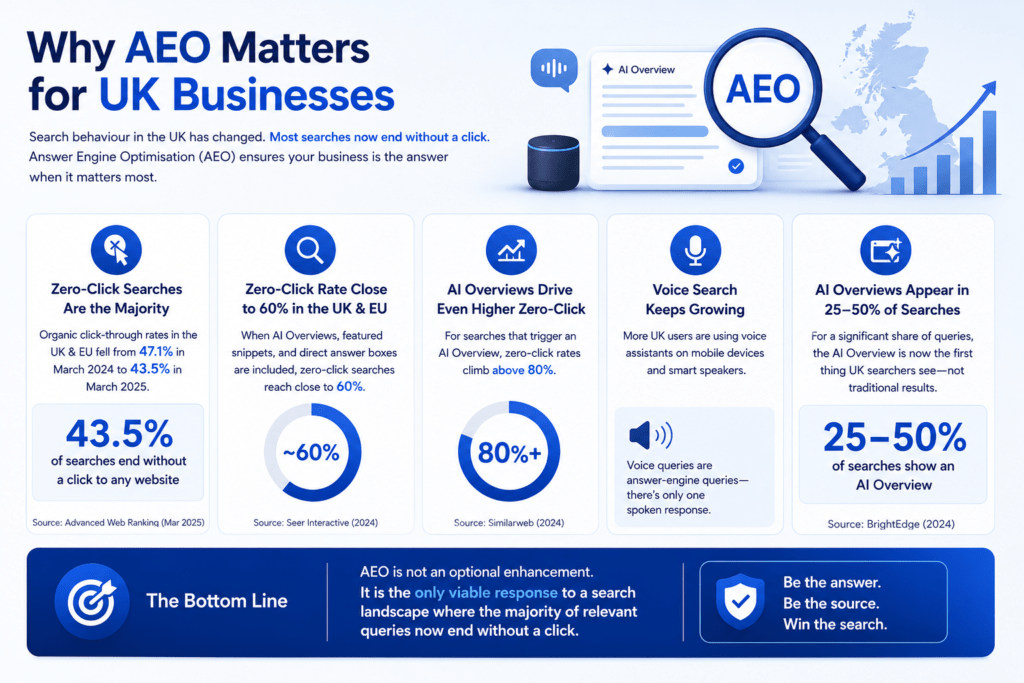
The zero-click trend is now the majority behaviour, not the exception. Research tracking UK and EU search behaviour found organic click-through rates fell from 47.1 percent in March 2024 to 43.5 percent by March 2025, meaning the majority of UK searches now end without a click to any external website. Separate analysis places UK and EU zero-click rates at close to 60 percent once AI Overviews, featured snippets, and direct answer boxes are accounted for. For queries that trigger an AI Overview specifically, the zero-click rate climbs even higher, with some studies recording rates above 80 percent for these AI-summarised results.
For UK businesses that rely on informational queries to generate enquiries, demonstrate expertise, or build top-of-funnel awareness, this is not a marginal shift. It means the majority of the people asking the exact questions your business could answer never reach your website at all. Your only opportunity to influence their decision is to be the answer itself.
Voice search continues to grow steadily in the UK, driven by smart speaker adoption and the increasing use of voice assistants on mobile devices. Voice queries are answer-engine queries by definition: there is no list of results to scroll through, only one spoken response.
Google AI Overviews appearing in 25 to 50 percent of searches means that for a significant share of the queries relevant to your business, the traditional list of organic results is no longer the first thing a UK searcher sees. The AI Overview is. If your content is not structured to be the source of that overview, a competitor’s content will be.
The 5 Core AEO Principles
The conclusion is straightforward. AEO is not an optional enhancement for UK businesses that depend on search-driven discovery. It is the only viable response to a search landscape where the majority of relevant queries now end without a click.
AEO is built on five practical principles. Applied consistently across your most important content, they significantly increase the likelihood that your content becomes the extracted answer rather than the unclicked link beneath it.
Principle 1: Write in Direct-Answer Format
State the answer in the first sentence of every section, before any context, caveat, or background information. Answer engines extract the clearest, most direct statement available. If your content opens with throat-clearing, the answer engine has nothing clean to extract.
In practice: if a section is titled “How long does it take to register a UK limited company?”, the first sentence should answer that exactly: “Registering a UK limited company with Companies House typically takes 24 hours when filed online.” Context, exceptions, and detail can follow. The direct answer comes first, every time.
Principle 2: Use Structured FAQ Sections with 40 to 60 Word Answers
FAQ sections are one of the most reliably extracted content formats across all answer engines, from Google’s People Also Ask boxes to AI Overviews to chat-based responses. The optimal answer length for this format is 40 to 60 words: long enough to be genuinely useful, short enough to be extracted as a complete, self-contained unit.
Write each FAQ answer so it could stand entirely on its own, with no reference to “as mentioned above” or “see the section below.” Answer engines extract these passages independently of their surrounding context, so each one needs to make complete sense in isolation.
Principle 3: Implement FAQPage Schema Markup
Schema markup is structured data that explicitly tells search engines and AI crawlers what your content means, rather than leaving them to infer it from formatting alone. FAQPage schema specifically marks up your questions and answers in a machine-readable format that significantly increases the likelihood of extraction into featured snippets, AI Overviews, and voice assistant responses.
This is the technical implementation layer that pairs with the FAQ content itself. Well-written 40 to 60 word answers without FAQPage schema still perform reasonably well. The same content with correctly implemented schema performs measurably better, because you have removed any ambiguity about what the content is and how it should be used.
Principle 4: Cover the Full Question Landscape, Not Just Your Favourite Keywords
Most businesses build their content strategy around the keywords they already know from traditional SEO research. AEO requires a different starting point: the full range of questions your potential customers are actually asking, including the ones that never show up in keyword tools because they are too conversational, too specific, or too new.
This means going beyond your top five service-related keywords to cover the genuine breadth of what buyers want to know: pricing questions, comparison questions, process questions, eligibility questions, and the awkward edge-case questions that a thorough business should be able to answer confidently. The businesses that win at AEO are the ones that have mapped and answered this full landscape, not just the obvious queries.
Principle 5: Build Authority Signals That Answer Engines Trust
Answer engines, like generative engines more broadly, are cautious about which sources they extract from. Reviews, third-party citations, and consistent brand description across multiple platforms all reduce the uncertainty an AI system has about treating your content as a trustworthy, citable source.
This is not a separate workstream from your content. It is the credibility layer that determines whether your well-structured answer actually gets selected over a competitor’s. A business with a clearly written 50-word answer to “what does a conveyancing solicitor cost in the UK” but no reviews and inconsistent business details across the web will be outcompeted by a business with a similar answer backed by 80 verified Google reviews and consistent entity information everywhere it appears.
How to Identify the Right Questions to Answer
The foundation of effective AEO is knowing precisely which questions to target. Guessing wastes effort on content nobody is asking for, while genuinely common buyer questions go unanswered.
Several practical research methods work well for UK businesses. Google’s own People Also Ask boxes, visible beneath standard search results for most queries, show real related questions UK searchers are asking right now. Tools like AnswerThePublic and AlsoAsked aggregate autocomplete and related-question data into structured visual maps, making it easy to spot patterns and gaps across a topic area.
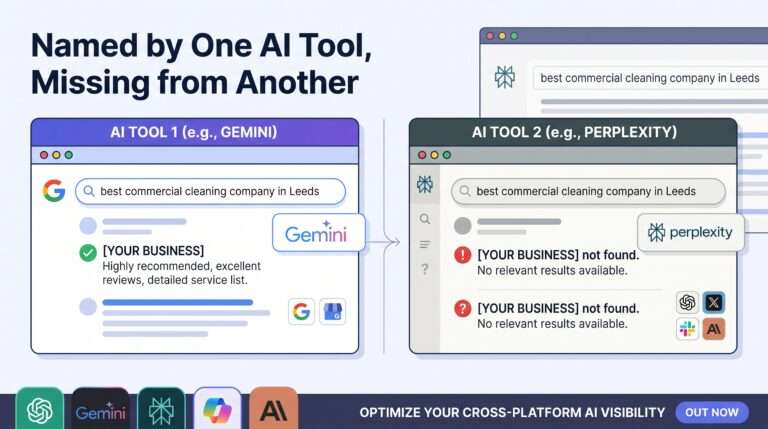
The most direct method, however, is manual testing. Open ChatGPT or Perplexity and ask the kinds of questions your potential customers would ask about your category and your specific business. Note where your business is mentioned, where it is missing, and where competitors appear instead. This manual process reveals AI-specific question patterns that traditional keyword tools often miss entirely, because the way people phrase questions to AI systems is frequently more conversational and more specific than how they phrase a Google search.
This entire process, identifying which questions matter and mapping where your current content does or does not answer them, is what we refer to internally as prompt coverage. Building a complete, prioritised map of buyer questions against your existing content is one of the highest-leverage activities in AEO, because it converts a vague sense of “we should probably do more FAQ content” into a specific, actionable list of exactly what to write next.
AEO Quick-Start Checklist for UK Businesses
Use this ten-point checklist to assess where your most important pages currently stand.
- Does each key service or product page answer the most common buyer question directly in the first paragraph, before any other content?
- Does the page include a dedicated FAQ section with five or more relevant questions?
- Are FAQ answers written at 40 to 60 words, with each one able to stand alone?
- Is FAQPage schema markup correctly implemented and validated on pages with FAQ content?
- Are headings phrased as the actual questions buyers ask, rather than vague topic labels?
- Have you tested your top three buyer questions directly in ChatGPT or Perplexity to see whether your business appears in the response?
- Are your business name, services, and location stated consistently across your website and every external platform where you appear?
- Does your content avoid burying the answer beneath unnecessary introductions, caveats, or marketing language?
- Do you have a recent, genuine flow of reviews on Google and at least one sector-relevant platform?
- Have you identified and prioritised the highest-value buyer questions your current content does not yet answer?
A business that can confidently tick all ten items is in a strong position. Most UK businesses, when they audit honestly, find they are missing four or five.
Frequently Asked Questions
What is AEO (Answer Engine Optimisation)?
AEO is the practice of structuring content so that it can be extracted and surfaced as a direct, standalone answer by AI-powered search systems, including Google AI Overviews, voice assistants, and AI chat platforms. It focuses specifically on making your content the single extracted answer to a question, rather than simply ranking well or being cited within a longer AI-generated response.
How is AEO different from GEO?
GEO (Generative Engine Optimisation) is the broader discipline of getting your content cited across generative AI platforms in general, including detailed AI-synthesised answers and brand mentions. AEO is more specific: it targets the moment your content becomes the direct, standalone answer itself, the kind you would hear from a voice assistant or see at the top of an AI Overview. The two overlap significantly in practice, but AEO is the sharper, more targeted layer.
How do I optimise for answer engines?
Start by writing direct answers in the first sentence of each section, before any context or background. Add FAQ sections with 40 to 60 word answers that can stand alone, implement FAQPage schema markup, and ensure your business details are consistent across your website and every external platform. Map the full range of questions your buyers actually ask, not just your known keywords, and prioritise content against that map.
Does AEO replace SEO?
No. AEO and SEO serve different purposes and work together. SEO ensures your content is technically sound, indexable, and ranks for relevant terms. AEO ensures that when a direct answer is needed, your content is the one extracted. A business with strong SEO but no AEO will still rank but will be squeezed out of the growing share of zero-click queries. Both are necessary parts of a complete search visibility strategy.
How do I know if my AEO strategy is working?
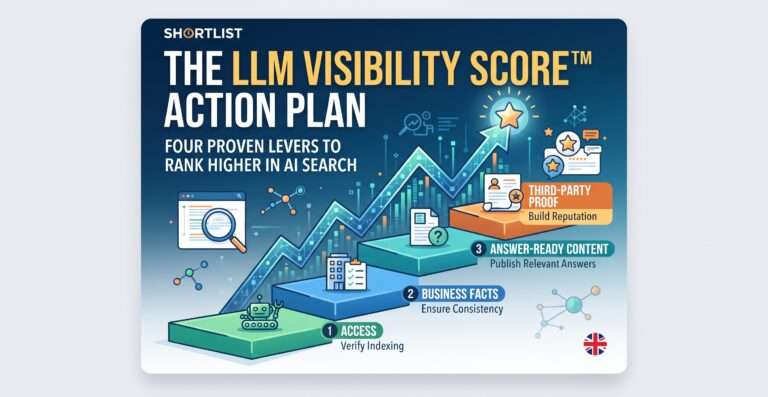
Test your most important buyer questions directly in ChatGPT, Perplexity, and Google, both before and after implementing AEO changes, and track whether your business appears in the response. Monitor whether your FAQ content begins appearing in Google’s featured snippets or People Also Ask boxes. For a systematic, benchmarked measurement across multiple platforms rather than manual spot-checks, the LLM Visibility Score™ tracks your performance over time.
Take the Next Step
A free AEO audit shows you exactly which questions AI systems are answering about your category right now, whether your business appears in those answers, and where your highest-priority content gaps are.
Get Your Free AEO Audit and see which questions your customers are asking AI today.