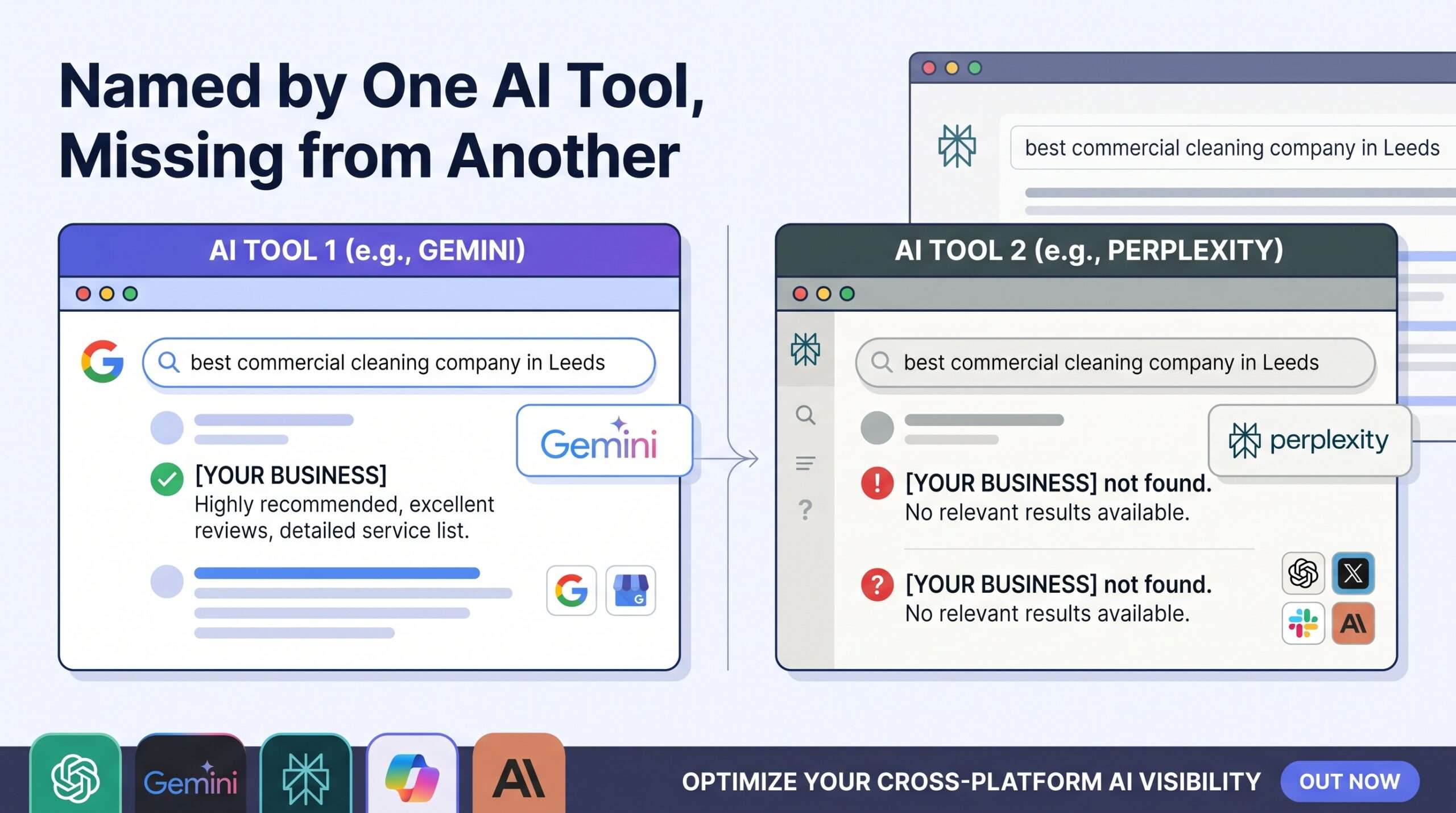
You check Gemini and there you are, named and described well. You check Perplexity for the same question and you have vanished. Same business, same day, two completely different answers. It is one of the most confusing things about AI search, and it leads a lot of businesses to draw the wrong conclusion from a single check.
The reason is not a glitch. Each AI tool finds and weighs its information differently, so being visible in one tells you very little about the others. This post explains why the tools disagree, why checking just one gives you a false read, and how to build a presence that holds up across all of them.
To be clear, this is about differences between tools. A separate issue is that a single tool can give different answers to the same question on different runs, which we cover in why a single ChatGPT check misleads you. Here we are looking at why ChatGPT, Gemini, Perplexity, Copilot, and Claude reach different conclusions from each other.
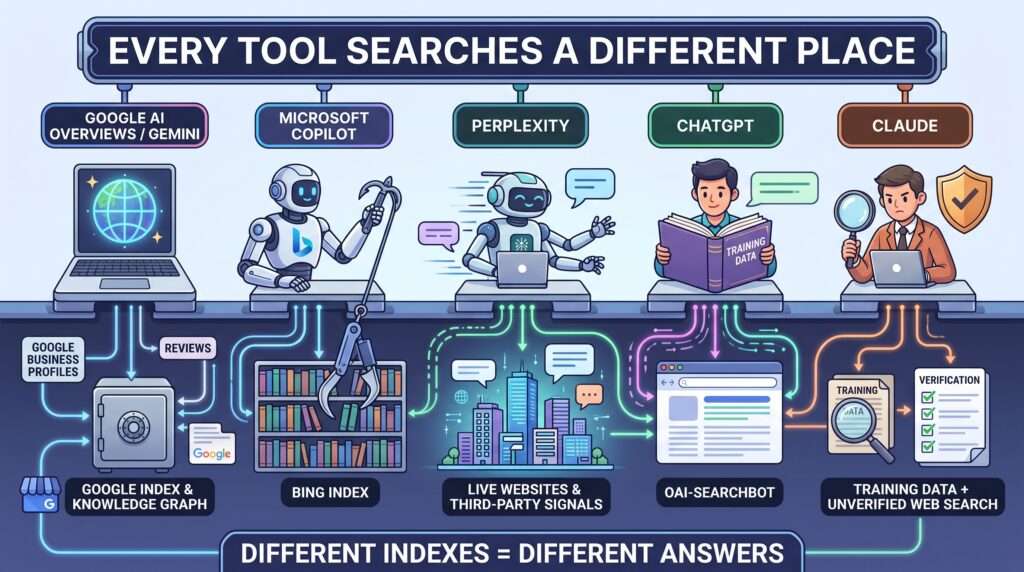
Every tool searches a different place
The simplest reason the answers differ is that the tools are not reading the same web. Each one pulls from a different index or blend of sources.
- Google AI Overviews and AI Mode draw on Google’s own index, the Knowledge Graph, and related data, with Gemini reasoning over the results. If you rank and are understood in Google, you are in the pool these features choose from.
- Gemini leans on the same Google foundations, so a complete Google Business Profile, consistent details, and genuine reviews carry real weight.
- Microsoft Copilot grounds its answers in the Bing index. Only pages Bing has crawled are eligible, so your Bing visibility, not your Google visibility, decides whether Copilot cites you.
- Perplexity runs its own retrieval and is heavily reliant on live crawling and third-party signals, citing sources inline.
- ChatGPT blends its training data with live web search when a question needs it, using its own retrieval crawler rather than Google’s ranking.
- Claude uses its training data plus a live web search that appears to draw on a different index again, and it is cautious about recommending anything it cannot verify.
Put those together and the pattern makes sense. A business that has invested in Google will tend to show up in Gemini and AI Overviews, yet be thin in Copilot if it has never touched Bing, and absent from Perplexity or Claude if the wider web does not corroborate it. Strength in one index does not transfer to another.
They also weigh evidence differently
Even when two tools can see the same page, they do not value it the same way.
Perplexity leans hard on off-site signals, so reviews, mentions, and the sentiment around your name influence it more than your own copy does. Google’s AI features sit on top of its ranking systems, so classic SEO fundamentals matter more there than for tools that crawl independently. Claude is unusually cautious, holding back when your information is thin or contradictory, so consistency across the web helps it more than volume of content. ChatGPT behaves differently again depending on whether it answered from training data or ran a live search, which can produce two different sets of businesses for the same question.
Recency plays out differently too. Perplexity and live-search modes reward genuinely current pages. Training-data knowledge moves slowly and can still carry an old mention for or against you. So the same page can be fresh enough for one tool and stale in the memory of another.
Why one check gives a false read
If you only ever test the tool you personally use, you build a picture that is confidently wrong. You might feel visible because Gemini names you, while your buyers using Copilot or Claude never see you at all. Or you might feel invisible because Perplexity skipped you, when in fact you are named across Google’s AI features every day.
This is why serious measurement tests across platforms rather than one. It also tests each prompt more than once, because answers vary between runs, and it records not just whether you appear but how prominently and how accurately you are described. A per-platform view is the only way to see where you are actually winning and where you are missing. We go through this in practice in how to run an AI competitor analysis, where the same prompt often surfaces a different set of competitors on each tool.
A worked example
A commercial cleaning company asks the same question, “best commercial cleaning company in Leeds”, across the tools.
Gemini and Google AI Overviews name them, because they have a strong Google Business Profile, good reviews, and pages that rank. Copilot does not, because they have never registered with Bing Webmaster Tools and Bing has barely indexed them. Perplexity names a competitor, because that rival appears in a couple of local “best cleaners” roundups and the company itself has no third-party mentions. Claude hedges and recommends no one specific, because the company’s service area and name are described inconsistently across its own listings.
Nothing is broken. Each tool reached a reasonable answer from the evidence it could see and the way it weighs that evidence. The company looks visible or invisible entirely depending on which tool you happen to open.
How to build presence that holds across all of them
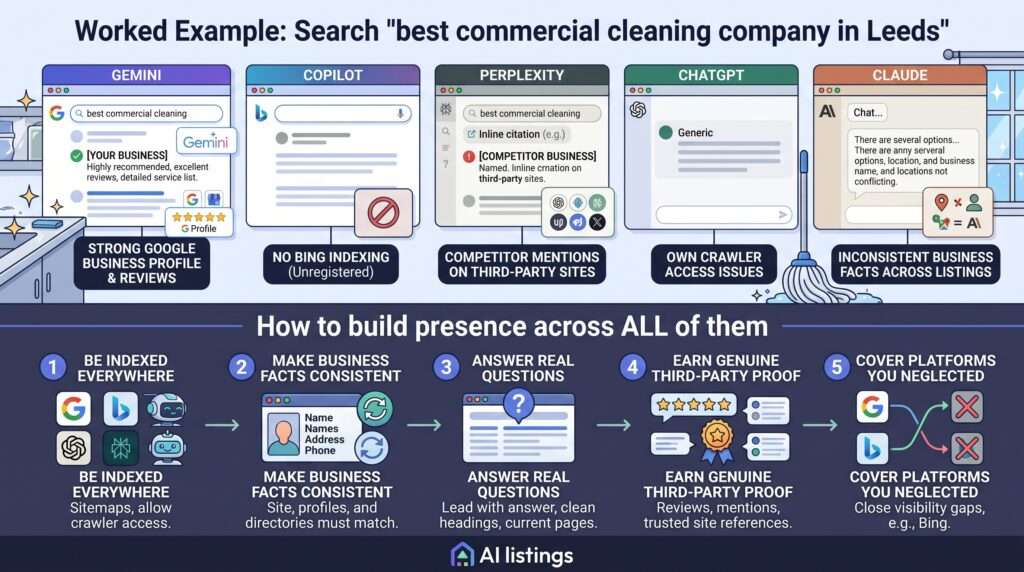
The good news is that the foundations overlap. You do not need a separate strategy for each tool. You need the signals they all rely on, applied consistently.
- Be indexed everywhere. Make sure Google and Bing can both crawl and index you, and that the AI-specific crawlers for ChatGPT, Perplexity, and Claude can reach your pages. Being absent from one index is often the whole reason a tool skips you.
- Make your business facts consistent. Name, services, location, and contact details should match across your site, your profiles, and directories. Consistency is what reassures the cautious tools and strengthens your entity for the ones that lean on the Knowledge Graph.
- Answer real questions in clean, extractable pages. Lead with the answer, use clear headings, and keep it current. This helps every tool, because they all read at the passage level.
- Earn genuine third-party proof. Reviews, mentions, and references on trusted sites are what tip Perplexity, Claude, and the live-search modes towards naming you.
- Cover the platforms you have neglected. Most businesses have done some Google work and no Bing work. Closing that gap alone often unlocks Copilot and lifts ChatGPT search visibility at the same time.
Do this and you stop being at the mercy of which tool a customer happens to use. You become one of the names that shows up wherever the question is asked.
Common mistakes
- Judging your AI visibility from one tool. The tool you use is not the tool your customers use. Test across all the major ones.
- Assuming Google covers everything. Google visibility helps Gemini and AI Overviews, but does nothing for Copilot’s Bing grounding or Perplexity’s own crawl.
- Ignoring off-site signals. If your claims live only on your site, the tools that lean on corroboration will skip you.
- Treating one good result as proof. A single strong answer, on one tool, on one run, is not a pattern. Measure repeatedly and per platform.
- Fixing content but not access. The best page in the world cannot be cited by a tool whose crawler you have blocked.
Frequently asked questions
Why does Gemini name my business but Perplexity does not?
Because they read different sources and weigh them differently. Gemini leans on Google’s index and your Business Profile, while Perplexity relies on its own crawl and third-party mentions. Strength in one does not carry over to the other.
Does ranking in Google help me across all AI tools?
Only some. Google’s own AI features benefit from strong Google visibility, but Copilot grounds on Bing and Perplexity and Claude use their own retrieval, so Google rankings do not automatically help there.
Is it a problem if I show up in one tool and not another?
It matters if your customers use the tool where you are absent. The safe approach is to build presence across all the major tools rather than assuming one covers the rest.
Why does the same tool sometimes name different businesses?
Because AI answers are regenerated each time and can vary between runs and by how a question is phrased. That within-tool variance is separate from the differences between tools, and both are worth measuring.
How do I check my visibility across every tool at once?
Run the same set of real customer prompts through each tool, more than once, and record where you appear, how prominently, and how you are described. A per-platform view shows where you are winning and where you are missing.
See your visibility on every platform
If you want to know where you appear and where you are missing across ChatGPT, Gemini, Perplexity, Copilot, and Claude, our AI visibility optimisation services test real prompts on each tool, report performance per platform rather than a single blended figure, and turn the gaps into an ordered plan. One check on one tool is not the full picture, and it is usually the wrong one.