
ChatGPT names your competitor when someone asks for a recommendation in your field. The next day, same question, it names someone else. A week later it mentions you, then drops you again. It feels random, and that makes it hard to know what to fix.
It is not random, but it is not a fixed ranking either. ChatGPT decides what to recommend in two quite different ways, and which one it uses changes the answer. Once you understand the two modes and the steps in between, the swings make sense and you can start to influence them.
This sits alongside our practical guides on how to get your business recommended by ChatGPT and how to rank in ChatGPT. Those cover the actions. This one explains the machinery underneath them, so the actions make sense rather than feeling like a checklist.
Two modes: memory and live search
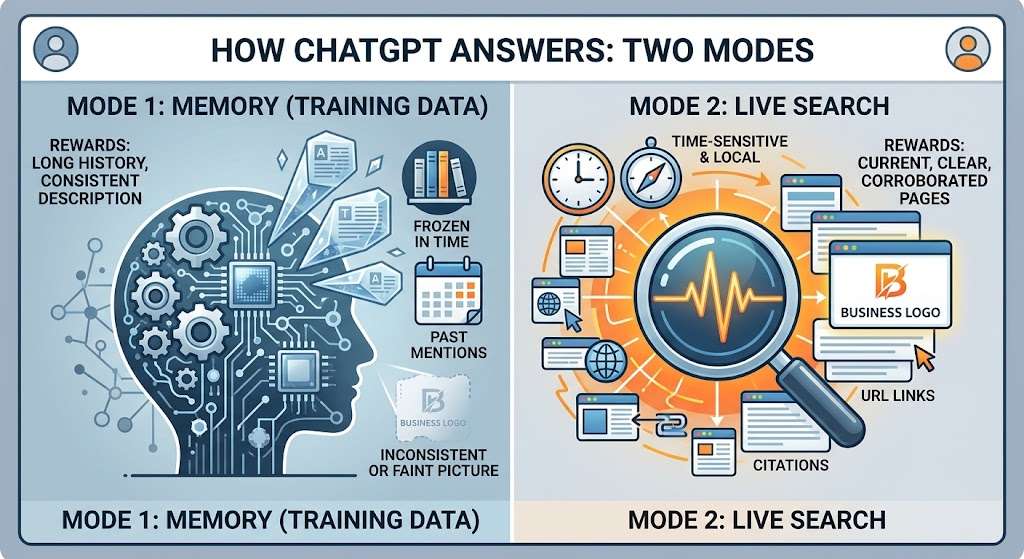
ChatGPT answers from one of two sources, and sometimes both.
Training data. This is the knowledge built in when the model was trained. It is a compressed picture of a huge amount of text from across the web: articles, websites, forums, directories, profiles, and reviews. If your business appeared often, in the right context, and was described consistently, that picture includes you. If it did not, you are faint or missing. Training data is frozen at a point in time, so a mention from a few years ago can still carry weight, and something published last month may not be in there at all.
Live search. When a question is time-sensitive or local, or when the user asks it to look, ChatGPT searches the web in real time, pulls back a handful of pages, and answers from what it finds, with links to the sources it used. This mode works much like other answer engines. It reaches for pages that are clear, well-structured, and repeated across several sources.
The two modes reward different things. Training data rewards a long history of being mentioned and described consistently. Live search rewards current, clear, corroborated pages right now. A business that only prepares for one of them will show up unevenly, strong in some answers and absent from others.
The four steps behind a recommendation
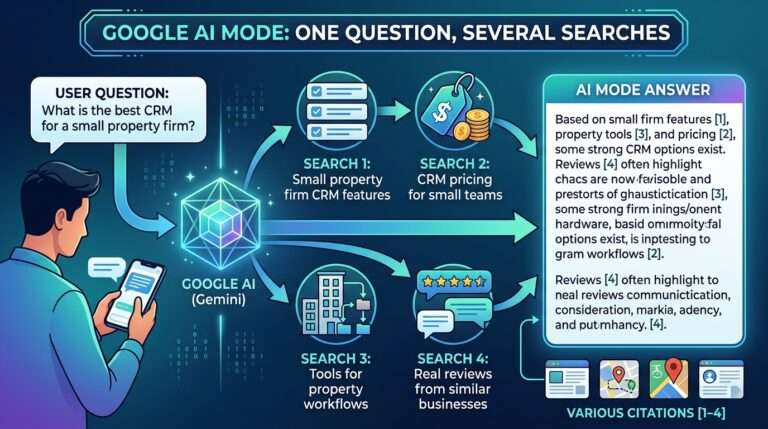
When live search is in play, a recommendation runs through a short chain.
- Query. ChatGPT reads the question and works out the intent. It also decides whether to search at all. For some questions it simply answers from training data, and no amount of outside work changes that decision.
- Retrieval. If it searches, it pulls back a set of candidate pages. This is where being findable and clearly written matters most.
- Synthesis. It combines what it found into one answer, leaning on information that appears consistently across sources rather than a claim that sits on only one page.
- Citation. It names the sources it used. Third-party pages are often cited alongside your own, not instead of them.
The useful lesson is in step one. You cannot force ChatGPT to search, and you cannot suppress a competitor. What you can do is be the clear, corroborated answer for the moments when it does search, and be well enough established that the training-data picture already includes you.
Why the answer changes from session to session
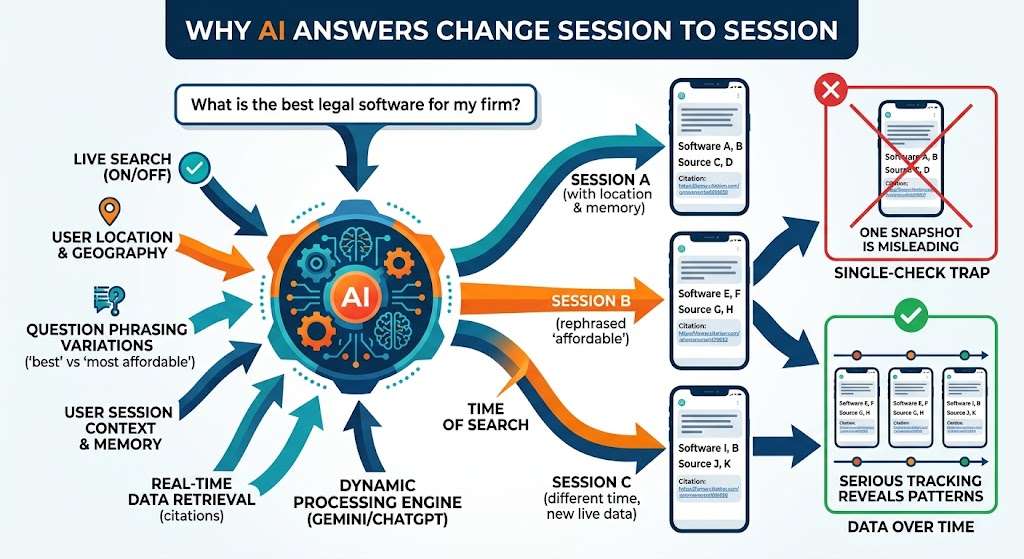
A few things move the result even when the question looks the same:
- Whether it searched. A training-data answer and a live-search answer can name different businesses.
- How the question was phrased. “Best”, “most affordable”, and “near me” pull different pages.
- Location and context. If the user has shared a location, or the conversation has built up context, the answer shifts.
- Memory. ChatGPT can carry details between chats for a signed-in user, which nudges what it suggests.
- Live retrieval is dynamic. The page cited this week may not be cited next week.
This is why one screenshot proves very little. We explain the trap in why a single ChatGPT check misleads you: a good result on a good day is not a pattern. Serious tracking uses fixed prompts, run more than once, with natural variations, recorded over time.
What actually moves the odds
Across both modes, the same foundations help.
- Be mentioned in the right places. Independent coverage, reviews, and reputable directories build the corroboration both modes rely on. This is the single biggest lever, and most of it happens off your own site. It is what we mean by trust signals for AI recommendations.
- Write clear, structured pages. Direct answers, sensible headings, and no burying the point. Cited pages tend to be the clearly formatted ones: FAQs, comparisons, and pages with clean structure.
- Keep your entity consistent. Same name, same details, same description of what you do, everywhere. Mixed signals weaken recognition in both training data and live retrieval.
- Stay current. Fresh, accurate content feeds the live-search mode and keeps outdated claims from undermining you.
- Make sure you can be crawled. ChatGPT search uses OpenAI’s own retrieval crawler, OAI-SearchBot. If it cannot access your pages, you are not eligible for the live-search mode at all. That is a floor, not a guarantee, and it is a common own goal for sites that blocked AI crawlers during the 2024 wave of “block the bots” advice.
One honest note: there is no paid placement in ChatGPT’s organic recommendations, and no submission button. Anyone selling a guaranteed number-one spot in ChatGPT is selling certainty that does not exist.
Which mode should you prioritise?
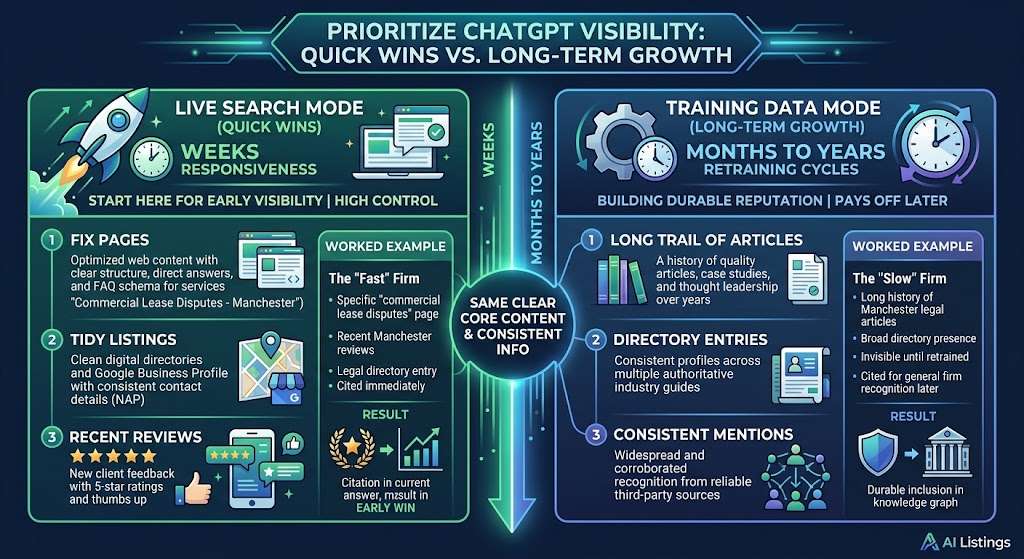
Start with the one you can move fastest. Live search responds to changes in weeks: fix your pages, tidy your listings, and gather a few recent reviews, and you can see movement in the next round of answers. Training data moves on a much slower cycle, because it only updates when the model is retrained, so the mentions you earn now tend to pay off later rather than today. In practice you work on both at once, since the same clear content and consistent information feed each of them. But if you need an early win, the live-search levers are where it shows up first, and they are also the ones fully within your control.
A worked example
Someone asks, “which firms handle commercial lease disputes in Manchester?”
If ChatGPT answers from training data, it leans on firms that have been written about often and described clearly over the years. A firm with a long trail of articles, directory entries, and consistent mentions is more likely to surface.
If it searches live, it pulls current pages: a clear “commercial lease disputes” page, recent reviews, an entry in a legal directory, consistent contact details. The firm that lines up across those sources gets named. The firm with one vague “commercial law” page and no outside footprint does not, even with the exact same expertise. Same business, different visibility, decided by how easy it is to find and verify.
Common mistakes
- Thinking of it as a ranking. There is no fixed league table to top. Aim for durable presence in the pool ChatGPT draws from.
- Optimising only your website. Both modes lean on what the rest of the web says about you. Ignoring off-site proof caps your visibility.
- Assuming an old mention lasts forever. A feature from years ago fades in influence. Recency matters, especially in live search.
- Reading one result as the truth. Answers vary by mode, phrasing, location, and memory. Track patterns, not snapshots.
- Blocking the crawler by accident. One broad line in your robots file or bot-management rules can remove you from the live-search mode entirely.
Frequently asked questions
Does ChatGPT use Google rankings to decide? No. Its base answers come from training data, and its live mode uses its own retrieval rather than Google’s ranking. The same content quality helps both, but they are separate systems, so a strong Google position does not guarantee a ChatGPT mention.
Can I pay to be recommended by ChatGPT? Not in the organic recommendation. There is no paid slot and no submit button. You influence it through clear content, consistent business information, and genuine third-party trust, not through payment.
Why does ChatGPT recommend me one day and not the next? Because the answer depends on whether it searched, how the question was worded, the user’s location and context, and which pages it retrieved that day. Live retrieval changes, so results move even for the same question.
Does structured data get me recommended? It helps by making your information easy for machines to read, which improves your chances of being retrieved and cited. It does not guarantee a recommendation on its own. Clear, corroborated content matters more.
How should I track my ChatGPT visibility? Use a fixed set of real customer questions, run each more than once with slight rewording, and record what is mentioned and cited and how it is described. Watch the trend over time rather than trusting a single result.
See how ChatGPT describes you
If you want to know whether ChatGPT names your business, a competitor, or no one at all for your key questions, our AI visibility optimisation services test those prompts, capture how you are described, and show where the gaps are. It is a clearer place to start than watching answers change and guessing why.