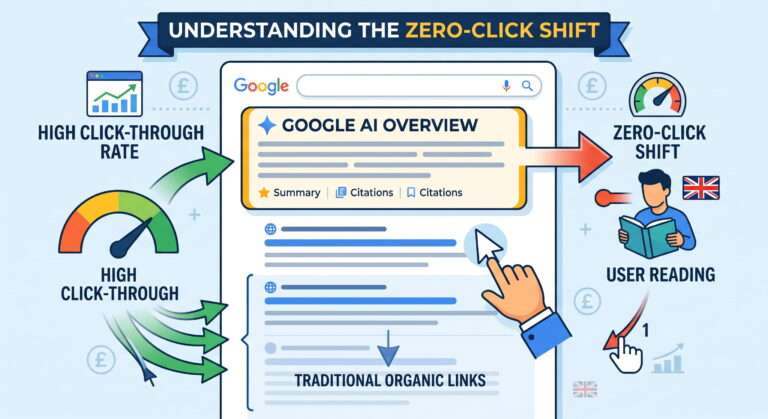
Google search used to hand you ten blue links and let you choose. Google AI Mode hands you one written answer and names a few sources inside it. If your business is not one of those sources, you are not in the answer, and for a growing share of searches the answer is all people read.
Being in that answer is not luck, and it is not the same as ranking first. AI Mode picks its sources through a specific process, and once you understand that process you can give it what it needs. This guide explains how AI Mode works, why it behaves differently from both classic search and AI Overviews, and the practical steps that make your pages easy for it to use.
If you have already read why traditional SEO is no longer enough, treat this as the Google-specific follow-up. That piece covers the shift from links to answers across the board. This one focuses on Google’s own conversational surface.
What Google AI Mode actually is
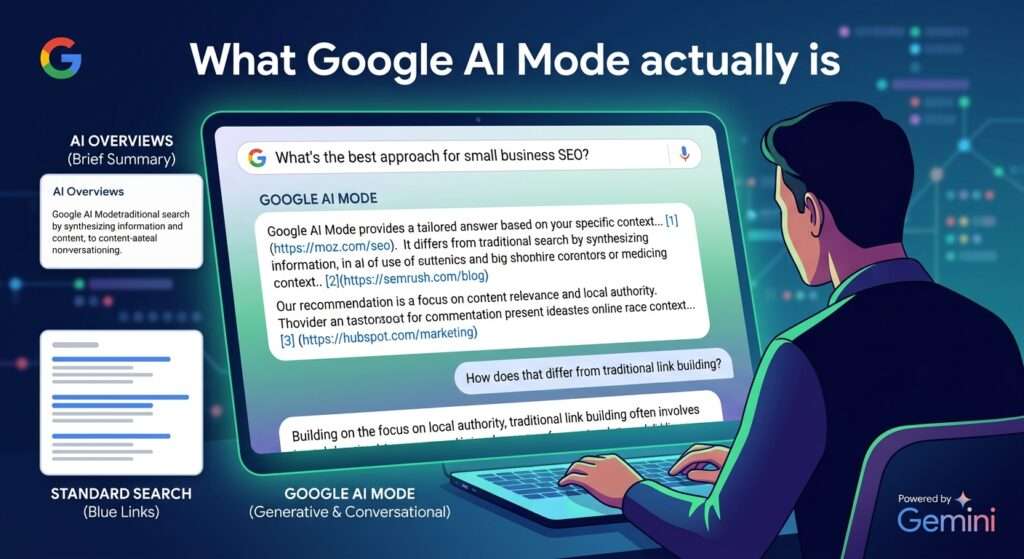
Google AI Mode is a generative search experience built into Google Search. You ask a question in plain language, get an AI-written answer with links to sources, then ask a follow-up and keep the thread going. It runs on Gemini and sits alongside the normal results rather than replacing them.
Two things separate it from what came before. First, it is conversational, so it holds context across a back and forth rather than treating every query as a fresh, isolated search. Second, it goes deeper than AI Overviews. AI Overviews is the short summary that sometimes appears at the top of ordinary results. AI Mode is a full surface of its own, and it works harder to build each answer. Both draw on the same underlying idea, but AI Mode pushes it further, which changes what it takes to appear.
One question becomes several searches
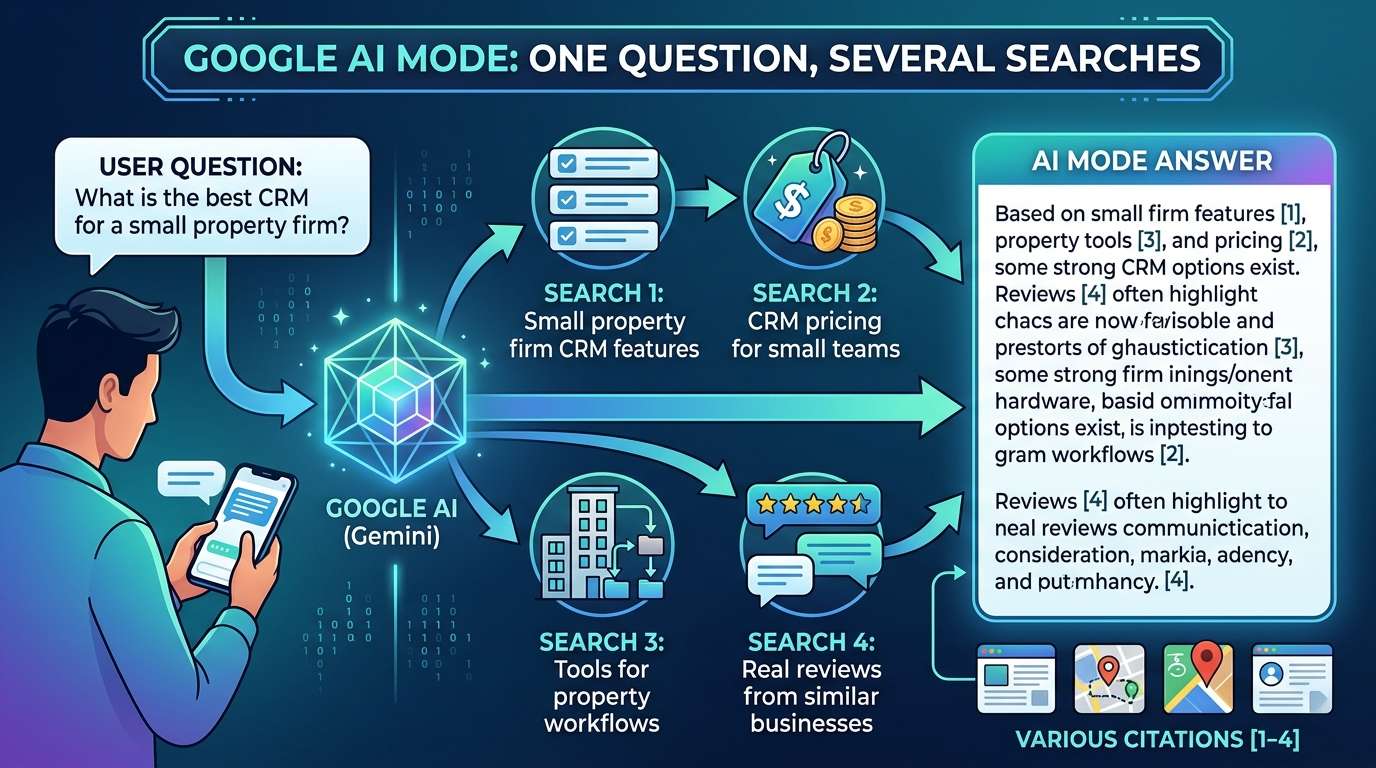
The mechanic that matters most in AI Mode is called query fan-out. Instead of running only the query you typed, Google breaks your question into related sub-questions and runs several searches at once, then combines the results into one answer. In its own documentation, Google describes AI Mode and AI Overviews as using a query fan-out technique, issuing multiple related searches across subtopics and data sources to build a response.
Here is why that changes your job. Say someone asks, “what is the best CRM for a small property firm?” Behind the scenes, AI Mode might search for the features small firms need, pricing for small teams, tools that handle property workflows, and reviews from similar businesses. Your page does not have to match the exact words the person typed. It has to answer one of the sub-questions Google runs in the background. A page that targets only the head phrase, and says nothing about pricing, setup, or that specific use case, misses most of those side searches and most of its chances to be pulled in.
The deeper AI Mode goes, the more this compounds. Its most advanced mode can run a large number of searches for a single question before it answers. Broad, shallow pages have little chance of satisfying all of those angles, while a page that genuinely covers its topic can be cited more than once.
Where AI Mode gets its sources
AI Mode runs on Gemini, but it does not invent its sources. It retrieves from the same places standard Google search already uses: the live web index, the Knowledge Graph, the Shopping Graph, and real-time data. Gemini then reasons over what comes back and writes the answer.
Two practical points follow from that.
First, classic SEO still matters here in a way it does not for some other AI tools. If a page is not indexed and does not rank, it is not in the pool AI Mode draws from to begin with. You cannot appear in an answer built from Google’s index if you are not in that index. This is why AI visibility and traditional search visibility support each other rather than competing.
Second, because Google is stitching together passages from several searches, AI answers tend to cite a wider and more varied set of sources than a normal results page. There is more room than the two or three names in the written answer suggest, but it still rewards genuine depth over a single thin page.
A note on structured data
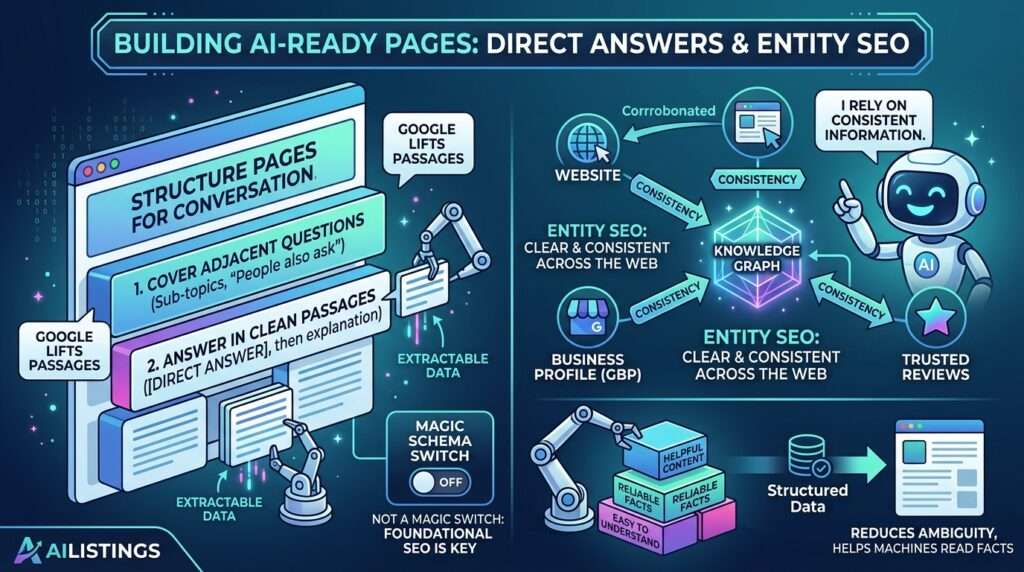
It is worth being straight about schema, because there is a lot of noise about it. Google’s own guidance is clear: you do not need to add special structured data, machine-readable files, or AI-specific markup to appear in AI features. The same foundational SEO that works for Search works here: content that is helpful, reliable, technically sound, and easy to understand.
Structured data still has value. It helps machines read your facts cleanly and reduces ambiguity about what your business is. Just do not treat it as a magic switch for AI Mode. The heavy lifting is done by clear content, a site Google can crawl and index, and consistent information across the web.
How to structure pages that hold up in a conversation
The aim is to be useful across a spread of related questions, not just one keyword.
- Cover the adjacent questions. Map the sub-questions around your main topic and answer each one plainly on the page. The “People also ask” box and related searches are a decent starting list for what Google fans out into.
- Answer in clean, self-contained passages. Lead with the answer, then explain. Each section should give a direct answer a system can lift without editing, an approach we cover in detail in how to structure content for AI search.
- Make your entity clear and consistent. Who you are, what you do, and where you work should read the same way on your site, your Google Business Profile, and across the web. AI Mode leans on the Knowledge Graph, and that is built from consistent, corroborated information. This is the heart of entity SEO.
- Keep it current. Stale pages get filtered out. Recent, accurate content survives the process.
- Earn genuine mentions. Reviews and references on trusted third-party sites help confirm your claims. Manufactured mentions do not, and Google says as much.
A worked example
A homeowner asks, “who should I call for emergency boiler repair near me tonight?”
AI Mode does not just search that phrase. It checks service fit, coverage area, opening hours, reviews, and a way to get in touch, then names a business it can stand behind on all of those. A firm with a clear “emergency boiler repair” page, listed service areas, visible hours, strong reviews, and a phone number that matches everywhere is easy to name. Every background check lines up.
A firm with a general “heating services” page, no stated hours, and thin reviews fails several of those checks and gets left out, even though it does exactly the same work. Nothing is wrong with the business. It simply did not give AI Mode enough clear, consistent evidence to name it with confidence, so the answer went to the firm that did.
Common mistakes
- Optimising for a single keyword. Fan-out rewards topic coverage. One page targeting the head term leaves most of the background searches unanswered.
- Assuming AI Mode and AI Overviews are the same. They share the Gemini model but sit in different places and apply fan-out differently. AI Mode goes deeper and runs longer conversations.
- Ignoring indexing. If a page is not indexed and ranking, it is not a candidate. The AI layer sits on top of search, it does not replace it.
- Over-investing in schema. Structured data helps, but it is not the requirement some make it out to be. Clear, helpful, well-structured content comes first.
- Inconsistent business details. Mismatched name, address, hours, or service areas undermine the entity signals AI Mode relies on.
Frequently asked questions
Is AI Mode the same as AI Overviews? No. AI Overviews is the short summary that can appear at the top of normal results. AI Mode is a separate, conversational experience where you can ask follow-up questions. Both use query fan-out, but AI Mode applies it more aggressively and builds deeper answers from more searches.
Do I still need traditional SEO for AI Mode? Yes, more than for most AI tools. AI Mode pulls candidate sources from Google’s index, so a page that is not indexed and ranking cannot appear. Strong SEO foundations are what put you in the pool it chooses from.
What is query fan-out in plain terms? Google turns your one question into several related searches, runs them together, and combines the best results into a single answer. Your page can appear by answering any of those related searches, not only the exact phrase the user typed.
Do I need special schema to appear in AI Mode? No. Google states you do not need special structured data or AI-specific files to appear in its AI features. Schema can still help machines understand your content, but clear, helpful, indexable content is what matters most.
How do I find the sub-questions Google might run? Start with the “People also ask” box, related searches at the foot of the results, and the follow-up questions your own customers ask. Answer those directly on the page, each in its own clear section.
Where to start
If you want to know whether Google’s AI answers are naming your business for the questions that matter in your market, that is worth checking before you change anything. Our AI visibility optimisation services test real customer prompts across AI Mode and other tools, show where you are missing, and turn the gaps into a short, ordered list of fixes.