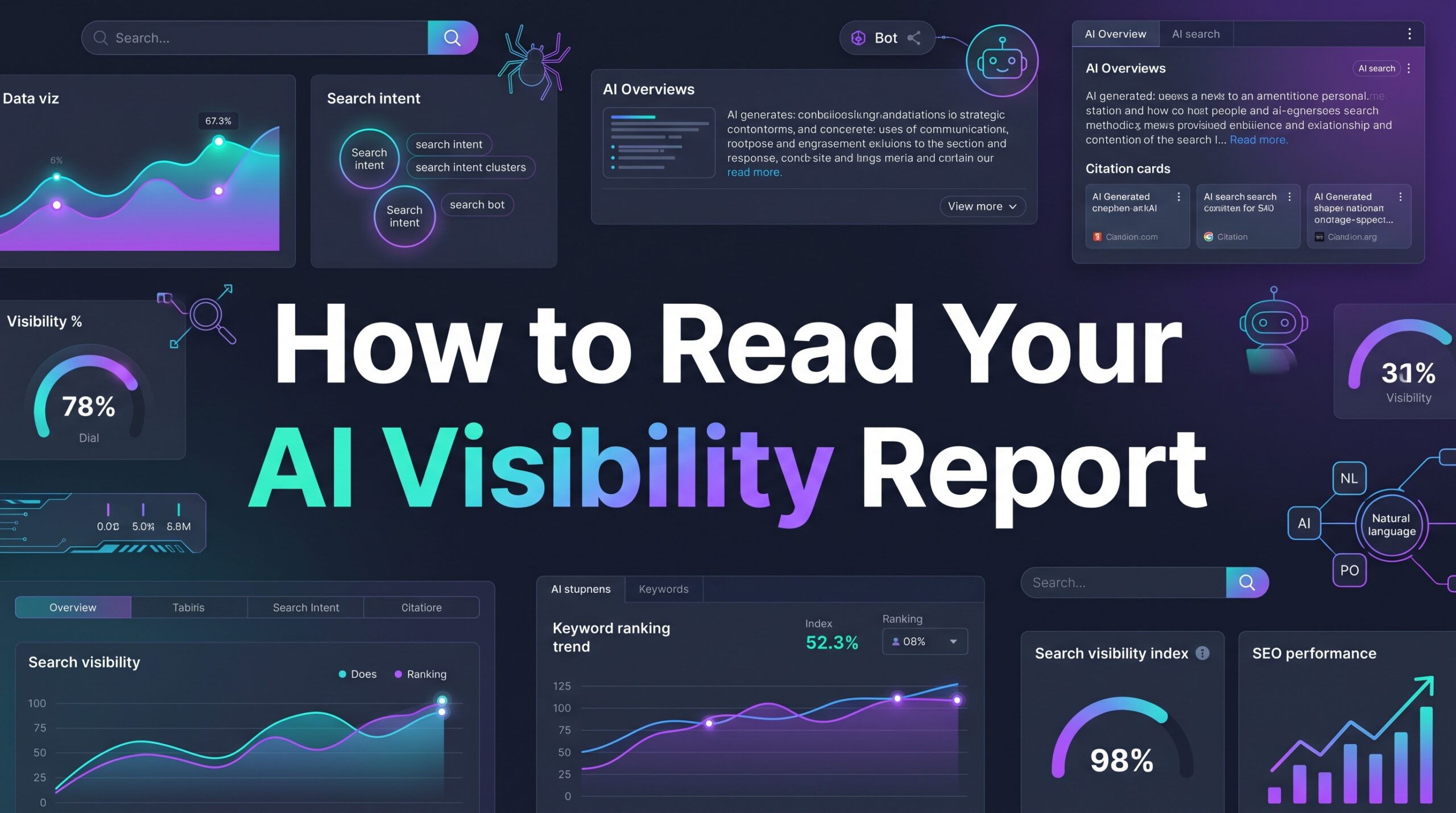
An AI visibility report can look like a wall of numbers: a score, five platforms, dozens of prompts, competitor names and notes on what each tool said. It is easy to read the headline, feel good or bad about it, and file it away. The value is not in the number. It is in the short list of fixes the number points to.
This guide walks through what each section of a per-platform report shows, how to read results that differ from one AI tool to the next, and how to turn the findings into three to five fixes in order of priority. It is the reading half of the monthly track-and-improve loop in the Shortlist System™.
In short: Read the trend before the number, then the per-platform breakdown, then which prompts you are missing. Check whether AI tools describe you accurately and whether they recommend you or only mention you. Fix accuracy and access problems first, then gaps that affect every platform, then high-intent prompts you miss, then your recommendation share.
What does an AI visibility report show?
Most per-platform reports, including ours, are built from the same raw material: a fixed set of buyer prompts, run several times on each major AI tool, with every answer recorded. Each section that comes out of that data answers a different question.
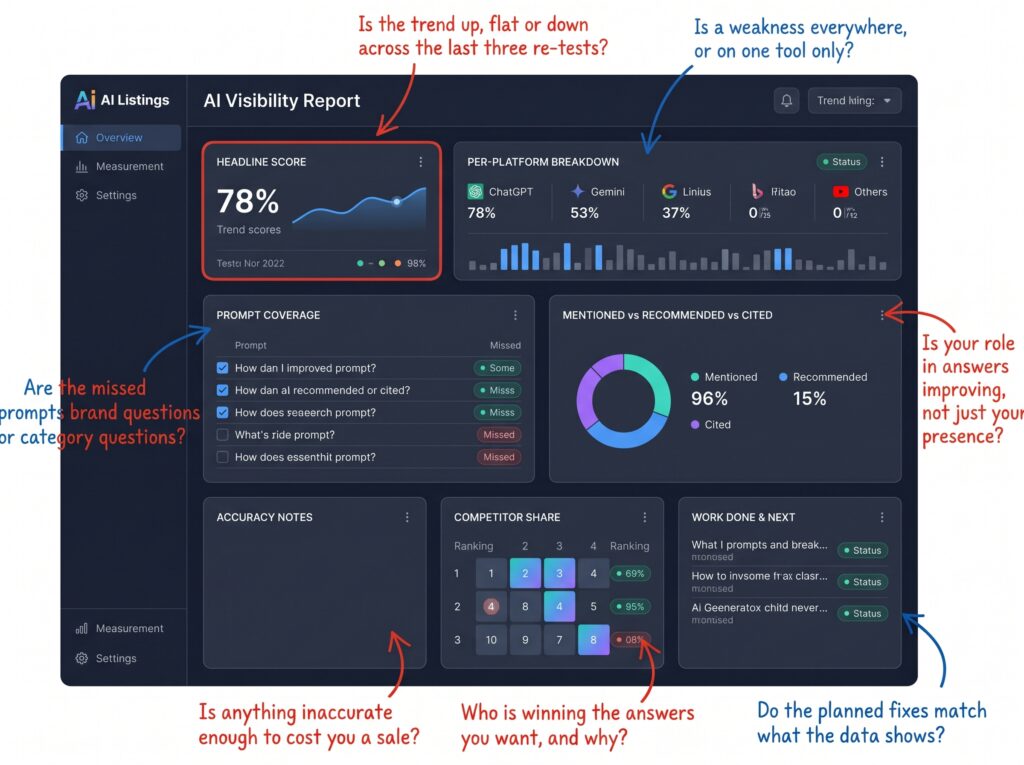
| Section | What it tells you | The question to ask |
|---|---|---|
| Headline score and movement | How often you are named across all prompts and tools, and the change since last month | Is the trend up, flat or down across the last three re-tests? |
| Per-platform breakdown | Your score on each AI tool separately | Is a weakness everywhere, or on one tool only? |
| Prompt coverage | Which prompts you appear in and which you miss | Are the missed prompts brand questions or category questions? |
| Mentioned, recommended or cited | Whether you are listed, actively recommended or used as a source | Is your role in answers improving, not just your presence? |
| Accuracy notes | What AI tools say about you, and where it is wrong | Is anything inaccurate enough to cost you a sale? |
| Competitor share | Who appears for the prompts you miss | Who is winning the answers you want, and why? |
| Work done and next | What changed last month and what is planned | Do the planned fixes match what the data shows? |
If you need a refresher on how the headline number is built, see what an LLM Visibility Score is and how it is measured.
Read the trend before the number
A single month’s score is a snapshot of something that moves. AI tools generate a fresh answer every time, so the same prompt can name different businesses on different runs. Research from SparkToro found less than a one-in-100 chance that ChatGPT or Google’s AI would give the same list of brands twice, but how often a brand appeared across many runs was far more stable. That is why a good report shows rates, not screenshots.
Read the headline in three steps:
- Compare it with the last three re-tests. One month up or down is often noise. A consistent direction across three is a signal.
- Check the prompt set has not changed. A score is only comparable if the prompts, platforms and number of runs stay the same.
- Ignore scores from other tools or agencies. Each uses its own prompts and method, so 30% from one is not comparable with 30% from another.
If you are tempted to judge the month on a quick check of your own, read why a single ChatGPT check misleads you first.
Why do results differ by AI tool?
The per-platform breakdown is often the most useful part of the report, because each AI tool finds and weighs information differently. Our guide to why you appear in one AI tool but not another explains the mechanics. In practice, a weak score on one platform usually points to a specific cause:
| Weak on | Likely cause | First thing to check |
|---|---|---|
| ChatGPT | Live search cannot reach or does not trust your pages, or the model knows little about you from training | Crawler access and third-party mentions. See how ChatGPT chooses businesses |
| Gemini and Google AI features | Weak Google signals: a thin Business Profile, inconsistent details or pages not indexed | Google Business Profile and indexing. See Gemini SEO |
| Copilot | Pages missing from Bing’s index | Bing Webmaster Tools verification. See Copilot SEO |
| Perplexity | Few independent sources mention you | Reviews, roundups and mentions. See Perplexity SEO |
| Claude | Thin or contradictory information makes it cautious | Consistency of your business facts. See getting recommended by Claude |
For Google’s AI features you can also cross-check against first-party data. Search Console’s generative AI performance report shows how people discover your content through AI Overviews and AI Mode, which makes a useful companion to prompt-based testing.
Read prompt coverage: brand questions versus category questions
Split the prompt list in two. Brand prompts are questions that name you, such as “is [your business] any good?”. Category prompts are questions that do not, such as “who is the best accountant for contractors in Leeds?”. They tell you different things.
- Strong on brand, weak on category: AI tools recognise your name but do not link it to the buyer’s problem. This usually means a content gap.
- Weak on both: AI tools cannot verify you. Start with access and business facts.
- Missed prompts that cluster around one service or location: you probably have no page that answers that need clearly.
Category prompts are where new customers come from, so a rise there matters more than a rise on brand prompts. If the prompt set itself feels thin, finding the exact prompts your customers ask AI shows how to widen it at the next agreed review.
Mentioned, recommended or cited?
Being in an answer is not the same as being chosen. A good report separates three roles:
- Mentioned: your name appears, often in a list, with no endorsement.
- Recommended: the answer suggests you as a good option for the buyer’s need.
- Cited: the AI tool uses your page as a source, usually with a link.
The mix tells you which lever to pull. Many mentions but few recommendations point to weak independent proof. Recommendations without citations suggest AI tools trust you but find your pages hard to quote. What an AI citation audit reveals covers the cited column in more depth.
Check what AI tools say about you
Read the accuracy notes before anything else on the fix list. If AI tools give the wrong address, list a service you stopped offering or quote an old price, that error reaches buyers even when you are named. It also signals that the web disagrees about your business, which suppresses recommendations more broadly. How to defend your brand against AI hallucinations explains how these errors arise and how to correct them at the source.
Read the competitor section
For every prompt you miss, the report should show who appears instead. Look for patterns rather than single names. If the same two competitors win most of your missed category prompts, study what they have that you lack: a page for that exact service, more recent reviews, a mention in a local roundup, or simply consistent details. Our guide to running an AI competitor analysis turns that into a repeatable method.
How do you turn the report into a fix list?
A report earns its keep when it ends in a short, ordered list. Use this order of priority:
- Accuracy errors and access blocks. Anything wrong about you, and any crawler that cannot reach you. These are usually quick to fix and affect every other result.
- Gaps that affect every platform. Inconsistent business facts and thin profiles hold you back everywhere at once.
- High-intent category prompts you miss. Start with comparison and “best provider for” questions closest to a purchase.
- Recommendation share. Reviews, mentions and listings that turn mentions into recommendations.
- Everything else. Single-platform gaps on low-intent prompts can wait.
Keep the list to three to five items a month. Each fix should name the prompts and platforms it is meant to move, so the next re-test can show whether it worked.
How does the report fit the monthly loop?
The report is one step in a cycle: test, read, fix, re-test. The fixes you choose this month are judged by next month’s report, so write them down with the prompts they should move. Over a quarter, that record shows which kinds of fixes pay off for your business.
Visibility is a leading indicator rather than the end goal. Alongside the report, track branded search volume, direct traffic and any enquiries where the buyer says an AI tool suggested you. Our guide to how AI visibility helps generate leads covers which business signals to track.
A worked example: a commercial landscaping firm in Kent
Here is how one month’s report might be read for a commercial landscaping firm in Kent (an illustrative example, not a named client).
| Platform | Score this month | Change since last month |
|---|---|---|
| ChatGPT | 18% | Up 3 points |
| Gemini and Google AI features | 24% | Up 2 points |
| Copilot | 0% | No change |
| Perplexity | 9% | Up 1 point |
| Claude | 12% | Down 2 points |
| Overall | 13% | Up 1 point, the third rise in a row |
The trend. The overall score has risen for three re-tests in a row, so the direction is real, if slow. Claude’s small drop is within normal variation.
The platforms. Copilot at zero is the stand-out gap. It affects every prompt and almost always means the site is missing from Bing’s index.
The prompts. Brand prompts are healthy. The firm misses six category prompts about maintenance contracts for business parks, and the same two competitors win most of them.
Roles and accuracy. The firm is mentioned far more often than it is recommended, and three tools still quote an office address it left last year.
That reading produces a four-item fix list for the month:
| # | Fix | Why it is on the list | What should move |
|---|---|---|---|
| 1 | Correct the old address on two directories and the Google Business Profile | Three tools quote the wrong address | Accuracy on every platform |
| 2 | Verify the site in Bing Webmaster Tools | Copilot score is zero | Copilot appearances |
| 3 | Publish a page answering questions about maintenance contracts for business parks | Six category prompts missed; two competitors win them | Category prompts on Perplexity and ChatGPT |
| 4 | Send a review request after every completed contract | Mentioned often, rarely recommended | Recommendation share over the next quarter |
Next month’s report will show whether each fix moved what it was meant to.
Common mistakes
- Reading only the headline number. The breakdowns tell you what to do; the headline only tells you how you are doing.
- Reacting to one platform’s dip in one month. Wait to see whether it holds before changing course.
- Comparing scores across agencies or tools. Different prompts and methods make the numbers incomparable.
- Building a fix list longer than you can deliver. Five finished fixes beat fifteen started ones.
- Treating every missed prompt as equal. A missed comparison question near purchase matters more than a missed general one.
- Changing prompts between reports. Add new prompts at agreed points, or the trend becomes meaningless.
Frequently asked questions
What should an AI visibility report include?
A useful report shows your overall score and its trend, a breakdown by AI tool, which prompts you appear in and which you miss, whether you are mentioned, recommended or cited, what AI tools say about you, which competitors win the prompts you miss, and the fixes planned for next month.
How do I read an AI visibility score?
Look at the trend before the figure. Compare the score with the last three re-tests using the same prompts, then break it down by platform and by prompt type. A score is a rate across many runs, so small month-to-month movements are often noise rather than real change.
Why is my visibility different on each AI tool?
Each AI tool draws on different sources. Google’s AI features lean on Google’s index and Business Profile, Copilot on Bing’s index, Perplexity on its own crawl and independent mentions, and Claude is cautious when information is thin. A weakness on one tool usually points to one specific cause.
What is a good AI visibility score?
No single figure counts as good. A score reflects your own prompt set and how crowded your category is, so a narrow local market and a broad national one produce very different numbers. Compare yourself with close competitors on the same prompts, and judge your own trend over several months.
Why did my AI visibility score drop this month?
Scores can move without any change on your side, because AI answers differ from run to run, models get updated and competitors keep improving. Check whether the drop holds across platforms and prompts. A fall concentrated on one tool or one group of prompts usually points to a specific cause.
What is the difference between mentioned, recommended and cited?
Mentioned means your name appears, often in a list. Recommended means the answer suggests you for the buyer’s need. Cited means the AI tool uses your page as a source, usually with a link. Many mentions with few recommendations usually points to weak independent proof.
Which fixes should I do first?
Fix accuracy errors and crawler access first, because they are usually quick and affect everything else. Then fix gaps that hold you back on every platform, such as inconsistent business facts. After that, target the high-intent category prompts you miss, then build reviews and mentions.
How many fixes should I take on each month?
Three to five. A short list gets done, and each fix can be linked to the prompts and platforms it should move, so the next report shows whether it worked. Long lists spread effort thinly and make it hard to tell which change made the difference.
How often should I get an AI visibility report?
Monthly suits most businesses. It gives fixes time to be crawled and picked up, while still catching problems early. More frequent reports mostly capture random variation between AI answers, and less frequent ones make it harder to link changes to results.
Can I check my own AI visibility between reports?
Yes, but treat it as a spot check. Run a few key prompts in a logged-out session on two or three AI tools and note what you see. One check can mislead, because answers vary between runs, so rely on the full monthly re-test for decisions.
Does Google Search Console show AI visibility?
Partly. Search Console’s generative AI performance report shows how people discover your content through Google’s AI features, such as AI Overviews and AI Mode. It does not cover ChatGPT, Copilot, Perplexity or Claude, so it works best alongside prompt-based testing across all the major AI tools.
Does a higher AI visibility score mean more leads?
Not automatically, but it usually helps. Visibility is a leading indicator: being recommended for category prompts puts you in front of buyers earlier. Track branded searches, direct visits and enquiries that mention an AI tool alongside the score to see the effect on your business.
Get your first report
If you do not have a baseline yet, the first report is the one that sets it. Request your free visibility score and we will test your key prompts in ChatGPT, Gemini, Perplexity, Copilot and Claude, break the results down by platform and prompt, and show you the first three fixes we would make.