
Ask ChatGPT to recommend a business like yours, and pay close attention to the names that come back. There is a good chance at least one of them is a company you do not think of as a competitor at all. That is the first uncomfortable lesson of AI competitor analysis: the businesses AI recommends are not always the ones you watch on Google.
Most businesses keep a rough mental list of their rivals, built up over years of seeing the same names in search results and local ads. AI answers scramble that list. A tool might reach for a national brand, a well-written blog, a directory, or a smaller competitor who happens to have exactly the right content, while ignoring the rival you have been benchmarking against all along.
An AI competitor analysis is how you find out who you are really up against in AI search, why they win, and where the openings are. This guide takes you through it step by step, from building your prompt list to turning the findings into a plan. It is a practical method, not a theory, and you can run the first pass yourself in an afternoon.
What an AI competitor analysis actually is
An AI competitor analysis is a structured look at which businesses AI tools recommend for the questions your customers ask, how often each one appears, and what they are doing to earn that place.
It has the same spirit as a traditional competitor analysis, but the ground has shifted. A traditional analysis compares rankings, backlinks and ad spend. An AI competitor analysis compares presence inside answers: who gets named, who gets cited as a source, and who the AI treats as the safe recommendation. Those are different measures, and they often point to different winners.
It also builds on two things we have covered before. It explains, in your specific market, the pattern behind why some businesses appear repeatedly in AI answers, and it turns the general question of why you do not appear while competitors do into a concrete, named list of who is beating you and how.
Why your AI competitors are not your search competitors
This is the idea that catches people out, so it is worth sitting with. The set of businesses AI recommends overlaps with your search rivals, but it is not the same set.
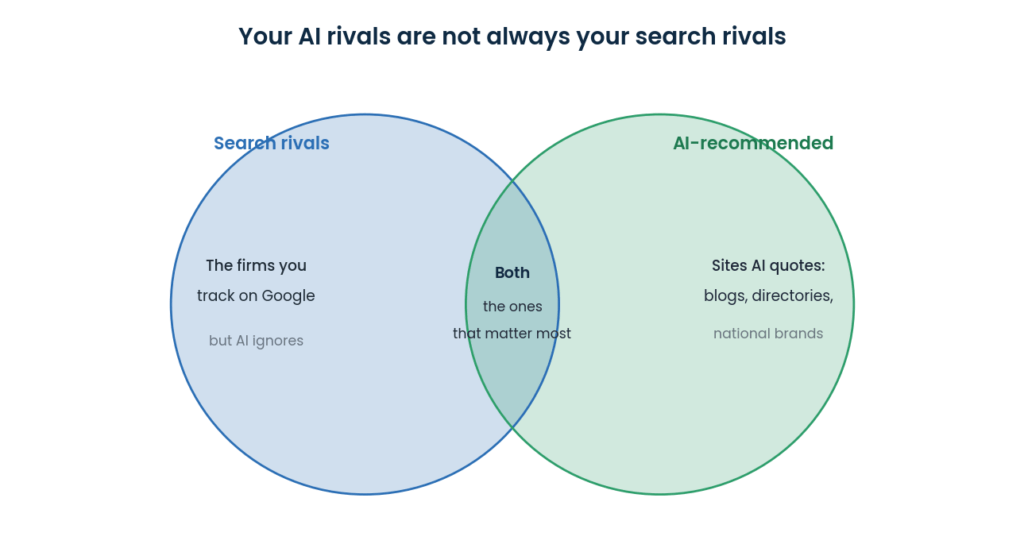
Some of your AI rivals are familiar. Others are sources you have never tracked.
There are a few reasons for the difference. AI tools often pull from sources that rank well for information rather than for local service, so a national guide or a review site can end up in the answer instead of a local rival. They also favour businesses with clear, well-structured content, which means a smaller competitor with better pages can outrank a larger one who dominates Google. And because AI leans on trust signals like reviews and consistent listings, a business with a strong reputation can appear even if its search presence is modest.
The practical upshot is that you cannot assume your Google competitors are your AI competitors. You have to look at who the AI actually names, which is exactly what the analysis is for. Skip that step, and you risk benchmarking against the wrong businesses entirely.
Why this matters now
When a customer asks an AI tool for a recommendation and gets a shortlist of three or four names, that shortlist is the market as far as they are concerned. If you are not on it, you are not being considered, and you may never know it happened. Understanding who is on that list, and why, is the difference between competing and being quietly left out.
There is a strategic advantage in doing this early, too. Most businesses have not thought about their AI competitors at all. They are still watching Google. The ones who map the real AI landscape first can see which questions are already owned, which are up for grabs, and where a focused effort would pay off. That maps onto the wider idea of being found versus being chosen, because a competitor analysis shows you not just who is found, but who is chosen, and what it took.
It is worth being honest about the discomfort here. Seeing a rival you underrated, or a directory you dismissed, sitting where you expected to be is not a pleasant moment. But it is a useful one. Every name on that list is information, and the businesses that act on it calmly, rather than ignoring it, are the ones that close the gap. The analysis is only as valuable as your willingness to believe what it shows you.
How to run an AI competitor analysis, step by step
Here is the sequence. It reuses work you may already have done, and none of it needs paid tools to get started.
- Build your prompt list. Start with the real questions customers ask, across discovery, comparison, validation and decision. If you have already done this, reuse it. If not, our guide to finding the prompts your customers ask AI walks through how to build one.
- Record who AI recommends. Run each prompt across the main platforms and write down every business that appears, not just the ones you expected. This is how the real competitor set reveals itself. Keep a tally of how often each name comes up.
- Measure share of voice. Work out what portion of your prompts each competitor appears in. This turns a messy list of names into a ranking, and it shows you who dominates, who is occasional, and where you sit among them.
- Diagnose why they win. For the competitors who appear most, look at what they are doing: their content, their reviews, their listings, and whether their pages are cited as sources. This is the heart of the analysis, and we break it down below.
- Find the gaps and openings. Look for prompts where nobody appears strongly, and prompts where only a weak competitor leads. These are your best opportunities, because they are winnable.
- Turn it into a plan. Convert the findings into a short list of moves: content to build, pages to improve, and prompts to target first.
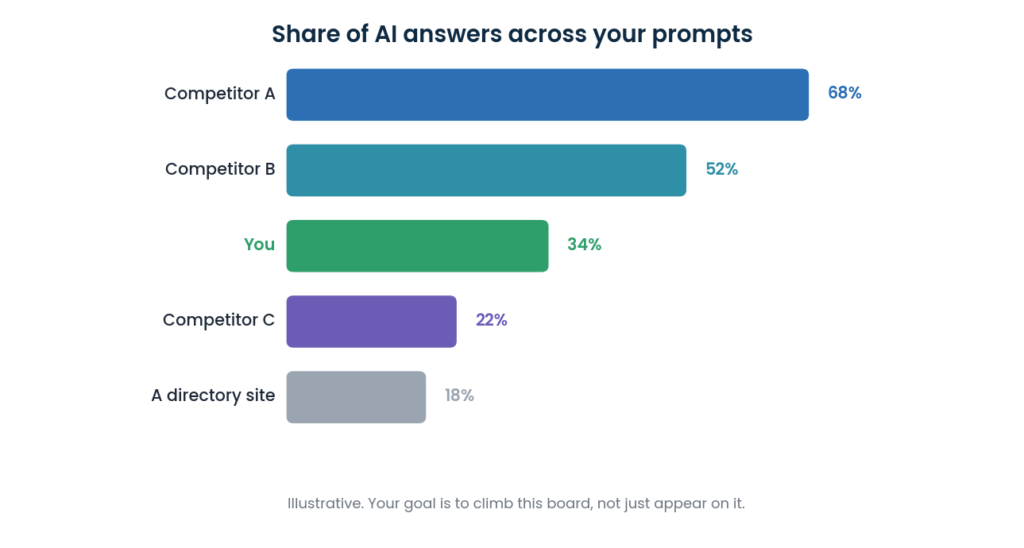
Turning a list of names into a share-of-voice ranking shows who you are really chasing.
Run each prompt a few times, because AI answers vary between runs and a single check can mislead. If you want to fold the citation angle in, run this alongside a citation audit, which tells you not just who is named but whose pages the AI actually uses as the source. The two together give you a full picture of the competitive landscape.
Which platforms to check, and what each tells you
Not every AI platform behaves the same way, and a competitor who dominates one can be absent from another. Checking across a few gives you a truer picture and often reveals where your own best opportunities lie.
ChatGPT reaches a huge audience for recommendations. Note whether it answers from memory or searches the web, as the two can produce different competitor sets for the same prompt.
Google AI Overviews and Gemini sit inside the search habit people already have, and they lean on the content that ranks. Competitors who are strong in traditional search tend to show up here first.
Perplexity shows its sources openly, which makes it the best place to see whose pages are actually cited rather than just mentioned. Treat it as your citation lens.
Copilot can surface a different mix again, particularly for business and professional queries.
Record each platform separately. A competitor who wins everywhere is a genuine market leader worth studying closely. A competitor who wins on only one is a narrower threat, and often a sign of a specific strength you can match.
Reading the gaps
The share-of-voice ranking tells you where you stand. The gaps tell you where to go next. When you lay your prompts out against who wins each one, three useful groups appear.
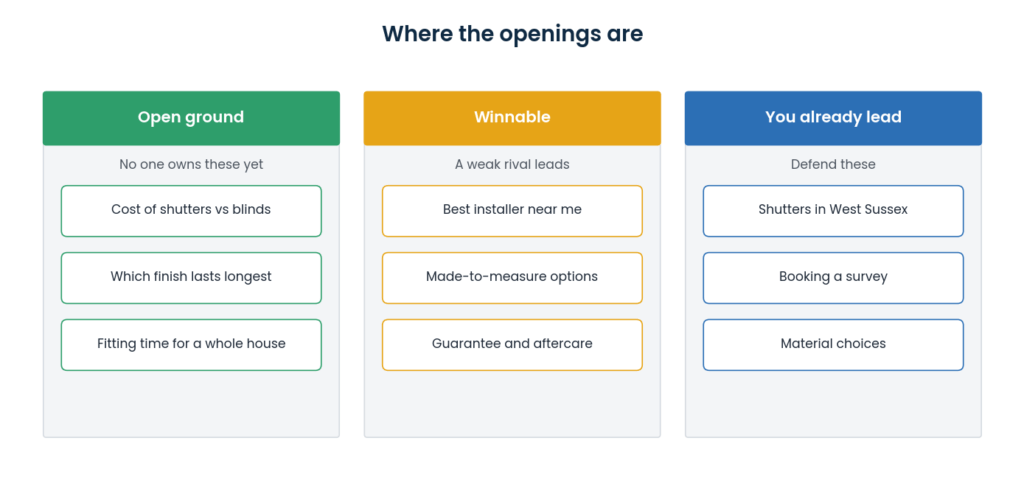
Sort every prompt into open ground, winnable, or already yours, and your plan becomes obvious.
Open ground. Prompts where no business appears strongly. These are the easiest wins, because you are not displacing anyone. Being the first to build a clear, citable answer can hand you the spot outright.
Winnable. Prompts where only a weak competitor leads, or where the current source is a generic directory rather than a strong business. A better answer can take these.
Already yours. Prompts where you already appear. These need defending, not chasing, because a competitor can take them from you the same way you would take theirs.
Sorting your prompts this way turns the analysis into a plan almost by itself. You start with open ground and winnable prompts, and you keep an eye on the ones you already hold.
What to study on a winning competitor
When one competitor keeps appearing, that consistency is a signal worth decoding. Open their site and their wider presence and look for the specific things AI tends to reward.
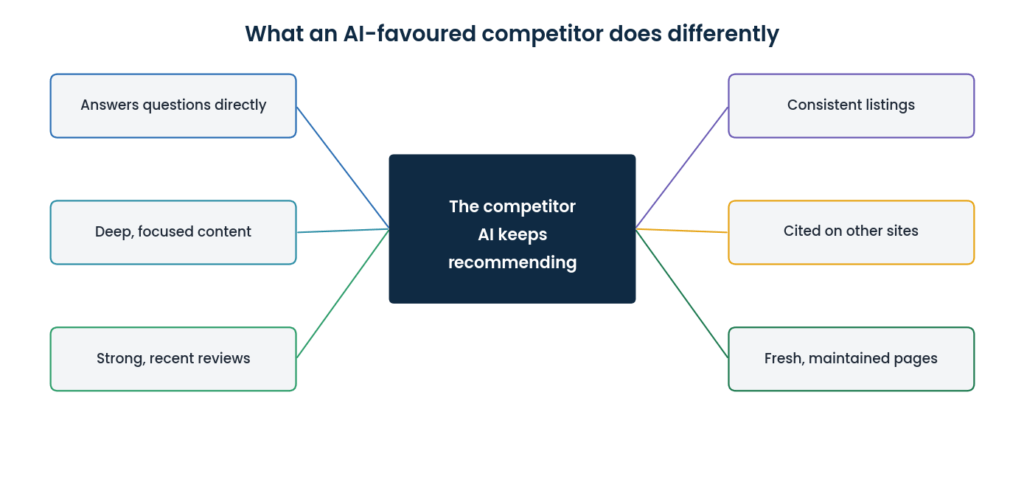
The traits that show up again and again on the businesses AI keeps recommending.
How they answer questions. Do their pages answer the prompt plainly and early, or bury it? Businesses that get recommended usually write in a way that is easy to lift into an answer. Our guide to structuring content so AI systems can extract it describes what you are looking for.
The depth of their content. Do they cover the topic thoroughly, with pages for specific questions, or do they have a single thin services page? Depth builds the topical authority AI trusts.
Their reviews and reputation. Strong, recent reviews and consistent mentions across the web feed the trust signals for AI recommendations that push a business up the list. Check how their reputation compares with yours.
How clearly they are described. Is their business, its services and its location stated consistently everywhere? This clarity helps AI connect the dots, and it is the core of entity recognition. Inconsistent competitors are often the easiest to overtake.
You are not copying them. You are working out what the AI rewards in your category, then doing it better and more clearly than they have. Often the winning competitor has one or two obvious strengths and several weaknesses you can exploit.
When a directory or national brand dominates
One of the most common findings is that a directory, a review platform or a national brand keeps appearing instead of any local business, including you. It can feel discouraging, but it is often an opportunity in disguise.
These sources usually win for one reason: they have broad, structured content that answers the question in a general way, and the AI reaches for them because nothing more specific is available. That generality is their weakness. A directory can tell someone that shutter companies exist in an area. It cannot answer, in a genuinely useful way, how much a particular type of shutter costs to fit in a specific kind of home.
That is where a focused local business can win. By building clear, specific pages that answer the exact question better than a generic source can, you give the AI a stronger option to reach for. Our guide to how businesses get recommended by AI covers how specificity and clarity move you ahead of broad, impersonal sources.
So when a directory tops your analysis, do not treat it as an immovable competitor. Treat it as a placeholder the AI is using until something better exists, and then be that something better.
A worked example: a Milton Keynes driving school
Take a driving school in Milton Keynes running its first AI competitor analysis. They ask the obvious prompts, from who offers driving lessons in the area to how much a course of lessons costs, and record every business the AI names.
The results surprise them. Their usual local rival, the one they have watched for years, barely appears. Instead, two names dominate: a national booking platform that lists instructors, and a smaller local school with an unusually detailed website. A review site rounds out most answers. Their own school appears in only a third of the prompts, and almost never for the cost and comparison questions.
Digging in, the pattern is clear. The national platform wins because it has depth and structure the AI can lift easily. The small local school wins because it has a page for nearly every question a learner might ask, each answered plainly. The driving school’s own site, by contrast, has one page covering everything and a lot of marketing language around it.
The plan follows. There is open ground on questions about nervous learners and intensive courses that nobody answers well. There are winnable prompts where only the review site leads. And there is a clear model to learn from in the small local school’s question-led pages. None of this was visible from watching Google. It only appeared once they looked at who the AI actually recommends.
What makes the example instructive is how ordinary it is. The driving school did not need a bigger budget or a famous brand to compete. It needed to see the real landscape, copy the approach that was already working in its market, and apply it to the questions nobody had answered yet. That is within reach of almost any business willing to look.
Turning the analysis into a content plan
An analysis that stays in a spreadsheet changes nothing. The final move is to turn what you found into a short, ordered content plan.
Begin with the open ground, the prompts nobody answers well. These are the quickest wins, and a single clear page can claim each one. Next come the winnable prompts, where a weak competitor or a generic source currently leads and a better answer can take the spot. Leave the prompts you already own until last, but do not forget them, because they need maintaining.
For each priority prompt, decide what the answer should be and which page will carry it. Group related prompts onto thorough, well-structured pages rather than spreading thin content across many, match the customer’s wording, answer plainly and early, and give the AI a reason to prefer you over the current source.
This is also where the analysis connects to the rest of your AI visibility work. The prompts come from your prompt research, and the progress you make can be tracked with an LLM Visibility Score, so you can prove that closing the gaps is moving you up the rankings you mapped.
Common mistakes
A few errors take the value out of an AI competitor analysis. They are easy to sidestep once you know them.
Only recording competitors you expected. The point is to discover who actually appears. If you only note the rivals you already track, you miss the sources that are really beating you.
Counting mentions without checking citations. A competitor named in the text is not the same as one whose page is the cited source. The cited ones are usually the stronger position, so note the difference.
Stopping at the ranking. Knowing who wins is not enough. The value is in working out why, so you know what to change.
Ignoring open ground. It is tempting to fixate on the leader, but the fastest wins are usually the prompts nobody owns yet.
Treating it as a one-off. The landscape shifts as competitors improve. Re-run the analysis periodically, ideally alongside your visibility audit, so you catch changes while they are still small.
Frequently asked questions
How is an AI competitor analysis different from a normal one?
A normal competitor analysis compares rankings, backlinks and advertising. An AI competitor analysis compares presence inside AI answers: who gets recommended, who gets cited as a source, and why. The winners are often different, because AI weighs content clarity and trust signals differently from search.
How do I find out who my AI competitors are?
Run your buyer prompts across the main AI platforms and record every business that appears, not just the ones you expected. The names that come up most often are your real AI competitors, and some of them will surprise you.
What if a directory or national brand keeps winning?
That is common, and it is useful information. It usually means the answer relies on structured, in-depth content rather than local service. You can often compete by building clearer, more specific pages for the exact questions those sources answer generically.
How often should I run one?
Quarterly works well for most businesses, and it pairs naturally with your visibility audit. The competitive landscape moves as businesses improve their content, so periodic checks keep your plan current.
Can I really overtake an established competitor?
Often, yes. AI favours clear content, depth and trust signals, all of which you can build. If a competitor wins on one strong page, a more thorough and better-structured answer can take the spot. Established does not mean untouchable in AI search.
Putting it to work
An AI competitor analysis replaces a stale mental list of rivals with the real one. It shows you who the AI recommends, why they earn it, and where the openings are, which is everything you need to plan your next move with confidence rather than guesswork.
Start this week with a small version. Take ten of your most important prompts, run them across two platforms, and write down every business that appears. Rank them by how often they show up, then look at what the top one does differently. That single pass will tell you who you are really competing with in AI search.
If you would like a full analysis, benchmarked properly and turned into a plan, that is part of our AI optimisation services. Book a discovery call and we will show you who AI recommends in your market, why they win, and how to take their place.