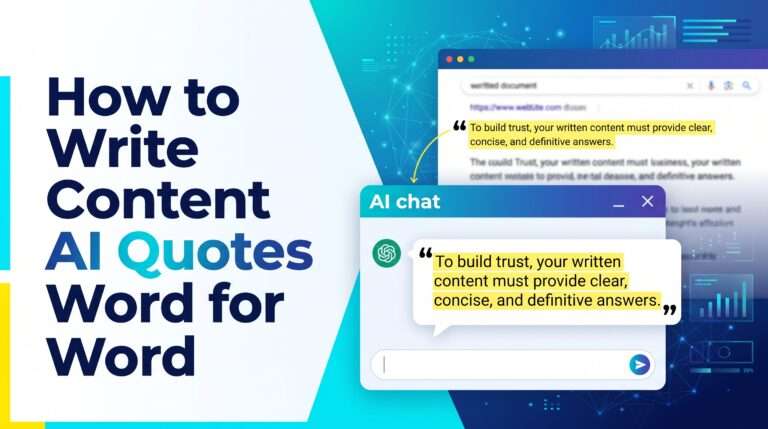

A small kitchen fitter in the North West won a job last month because ChatGPT named him when a homeowner asked which local firms it would recommend. He does not know that is why he won it. His SEO agency, if he has one, is not tracking it. The enquiry simply appeared, slightly warmer than usual, faster to close, less price-sensitive.
This is the shift already underway in most UK categories. And most businesses are still optimising for the model that came before it.
There is a single distinction at the centre of this shift. Understanding it changes how you think about your entire digital presence.
Search engines help you get found. AI tools decide whether you get chosen.
SEO was a click economy. Match a page to a keyword, rank it, hope the click converts. GEO is a recommendation economy. A buyer asks a machine for help with a problem. The machine names a small set of brands worth looking at. The buyer investigates one or two of them.
The unit of value has moved. It used to be a click. Now it is a place in the buyer’s consideration set, before they have visited a single page.
This guide explains exactly what GEO is, why the commercial stakes are higher than most agencies admit, and what UK businesses need to do to start being chosen, not just found. For a full technical breakdown of how GEO works at the content level, see What Is GEO? The Complete Guide.
What is GEO? The definition
Generative Engine Optimisation (GEO) is the work of making your brand more likely to be recommended by AI systems when a buyer asks for help. It is the discipline at the heart of AI Listings’ AEO and GEO services, and it is distinct from traditional SEO in ways that matter commercially.
Not cited. Not mentioned. Not scraped. Recommended.
A homeowner asks Gemini which insulation firm to use in Cheshire. A finance director asks ChatGPT which forecasting tool fits a five-person team. A buyer asks Perplexity for wedding photographers under £2,500 in the North West. In each case the AI returns a shortlist, usually three, sometimes five, occasionally one. That shortlist is now the market the buyer will explore.
You either appear on it, or you do not. GEO is the discipline that determines which side of that line you are on.
Why GEO matters: the commercial argument
A lot of tool vendors have decided GEO means ‘AI visibility’, which usually means whether your URL appears in a footnote underneath an AI answer. That is interesting data. It is not particularly commercial.
Boards do not pay for footnotes. They pay for revenue.
The reason GEO matters financially is that AI recommendations sit unusually close to the purchase decision. Someone asking ChatGPT which is the best CRM for a small B2B sales team is not a casual browser. They are inside an evaluation cycle. If you are on the shortlist at that moment, the next quarter of your pipeline changes. If you are not, it does not.
The data backs this up:
- AI-referred visitors convert 4.4 times better than organic search visitors (Salesforce, 2025)
- Google AI Overviews now appear in 25 to 50 percent of all searches (Semrush, 2025)
- Click-through rates to the number-one organic result drop by 58 percent when an AI Overview appears (Semrush, 2025)
- AI search traffic grew 527 percent year on year (Ahrefs, 2026)
- ChatGPT recorded 19.1 million unique UK visitors by end of 2025, making it the seventh most visited website in the UK (DataReportal, 2025)
The casual browse query, the top-of-funnel keyword click that generated traffic but rarely generated revenue, is exactly the one AI now resolves without sending a click anywhere. For more on how this shift affects lead generation, see how AI visibility generates leads for UK businesses.
GEO vs SEO: why ‘it’s just SEO’ does not hold up
The ‘it’s just SEO’ line is largely a budget defence. If everything is SEO, the same retainers and the same monthly reports stay in place, and nobody has to admit the model changed. That is convenient. It is also wrong.
SEO is about getting a page to rank. GEO is about getting a brand to be recommended. The two overlap, but they are not the same thing.
| Dimension | Traditional SEO | GEO |
| The unit | A keyword | A prompt |
| The goal | Get a page to rank | Get a brand recommended |
| The output | A ranked page | A consideration set |
| What the buyer receives | A list of links to evaluate | A named shortlist to investigate |
| What you optimise | Pages and domains | Brand evidence and content clarity |
| Core signal | Backlinks and authority | Consistency, trust, and third-party validation |
| Who decides | Search algorithm | Large language model reasoning |
| Measurement | Rankings and organic traffic | Recommendation frequency and accuracy |
The most important row is the last one. In SEO, an algorithm weighs technical and content signals. In GEO, a large language model reasons about which businesses are most credible, most consistent, and most clearly matched to the query. That reasoning process rewards different things.
A keyword is not a prompt. ‘Best accountant Manchester’ is a keyword. ‘I run a six-person consultancy in Manchester, hate Xero, and need someone who actually understands SaaS finance’ is a prompt. The second carries far more context, and the answer it produces is a recommendation rather than a list of links.
SEO still matters, and matters strongly. A site that is technically broken, badly written, or commercially confused will struggle to be either ranked or recommended. See our SEO services for how AI Listings handles the technical foundation alongside GEO work.
How AI systems actually make recommendations
Large language models cannot know whether your firm is genuinely the best choice for a specific buyer next Thursday. They approximate. They look at the evidence available to them: what was absorbed in training, what is retrieved at the moment of the query, and what other sources say about your business in the context of the problem being asked about.
The commercial implication is straightforward:
The machine needs evidence to recommend you. Your job is to supply it.
That is GEO, and it is not a trick. It is not stuffing forums with mentions. It is not publishing 500 thin blog posts on the back of a content velocity pitch. It is the deliberate work of reducing the AI’s uncertainty about why you would be a sensible answer to the question being asked.
Think of it as removing doubt. Each useful, consistent piece of evidence, a clear service page, a customer review, a journalist’s mention, a third-party comparison, a case study, makes it slightly easier for the machine to name you with confidence. Each piece of vague or contradictory evidence makes it harder.
The brands being chosen most often are the ones that have removed the most doubt.
How the Shortlist System works
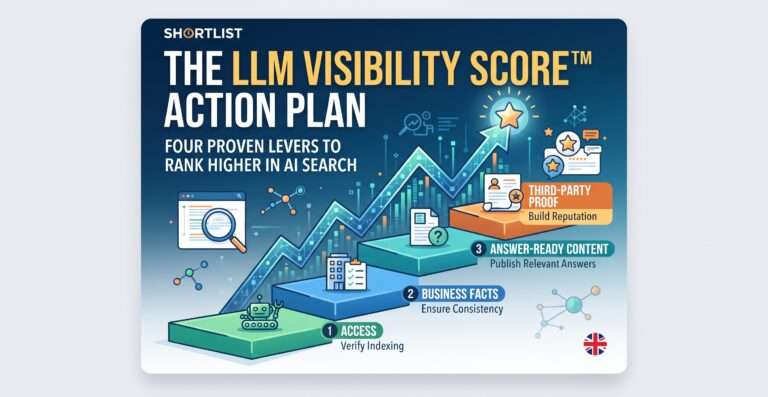
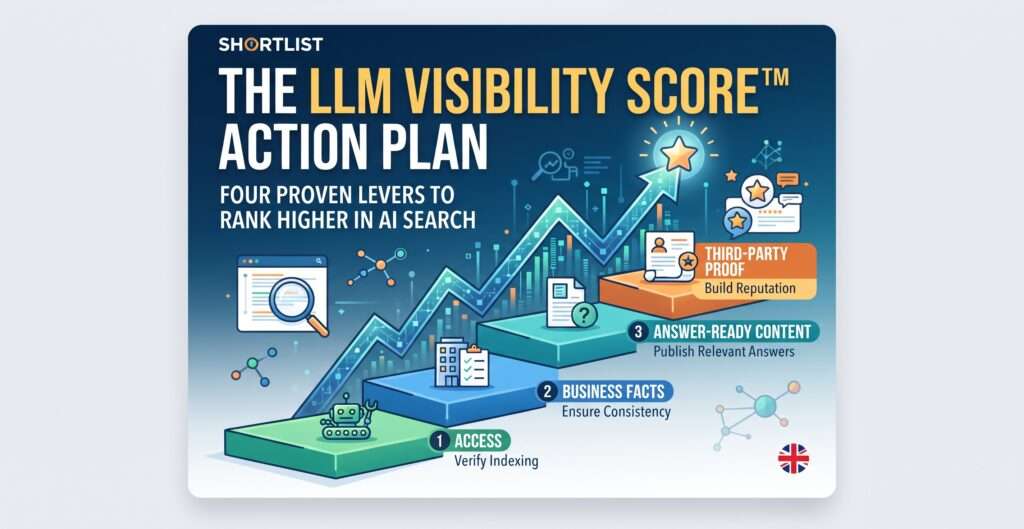
The Shortlist System is AI Listings’ structured methodology for reducing AI uncertainty about a business. It covers four stages: establishing your LLM Visibility Score baseline, applying Hallucination Guard to fix brand signal inconsistencies, building Prompt Coverage Maps to identify and fill content gaps, and tracking improvement over 90 days. Each stage directly addresses one of the evidence dimensions AI systems use to decide whether to recommend a business.
The 4 pillars of GEO: where the evidence comes from
GEO evidence falls into four categories. Most businesses have work to do in all four. The right starting point is wherever your current evidence is thinnest.
1. Your own pages: the foundation
Before anyone starts chasing journalists or building citations, the cheapest place to begin is the place you already own, and the place most businesses have not seriously looked at in two years. Your own website.
Most UK business websites are poor at explaining why the business should be chosen. They list services. They use the same phrases as every competitor: ‘bespoke,’ ‘passionate,’ ‘trusted.’ They explain what the business does without answering the questions a buyer actually has.
Every revenue page should answer five questions clearly:
- Who exactly is this for?
- What specific problem does it solve for them?
- What does your approach actually look like in practice?
- Why is it sharper than the alternatives they would otherwise consider?
- What evidence exists that you have done this before, for people like them?
A page that handles these five questions well is something both a human buyer and an AI system can interpret and act on. A page that does not is largely invisible to both.
This is also the content structure principle that drives AI extraction. State the answer first. Use direct headings. Keep paragraphs short. Add FAQ sections with 40 to 60 word answers. For a complete practical guide, see How to Structure Content So AI Systems Can Extract and Use It.
2. Owned media: the same message, repeated
Once your core pages are clear, push the same message into the world through media you control. Blog content, newsletters, LinkedIn, video, guides, and reports all build evidence around the problems you solve and the buyers you solve them for.
The goal here is different from the old SEO content factory. You are not chasing keyword volume. You are accumulating evidence.
Every piece of owned media should pass a single test before it is published: if a buyer reads it with no AI search context and no agenda, does it earn its place? Does it say something specific, provable, and useful? If the answer is no, it is machine spam dressed as strategy.
The Prompt Coverage Maps methodology is the structured approach to this. Rather than guessing which content to produce, a Prompt Coverage Map identifies every question your buyers are currently asking AI systems in your category, maps your existing content against those prompts, and produces a prioritised list of the gaps most worth filling. This sits within our AI visibility optimisation services.
3. Earned media: when other people make the claim for you
Owned media is you talking about yourself. Useful, but limited. Earned media is other people talking about you. It is more powerful, harder to manufacture, and disproportionately important to GEO.
AI systems lean on mentions in trusted publications, customer reviews, journalists’ lists, comparison sites, and podcast conversations when working out who is credible in a category. A brand that appears in multiple independent sources is treated with more confidence than one that only appears on its own website.
For UK service businesses, high-value earned citation sources include Trustpilot, Checkatrade, Which? Trusted Traders, Yell, relevant trade association directories, and UK regional and sector press. Building citations on US-centric platforms has minimal value for UK GEO.
Paid coverage counts too. An advertorial in the right publication, clearly positioned, giving a buyer a real reason to consider you, is sensible marketing. What matters is whether the encounter is meaningful and in context, not whether money changed hands. The old SEO frame treated a link as a vote. GEO treats a mention as an encounter, and the context around the encounter is at least as important as the link itself.
4. Reviews: the trust signal AI systems check first
AI systems use reviews as a primary trust signal. Before recommending a business, they look for evidence that other buyers have made the same decision and found it worthwhile.
For UK businesses, this means active review presence on Google, Trustpilot, and any sector-specific review platform relevant to your category. Recency matters as much as volume. Ten reviews from this year carry more weight than fifty reviews from four years ago.
Asking satisfied customers for a review is one of the highest-leverage activities available to any business trying to improve GEO performance. Most businesses do not do it systematically. The ones that do build a compounding evidence base that is extremely difficult for competitors to replicate quickly.
The GEO flywheel: why early movers win
Larger brands tend to win recommendation battles for a straightforward reason: they are seen more often, mentioned more often, and remembered more often. AI systems recommend them more frequently because there is more evidence pointing in their direction. Visibility breeds visibility.
This is the rich-get-richer pattern running through almost every market. The brands already being chosen accumulate the reviews, the mentions, and the third-party validation that make them easier to choose next time.
The encouraging reality for a small UK business is that the flywheel does not start by itself. Every brand currently benefiting from it pushed the spokes manually first. The case study had to be written. The journalist had to be pitched. The review had to be asked for. The page had to be published. The first hundred meaningful encounters were forced.
In most local and niche categories the evidence base is still thin enough that a deliberate operator can move into the AI consideration set within twelve to twenty-four months. That window is real and it will close. The AI search land grab is not over. But it is not as open as it was twelve months ago.
How to measure GEO performance
There is no single metric for GEO, and anyone selling you one is selling you a dashboard, not a strategy. What you measure is two things in parallel.
Prompt monitoring
Build a list of the questions your buyers might actually type into ChatGPT, Perplexity, or Google AI Overviews. Mix them: broad (‘best CRM for small business’), narrower (‘best CRM for a five-person B2B consultancy’), and specific (‘CRM under £30 a month with simple invoicing for a UK consultancy’). Track who gets recommended, how often, and with what supporting evidence.
Do not worship the citations. Use them directionally to identify which sources, reviews, and publications AI answers are leaning on. That tells you where your evidence gaps are.
The LLM Visibility Score is the structured version of this process, testing your business against a defined set of relevant prompts across multiple AI platforms and benchmarking your performance against competitors. It is part of the Shortlist System and produces a score you can track over time.
Commercial signals on the ground
The second measurement track is the commercial signals that show whether the system as a whole is moving:
- Brand search volume: are more people searching your name directly?
- Direct traffic: are more people arriving without a referral source?
- Revenue page engagement: are buyers spending more time on the pages that matter?
- Lead quality: are prospects arriving warmer, knowing more about you before the first call?
- Review volume and language: are more customers leaving reviews, and are the reviews more specific?
- Inclusion in third-party lists and comparisons: are you being cited in places you were not before?
You will not prove that a specific pound of revenue came from a specific AI answer. That is attribution fantasy. What you can see clearly enough is whether your brand is being chosen more often, by warmer buyers, in more places. If branded search is rising, revenue-page engagement is rising, and lead quality is improving, the work is paying off.
How to start: three steps any UK business can take today
GEO does not require a complete rebuild of your marketing strategy. It requires targeted action in three areas, in this order.
Step 1: find out where you stand
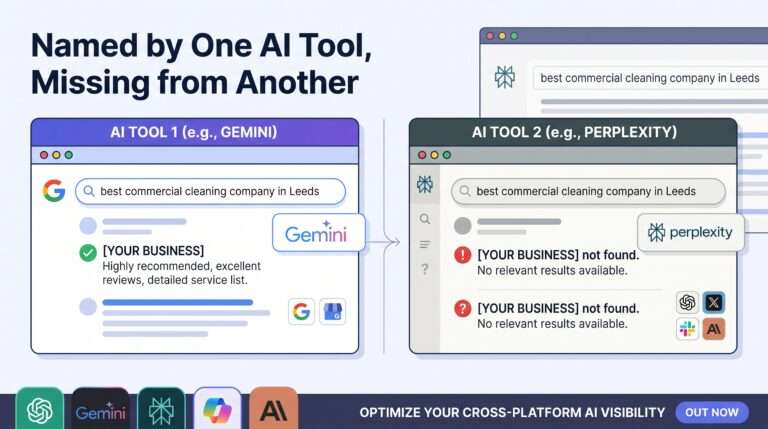
Open ChatGPT, Gemini, and Perplexity. Type the prompts your buyers would actually use. If your competitors are named and you are not, that is your starting point. If you are named only generically, that is your starting point. If nobody in your category is being recommended yet, that is the most interesting starting point of all.
For a systematic baseline, the LLM Visibility Score assessment covers a structured set of prompts across multiple platforms and benchmarks your performance against competitors. You can request it through our AI visibility optimisation services page.
Step 2: fix your own pages first
Before chasing external citations, audit your core service pages against the five questions above. Most pages fail on questions three, four, and five: they explain what the business does but say nothing specific about the approach, the differentiation, or the proof. These are the gaps AI systems notice most.
While auditing, check content structure. Are pages written with direct-answer formatting? Is there a FAQ section on every key page? For a complete content structure checklist, see How to Structure Content So AI Systems Can Extract and Use It.
Step 3: build evidence systematically
With your own pages clear, push the message outward. Ask for reviews. Identify five directories or trade publications where your business should appear but does not. Publish one piece of owned content per week that answers a specific question your buyers are asking AI systems right now. Our AEO and GEO services handle this systematically as part of a managed engagement.
Frequently asked questions
What is GEO?
Generative Engine Optimisation (GEO) is the practice of making your brand more likely to be recommended by AI systems when a buyer asks for help. The goal is not to rank in search results. It is to appear on the shortlist AI tools produce when a buyer asks which businesses to consider. GEO targets the recommendation rather than the click. For a full technical breakdown, see our complete guide to GEO.
How is GEO different from SEO?
SEO targets rankings in search engine results pages. GEO targets recommendations in AI-generated answers. SEO optimises pages and domains. GEO optimises brand evidence and content clarity. A business can rank well on Google and be completely absent from AI recommendations, and increasingly, the recommendation matters more commercially than the ranking.
Which UK businesses need GEO most urgently?
Any UK business where buyers research and evaluate options before making contact: professional services, financial services, local trades, B2B software, hospitality, and specialist retail. If your customers compare options before reaching out, AI is now part of how they make that comparison. The businesses most at risk are those in competitive local categories where competitors are already building AI evidence bases.
How long does GEO take to show results?
Most businesses see measurable improvements in how accurately AI systems describe them within 30 days of fixing brand consistency and content structure issues. More consistent recommendations across multiple platforms typically build over 60 to 90 days. This timeline is covered by the 90-Day Improvement Guarantee, part of the Shortlist System. If your LLM Visibility Score does not improve within 90 days, work continues at no additional cost.
Can a small UK business compete with larger brands on GEO?
Yes, and more easily than on traditional SEO. Research published at ACM SIGKDD 2024 by Princeton University found that pages already ranking at position one saw minimal GEO benefit, while pages at position five saw 115 percent visibility increases after GEO optimisation. In most local and niche categories, the evidence base is still thin enough that a small, deliberate operator can move into the AI consideration set within 12 to 24 months.
If your competitors are named in AI answers and you are not, that gap is already costing you leads. Find out exactly where your business stands.