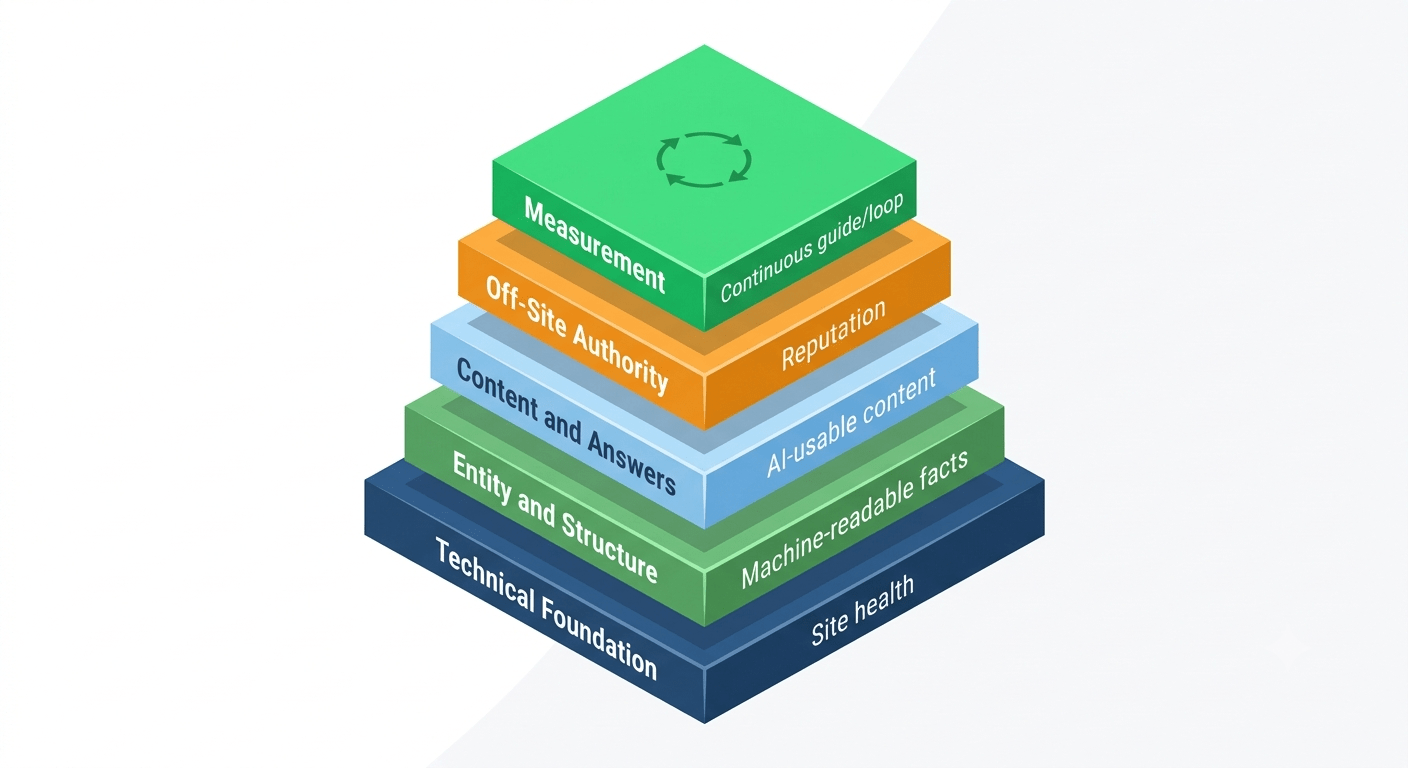
When an AI tool recommends a business, it can look like a single event. The customer asks, the name appears, and you either made the cut or you did not. But behind that one moment sits a whole set of things working together, and understanding them is the difference between hoping to appear and knowing how to.
Being recommended is not one thing you can switch on. It is the result of several layers stacked on top of each other, from the technical health of your site up to how you measure your progress. Each layer supports the ones above it, and a weakness low down undermines everything built on top. Businesses that struggle in AI search have usually poured effort into one layer while neglecting another that quietly holds them back.
This guide lays out the AI visibility stack: the five layers that decide whether AI names you, what each one involves, and how they fit together. It doubles as a map of the whole discipline, so you can see where your own effort is going and where the gaps are. Think of it as the big picture that the more specific guides slot into.
What the AI visibility stack is
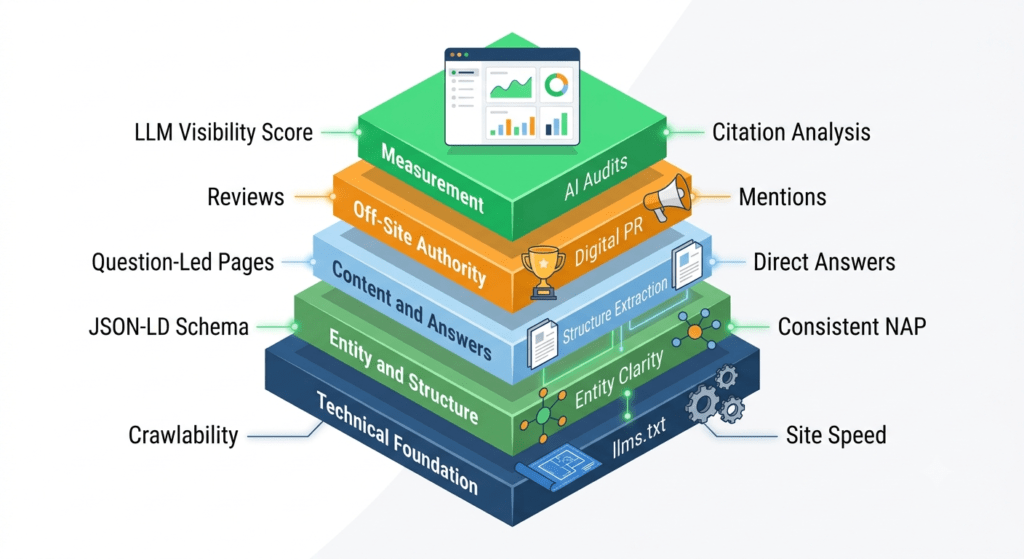
The AI visibility stack is a simple model that organises everything affecting whether AI recommends you into five layers, built from the ground up. Each layer depends on the ones beneath it, which is why the order matters as much as the contents.
At the bottom sits your technical foundation, the health of the site itself. Above it comes structure, which makes your business machine-readable. Then content, the clear answers AI can actually use. Above that, off-site authority, the reputation that tells AI you can be trusted. And at the top, measurement, which tells you whether the rest is working and where to improve. Read from the bottom up, it is also the order in which to build.
The value of the model is that it stops you working at random. Instead of chasing whatever tactic you read about last, you can see which layer is weak and work there. It turns a vague goal, be more visible in AI, into a set of concrete, ordered jobs. It also explains why the old checklist quietly stopped working. We made that wider case in why traditional SEO is no longer enough, and the stack is what replaces it.
Why think in layers
You could, in theory, just work on everything at once. In practice, that is how effort gets wasted. Without a structure, businesses tend to do whatever feels productive, which usually means more content, and then wonder why it changes nothing. The layers give that effort a direction.
Thinking in layers does two things. It shows you the dependencies, so you do not build on foundations that cannot hold the weight. And it gives you a diagnosis, because when something is not working you can point to the layer responsible instead of guessing. A problem you can locate is a problem you can fix.
It also keeps expectations honest. Some layers pay off quickly, like fixing a technical issue or adding schema. Others, like building authority, take months. Knowing which layer you are working on tells you what kind of result to expect and when, which saves a great deal of frustration.
If the model feels familiar, that is deliberate. It mirrors how you would build anything solid, from the ground up, with each stage supported by the one before it. AI visibility is not a special case that rewards clever tricks. It rewards the same patient, ordered work that has always separated the businesses that last from those forever chasing the latest tactic. If you want the shorter version of what actually changed, AI SEO vs traditional SEO sets the two approaches side by side.
Layer 1: The technical foundation
Everything starts with a site that machines can actually reach and read. If an AI cannot crawl your pages, or they load slowly and inconsistently, nothing you build on top can help. This layer is unglamorous and easy to overlook, which is exactly why it trips people up.
The essentials are a crawlable, accessible site with clean structure and reasonable speed, pages that are not blocked from the systems that need to read them, and content that lives in text rather than trapped inside images or scripts. It is also where a newer file comes in.
It helps to remember that AI systems, like search crawlers, have limited patience. If a page is slow, blocked, or buried in code they cannot parse, they simply move on to a source that is easier to use. You are competing for a machine’s attention, and the easiest sites to read have a real advantage before a single word of content is judged.
An llms.txt file, which tells AI systems how to find and use your most important content, sits at this foundational level. We cover it in what llms.txt is, and the original specification sets out the format. Get this layer right and you have given every other layer a chance to work. Get it wrong and you are asking AI to recommend a business it cannot properly read.
Layer 2: Entity and structure
Once your site can be read, the next job is making your business unmistakable. AI needs to understand that you are a specific organisation, connected to particular services and places, described consistently wherever it looks. This is the layer that turns a readable site into an understood business.
Two things do most of the work here. The first is entity clarity, making sure your name, services and location are stated the same way across the web, which we cover in improving entity recognition in LLMs. The second is structured data, the schema markup that states your facts in a language machines read directly, covered in our guide to schema markup for AI search.
Together they remove ambiguity. When your business is described consistently and your facts are marked up clearly, AI can build a confident picture of you rather than a hesitant guess. That confidence is what lets it recommend you without hedging, and it is why this layer punches well above its weight. The wider discipline behind it, and why brand signals now carry so much weight, is set out in entity SEO and AI search visibility.
Layer 3: Content and answers
With a readable, well-understood site in place, content is where you earn your presence. This is the layer most people think of first, and it matters enormously, but it works best on top of the two below it rather than on its own.
Good content for AI search is clear, question-led and direct. It answers the questions customers actually ask, plainly and early, in language close to how they ask it. That discipline has a name, answer engine optimisation, and it is the practical craft of this layer. It starts with knowing the questions, which is why finding the prompts your customers ask comes first, and it depends on structuring content so AI systems can extract and use it.
Depth matters too. A business that covers its subject thoroughly, with a page for each real question, builds the topical authority AI trusts. The aim is to become the obvious, most useful answer to the questions in your niche, which is exactly the goal we set out in how to become the answer in AI search. Content is where visibility is won, but only when the layers beneath it let the content be read and understood.
It is worth stressing that more content is not the same as better content. A single thorough page that answers a real question well will usually outperform ten thin pages that skirt around it. AI is looking for the clearest, most complete answer, not the largest pile of words. Depth and clarity beat volume every time on this layer.
Layer 4: Off-site authority
AI does not judge you on your own website alone. It weighs what the rest of the web says about you, and that off-site reputation is a layer in its own right. A business can have excellent content and still lose to a rival with a stronger reputation, because AI leans towards sources it can verify from more than one place.
This layer is built from reviews, consistent listings, and mentions on other reputable sites, the trust signals for AI recommendations that raise your standing. It is also where earned mentions and digital PR come in, giving AI corroboration from sources beyond your control. The more the wider web agrees about who you are and that you are good, the more confidently AI can name you.
This is often the layer that separates two otherwise similar businesses. When AI has to choose, it favours the one with the reputation to back it up, which is a large part of how businesses get recommended by AI. It is also the clearest example of the difference between being found and being chosen, which we unpack in GEO in plain English. Building this layer is slower than the others, but it is also the hardest for a competitor to copy quickly, which makes it durable.
Layer 5: Measurement
The top layer is knowing whether any of it is working. Without measurement, you are guessing, and guessing is expensive. Measurement turns the whole effort from a hopeful exercise into a managed one, and it tells you which lower layer to return to next.
This layer is built from a few practices. An LLM Visibility Score gives you a single figure to watch. A regular visibility audit shows where you appear and where you do not. A citation audit tells you whether your pages are used as sources. And an AI competitor analysis shows you how you compare with rivals.
Measurement sits at the top because it looks down over everything else. It tells you which layer is weak, whether your work is paying off, and where the next opportunity is. Skip it, and you are improving in the dark. Build it, and every other layer gets more effective, because you know where to aim.
How the layers reinforce each other
The layers are not just stacked, they feed each other. A clear technical foundation makes your content easier to read. Clean entity data makes your reviews easier to attribute to the right business. Strong content gives other sites something worth linking to, which builds authority. Authority makes AI trust the content more. The stack is a loop as much as a ladder.
This is why progress can feel slow at first and then accelerate. Early on, each layer is working alone. As they come together, they start to compound, and the same amount of effort produces a bigger result. A business that has built a solid stack finds that new content is picked up faster and new reviews carry more weight, because everything is reinforcing everything else.
It also means the stack is hard to fake. You cannot shortcut your way to the top, because measurement only tells you the truth about what the lower layers have actually achieved. The businesses that win in AI search are the ones that built the whole thing, patiently, in order.
Why the weakest layer decides your result
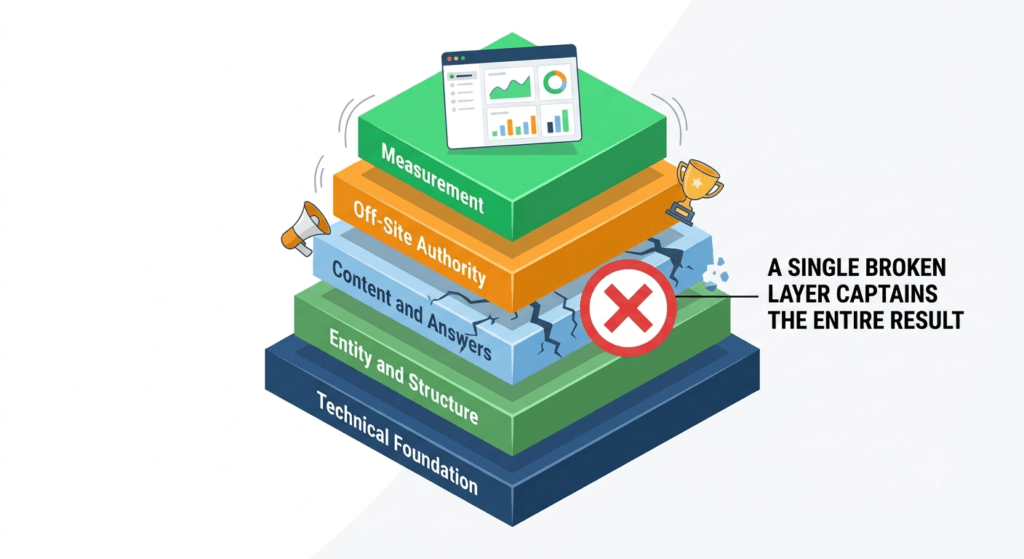
The most important thing about the stack is that it behaves like a chain. Your result is set by your weakest layer, not your strongest. Brilliant content cannot rescue a site AI cannot crawl. A flawless technical setup cannot help a business the web has never heard of. The layers only add up when none of them is badly broken.
This is why so many businesses feel stuck despite real effort. They have poured everything into one layer, usually content, while a neglected layer beneath quietly caps their results. They write more and more, and it makes little difference, because the site cannot be read cleanly or the business cannot be verified. The problem is not the layer they are working on. It is the one they are ignoring.
The practical lesson is to find your weakest layer and fix it before pouring more into your strongest. A quick honest assessment of each layer, strong, patchy or weak, usually makes the bottleneck obvious. Fixing it often unlocks value that the work you had already done was unable to deliver.
How to build the stack
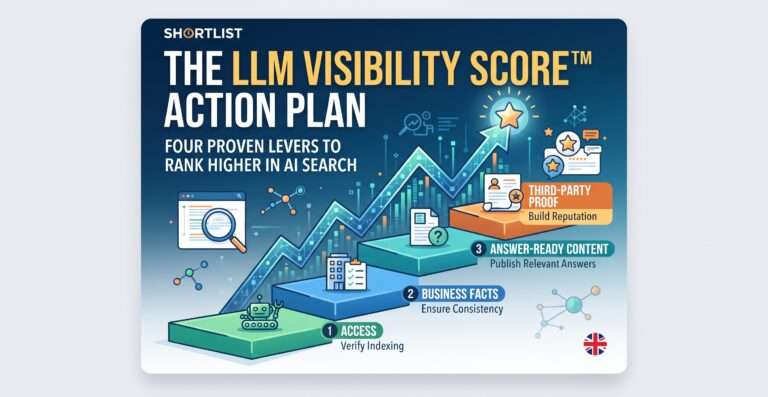
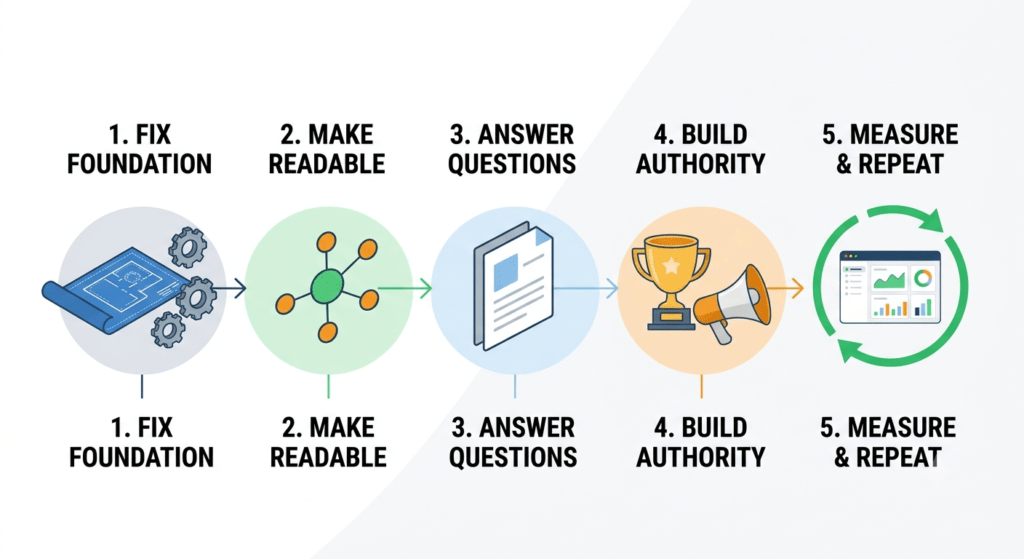
Because each layer rests on the ones below, you build from the bottom up. Working in this order means every layer you add stands on solid ground rather than shaky foundations.
- Fix the foundation. Make sure your site is crawlable, accessible and reasonably fast, and that AI can read your content. Nothing else works until this does.
- Make it readable. Get your entity details consistent and add schema markup, so machines understand who you are and what you offer without guessing.
- Answer the questions. Build clear, question-led content around the real prompts customers ask, with direct answers and genuine depth.
- Build authority. Strengthen reviews, listings and mentions so the wider web backs up what your site claims.
- Measure and repeat. Track your visibility, audit where you appear, and use what you learn to return to whichever layer needs it next.
If you would rather work from a list than a model, our AI visibility checklist for small businesses covers much of the same ground in a form you can tick off as you go.
You do not have to perfect each layer before touching the next. But you should not build high on weak foundations. A reasonable base at each level, in order, beats an obsessive focus on one layer and neglect of the rest.
A worked example: a local roofing company
A roofing company has been writing blog posts for a year, hoping to appear when people ask AI for a recommendation. It has barely moved. Looked at through the stack, the reason is clear, and it is not the content.
Their site is slow and much of the key information sits inside images the AI cannot read, so the technical foundation is weak. Their business name and service area are written differently across their listings, so the entity layer is patchy. The content they have worked so hard on is strong, but it is sitting on top of two broken layers, which is why it has not paid off. Their reviews are good but scattered, and they measure nothing, so they had no way of seeing any of this.
The fix follows the stack. First they repair the foundation, moving key information into readable text and speeding the site up. Then they make their business consistent everywhere and add schema. Only then does their existing content start to earn its place, because the layers beneath finally let it be read and understood. They tidy their reviews, begin tracking their visibility, and for the first time can see the improvement happening. The content was never the problem. The layers beneath it were.
The lesson generalises. Almost every business that feels stuck in AI search is strong on one layer and weak on another it has not thought about. The stack is useful precisely because it makes that hidden weakness visible, and a visible weakness is one you can finally do something about.
Common mistakes
A few patterns show up again and again when businesses work against the stack rather than with it.
Building high on weak foundations. Pouring effort into content while the site cannot be read or the business cannot be verified. The upper layers cannot compensate for a broken lower one.
Skipping straight to authority. Chasing reviews and mentions before the site and content are in order. Authority helps, but it cannot carry a business AI cannot understand.
Never measuring. Working across every layer with no way of knowing what is helping. Without measurement you cannot find your weakest layer or prove your progress.
Treating one layer as the whole job. AI visibility is not just content, or just schema, or just reviews. It is all of them, in order, supporting each other.
Perfecting one layer while ignoring the rest. A reasonable standard across all five layers beats excellence in one and neglect of the others.
Frequently asked questions
What is the AI visibility stack?
It is a model that organises everything affecting whether AI recommends you into five layers, built from the ground up: technical foundation, entity and structure, content and answers, off-site authority, and measurement. Each layer supports the ones above it.
Which layer should I start with?
Start at the bottom. Make sure your site is technically sound and readable, then work upward through structure, content, authority and measurement. Building in order means each layer stands on solid ground.
Why isn’t my content working?
Often because a layer beneath it is weak. If your site cannot be read cleanly or your business cannot be verified, even excellent content struggles. Check the technical and structure layers before writing more.
Do I need to complete each layer before the next?
No. You need a reasonable standard at each level before building high on it. A solid base across all five layers beats perfection in one and neglect of the rest.
How do I know which layer is weakest?
Assess each honestly as strong, patchy or weak, and let measurement guide you. A visibility audit and a look at each layer usually make the bottleneck obvious, and that is where to work next.
See the whole picture
The AI visibility stack turns a confusing goal into a clear structure. Instead of chasing tactics, you can see the five layers that decide whether AI recommends you, work out which is holding you back, and fix it in the right order. It is the map that everything else fits into. For the platform-level view of what a well-built stack produces, how to rank in ChatGPT and Gemini shows where the layers surface in practice.
Start by rating your own stack. Give each of the five layers an honest mark, and look for the weakest one. That single assessment usually reveals why your results have stalled, and it points you straight at the work that will make the biggest difference.
None of the layers is beyond an ordinary business. You do not need a large budget or a technical team, only a clear order of work and the discipline to follow it. Fix the foundation, make yourself readable, answer the questions, build your reputation, and measure as you go. Do that, in that order, and being recommended stops being a matter of luck and starts being a result you have earned.
If you would like your whole stack assessed and built properly, in the right order, that is what our AI optimisation services are for. Book a discovery call and we will show you which layer is holding you back, and what it would take to be the business AI recommends.