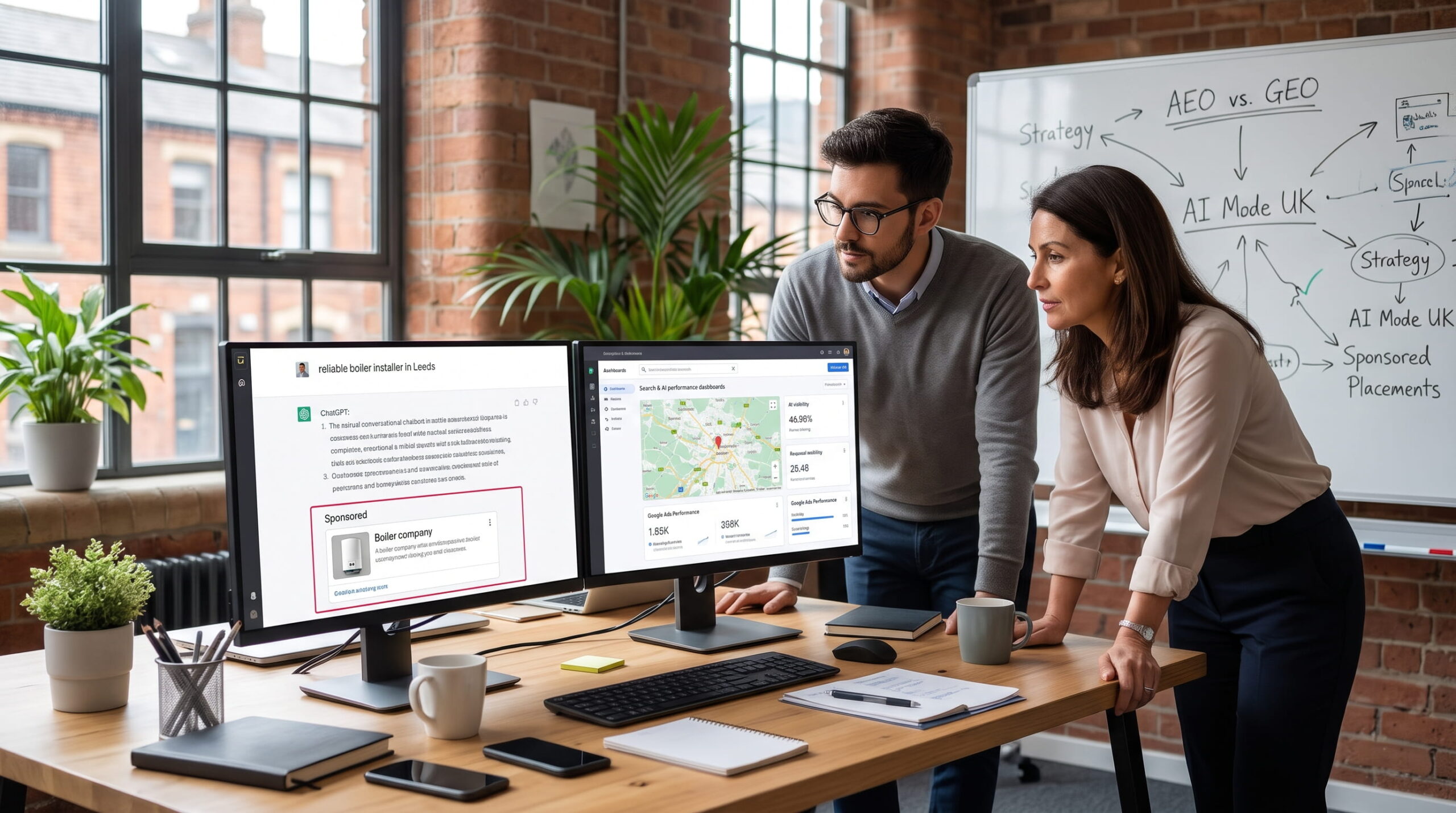
A homeowner in Leeds asks ChatGPT to recommend a reliable boiler installer. The answer names three local firms, each with a line on why. Underneath, in a box marked as sponsored, sits a fourth firm that paid to be there. A year ago that box did not exist in the UK. Now ChatGPT ads are live here, Google has said ads are coming to AI Mode in the UK before the end of 2026, and a lot of business owners are asking the same question: should we stop working on being recommended and simply pay to be seen?
The short answer is no, but the question deserves a proper one. Ads in AI answers are real, they are growing, and for some businesses they will be worth testing. They are also widely misunderstood. They do not buy a place inside the answer, they do not change what the AI says about you, and they cannot fix a business the AI does not trust. This guide explains what is actually live in the UK, how each platform handles ads, how paid placements and organic AI visibility affect each other, and how to decide whether your business should spend money here at all.
In short:
- ChatGPT shows ads in the UK to logged-in adults on the Free and Go plans. Ads sit below the answer, carry a sponsored label and, according to OpenAI, do not influence what ChatGPT says.
- Google can show ads above and below AI Overviews in the UK. Ads inside AI Overviews are not available here yet, and Google plans to bring ads to AI Mode in the UK in the fourth quarter of 2026, using existing Search, Shopping and Performance Max campaigns.
- Microsoft serves ads in Copilot through Microsoft Advertising. Perplexity has ended its ad programme, Anthropic has pledged to keep Claude ad-free, and Google says it has no current plans for ads in the Gemini app.
- Paying for an ad buys a labelled slot next to the answer. It does not buy a mention in the answer. The shortlist itself is still earned through the signals AI tools trust.
- Most businesses should secure their organic AI visibility first, then test ads on the prompts where buying intent is highest and organic coverage is weakest.
Platform details in this guide were checked on 20 November 2026. This area changes quickly, so check each platform’s own documentation before you commit budget.
What are ads in AI answers?
Ads in AI answers are paid placements that appear alongside a response from an AI assistant or AI search feature. They sit in a separate, labelled slot, usually below or beside the answer, and they are chosen by an ad system rather than written by the model.
Every AI answer has two layers. The first is the answer itself: the businesses named, the reasons given, the sources cited. It comes from the model, its training data and whatever it retrieves from the web. We cover how that selection works in how ChatGPT chooses which businesses to recommend. The second layer is the ad slot. It is filled by an auction among advertisers whose ads match the conversation, and it is labelled so the user knows it is paid.
The platforms that run ads say the two layers are kept apart. OpenAI calls this answer independence. Google labels its placements as sponsored. That separation is the single most important thing to understand about this new channel, because it decides what money can and cannot do for you.
Which AI platforms show ads in the UK right now?
Seven AI experiences matter most to UK buyers, and their approach to advertising could hardly be more different. Here is where each one stood on 20 November 2026.
| Platform | Ads in the UK? | Where ads appear | How advertisers buy |
|---|---|---|---|
| ChatGPT | Yes, since June 2026, for Free and Go users only | Below the answer, labelled as sponsored | OpenAI’s own Ads Manager (self-serve beta) or directly with OpenAI |
| Google AI Overviews | Partly: above and below the overview, not inside it | Above or below the AI Overview. Inside it only in selected English-speaking markets | Existing Search, Shopping and Performance Max campaigns |
| Google AI Mode | Not yet. Planned for Q4 2026 | Within or below the AI Mode response | Existing eligible Google Ads campaigns |
| Microsoft Copilot | Yes, through Microsoft Advertising | Alongside the Copilot response | Microsoft Advertising campaigns, with no separate Copilot campaign type |
| Perplexity | No. Ad programme ended in February 2026 | None | None |
| Gemini app | No | None | Google says there are no current plans |
| Claude | No | None | Anthropic has pledged to stay ad-free |
OpenAI, Google and Microsoft are building ad businesses around their AI answers, while Perplexity and Anthropic have decided ads would damage trust in theirs. Paid reach inside AI tools is therefore concentrated in ChatGPT, Google and Copilot. Anyone researching your category in Perplexity, Claude or the Gemini app can only find you organically.
How do ChatGPT ads work?
ChatGPT ads are sponsored listings shown beneath a ChatGPT response, matched to the topic of the conversation and bought through OpenAI’s own advertising platform. OpenAI began testing them in the US on 9 February 2026, started its UK pilot in June 2026 and confirmed on its announcement page in August that ads had launched in the UK. The UK was its first European market.
Who sees ChatGPT ads?
Only logged-in adults on the Free and Go plans see ads. Plus, Pro, Business, Enterprise and Education users do not. OpenAI also says it does not show ads to users who are under 18, or who it predicts are under 18, and does not show them in conversations about sensitive or regulated topics such as health, mental health and politics. Free users can opt out of ads in exchange for fewer daily messages.
That matters for planning. Many of the professionals and business buyers you most want to reach pay for ChatGPT, so they will never see your ad. A campaign reaches the large free audience, not the whole of ChatGPT.
Where do the ads appear and how are they labelled?
Ads are visually separated from the answer and labelled as sponsored. In OpenAI’s own example, a sponsored product listing appears below the response with a note that ads do not influence the answer. OpenAI’s advertising principles, published in January 2026, state that ads do not influence the answers ChatGPT gives and that conversations are kept private from advertisers.
How are ads matched to conversations?
OpenAI says ads are matched to the topic of the conversation and, where the user allows it, to past chats and past interactions with ads. The UK rules are stricter than the US ones. OpenAI updated its policy in June 2026 so that personalised ads in the UK and EU rely on the explicit consent of the user. Without that consent, people still see ads, but those ads are selected from the current conversation rather than their history.
In practice, your ad is matched to what people are discussing, not to a keyword list in the way it would be on Google. If your offer and landing page do not clearly relate to the questions your buyers ask, the system has little reason to show it. That is the same discipline that drives organic visibility, which is why prompt research pays off on both sides.
What do advertisers get back?
Advertisers do not see chats, chat history, memories or personal details. OpenAI says they receive aggregate performance data such as views and clicks. You will not learn what someone typed before they saw your ad. Unlike search term reports in Google Ads, you never see the query, which makes your own analytics more important.
How can UK businesses buy ChatGPT ads?
At launch, UK advertisers had to register interest and work with OpenAI directly. Trade press, including Digiday, reported in June 2026 that OpenAI had opened its self-serve Ads Manager to UK businesses in beta. Buying options have grown from paying per thousand impressions to include cost per click and cost per action. The tool is still a beta, so expect features and access rules to change.
Why do your landing pages now matter to another crawler?
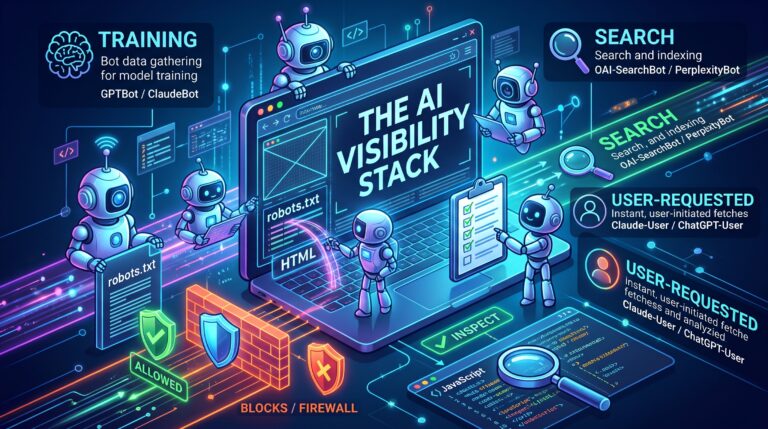
OpenAI checks the landing pages of submitted ads with a dedicated crawler called OAI-AdsBot. According to OpenAI’s documentation, it only visits pages submitted as ads, uses them to check policy compliance and relevance, and does not use the data to train its models. If your firewall or bot protection blocks it, your ads may not be approved. It works alongside the crawlers that read your site for organic answers, which we explain in how AI crawlers read your website.
How do Google AI Overviews and AI Mode ads work?
Google’s ads in AI search are not a new product you sign up for. They are your existing Google Ads campaigns appearing in new places, which means many UK businesses are already in this channel without ever deciding to be.
Ads around and inside AI Overviews
Google’s help documentation says ads can appear above, below or within AI Overviews. Ads above or below an AI Overview can show in every market where AI Overviews are available, which includes the UK. Ads within the AI Overview itself are limited to English in a list of countries that, on 20 November 2026, did not include the UK.
Eligible ads come from Search, Shopping and Performance Max campaigns. To appear within an AI Overview, Google requires AI-powered matching such as broad match or keywordless targeting, and it matches ads to both the query and the content of the overview. Advertisers cannot target these placements directly, cannot opt out of them, and Google Ads does not currently offer separate reporting for ads shown within AI Overviews.
AI Mode ads are coming to the UK
AI Mode, the conversational version of Google Search, has been available in the UK since July 2025 without ads. On 28 October 2026, Google announced it was scaling ads in AI Mode across ten more countries and said it plans to expand to further markets, including the United Kingdom, in the fourth quarter of 2026. It gave no exact UK date. In the US, Google is also launching ads that can appear on follow-up questions within an AI Mode conversation. That has not been announced for the UK.
Google also said click-through rates for sponsored and organic product listings in AI Mode are already similar, and that AI Mode queries are on average three times longer than traditional searches. Both figures come from its own US data, so treat them as signals, not forecasts for your account.
What does this mean for your Google Ads account?
If you run Search campaigns with broad match, Performance Max or Shopping, assume your ads are already eligible to appear around AI Overviews and will become eligible for AI Mode when it launches here. Three things follow:
- Your product feed, ad assets and landing pages are now read in an AI context. A vague or outdated feed effectively becomes the copy in the sponsored slot.
- Negative keywords and brand exclusions are your main controls, because you cannot switch the placement off on its own.
- Your reporting will blend these placements with regular search results, so do not expect a tidy AI Mode line in your account.
The organic side of the same results needs its own attention. Our guides to appearing in Google AI Mode and to AI Overviews and the zero-click shift cover what earns a citation, and our Google AI optimisation service puts that into practice.
What about Copilot, Perplexity, Gemini and Claude?
Microsoft Copilot. Microsoft has shown search ads in its AI chat experience since 2023. Ads in Copilot come from Microsoft Advertising campaigns, including Search and Performance Max, rather than a separate Copilot product. Because Copilot draws on Bing, organic visibility there depends on the Bing foundations we describe in our Microsoft Copilot SEO guide. Copilot sits inside Windows, Edge and Microsoft 365, which can make it relevant for firms that sell to business buyers.
Perplexity. Perplexity was one of the first AI search tools to test ads, with sponsored follow-up questions from late 2024. It shut the programme down in February 2026, with reports citing concerns that ads would undermine trust in its answers. Today the only way into a Perplexity answer is to be one of the sources it chooses to cite, which we explain in how Perplexity chooses its sources and citations.
Gemini app. Google has said publicly that there are no ads in the Gemini app and no current plans to change that. Note the word current. Ads do run in Google’s AI search features, which also use Gemini models, so the line is between the Gemini app and Google Search.
Claude. In February 2026, Anthropic published a commitment that Claude will remain ad-free, with no sponsored links beside conversations and no advertiser influence on responses. If your buyers use Claude for research, organic visibility is the only route, covered in how to get your business recommended by Claude.
Can you pay to appear inside an AI answer?
No. On the platforms that run ads, you can pay for a labelled placement next to the answer, but you cannot pay to be named, described or recommended within the answer itself. OpenAI says ads do not influence ChatGPT’s answers, and UK advertising rules require ads to be obviously identifiable as ads.
That is why the real decision is not ads or organic. It is a choice between two different assets that do different jobs.
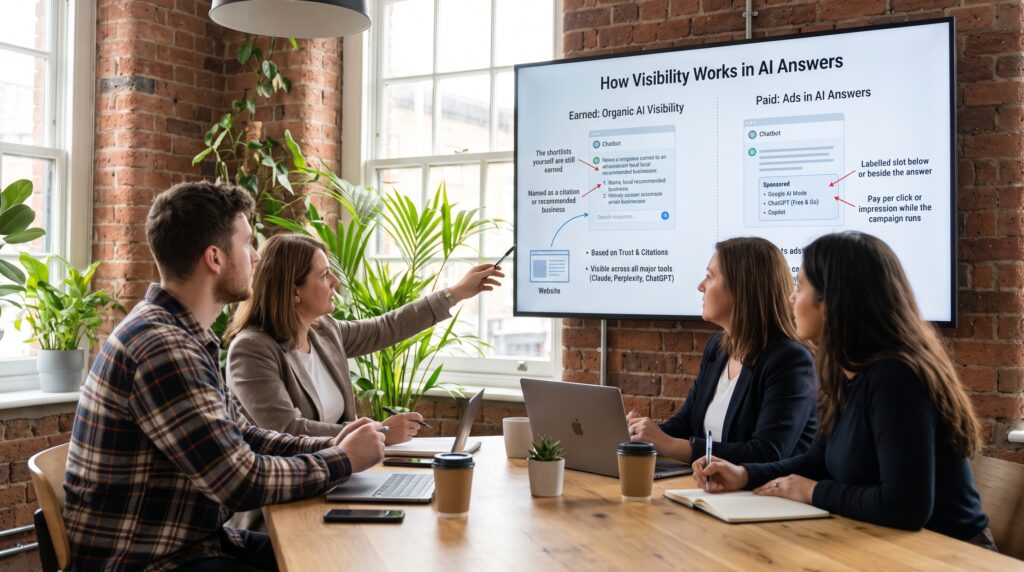
| Earned: organic AI visibility | Paid: ads in AI answers | |
|---|---|---|
| Where you appear | Inside the answer, as a named recommendation or cited source | In a labelled slot below or beside the answer |
| What decides it | The evidence AI tools find and trust about your business | An auction among eligible advertisers, weighted by relevance |
| How the user reads it | As the AI’s own view | As advertising |
| Platforms covered | All major AI tools, including Perplexity, Claude and Gemini | ChatGPT (Free and Go), Google AI features and Copilot |
| Cost model | Ongoing investment in content, proof and technical work | Pay per impression, click or action while the campaign runs |
| When you stop | Gains tend to persist, though they need maintaining | Visibility ends when the budget ends |
| Control | Indirect: you shape the evidence, not the output | Direct over budget, copy and landing pages. Limited over placement on Google |
| Measurement | Prompt-based tracking such as an LLM Visibility Score™, plus referral traffic | Platform reporting, often aggregated, plus your own analytics |
Paid placements give you speed and control over the message. Earned visibility gives you the credibility of being chosen and reach across tools that do not sell ads at all. The businesses that get most out of AI search will treat ads as a way to add reach on specific, high-intent prompts, not as a replacement for being on the shortlist. If ChatGPT is where you are weakest organically, that is the gap our ChatGPT SEO service is designed to close.
How do ads and organic AI visibility affect each other?
Paid and organic placements share a screen, and in several ways they share the same raw materials. Ignoring that connection is where most wasted budget will come from.
The same pages feed both
Your website is the source material for both layers. AI tools read it to decide whether to recommend you, and ad systems read it to judge relevance and quality. OpenAI’s crawler checks your ad landing pages, and Google uses your feeds, assets and pages to build ads in its AI experiences. A clear, factual service page with prices, coverage areas and proof helps you in the answer and in the sponsored slot. A thin page hurts both. Writing that AI tools can lift cleanly, as described in how to write content AI quotes word for word, also makes better landing page copy.
What happens when your ad sits under an answer that names a competitor?
Go back to the Leeds boiler search. If ChatGPT recommends three competitors and your sponsored listing sits underneath, the user has just been told by the AI, in its own voice, to consider someone else. Your ad has to overcome that. Being in the answer and in the ad slot reinforces your position. Being only in the ad slot can look as though you paid because you were not chosen.
Ads cannot correct what the AI believes about you
If an AI tool has your prices, opening hours or services wrong, buying ads does not fix it. The answer still says what it says, and your ad may sit directly beneath the mistake. Correcting inaccurate information is organic work, which is what our Hallucination Guard™ approach to AI hallucinations is built for.
Ads can add reach where organic visibility is thin
If you are named well in Gemini and Google AI Overviews but rarely in ChatGPT, a targeted ChatGPT campaign can cover that gap while the organic work catches up. Ads can also put a new service in front of buyers before AI tools have enough evidence to recommend it.
Ads compete for the click, not the shortlist
On Google, AI Overviews already reduce clicks to organic results for many searches. Sponsored slots around AI answers will compete for the clicks that remain. That makes a place inside the answer more valuable, not less, because it is the one position on the screen the user does not read as paid.
Should your business advertise in AI answers?
Use this four-question test before you spend anything. We call it the earn-then-rent check, because the right answer for most businesses is to secure their organic position first and then rent extra reach where it pays.
- Are you named in AI answers for your most valuable prompts? Run your core buyer questions across ChatGPT, Google AI Mode, Gemini, Perplexity, Copilot and Claude. If you rarely appear, fix that first. Ads under answers that recommend competitors are an expensive way to learn that you are not trusted.
- Is there a platform gap? If your LLM Visibility Score™ is healthy on some tools but weak on ChatGPT, a ChatGPT test can make sense while you close the gap organically.
- Is the intent high enough to justify paying? Ads earn their keep on prompts close to a decision, such as comparing providers, asking for a quote or checking availability. Research-stage questions rarely convert from a sponsored click.
- Can you measure the result? If you cannot see AI referrals and leads in your analytics and CRM, you will not know whether the test worked. Sort tracking before launch.
Your answers point to one of these starting positions.
| Your situation | Recommended move |
|---|---|
| You are rarely named in AI answers for your core prompts | Invest in organic AI visibility first and hold off on AI ad budgets |
| You are named on some platforms but not in ChatGPT | Run a small, time-limited ChatGPT test on high-intent topics while fixing the organic gap |
| You already run Google Search with broad match, Shopping or Performance Max | You are already in this channel. Audit feeds, assets, negatives and landing pages before AI Mode ads reach the UK |
| You sell to business buyers who work in Microsoft tools | Review Microsoft Advertising for Copilot reach alongside Bing organic work |
| You work in a regulated or sensitive field | Expect restrictions. ChatGPT does not show ads in sensitive conversations such as health, so organic trust signals carry more weight |
| Your buyers lean on Perplexity or Claude | Organic visibility is the only route on those tools, and ads elsewhere will not reach this research |
For the wider question of where to put marketing budget across search and AI, our practical guide to when to invest in SEO, AEO or GEO works through the same logic for organic channels.
How do you run a sensible first test of ChatGPT ads?
If the four questions point towards testing, keep the first campaign small, specific and time-limited. This is the sequence we suggest.
- Record your organic baseline. Log how often you are named for your priority prompts on each platform. Without this control, you cannot tell whether the ads helped or organic movement did the work. Our guide on how to read your AI visibility report explains what to capture.
- Choose a narrow set of high-intent topics. Pick two or three buying conversations, such as finding a boiler installer in Leeds or comparing commercial cleaning contracts in Manchester. Match the ad and the landing page closely to each one.
- Build landing pages that answer the conversation. Lead with what the person was asking about: price ranges, service area, availability and proof. Make sure OAI-AdsBot can reach the page and that it loads quickly on mobile.
- Set a fixed budget and an end date. Decide in advance what you will spend and for how long, for example four to six weeks. Cost per click bidding makes spend easier to cap.
- Track it properly. Google Analytics added an AI Assistant channel in May 2026 for traffic from chatbots such as ChatGPT, Gemini and Claude. Tag your ad links with their own UTM parameters so paid clicks stay separate from organic ChatGPT referrals, and add a “how did you hear about us” field to your forms. OpenAI’s reporting is aggregated, so your own data does most of the work.
- Compare paid and organic outcomes. At the end, compare leads and cost per lead from the ads with the enquiries that arrived from organic AI referrals and your other channels.
- Decide, then write it down. Scale, adjust or stop, and record which topics and messages converted. That shapes your next campaign and your organic content.
Worked example: a Leeds heating firm weighs up ChatGPT ads
This is an illustrative scenario, not a client case study.
A family-run heating firm in Leeds, with eight engineers, wins most of its work from Google search and referrals. The owner hears that ChatGPT ads are live in the UK and asks whether to move part of the Google Ads budget across.
Step one is the baseline. The firm tests 20 buying prompts, such as “best boiler installer in Leeds”, “how much is a combi boiler replacement in Leeds” and “Gas Safe registered boiler installers near Headingley”. It is named in Google AI Overviews for 9 of the 20, in Gemini for 7, in Copilot for 4 and in ChatGPT for only 2. Two competitors appear in ChatGPT for most of the prompts.
Step two is the diagnosis. The ChatGPT gap traces back to thin evidence beyond its own website: few recent third-party reviews, inconsistent directory details and no page stating typical prices or areas covered.
Step three is the plan. The owner decides to fix the organic gaps first: a pricing and coverage page, a steady review request process and corrected listings. Because the winter boiler season is close, the firm also runs a six-week ChatGPT test on three high-intent topics: boiler replacement quotes, emergency boiler repairs and annual servicing plans. Each topic gets its own landing page, its own UTM tags and a hard budget cap.
Step four is the review. When the test ends, the owner compares cost per lead across ChatGPT ads, Google Ads and organic AI referrals, then re-runs the same 20 prompts. If organic ChatGPT mentions have risen, the paid test can wind down or narrow to the best topic. If not, the firm keeps both running while it works out why.
The point of the example is the order of operations. The ads did not replace the organic work. They covered a seasonal gap while the firm fixed the reason it was missing from the answer in the first place.
What UK rules apply to ads in AI answers?
UK advertising rules apply to AI placements in the same way as any other medium. This is not legal advice, but there are three areas every business should know about.
- Ads must be identifiable. Rule 2.1 of the CAP Code says marketing communications must be obviously identifiable as such. The platforms add the sponsored label, but your ad copy must not pretend to be the AI’s own recommendation or independent advice.
- Claims must stand up. Ads in AI answers are covered by the usual rules on misleading advertising. Words such as best, cheapest or number one need evidence, exactly as they do in search ads.
- Data and consent rules differ from the US. OpenAI relies on consent for personalised ads in the UK, and the Information Commissioner’s Office says storage and access technologies used for online advertising, including ad measurement, generally need consent under PECR. Check that your cookie banner and analytics setup cover any tags you add for AI campaigns.
The same honesty applies to how anyone talks about AI visibility. Nobody can pay to be named inside an AI answer, and a provider who implies otherwise is confusing the ad slot with the answer.
Common mistakes to avoid
- Treating ads as a shortcut to the shortlist. A sponsored slot does not put you in the answer, and it does not change how the AI describes you.
- Cutting organic work to fund ads. Ads stop when the money stops. If the cut weakens the evidence AI tools rely on, you can end up paying more just to stand still.
- Forgetting the Google campaigns you already run. Broad match, Performance Max and Shopping are already eligible for placements around AI Overviews. Audit them before AI Mode ads arrive.
- Sending AI traffic to a generic homepage. People arrive from a conversation with a specific question. A landing page that does not answer it wastes the click.
- Blocking the crawlers that review your pages. Bot protection that stops OAI-AdsBot can stop your ChatGPT ads being approved, and blocking search crawlers can remove you from the organic answer.
- Judging results on platform reporting alone. ChatGPT reporting is aggregated and Google does not split out ad performance within AI Overviews. Use your own analytics, UTM tags and lead source data.
- Assuming every buyer can see your ad. Paid ChatGPT plans, Perplexity, Claude and the Gemini app show no ads, so much AI research happens where only organic visibility counts.
Frequently asked questions
Are ChatGPT ads available in the UK?
Yes. OpenAI started its UK ad pilot in June 2026, its first European market, and confirmed in August 2026 that ads had launched in the UK. Ads appear for logged-in adults on the Free and Go plans, and trade press reports that a self-serve Ads Manager beta has been open to UK advertisers since June 2026.
Do ChatGPT ads affect which businesses ChatGPT recommends?
OpenAI says they do not. Its published principle of answer independence states that ads do not influence ChatGPT’s answers, and ads are shown separately with a sponsored label. To be recommended inside the answer, a business still needs the evidence that organic visibility depends on.
Can I advertise inside Google AI Overviews in the UK?
Not inside the overview itself yet. Google’s help documentation lists the countries where ads can appear within AI Overviews, and the UK was not on that list on 20 November 2026. Ads can appear above and below AI Overviews in the UK, drawn from existing Search, Shopping and Performance Max campaigns.
When will Google AI Mode show ads in the UK?
Google said on 28 October 2026 that it plans to expand ads in AI Mode to more markets, including the UK, in the fourth quarter of 2026. It has not given an exact date. Existing eligible campaigns will serve there, and you cannot opt out of AI Mode separately from Search.
Do Perplexity or Claude offer advertising?
No. Perplexity ended its sponsored question programme in February 2026, and Anthropic has committed to keeping Claude ad-free. On both platforms, the only way to appear is to be cited or recommended in the answer itself.
Should a small business test ChatGPT ads?
Only once it is named in AI answers for at least some of its key prompts and can track the leads that arrive. A small, time-limited test on high-intent topics is sensible for a business with a clear platform gap. For a business that is not yet recommended anywhere, organic work usually returns more.
Will ads make organic AI visibility less valuable?
More likely the opposite. As sponsored slots fill the space around AI answers, the answer itself becomes the one position on the screen that the user reads as the AI’s own view. A place there cannot be bought and is more trusted, which is why The Shortlist System™ is built around earning it.
See where you stand before you spend
Before you put money into AI ads, find out how often AI tools already name you, where the gaps are and which competitors are taking your place. That baseline shows whether your budget would work harder on paid reach or on the evidence that puts you in the answer.
Check your AI visibility for free to see your starting point, or book a discovery call to talk through whether AI ads make sense for your business. We are independent of OpenAI, Google, Microsoft, Perplexity and Anthropic, so our advice is about what works for you, not about selling ad inventory.