How Google AI Overviews Drive the Zero-Click Shift
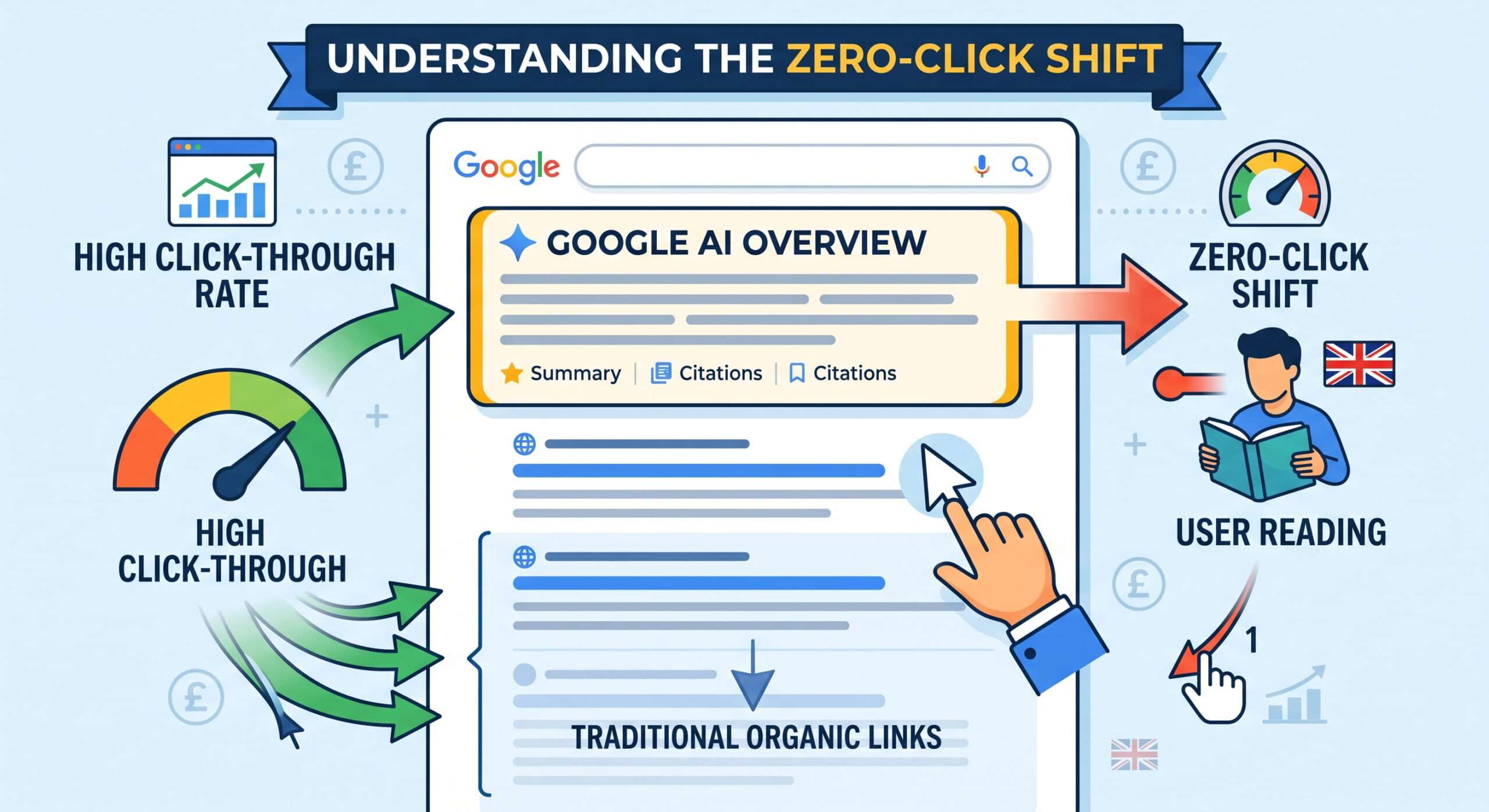
Something has quietly changed at the top of Google. Where you once saw a list of blue links, you now often see an answer: a few paragraphs, generated by AI, sitting above the results and frequently making the click unnecessary. This is Google AI Overviews, and it is the engine behind a growing zero-click shift, where more and more searches end without anyone visiting a website at all. For any business that has relied on search traffic, understanding AI Overviews and the zero-click shift is no longer optional, and the data on it is striking.
The numbers give the picture. A Pew Research Center analysis of real browsing behaviour found that when an AI Overview appeared, people clicked through to a website about 8% of the time, compared with about 15% when there was no AI summary, close to half as often. Only around one in a hundred clicked a link inside the summary itself. In that same study, roughly one in five searches produced an AI Overview, and that share has been climbing since.
This guide explains what AI Overviews are and why they cause zero-click behaviour, what the current data actually shows, which businesses are most exposed, and, most importantly, how to respond: by becoming the source the AI cites rather than mourning the click that has gone. It is written for UK businesses trying to make sense of a genuinely significant change, without the hype.
What AI Overviews are, and why they cause zero clicks
Start with the mechanics, because the effect follows directly from them. An AI Overview is an AI-generated summary that Google places at the very top of many results pages, answering the query in a few sentences drawn from across the web.
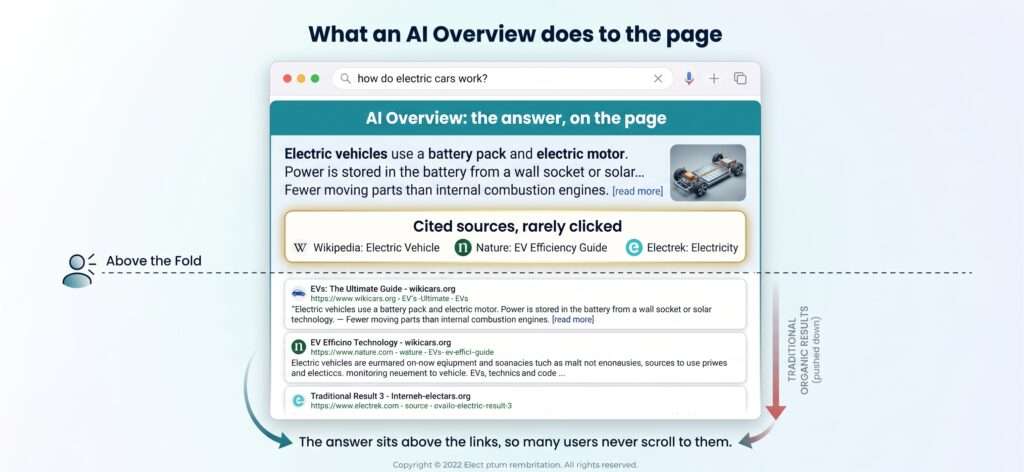
The AI Overview puts the answer above the links, so many users never scroll down to click.
The consequence is straightforward. If the answer is right there at the top, many people simply read it and move on, with no need to click any result. The links are still there, but they have been pushed down the page, below an answer that often satisfies the query on its own. That is what zero-click means: the search is resolved on the results page itself, and no website receives a visit. The AI Overview is not the only cause of zero-click behaviour, but it has accelerated it sharply.
This is part of a broader movement, the shift from search engines to AI answers, playing out inside Google itself. Rather than sending you elsewhere to find an answer, Google increasingly gives you the answer directly. For users it is often convenient. For businesses that depended on being the link people clicked, it removes the very step they relied on.
What the data actually shows
It is worth looking at the evidence squarely, because this is a topic prone to both panic and denial. The honest reading is that the effect is real and significant, though its exact size varies by how it is measured.
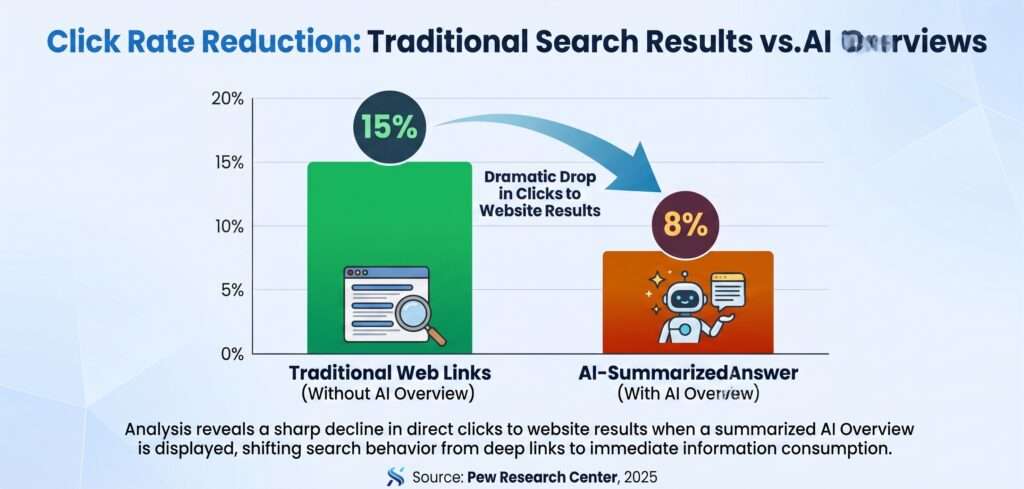
The headline finding: an AI Overview roughly halves the chance of a click to a website. Source: Pew, 2025.
The Pew figures above are the most rigorous, because they track real behaviour rather than estimates: an AI Overview roughly halved the click-through rate. Broader industry analysis of zero-click search in 2026 points the same way, finding that the share of Google searches resulting in a click to any website has fallen further, and that click-through drops sharply on the queries where an AI Overview appears. Different studies produce different exact numbers, from modest declines to severe ones, depending on query type and method, but every serious study finds a decline. The direction is not in dispute.
In fairness, Google itself contests the gloomier readings. It has questioned the methodology of some studies, and argues that its AI features expand visibility rather than reduce it, and that the clicks that do happen are higher quality. There is something to the point that intent matters, as we will see. But for most businesses relying on informational search traffic, the lived experience matches the data: fewer clicks are coming from the same searches. It is wiser to plan for that than to hope it reverses.
Why this is a change, not a catastrophe
It is easy to read the figures and conclude that search visibility is finished. It is not, and the panic is as unhelpful as the denial. What is happening is a change in the shape of visibility, not its disappearance. The customer still has the question; the AI still needs sources to answer it; your business can still be the answer. What has changed is the mechanism, not the opportunity.
There is even an upside hidden in the shift. Because an AI Overview draws on a curated set of sources and names only some of them, being one of those few is a more prominent, more trusted position than being the tenth blue link ever was. The page used to offer ten links competing for attention. The overview offers one answer, attributed to a handful of sources. If you are among them, you have more of the available attention, not less.
So the right posture is neither despair nor denial, but adaptation. The businesses that come through this well will be the ones that accept the new shape of visibility quickly and set about earning a place in the answer, while their competitors are still arguing about whether the click is really gone.
One more figure from the Pew work is worth holding onto: the typical AI Overview cited three or more sources, and a single-source answer was rare. That matters, because it means being cited is not a winner-takes-all contest for one slot. There is genuine room to be among the sources an overview draws on, if your content earns it.
Which businesses are most exposed
The zero-click shift does not hit every business equally, and understanding where you sit changes how worried you should be, and what you should do.
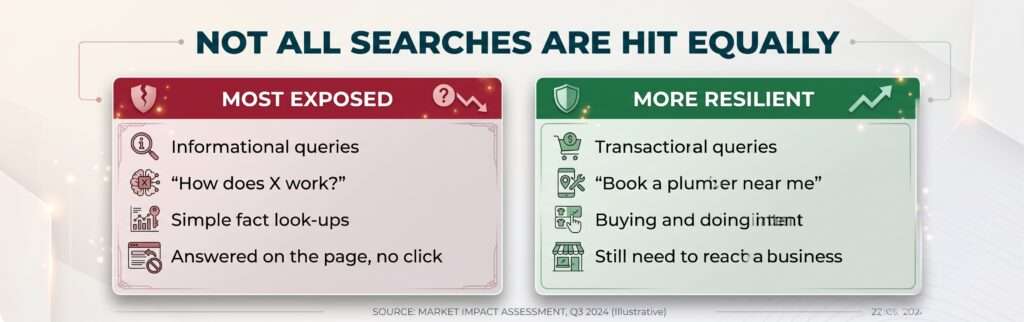
Informational queries are hit hardest. Transactional, local intent is more resilient.
The most exposed content is informational: simple questions and fact look-ups that an AI Overview can answer completely on the page. If your traffic came largely from people searching how something works or what something means, and then reading your article, that traffic is most at risk, because the AI can now satisfy that query without the click. Publishers and content-heavy sites have felt this first and hardest.
More resilient is transactional and local intent: searches where the person needs to actually reach and use a business. Someone wanting to book a plumber, get a quote or visit a shop still has to go beyond the summary to a real business. For local service businesses, this is reassuring, because much of what their customers search for has this doing intent. It also shifts the emphasis towards being present when customers find businesses through AI search, rather than towards winning informational clicks.
The new goal: become the cited source
Here is the shift in mindset that matters most. When the click is disappearing, the old goal, rank a link and win the click, is no longer the whole game. The new goal is to be the source the AI cites and repeats in its answer.
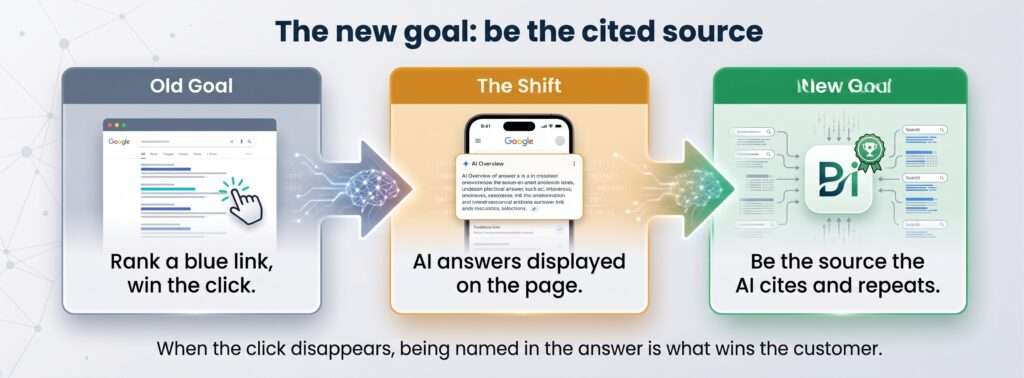
When the click goes, being named in the answer is what wins the customer.
This reframes everything. An AI Overview draws its answer from sources, and it names some of them. Being one of those cited sources means your business appears in the answer the customer reads, even if they never click, and analysis suggests brands cited in an AI Overview tend to earn more of the clicks that remain than those left out. So the aim is to become the answer, not merely to rank beneath it. Visibility inside the summary is the new prize, and it is one you can compete for.
Winning it means the same disciplines that underpin AI visibility generally. Clear, genuinely useful content that answers real questions well is what AI Overviews draw on, so structuring content for AI so it can be extracted cleanly is central. It also means accepting that traditional SEO is no longer enough on its own: ranking a page matters less if the answer, and the citation, is what the customer actually sees.
A UK note on timing
A brief but useful point for UK businesses specifically. Google tends to roll out its newest answer features on its US site first, with other markets, including the UK, following behind.
In practice this means the zero-click effect, while already present in the UK, has often been a little less pronounced here than on the US google.com, simply because the features arrive later. That is not a reason to relax. It is a reason to act now, while the shift is still gathering pace here, so that you are established as a cited source before AI Overviews reach their full extent in the UK. The businesses that prepare during the lag will be in a far stronger position than those that wait for the change to be unavoidable.
How to respond, practically
So what should a business actually do? The response is not to fight the tide, but to adapt to it deliberately. A few priorities matter most.
Answer the real questions clearly. Write genuinely useful, clear answers to the questions your customers ask, in a form an AI can lift. This is what gets you cited in overviews, and it is the foundation of the whole response.
Focus on intent that still needs you. Lean into the transactional and local searches where customers must still reach a business, rather than relying on informational traffic that the overview now absorbs.
Aim to be cited, not just ranked. Treat appearing in the AI Overview, as a named source, as the goal, and structure your content so it is easy to quote and attribute.
Broaden beyond Google. The same shift is happening across AI assistants, so build visibility everywhere customers ask questions, not on Google clicks alone.
Measure differently. Stop judging success by clicks alone. Track whether you appear and are cited in AI answers, because that visibility now matters even when no click follows.
Common mistakes
A few responses to the zero-click shift make things worse rather than better. They are worth naming.
Pretending it is not happening. Ignoring the shift and hoping clicks return leaves you exposed. Every serious study finds a real decline; plan for it.
Panicking and chasing volume. Flooding out more thin informational content is exactly the material overviews absorb without a click. Quality and citability matter more than volume.
Judging success by clicks alone. Clinging to click metrics misses the value of being cited without a click. Measure visibility in AI answers too.
Ignoring intent. Treating all traffic as equally at risk wastes effort. Focus on the transactional and local intent that still needs a real business.
Staying Google-only. Fixating on Google ignores the wider move to AI assistants. Build visibility across all the places customers now ask.
A worked example: a local estate agent
An independent estate agent had built a healthy stream of traffic over the years from helpful guides: how to prepare a house for sale, what the buying process involves, how conveyancing works. For a long time these articles brought in visitors who often went on to become clients. Then the traffic began to slide, and the cause was the zero-click shift.
When people searched those informational questions, an AI Overview now answered them at the top of the page, drawing partly on content like the agent’s, but rarely sending a click. The guides were still good and still being used, in a sense, but as raw material for an answer the reader consumed on Google, not as pages anyone visited. The informational traffic that had fed the business was being quietly absorbed into the overview.
The agent adapted rather than despaired. It kept writing genuinely useful guides, but reshaped them to be clearly answer-first and easy to cite, so it stood a better chance of being the named source in the overview. It leaned harder into the local, transactional searches, people looking for an agent in its towns, where customers still had to make contact. And it started measuring whether it appeared in AI answers, not just clicks. The informational click traffic did not fully return, and it was not meant to. Instead the agent became a source AI drew on and a business it recommended for local, transactional queries, which is exactly how firms now get recommended by AI. It had stopped fighting the shift and started using it.
The estate agent example is encouraging precisely because nothing about its expertise had to change. The same knowledge that once filled its guides now feeds the answers it is cited in and supports the local searches it still wins. The shift did not make its expertise worthless. It changed the form in which that expertise reaches customers, from a page they visited to an answer they were given.
Frequently asked questions
What is an AI Overview?
It is an AI-generated summary Google places at the top of many results pages, answering the query in a few sentences drawn from across the web. Because it often answers the question on the page, many users read it and move on without clicking any result.
What does zero-click mean?
A zero-click search is one that ends without the user visiting any website, because the answer was provided on the results page itself. AI Overviews have accelerated this by giving a complete answer at the top, so no click is needed to satisfy the query.
How much do AI Overviews reduce clicks?
Rigorous behavioural data from Pew found the click-through rate roughly halved when an AI Overview was present, about 8% versus 15%. Other studies find declines ranging from modest to severe depending on query type and method, but all find a decline. Google disputes the gloomier readings.
Is my business at risk?
It depends on intent. Businesses reliant on informational search traffic are most exposed, because overviews answer those queries directly. Transactional and local searches, where customers must reach a real business, are more resilient, which is reassuring for many local service businesses.
How do I respond to the zero-click shift?
Aim to become the source the AI cites rather than just a link beneath it: answer real questions clearly and citably, focus on intent that still needs a business, build visibility beyond Google, and measure whether you appear in AI answers, not just clicks.
From winning the click to being the answer
Google AI Overviews have made the zero-click search a central feature of how people find information, and the data confirms it: when the answer is on the page, far fewer people click through. For businesses built on informational search traffic, that is a genuine challenge. But it is not the end of visibility, only a change in what visibility means.
The response is to stop chasing a click that is disappearing and start earning a place in the answer itself. Write genuinely useful, citable content, focus on the customer intent that still needs you, and treat being named in AI answers as the goal. That is the heart of answer engine optimisation, and it is how you turn the zero-click shift from a threat into an opportunity.
If you would like help adapting to AI Overviews and becoming a cited source rather than a lost click, that is part of our AI optimisation services. Book a discovery call and we will help you stay visible as search becomes answers.