The right SEO vs AEO vs GEO strategy starts with your biggest bottleneck, not the newest acronym. Start with search engine optimisation (SEO) if Google and Bing cannot crawl, index or rank your key pages. Add answer engine optimisation (AEO) when those pages rank but AI tools rarely quote them. Invest in generative engine optimisation (GEO) when AI tools find you but recommend competitors.
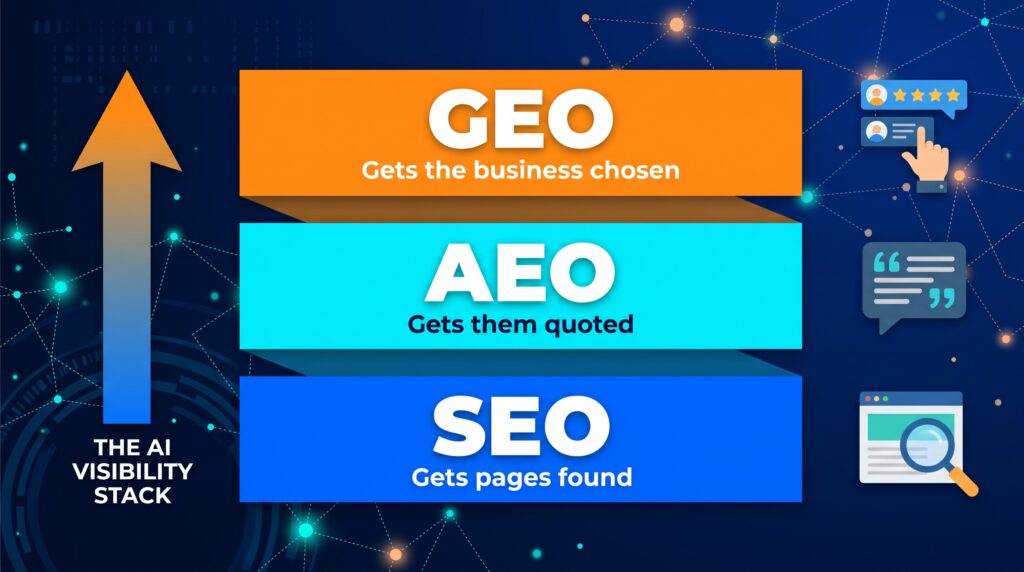
In short: SEO gets your pages found, AEO gets them quoted, and GEO gets your business chosen. Most businesses need all three, in that order, at different weights. Your budget decides how many you run at once, not the order they go in.
This guide is for UK business owners deciding where the next pound of marketing budget should go. If you want the definitions first, our guide to AEO vs GEO vs SEO explains what each term means. Here we cover the decision itself: which to prioritise, when to add the next one, and how the three build on each other.
Why does the order of SEO, AEO and GEO matter?
The order matters because SEO, AEO and GEO are layers, not alternatives. AI search tools retrieve pages from search indexes, so a page has to be found before it can be quoted, and quoted before the business behind it is recommended.
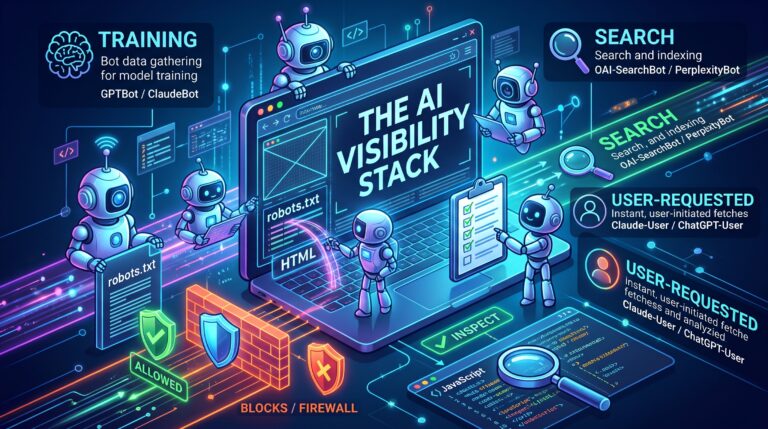
We set out the same logic in the AI visibility stack, which runs from technical foundations at the bottom to off-site authority and measurement at the top.
SEO comes first because AI tools retrieve from search indexes
Google’s guidance on its generative AI features says AI Overviews and AI Mode are rooted in its core search ranking and quality systems. A page must be indexed, and eligible to show with a snippet, before it can appear in them.
Microsoft Copilot works the same way with Bing’s index, as we explain in Microsoft Copilot SEO. So if you are asking which comes first, SEO or GEO, the answer is SEO. A page that cannot be found cannot be quoted or recommended.
AEO comes second because found pages still have to be quotable
An AI tool such as ChatGPT, Perplexity or Google AI Mode will pass over a page it has retrieved if the answer is buried, vague or spread across several sections. AEO fixes that by putting a clear, direct answer under each question your buyers ask. Our guide on how to structure content for AI search covers the practical steps.
GEO comes third because recommendations need outside proof
GEO builds the evidence beyond your website that makes AI tools confident enough to name you: consistent business facts, reviews, mentions and directory listings. These are the trust signals AI tools look for before recommending one business over another.
That evidence works best when it points to pages that are already findable and clear, which is why GEO follows SEO and AEO rather than replacing them.
Is SEO still worth it with AI search?
Yes. AI search has raised the stakes for SEO rather than replaced it, and Google’s own guide treats optimising for its AI features as SEO. We look at why people think SEO is dead, and why the evidence points the other way.
What has changed is that SEO alone is no longer enough. Research from Ofcom, the UK communications regulator, on how the UK goes online in 2025 found that about 30% of Google searches now show an AI Overview. ChatGPT had 1.8 billion UK visits in the first eight months of 2025, up from 368 million a year earlier.
For any UK business planning an AI search strategy, the question is no longer whether to invest beyond SEO, but when.
SEO vs AEO vs GEO compared as investments
SEO, AEO and GEO differ in where the work happens, where the results show and how quickly they move. The table sets them side by side.
| SEO | AEO | GEO | |
| What it does | Gets your pages crawled, indexed and ranking | Makes your pages easy for AI tools to quote | Gets your business named and recommended in AI answers |
| Where the work happens | Your website: technical health, content, links | Your website: answer-first content, FAQs, schema | The wider web: business facts, reviews, mentions, listings |
| Where results show | Google and Bing search results | Citations in AI Overviews, AI Mode, ChatGPT, Perplexity, Copilot and Gemini | Recommendations in those same AI answers |
| First sign of progress | Rankings and organic traffic | Your pages cited in AI answers | A rising share of AI answers that recommend you |
| Typical pace | Early movement in 8 to 12 weeks, larger gains from month four | Early gains often within 30 to 60 days of pages being re-crawled | Builds over months, judged across a 90-day window |
What is the difference between AEO and GEO in practice?
AEO changes your own pages; GEO changes how the rest of the web describes you. AEO work rewrites content so AI tools can lift a clear answer from it. GEO work cleans up business facts, earns reviews and builds independent mentions, so AI tools trust you enough to recommend you.
Our plain-English guides to answer engine optimisation and generative engine optimisation cover each one in more depth.
How long do SEO, AEO and GEO take to work?
SEO usually shows early movement within 8 to 12 weeks, with larger gains from month four, although technical fixes can show within days. AEO and GEO often show early gains within 30 to 60 days, with measurable AI visibility improvement targeted within 90 days.
These are the timeframes we work to across our SEO services and AEO and GEO services. They overlap more than they compete: the first AI visibility gains often come from tidying business facts that also help local search.
How do you find your starting point?
Your starting point is the first of five questions you answer “no” to. Answer them honestly, ideally with data from an AI visibility audit rather than a guess, and put your next budget there.
| Question | If the answer is no | Start with |
| Can Google and Bing crawl and index all your key pages? | Nothing else will be seen until this is fixed | SEO |
| Do you rank on page one for your main services? | AI tools have fewer reasons to retrieve your pages | SEO, writing new content answer-first |
| Do AI tools such as ChatGPT and Gemini describe your business accurately? | Inconsistent facts are confusing them | GEO fact clean-up |
| Are you named when buyers ask AI tools about your category? | Your pages are findable but not quotable | AEO |
| When you are named, are you recommended? | Too little independent proof backs you up | GEO reviews and mentions |
Accuracy sits above content for a reason. If AI tools have the wrong picture of who you are, fix that before writing anything new, because pages built on contradictory facts get cited less.
The table also settles the common question “should I invest in SEO or AEO?”. If either of the first two answers is no, invest in SEO. If both are yes and AI tools describe you correctly but rarely name you, invest in AEO.
How to split an SEO, AEO and GEO budget
Budget changes how many lines you can run at once, not the order they go in. Whatever you spend, the first “no” from the five questions gets funded first.
Small budget: AEO vs SEO for a small business
For a small business, the AEO vs SEO choice is often a false one, because one piece of work can do both. Run one line at a time and pick work that counts twice.
Fix crawl and indexing problems, make your business details identical everywhere, and rewrite your three to five most important service pages so they answer buyer questions in the first sentence. That is SEO and AEO in a single piece of work, and it lays the ground for GEO later.
Moderate budget: add AEO where buyers decide
Keep an SEO retainer for technical health and content, and add AEO to the pages closest to a purchase. Start a simple review routine now, because reviews take longest to build and help both local rankings and AI recommendations.
Larger budget: run all three under one measurement plan
Run SEO, AEO and GEO in parallel, measured by rankings and traffic for SEO, citations for AEO, and a repeatable AI visibility score for GEO. Spending more does not shortcut the order, but it lets the later layers start while the earlier ones are still being finished.
How much of your budget should go on AI visibility?
There is no fixed percentage that suits every business. The share should follow your bottleneck: while your SEO foundation is broken, most of the budget belongs there. Once you rank and AI tools describe you correctly, a growing share can move into AEO and GEO.
Re-test your key prompts every quarter and move money to whichever layer is now holding you back.
Where to start by type of business
Your type of business changes which layer is most likely to be the bottleneck. Treat the table as a starting assumption, then check it against the five questions.
| Business type | Usually start with | Why |
| Local services (trades, clinics, salons) | SEO and GEO | AI answers to “near me” questions lean on Google Business Profile details, reviews and consistent listings |
| B2B services and SaaS | AEO and GEO, on solid SEO | Buyers ask AI tools for shortlists, which draw on comparison content, documentation and review platforms |
| Professional services (legal, accounting, consulting) | GEO fact clean-up, then AEO | Trust decides recommendations, so credentials and accurate firm details matter before new content |
| E-commerce | SEO | Product discovery still runs heavily through search indexes and product data |
So a local business should usually prioritise SEO and GEO for AI search, while a SaaS company should prioritise AEO and GEO on top of solid SEO.
Our guide to getting recommended for “near me” searches covers the local GEO basics in detail. For software companies, AI SEO for SaaS explains how AI tools such as ChatGPT and Perplexity build a software shortlist.
How do SEO, AEO and GEO compound over time?
Once all three are running, SEO, AEO and GEO feed each other. That is the best reason to sequence them carefully.
- Answer-first pages do double duty. A page that answers a buyer’s question in its opening lines tends to perform well in search and is easier for AI tools to quote.
- Consistent facts help everywhere. The same clean-up that stops AI tools describing you wrongly also strengthens local search listings.
- Reviews and mentions serve both. They support local rankings and give AI tools the independent proof they need before recommending you.
- Being cited builds recognition. As AI tools quote your pages more often, more people see your name, search for it directly and mention you, which feeds back into all three.
Progress usually arrives in three phases.
Months one to three: most of the visible progress comes from fixes.
Months four to six: content and citations build.
Months seven to twelve: reputation work starts to show in how often you are recommended. A year in, the three are hard to separate, which is exactly the point.
When should you delay a service line?
Delay a service line when the layer beneath it is not ready to support it. Knowing what not to buy yet is part of good sequencing.
- Delay GEO outreach if your site cannot be crawled properly. Mentions that point to pages AI tools cannot read do little.
- Delay large AEO rewrites on pages that receive no impressions at all. Fix discovery first, then sharpen the answers.
- Do not stop at SEO if you rank well but AI tools never name you. Strong rankings do not guarantee AI recommendations.
- Be wary of “AEO hacks”. Google’s guide, linked above, says you do not need to split content into tiny chunks, create special AI text files or chase inauthentic mentions. Clear content and real trust signals do the work.
Worked example: an independent opticians in Norwich
In this illustrative example (not a named client), an independent opticians in Norwich fixed its SEO and business facts first, made its service pages AEO-ready in the same rewrite, and built GEO through reviews from month four. Here is how the decision played out.
The starting point. The practice ranks on page two for “opticians Norwich”. Its site has duplicate location pages and slow mobile load times. When people ask AI tools for an independent optician in Norwich, the practice appears occasionally, and one tool lists an address it left two years ago.
The decision. The five questions point to SEO first, with a GEO fact clean-up alongside because AI tools have the wrong address. Dedicated AEO work waits until the pages are fixed, and so does a GEO push for press coverage.
Months one to three. Technical fixes go in, the duplicate pages are merged, and the address and opening hours are made identical across the website, Google Business Profile and every directory. The core service pages for eye tests, contact lenses and children’s eyecare are rewritten to answer common questions in their first lines, so the SEO content is AEO-ready from day one.
Months four to six. Rankings reach page one for the main terms, and AI tools now describe the practice correctly. A review request after each appointment builds a steady flow of recent reviews. The practice appears in more AI answers, and increasingly as a recommendation rather than a passing mention.
The lesson. The practice did not need to choose between SEO, AEO and GEO. It needed the right order, and work that counted for more than one layer. Progress was measured with an LLM Visibility Score™, the benchmark behind the Shortlist System™, alongside normal search reporting.
Common mistakes when choosing between SEO, AEO and GEO
Most wasted spend on SEO, AEO and GEO comes from one of five mistakes.
- Choosing by trend rather than by bottleneck. The newest discipline is not always the one holding you back.
- Treating the three as rival suppliers. They work best as one plan with separate measures, not three disconnected projects.
- Writing new content before fixing facts. Pages built on contradictory business details get cited less.
- Dropping SEO to fund AI work. AI tools draw heavily on what search engines have indexed, so the foundation still matters.
- Buying any of the three without a baseline. Without a starting measurement, you cannot tell which investment worked.
Frequently asked questions
Should I invest in SEO, AEO or GEO first?
Start with SEO if search engines cannot properly crawl, index or rank your key pages, because AEO and GEO both depend on that. If your pages rank but rarely appear in AI answers, add AEO. If AI tools find you but recommend competitors, invest in GEO. Most businesses need all three, in that order.
Do I still need SEO if I invest in AEO and GEO?
Yes. AI tools build many answers from pages that search engines have already crawled and indexed. Google says its AI Overviews and AI Mode rest on its core search ranking systems, and Microsoft Copilot draws on Bing’s index. Without a sound SEO foundation, AEO and GEO work has far less to build on.
Can I do AEO without SEO?
Only partly. You can rewrite pages so they answer questions clearly, and that helps people as well as AI tools. But if the pages are not indexed or are hard to find, answer engines rarely retrieve them. AEO works best on pages that already have a solid technical and search foundation.
What is the practical difference between AEO and GEO?
AEO is work on your own pages, so AI tools can find and quote clear answers. GEO is work on how the wider web describes you, so AI tools trust you enough to recommend you. AEO changes your content; GEO changes your reputation, facts and mentions across other sites.
Which matters most for a local business?
Usually SEO and GEO first. Local buyers ask AI tools such as ChatGPT and Google AI Mode for nearby providers, and those answers lean on Google Business Profile details, reviews and consistent listings. Fix the basics of local SEO, keep your facts identical everywhere, and build a steady flow of reviews before investing heavily in AEO content.
Which matters most for a B2B or SaaS company?
Usually AEO and GEO, on top of solid SEO. B2B buyers increasingly ask AI tools for shortlists, and those answers draw on comparison content, documentation and review platforms. Clear pages that answer evaluation questions, plus a strong third-party footprint, tend to decide who gets named.
How long does each one take to show results?
Technical SEO fixes can show within days, with early ranking movement typically within 8 to 12 weeks and larger gains from around month four. AEO and GEO often show early gains within 30 to 60 days, with measurable improvement in AI visibility targeted within 90 days.
What if I only have a small budget?
Fix the foundation first and choose work that does double duty. Resolve crawl and indexing problems, make your business details consistent everywhere, and rewrite your most important service pages so they answer buyer questions directly. Those steps improve SEO and AI visibility at the same time.
How much of my budget should go on AI visibility?
There is no fixed percentage. Put most of the budget into SEO while your pages cannot be found or ranked, then move a growing share into AEO and GEO once you rank and AI tools describe you correctly. Re-test your key prompts each quarter and fund whichever layer is now the bottleneck.
Can one agency handle SEO, AEO and GEO?
Yes, and it often helps, because the three overlap. The same answer-first page can improve rankings and AI citations, and the same consistent business facts help both local SEO and AI recommendations. AI Listings is a UK agency that runs all three as one programme. Whoever you choose, check that each line is scoped and measured separately.
Is GEO just digital PR?
No, though PR is part of it. GEO also covers making your business facts consistent, earning reviews, keeping directory listings accurate and measuring how AI tools describe you. PR adds independent mentions, but without consistent facts and measurement it rarely shifts what AI tools recommend on its own.
How do I know when to add the next service line?
Measure first, then add a line when the current one stops being the bottleneck. If you rank well but AI tools rarely quote you, add AEO. If AI tools quote your pages but recommend competitors, add GEO. A baseline AI visibility score and regular re-tests make that decision clear.
How do SEO, AEO and GEO work together over time?
SEO gets your pages found, AEO gets them quoted, and GEO gets your business chosen. Each strengthens the others: answer-first pages tend to rank better, consistent facts help both local search and AI tools, and reviews support rankings and recommendations alike. Over a year the gains compound.
Find your starting point with AI Listings
A sound SEO vs AEO vs GEO strategy is a sequence, not a choice, and the right first step depends on where you are now. That is quick to measure.
AI Listings is a UK agency that runs SEO, AEO and GEO as one programme, with separate measures for each. Book a discovery call and we will check your search foundation, run your key prompts across the major AI tools, including ChatGPT, Gemini, Perplexity and Google AI Overviews, and tell you which of the three to start with. To see how the three fit together in practice, browse our full range of services.