Someone in your town opens ChatGPT and asks for the best business like yours nearby. In a few seconds they have three names and a reason to choose one of them. They never see a map, never scroll a list, never compare a page of options. If your business is one of those three names, you have just won a customer without lifting a finger. If it is not, you were never in the running, and you will never know it happened. That is local AI visibility, and it now decides who gets the call.
This is what near me has become. For years, local discovery meant the map pack and a page of local results, where being visible was largely about ranking. AI search has changed the shape of the question and the answer. The customer asks in plain language, and the AI replies with a short, spoken shortlist of specific businesses. BrightLocal’s Local Consumer Review Survey found the share of US consumers using AI tools to find local businesses jumped from 6% to 45% in a year. Local visibility is now about being on that shortlist.
This guide explains what local AI visibility is, why local search behaves differently in AI answers, the signals that decide who gets recommended nearby, and how to make sure your business is the one named. It is written for local and service businesses, the sector where this shift is furthest along.
What local AI visibility means
Local AI visibility is how often, and how well, your business appears when people ask AI tools for recommendations in your area. It is the local version of AI visibility in general, focused on the near me questions that lead to local work.
The mechanics are the same as broader AI visibility, but the signals lean local. When someone asks for the best option nearby, the AI weighs where you are, how consistently your details appear, and what your local reputation looks like, then decides whether to name you. It is closely tied to how customers find businesses through AI search, just narrowed to a specific place.
The prize is being the default local answer. When AI reliably names your business for the near me questions that matter, you capture customers at the exact moment they are choosing, before they have looked at anyone else. For a local business that is about as valuable as visibility gets, and it is why AI visibility turns into leads so directly.
It is worth stressing how high the stakes are for a local business specifically. A national brand can lose a little AI visibility and absorb it. A local business that stops being recommended for its own town loses its most valuable customers at the very moment they are ready to buy, and it often cannot see the loss, because the enquiries simply never arrive. That invisibility is what makes local AI visibility so easy to neglect and so costly to ignore.
How near me searches have changed
It helps to see the before and after clearly, because the change is easy to underestimate.
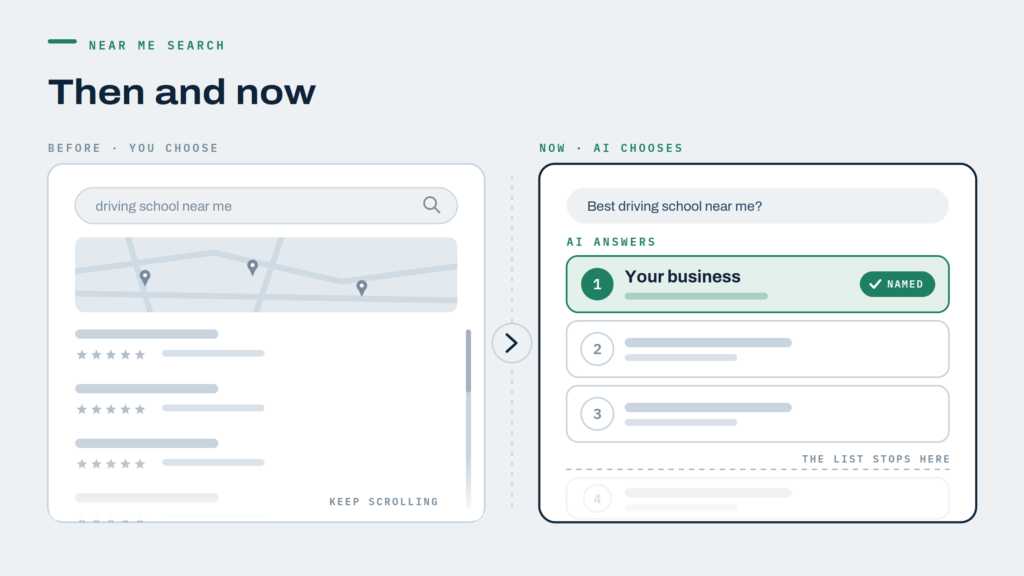
Near me has moved from a list you scrolled to a shortlist the AI speaks aloud.
Before, a near me search returned a map pack and a page of local listings. The customer did the choosing, scrolling through options, comparing reviews, and clicking a few. Being visible meant ranking in that pack, and even a middling position won some attention, because the customer was doing the work of looking.
Now, the AI does the choosing. It answers the question directly with a handful of named recommendations, often with a sentence explaining why one stands out. The customer acts on that shortlist. The work of comparing has moved from the customer to the machine, and the businesses the machine trusts are the ones that win. Being fourth on that list is the same as being invisible, because the list stopped at three.
Why local is different in AI search
Local AI visibility follows the same broad rules as any AI visibility, but three things make it distinct, and understanding them shapes everything you do.
Place is a hard filter. For a near me question, the AI needs to be confident about where you operate. If your location or service area is unclear or inconsistent, you are easy to leave out, because the AI cannot be sure you are relevant to that place. This makes entity clarity even more important locally than it is generally.
Local reputation weighs heavily. For local choices, reviews and local reputation carry a lot of weight, because they are exactly what a person would ask about. The trust signals for AI recommendations that matter everywhere matter even more when the question is which local business is best.
Consistency across sources is decisive. Local information lives in many places, from your website to directories to your Google Business Profile. When all of them agree about who you are and where you work, the AI is confident. When they disagree, it hesitates, and hesitation keeps you out of the answer. Local visibility rewards businesses whose details line up everywhere.
How AI decides which local business to name
It helps to picture what the AI is actually doing when it answers a near me question. It is not ranking a list in the old sense. It is assembling an answer from what it understands and trusts, and a few judgements sit behind that.
First, it works out relevance to the place. Can it confidently connect your business to the area in the question? If your location signals are clear and consistent, yes. If not, you are a risky inclusion, and easy to drop.
Then it weighs quality and trust. Among the businesses it is confident are relevant, which have the reputation to justify a recommendation? Reviews, consistency and corroborating listings all feed this. A business that is clearly relevant but poorly reviewed may still lose to one that is both.
Finally, it favours clarity. Where two businesses are similar, the one whose information is easier to read and quote tends to win, because the AI can describe it confidently. Being the easiest business to understand is a quiet but real advantage in a near me answer.
Put together, these three factors mean local AI visibility rewards diligence over cleverness. There is no trick that beats simply being accurate, consistent and genuinely well regarded in the places you serve. That is good news for honest local businesses, because the advantage goes to the ones that do the unglamorous work well rather than the ones that shout loudest.
The local signals AI leans on
A handful of signals do most of the work in deciding who gets recommended for near me questions. Strengthen these, and you strengthen your local AI visibility.
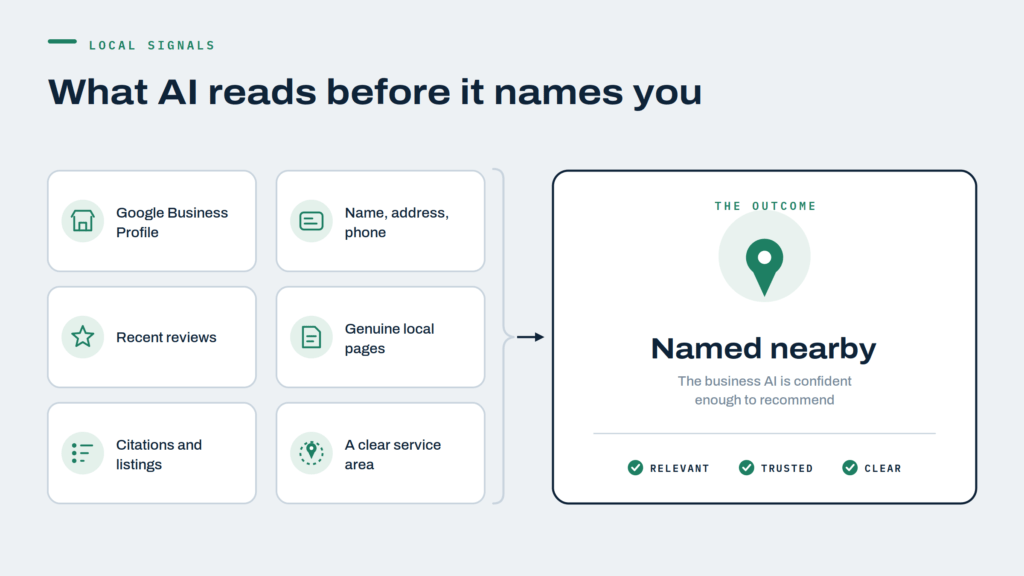
Get these local signals right and you give AI every reason to name you nearby.
Your Google Business Profile. A complete, accurate, active profile is foundational for local visibility. Google’s own guidance on local ranking sets out relevance, distance and prominence as the three factors, and your profile feeds all three. It is also one of the clearest sources AI systems use to understand a local business, so fill it out fully and keep it current.
Consistent name, address and phone. Your core details should be identical everywhere they appear. Inconsistent NAP information is one of the most common reasons a local business is left out of AI answers, because it makes the business harder to pin down.
Reviews. Recent, plentiful reviews that you respond to signal an active, trusted local business. They are among the strongest local trust signals, and they weigh heavily in who gets named.
Local content. Pages that genuinely speak to the places you serve, answering local questions, help AI connect you to those areas. Thin or generic pages do not.
Citations and listings. Consistent entries in relevant directories corroborate your details and location. When several trusted sources agree about you, the AI is more confident naming you. An AI citation audit shows which sources AI is actually drawing on when it describes you.
A clear service area. State plainly where you work, and back it with LocalBusiness schema so the facts are machine-readable. Our guide to schema markup for AI search covers which types matter most. Ambiguity about where you operate is an easy way to be excluded.
How to win near me recommendations
Turning those signals into results follows a clear sequence. None of it requires a big budget, just accuracy, consistency and a bit of genuine local reputation.
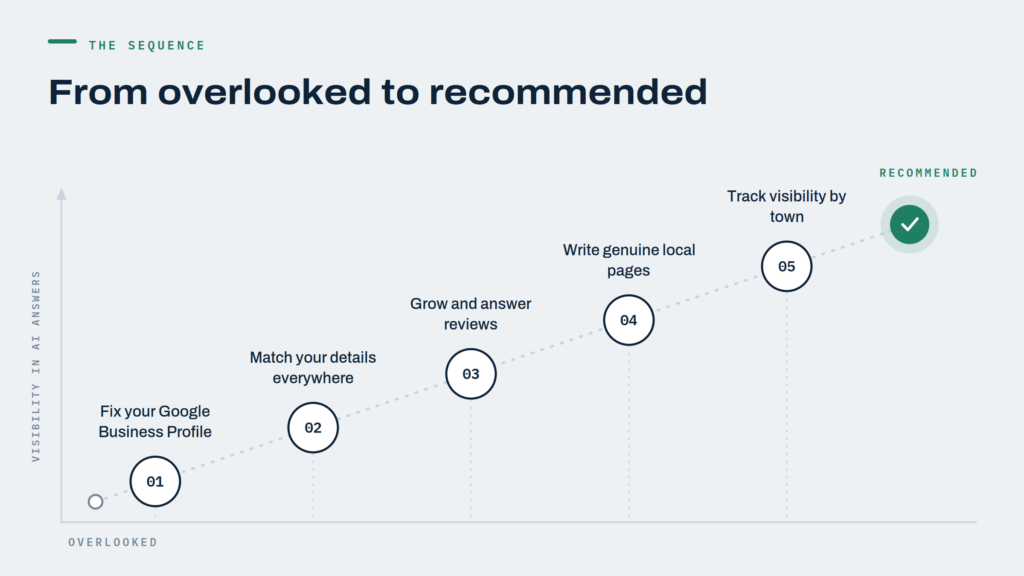
Five steps that move a local business from overlooked to recommended.
- Fix your Google Business Profile. Complete every field, choose accurate categories, add your service area, and keep it active. This is the fastest, highest-value local fix for most businesses.
- Make your details consistent everywhere. Audit your name, address and phone across your site, directories and profiles, and make them identical. Fix every discrepancy you find.
- Grow and answer your reviews. Ask happy customers for reviews, keep them coming steadily, and respond to them. A living stream of recent reviews is a powerful local signal.
- Write genuine local pages. Create pages that answer real questions for the specific places you serve, rather than one generic page. Speak to each area as it actually is.
- Track your visibility by location. Check how you appear for near me questions in each area you serve, so you can see where you are strong and where you are missing.
The starting point, as ever, is to see where you stand. Running an AI visibility audit for your near me questions shows your real local position, and pairing it with prompt research tells you exactly which local questions to target.
Local content that actually works
Local pages are where a lot of businesses go wrong, so they are worth getting right. The instinct is to spin up a page for every town with the same text and the place name swapped in. AI sees straight through that, and so do customers.
A local page that works answers real questions for that specific area. What does the service cost there, what is different about working in that town, what do local customers most often ask? Even a few genuinely specific details, a landmark, a local consideration, a nearby area you also cover, tell the AI the page is really about that place rather than a template.
You do not need dozens of pages on day one. A handful of genuine, useful pages for your most important areas beats a sprawl of thin ones. Build them where the demand is, make each one truly about its place, and let the AI see that you know the area rather than just naming it.
Checking your visibility town by town
If you serve more than one town, a single check hides as much as it reveals. That is the same trap as judging your whole position on one ChatGPT check. You might be strong in your home town and absent two towns over, and only a location-by-location look will show you that.
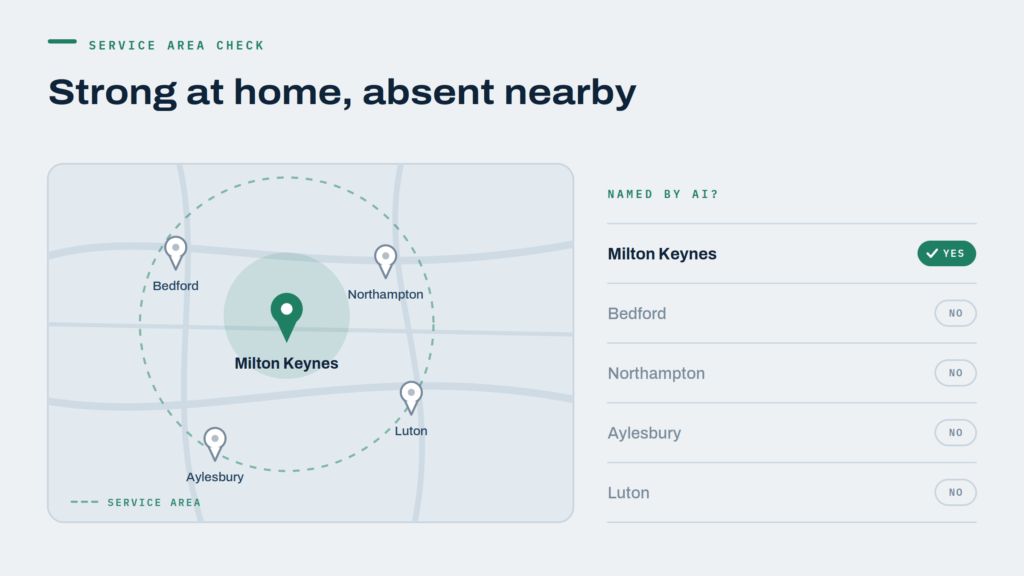
A town-by-town view reveals where you are strong locally and where you disappear.
Run your key near me questions for each area you serve, and record where you appear. Patterns emerge quickly. Often a business is recommended reliably in its home town, where its reputation and content are strongest, and fades in the surrounding areas where it has thinner local signals. Those weaker areas are your clearest opportunities, and comparing yourself against local rivals there, as in an AI competitor analysis, shows you what it would take to win them.
This town-by-town view also stops you wasting effort. Rather than improving everywhere at once, you can focus on the specific areas where a little work would move you from absent to recommended, which is usually where the quickest wins are.
How this differs from old local SEO
Much of this will sound familiar if you have done local SEO, and that is no accident. Local AI visibility rests on many of the same foundations: an accurate profile, consistent details, good reviews, genuine local content. If you have done that work, you are already part of the way there.
But there are differences worth holding in mind. Old local SEO aimed at a ranking in the map pack, a position you could hold and measure. Local AI visibility aims at being named in an answer, which is more binary: you are in the shortlist or you are not, with no comfortable middle positions. The same shift is happening outside local search too, which is why traditional SEO is no longer enough on its own.
The other difference is how the AI reads you. Local SEO could tolerate some messiness, because a human scanning the map pack would still recognise your business. An AI is less forgiving of ambiguity, because it is assembling an answer rather than displaying a list. That raises the premium on consistency and clarity. The good local SEO habits still help. They simply matter more, and sloppiness costs more.
Common mistakes
A few errors quietly undermine local AI visibility, and they are common enough to be worth naming.
Inconsistent details. Different addresses or phone numbers across the web make you hard to pin to a place. This is the single most common local visibility killer, and it is entirely fixable.
A neglected Google Business Profile. An incomplete or out-of-date profile throws away one of the clearest local signals you have. Treat it as a live asset, not a set-and-forget listing.
One generic page for every area. A single page trying to cover ten towns speaks convincingly to none of them. Genuine local pages beat a thin catch-all.
Ignoring reviews. Few reviews, or old ones you never respond to, weaken a signal that matters enormously for local choices. Keep them fresh and engage with them.
Checking only your home town. If you serve several areas, testing only one hides where you are actually missing. Check each town you care about.
A worked example: a Milton Keynes driving school
A driving school based in Milton Keynes also teaches across several surrounding towns. It assumed its local visibility was fine, because when the owner asked an AI about driving schools in Milton Keynes, it appeared. The town-by-town check told a different story.
In Milton Keynes itself, where the school had the most reviews and the clearest presence, it was recommended reliably. In the surrounding towns it taught in, it was largely absent, losing those learners to competitors with stronger local signals there. The business had simply never looked beyond its home town, so it had no idea half its service area was invisible in AI answers.
The fix was targeted. The school made its service area explicit, tidied its details so they matched everywhere, gathered reviews that mentioned the outlying towns, and wrote genuine pages for each area it taught in. Aimed squarely at getting recommended by AI in those specific places, the work steadily moved it into the answers it had been missing. Its home-town strength had masked a gap that, once seen, was straightforward to close. The full numbers from that engagement are in our Milton Keynes driving school case study.
The lesson applies to any multi-area business. Strength in your home base can hide real weakness elsewhere, and because you naturally check the place you know best, the gap stays invisible until you look for it deliberately. A town-by-town view is the cheapest insurance against losing a whole service area without noticing.
Frequently asked questions
What is local AI visibility?
It is how often, and how well, your business appears when people ask AI tools for recommendations in your area. It is the local version of AI visibility, focused on the near me questions that lead to local work.
How do I get recommended for near me searches?
Complete and maintain your Google Business Profile, keep your name, address and phone consistent everywhere, grow and respond to reviews, write genuine local pages, and state your service area clearly. Then track how you appear for near me questions in each area you serve.
Why does consistent information matter so much locally?
For a near me question, the AI needs to be confident about where you operate. When your details agree across your site, directories and profiles, that confidence is high. When they conflict, the AI hesitates, and hesitation keeps you out of the local answer.
Do reviews affect local AI recommendations?
Yes, strongly. For local choices, reviews are among the most important trust signals, because they are exactly what a customer would ask about. Recent, plentiful reviews that you respond to make you a safer business for AI to recommend.
I serve several towns. Do I need to check each one?
Yes. Visibility often varies by area, with a business strong in its home town and weak in surrounding ones. Checking each town you serve reveals where you are missing, and those weaker areas are usually your quickest opportunities.
Be the local name AI gives
Local AI visibility comes down to a simple goal: being the business AI names when someone nearby asks for the best option. That is won not with tricks but with accuracy, consistency and genuine local reputation, the same things that have always made a good local business, now made legible to AI.
Start with the basics that pay off fastest. Complete your Google Business Profile, make your details consistent everywhere, and check how you appear for near me questions in each area you serve. That alone will show you where you stand and where the quickest wins are.
If you would like your local AI visibility assessed and built properly across every area you serve, that is part of our AI optimisation services, and our AI visibility checklist for small businesses is a good companion. Book a discovery call and we will show you where you appear for near me searches, and how to be the name AI gives.
None of this is beyond a small local business. The work is mostly tidying, consistency and reputation, the kind of thing an owner can drive without a large budget. What it takes is the decision to treat AI answers as a place worth being, and the discipline to check now and then that you actually are.