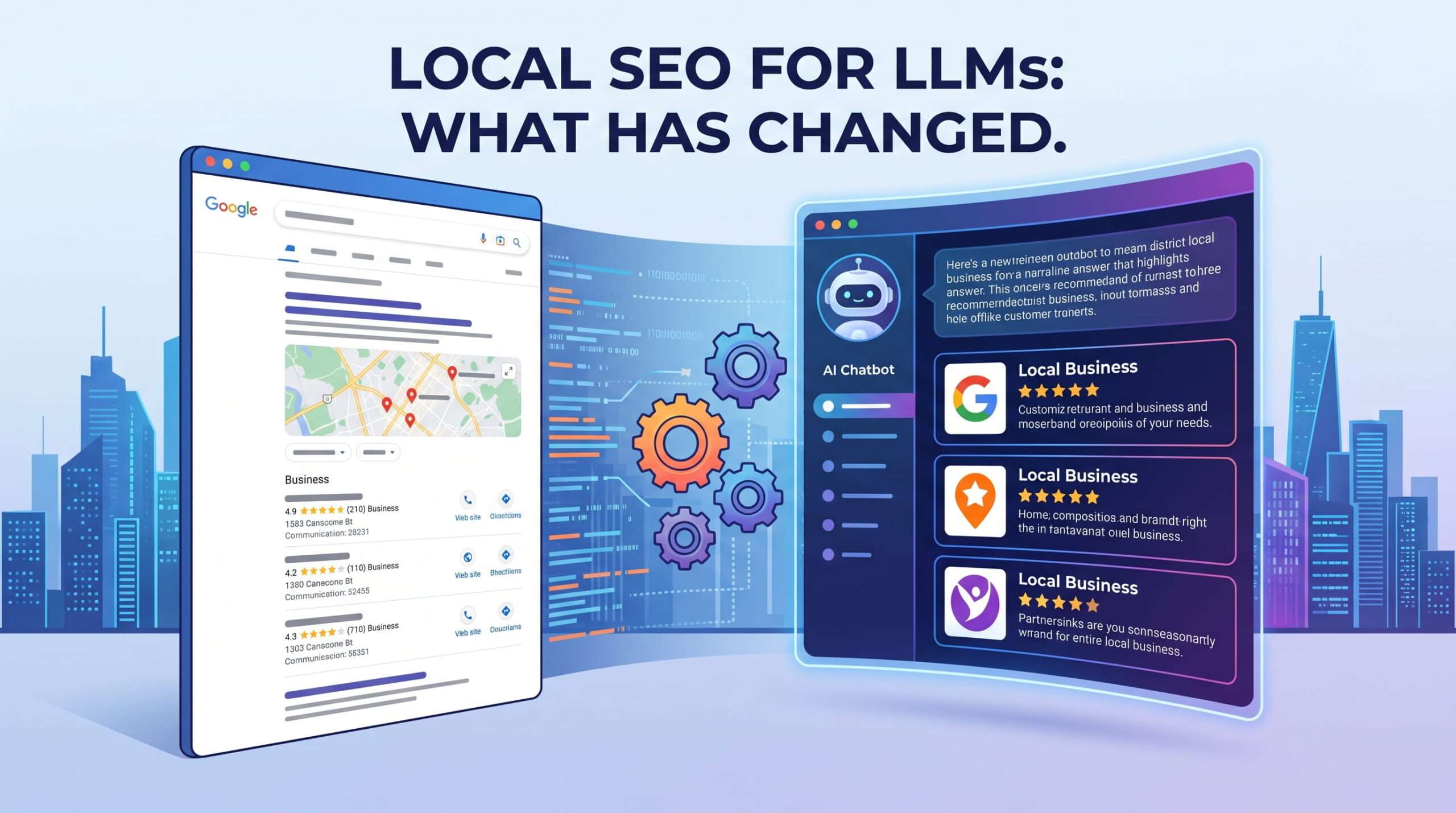
If you have spent years doing local SEO, you have earned a fair question: does any of it still count now that customers ask AI for recommendations instead of scrolling a page of local results? It is a reasonable worry, and the honest answer is reassuring. Almost everything you built still matters. What has changed is where it points and what the AI does with it.
Local SEO has not been swept away and replaced with something unrecognisable. The foundations, an accurate profile, consistent details, genuine reviews, real local relevance, carry straight over. But the goal has shifted from ranking in a list to being named in an answer, and that shift quietly changes the emphasis of the whole discipline. The same ingredients now need to be combined a little differently.
This guide explains what has actually changed about localised SEO in the age of large language models, what carries over untouched, what needs new emphasis, and how to adapt without throwing away the work you have already done. If you know local SEO, this is the update. If you are newer to it, it is a map of where the ground now lies.
Is local SEO dead? No, but it has moved
Let us deal with the dramatic version first, because it gets repeated a lot. Local SEO is not dead. The claim that it is comes from noticing that customers increasingly bypass the map pack, which is true, and leaping to the conclusion that the work behind local visibility no longer matters, which is not.
The reality is subtler. The signals that made you visible in local search, your profile, your consistency, your reviews, are the very same signals AI leans on to decide who to recommend. So the work still counts, it just feeds a different destination. We took apart the wider version of this misunderstanding in why people think SEO is dead, and the local version follows the same logic. The tools of discovery changed. The fundamentals of being a findable, trustworthy local business did not.
So the right frame is not death but migration. Your local SEO has migrated from serving a ranking to serving a recommendation. Understanding that migration is what lets you keep the value of your past work while adapting to how customers actually search now.
What has actually changed
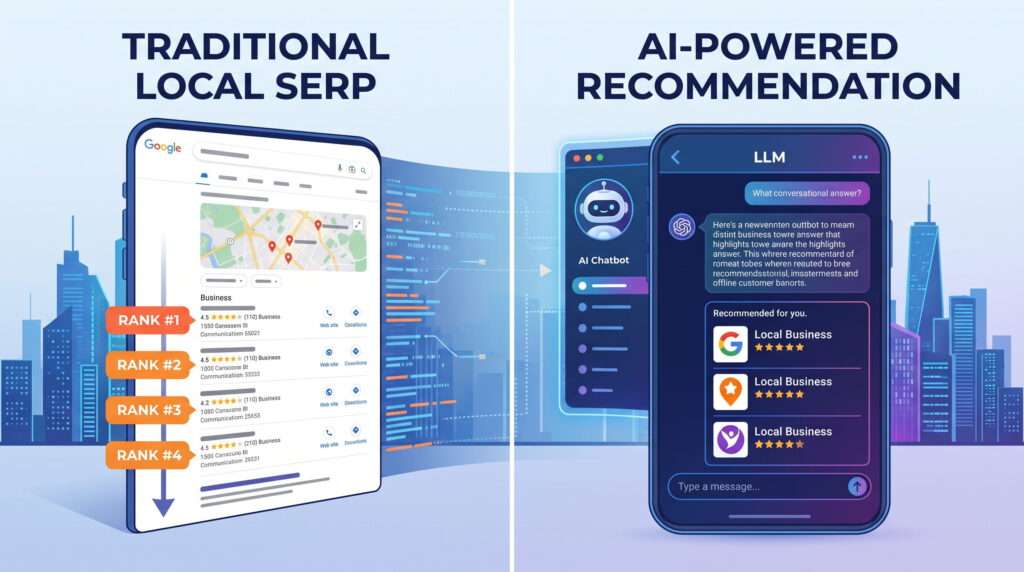
The clearest way to see the shift is side by side. The same local business, the same signals, but a changed goal and a changed set of rules for winning.
The ingredients are familiar. The goal, the unit and the rules have shifted.
The goal moved from ranking to being named. In local SEO, you aimed for a position in the map pack. In local AI visibility, you aim to be one of the businesses the AI actually names in its answer. The unit changed too, from a keyword to a full question, because people ask AI complete, natural questions rather than typing fragments, a point we cover in how to find the exact prompts your customers ask AI.
The rules for winning shifted with them. In the map pack, the highest-ranked nearby business tended to win, and being fifth still earned some clicks. In an AI answer, the most trusted and clearest business wins, and being fifth usually means being left out entirely, because the answer named three. Perhaps most importantly, messy data changed from a tolerated nuisance to an active liability. A human scanning the map pack forgave small inconsistencies. An AI assembling an answer uses them as a reason to leave you out.
What still works
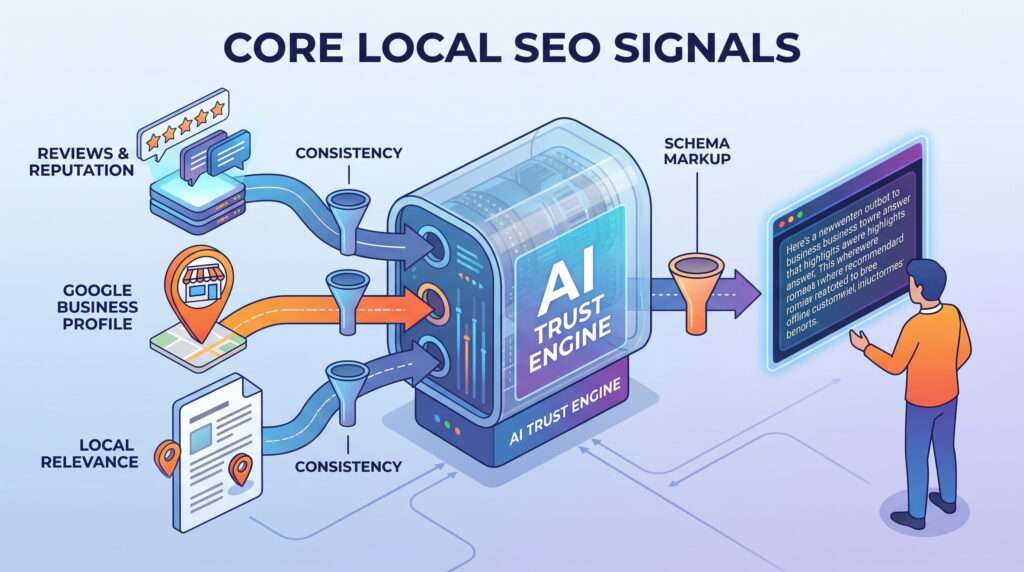
Start with the good news, because it is substantial. Most of the local SEO fundamentals carry over untouched, and if you have done them well, you are already a long way toward local AI visibility.
The local SEO foundations carry over. A few areas simply need new emphasis.
Your Google Business Profile. Still one of the clearest, most valuable local signals there is. A complete, accurate, active profile helps both search and AI understand your business. If anything, its importance has grown, because it is a source AI trusts for local facts.
Consistent name, address and phone. Still essential, and now more so. Consistency across your site, directories and profiles is what lets an AI confidently connect you to a place, and it underpins the entity recognition that decides whether you are relevant to a near me question.
Genuine reviews. Still one of the strongest local signals, and central to the trust signals AI weighs when choosing which local business to recommend. Recent, plentiful reviews you respond to matter as much as they ever did, arguably more.
Local relevance. Still fundamental. Content and signals that genuinely tie you to the places you serve remain the basis of local visibility. What has changed is how that relevance needs to be expressed, which brings us to what is new.
What is genuinely new
Alongside the familiar foundations, a few things now carry much more weight than they did in classic local SEO. These are where the discipline has genuinely moved, and where most of the adaptation happens.
Answering full questions. Because people ask AI complete questions, your content needs to answer them directly rather than target keyword fragments. A page that plainly answers what a customer asks, in their words, is far more useful to an AI than one stuffed with local keywords. This is the heart of structuring content so AI systems can extract and use it, applied locally.
Machine-readable clarity. Stating your facts in a form machines can read directly, through LocalBusiness schema markup, matters much more now. It removes the ambiguity that would otherwise keep you out of an answer. In classic local SEO this was a nice-to-have. For LLMs it is close to essential.
Being cited, not just ranked. In local SEO you wanted a high position. In local AI visibility you want your pages to be the source the AI uses, which is a subtly different and often higher bar. And consistency across sources has gone from good practice to a decisive factor, because the AI reads all your sources at once and treats disagreement between them as a reason to hesitate. Where local SEO forgave a little mess, LLMs punish it.
The pattern to notice is that nothing here contradicts good local SEO. The new-emphasis items are extensions of the same instincts, expressed for a machine reading an answer rather than a person scanning a list. If the old work was about being findable and trustworthy, the new work is about being unmistakable and quotable, which is the same virtue taken one step further.
The biggest shift: from ranking to being named
If you take one thing from all of this, take this. The defining change is the move from ranking to being named, and it changes the psychology of the whole exercise. Ranking was a spectrum, a position you could hold, improve and measure in small steps. Being named is closer to binary. You are in the answer or you are not.
That binary quality raises the stakes at the top and lowers the value of the middle. In a ranked world, steady incremental gains paid off, because moving from position eight to position five won you more clicks. In an AI answer that names three businesses, the gap between third and fourth is the gap between everything and nothing. This is a large part of why traditional SEO is no longer enough on its own for local businesses.
The practical consequence is that you should aim to be unambiguously among the best few options for the questions you care about, not merely respectable. Half-measures that would have earned a middling ranking can leave you off the shortlist entirely. It sounds harsh, but it also rewards focus: being genuinely excellent for a handful of important local questions beats being mediocre across many.
Why the migration favours patient businesses
There is a pattern in who wins as local SEO migrates to LLMs, and it is worth naming. The businesses that come out ahead are rarely the ones chasing the newest tactic. They are the ones that quietly kept their profile accurate, gathered honest reviews, and described themselves consistently, year after year. AI simply reads that diligence and rewards it.
This matters because it sets the right expectations. There is no shortcut that beats being a genuinely good, clearly described local business. The migration has not opened a loophole for the clever. It has raised the value of the unglamorous work that separates reliable businesses from careless ones. If that sounds like your business, the shift is on your side.
It also means the worst thing you can do is panic and tear up what works. Every time a new trend arrives, some businesses abandon their fundamentals to chase it, and lose the very signals that were carrying them. The steadier move is to keep the base intact and extend it, checking the evidence before you drop anything that was already working.
Three myths worth clearing up
A few persistent myths get in the way of adapting sensibly. Each contains a grain of truth wrapped around a wrong conclusion.
Each myth starts from a real observation and draws the wrong conclusion.
“Local SEO is dead.” It is not. It is the foundation AI builds its local recommendations on. Abandoning it removes the very signals that get you named.
“Rankings are all that matter.” Rankings still help, but being named in an AI answer now matters as much or more, and the two do not always move together. A business can rank well and still be absent from AI answers if its content and consistency are weak.
“AI ignores small businesses.” The opposite is often true. AI favours clear, trusted, well-described local businesses, which means a focused small business can beat a larger, messier competitor. Size is not the deciding factor. Clarity and trust are.
How to adapt your local SEO for LLMs
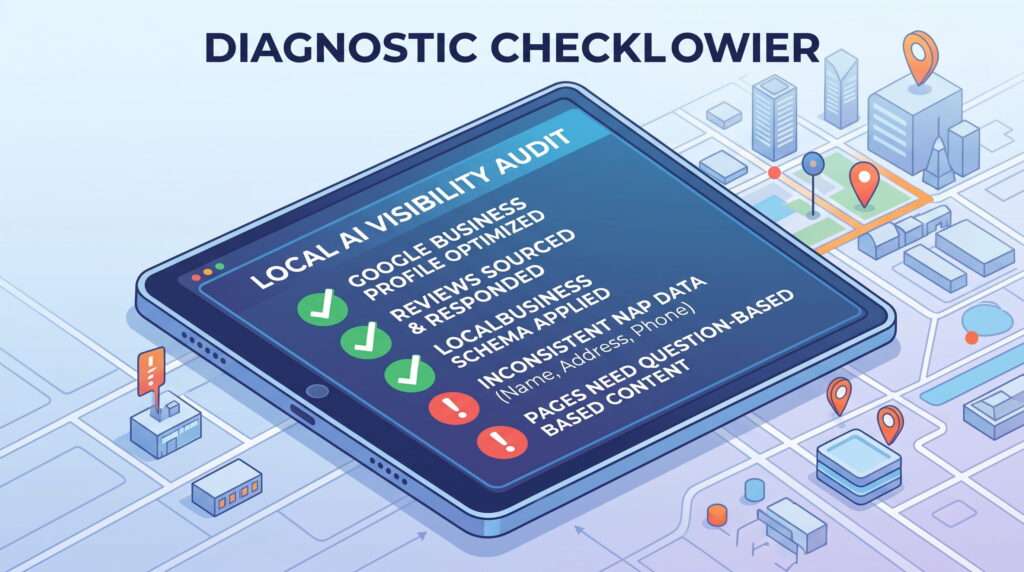
Adapting does not mean starting over. It means building on your existing local SEO with a few shifts of emphasis. Here is the sequence.
Extend your local SEO rather than replacing it. Five shifts do most of the work.
- Keep the basics strong. Maintain your Business Profile, your consistent details and your reviews. These still carry you, so do not neglect them while chasing what is new.
- Rewrite for questions. Turn keyword-targeted pages into pages that answer the real questions customers ask, plainly and early, in natural language.
- Add structure. Mark up your business, services and location with LocalBusiness schema, so your facts are machine-readable and unambiguous.
- Unify your data. Audit every place your details appear and make them agree. Eliminate the inconsistencies that give an AI a reason to leave you out.
- Measure in AI, not just search. Start checking how you appear in AI answers, not only where you rank, so you are measuring the destination that now matters.
The natural first move is to see where your adapted local SEO actually leaves you, which is what running an AI visibility audit is for. It shows you whether your local signals are translating into AI recommendations, and where they are not.
Where to focus first
If you cannot do everything at once, order matters. Some adaptations pay off faster than others, and starting in the right place saves effort.
Fix consistency first. Auditing and unifying your name, address and phone across every source is usually the highest-value, lowest-effort move, because inconsistency is the most common reason a local business is left out of AI answers.
Then strengthen your profile and reviews. These are foundational signals that help immediately, and most businesses can improve them quickly with a little consistent effort.
Then rewrite your most important pages. Focus on the handful of questions that drive the most valuable work, and make those pages answer them plainly. Add schema as you go rather than as a separate project.
Doing these in order means each step stands on the last, and you see results from the quick wins while the deeper content work takes effect. It also stops you spreading effort thinly across everything and finishing nothing, which is the most common way good intentions go to waste.
What this means for your existing work
If you have been doing local SEO well, the message is encouraging: you are not behind, you are well positioned. Your profile, consistency and reviews are exactly the assets that matter, and you mostly need to extend them rather than replace them. The businesses that struggle are usually the ones that neglected the basics, not the ones adapting from a solid base.
If you have not kept up with local SEO, the good news is that the fundamentals and the AI-era emphasis can be built together, so you are not doing two separate jobs. Everything points in the same direction: a clear, consistent, well-reviewed, genuinely local business that answers real questions. That description wins in both worlds, which is why the practical steps for AI visibility overlap so heavily with good local SEO.
A worked example: a Belfast chauffeur company
A chauffeur company in Belfast had solid local SEO. It ranked well for its main terms, had a tidy Google Business Profile, and a healthy stream of reviews. When AI search began to matter, the owner worried all that work was now wasted, and considered starting from scratch.
It was not wasted. When the company checked its AI visibility, the profile and reviews were already helping, and it appeared in some answers. The gaps were exactly the new-emphasis items. Its pages targeted keywords rather than answering the full questions customers asked, it had no schema, and a couple of directories listed an old address. None of these were failures of local SEO as it used to be practised. They were simply the places where the discipline had moved on.
The fix built on the foundation rather than replacing it. The company rewrote its key pages to answer real questions, added LocalBusiness schema, and corrected the inconsistent listings. Its existing profile and reviews did the rest, and it moved from appearing occasionally to being named reliably. The lesson was the one this whole article makes: good local SEO is not obsolete, it is the base you adapt from, and adapting is far quicker than starting again. Consistent, honest work compounds, exactly as it always has, and holding on to the fundamentals under the pressure of a new trend is what keeps it compounding.
It is worth noting what the company did not do. It did not abandon its rankings work, did not chase every new tactic, and did not assume its past effort was wasted. It checked, kept what worked, and extended it. That calm, evidence-led response is usually the right one when a discipline shifts under your feet, and it beats both complacency and panic.
Frequently asked questions
Is local SEO still worth doing?
Yes. The signals that made you visible in local search, an accurate profile, consistent details and genuine reviews, are the same ones AI uses to decide who to recommend locally. Local SEO now feeds AI recommendations as well as search rankings, so it is more relevant, not less.
What has actually changed for local SEO with LLMs?
The goal moved from ranking in the map pack to being named in an AI answer. Content needs to answer full questions rather than target keywords, machine-readable structure matters much more, and consistency across sources has become decisive rather than merely helpful.
Do I need to throw away my old local SEO work?
No. Most of it carries straight over. You extend it: rewrite pages to answer real questions, add schema, and make your data consistent everywhere. You are building on a solid base, not starting again, which makes adapting far quicker than people expect.
Why does data consistency matter more now?
An AI reads all your sources at once and treats disagreement between them as a reason to hesitate. Where a human scanning the map pack forgave small inconsistencies, an AI assembling an answer uses them to leave you out. Consistent details across every source removes that risk.
Can a small local business compete?
Very much so. AI favours clear, trusted, well-described local businesses over larger but messier ones. A focused small business that answers real questions and keeps its data clean can be named ahead of bigger competitors, because clarity and trust matter more than size.
Adapt, do not abandon
Localised SEO has not been replaced by something alien. It has evolved, from serving a ranking to serving a recommendation, and the fundamentals that made you a findable local business still make you a recommendable one. The task is to extend good local SEO, not to abandon it, and businesses that already do the basics well are closer than they think.
Start by checking how your current local signals translate into AI answers. Keep your profile, consistency and reviews strong, then rewrite for real questions, add structure, and unify your data. Each of those builds on work you have likely already done, which is why adapting is quicker and less daunting than the headlines suggest.
If you would like help mapping your existing local SEO onto what AI search now rewards, that is part of our AI optimisation services. Book a discovery call and we will show you what carries over, what needs new emphasis, and how to be named in the answers that matter. The businesses that thrive through this migration are rarely the ones with the biggest budgets. They are the ones that kept their heads, protected their fundamentals, and adapted steadily, which is a game any diligent local business can win.