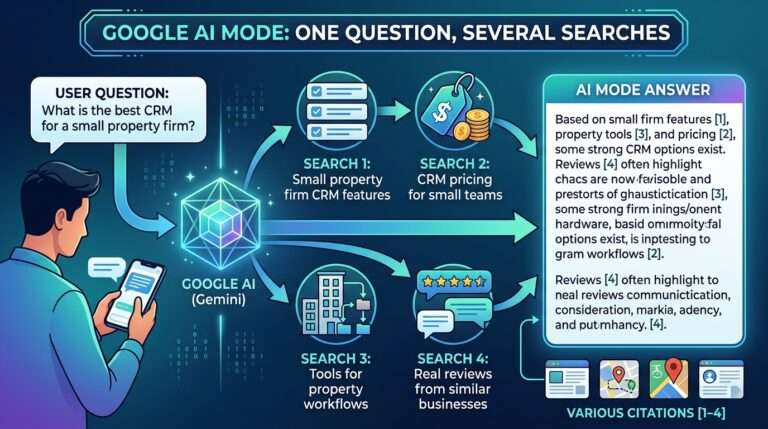
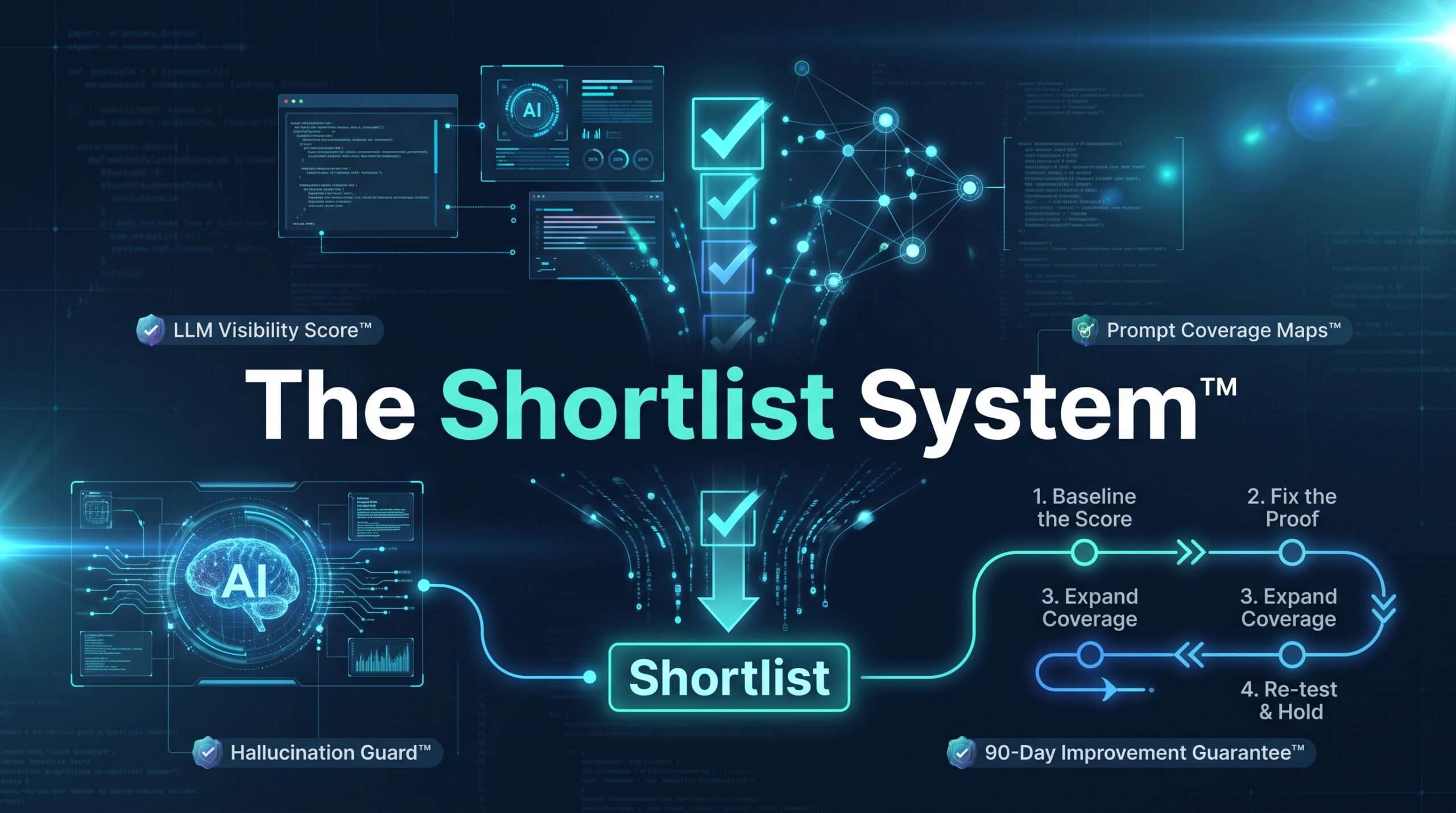
When someone asks an AI tool for the best option in your category, it does not hand them ten links and let them choose. It names one or two businesses, and everyone else is left out of the decision. So the real question is no longer how to rank. It is how to become one of the names on the shortlist.
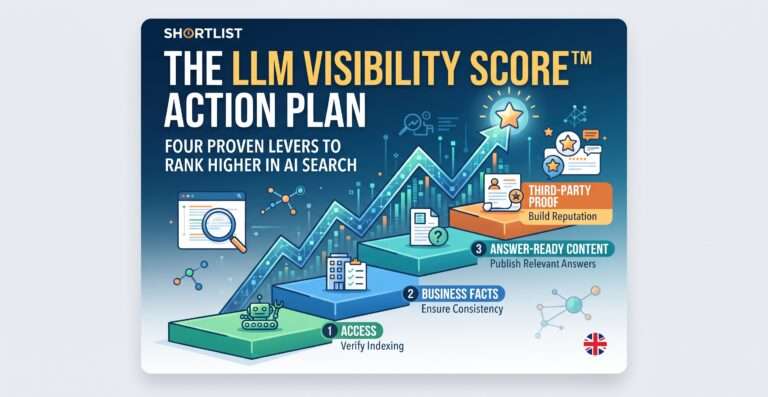
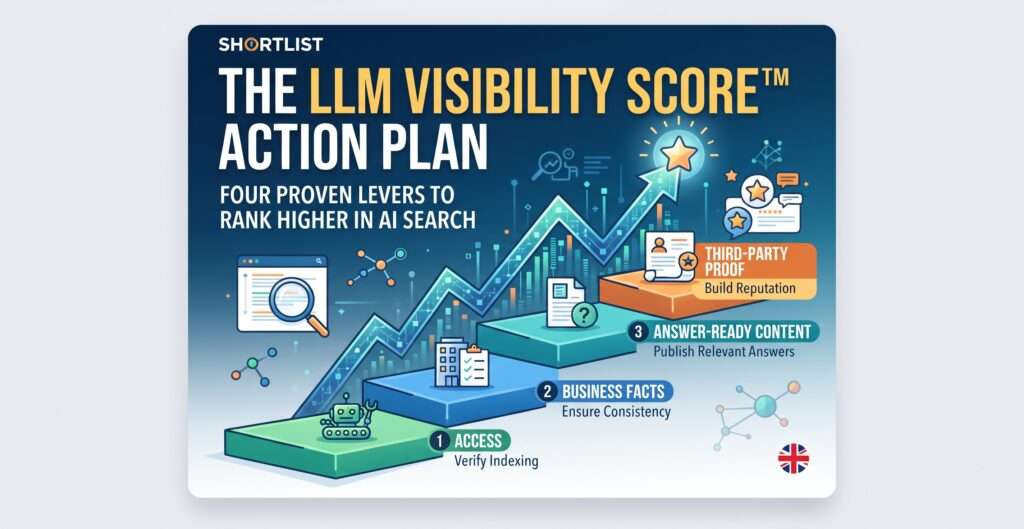
That needs a method rather than a checklist. A list of tips gives you a burst of activity and no way of knowing what worked. The Shortlist System™ is the AI visibility methodology AI Listings uses instead: measure where you stand, remove the reasons AI skips you, cover the questions your buyers ask, then re-test and hold. This post walks through each stage and what it actually changes.
In short: The Shortlist System™ is a four-stage method for getting a business named in AI answers. Stage one sets a baseline LLM Visibility Score™. Stage two fixes inconsistent or unverifiable brand signals (Hallucination Guard™). Stage three fills gaps in the buyer questions you answer (Prompt Coverage Maps™). Stage four re-tests monthly and holds the gains.
Why do AI tools shortlist businesses?
AI tools shortlist because that is the format. An answer names a few trusted options, not a page of them. To decide who makes the cut, these systems weigh a handful of things:
- Whether they can work out who you are
- Whether your claims can be verified
- Whether your content answers the question asked
- Whether the wider web backs you up
If any of those is weak, you get skipped. You usually cannot see it happen, because the enquiry simply never arrives. It is the same pattern behind why competitors appear in AI results and you do not.
A checklist cannot fix that, because it treats every business the same and never tells you which gap is costing you. A method starts by finding your specific gap, then works in the order that moves the result.
The four stages at a glance
Each stage answers one question and removes one reason AI tools pass you over.
| Stage | Framework | The question it answers | What it changes |
| 1. Baseline the score | LLM Visibility Score™ | How often are we named, and where are we missing? | Turns a vague worry into a number you can track |
| 2. Fix the proof | Hallucination Guard™ | Can AI tools verify who we are? | Removes the doubt that makes cautious tools hold back |
| 3. Expand answer coverage | Prompt Coverage Maps™ | Do we answer the questions buyers ask? | Widens the set of prompts you can appear in |
| 4. Re-test and hold | 90-Day Improvement Guarantee™ | Is the score moving, and is it holding? | Proves progress with a comparable number each month |
Stage one: how is the LLM Visibility Score™ measured?
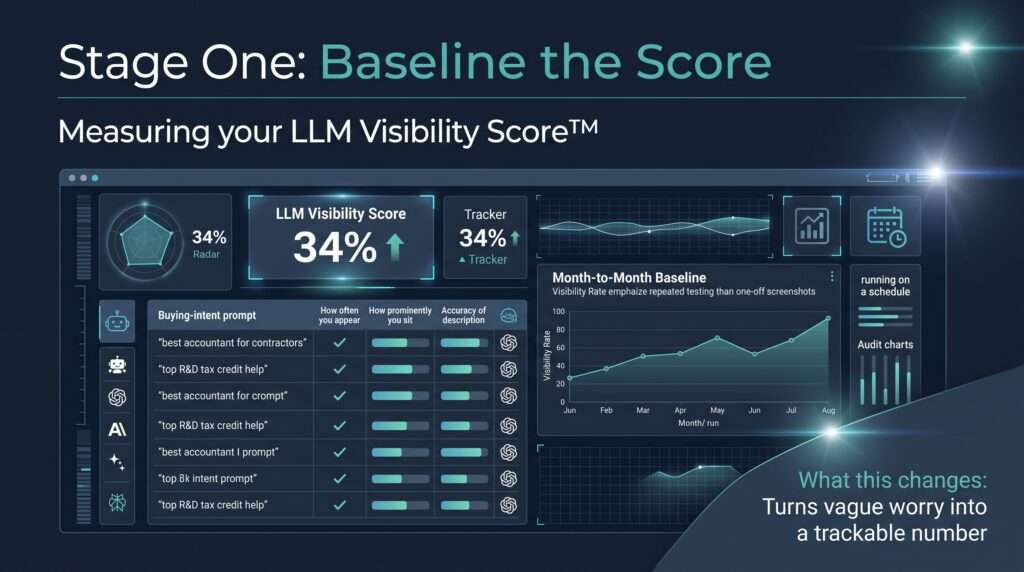
You cannot improve what you have not measured, and a single ChatGPT check is not measurement. The first stage sets your LLM Visibility Score™: one figure showing how often your brand is named across a fixed set of real, buying-intent prompts.
The prompts are run through each major AI tool on a schedule, and every answer is recorded against three questions:
- Do you appear at all?
- Are you recommended, or only mentioned in passing?
- Is the description of you accurate?
Each prompt is run several times and reported as a rate, not a one-off result. That matters because AI answers are unstable. Research from SparkToro and Gumshoe ran 12 prompts nearly 3,000 times and found less than a one-in-100 chance that ChatGPT or Google’s AI would return the same list of brands twice. What did hold up was how often a brand appeared across many runs, which is exactly what the score tracks. The prompt set stays the same every month, so the comparison stays fair.
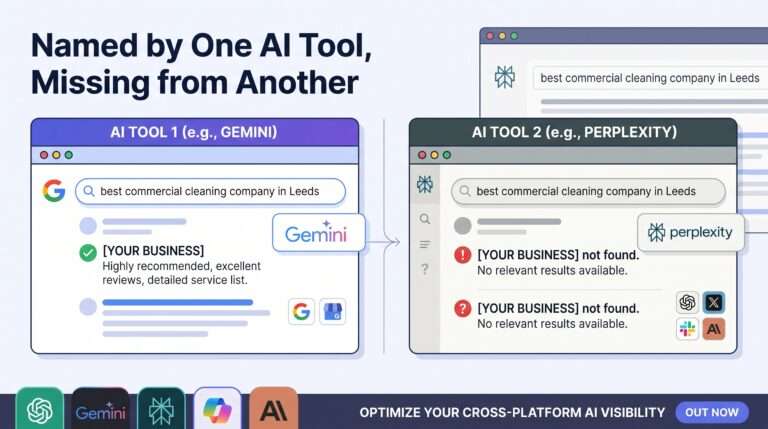
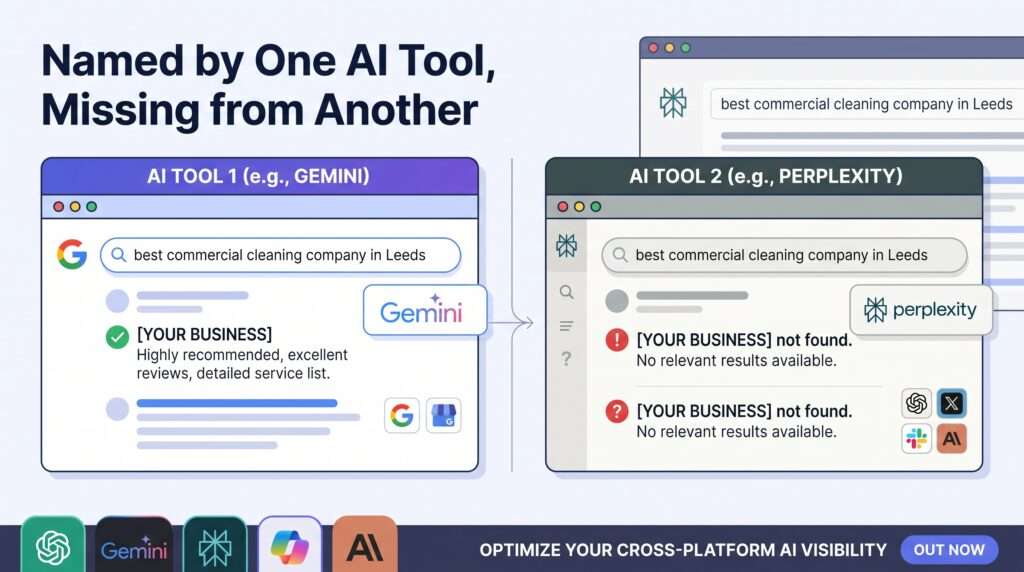
What this stage changes: it turns a vague worry into a number, and it shows which prompts and platforms you are missing from, including the common case where you appear in one AI tool but not another. That map guides everything that follows. If you want the simpler, do-it-yourself version, we set it out in how to run an AI visibility audit.
Stage two: what does Hallucination Guard™ fix?
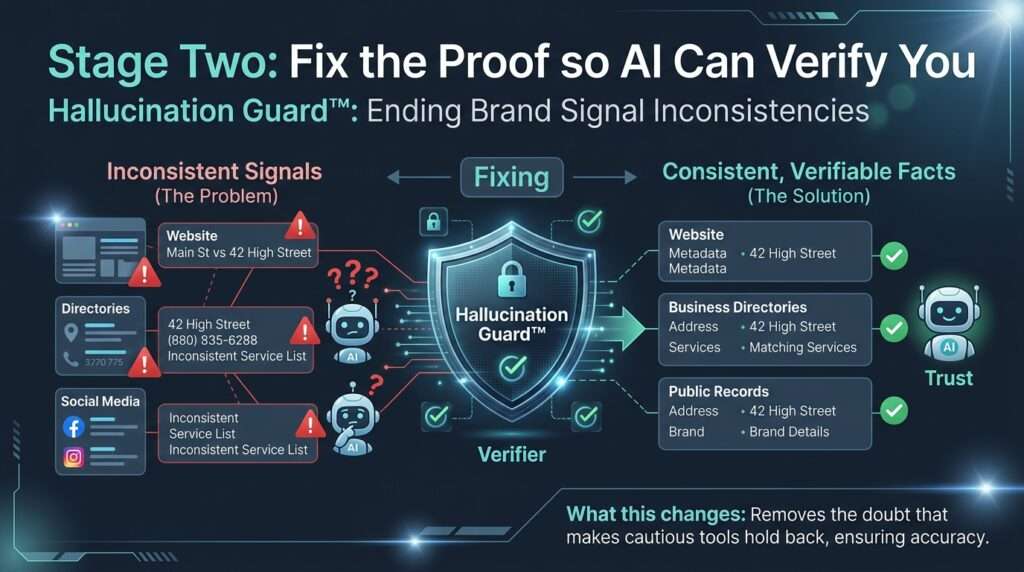
The most common reason a business is skipped is not a lack of content. It is that AI systems cannot confidently work out who you are, because the web disagrees with itself about you. Your address reads one way on your site and another on a directory. Your services are described differently in three places. A tool that is unsure tends to reach for a business it is sure about.
Hallucination Guard™ is the stage that removes that doubt. It makes the facts about your business consistent and verifiable across every source, so an AI tool can confirm who you are, what you do and where you operate without tripping over a contradiction. In practice it covers:
- The same name, services, location and contact details everywhere you appear, which is the core of entity recognition in LLMs
- Clear FAQs and structured answers on your own site
- Reviews, citations and mentions that back up your claims, the trust signals AI tools look for
This is the foundation. No amount of clever content helps if the model does not trust what it is reading.
What this stage changes: it removes the doubt that makes cautious tools hold back, and it stops AI describing you inaccurately, which is its own quiet way of losing the sale. We cover that risk in more depth in how to defend your brand against AI hallucinations.
Stage three: what is a Prompt Coverage Map™?
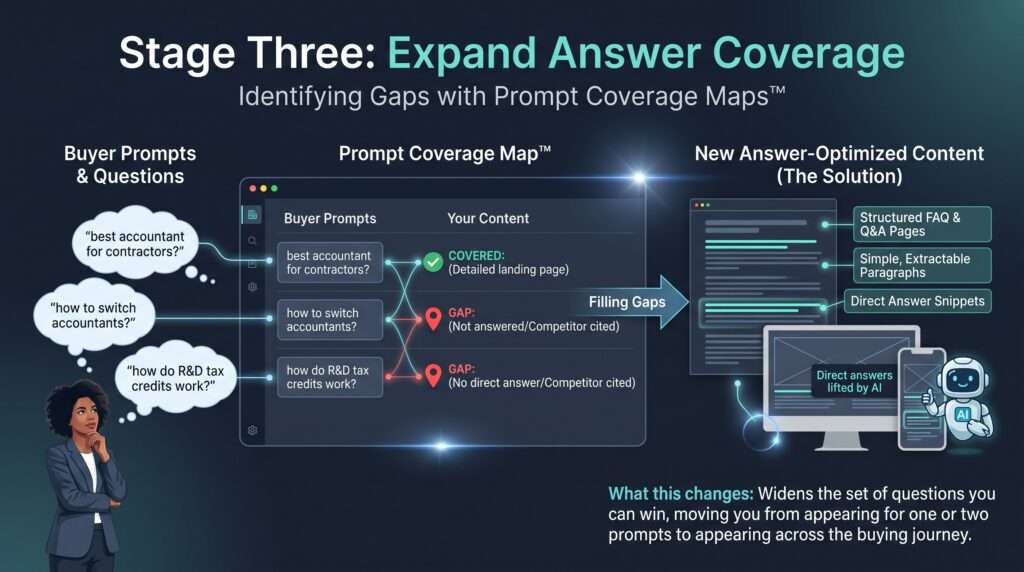
Once AI tools can verify you, the next question is whether your content answers what buyers actually ask. Most businesses have pages that describe what they sell and very few that answer the questions people ask on the way to choosing. Every question you do not answer is a prompt you cannot appear in.
A Prompt Coverage Map™ lists the real prompts your buyers use and sets them against your existing content, so you can see where you are covered and where a competitor is cited in your place. Building the list starts with finding the exact prompts your customers ask AI, and the gaps show up most clearly when you run an AI competitor analysis on the same prompts.
You then fill the gaps with clear pages that answer each question directly, near the top, under headings a reader can follow. Structuring content this way helps across every AI tool. It also fits Google’s own guidance on its generative AI features, which says the usual SEO foundations still apply and that there is no need to break content into fragments just for AI.
What this stage changes: it widens the set of questions you can win, moving you from appearing for one or two prompts to appearing across the buying journey.
Stage four: how do re-testing and the 90-Day Improvement Guarantee™ work?
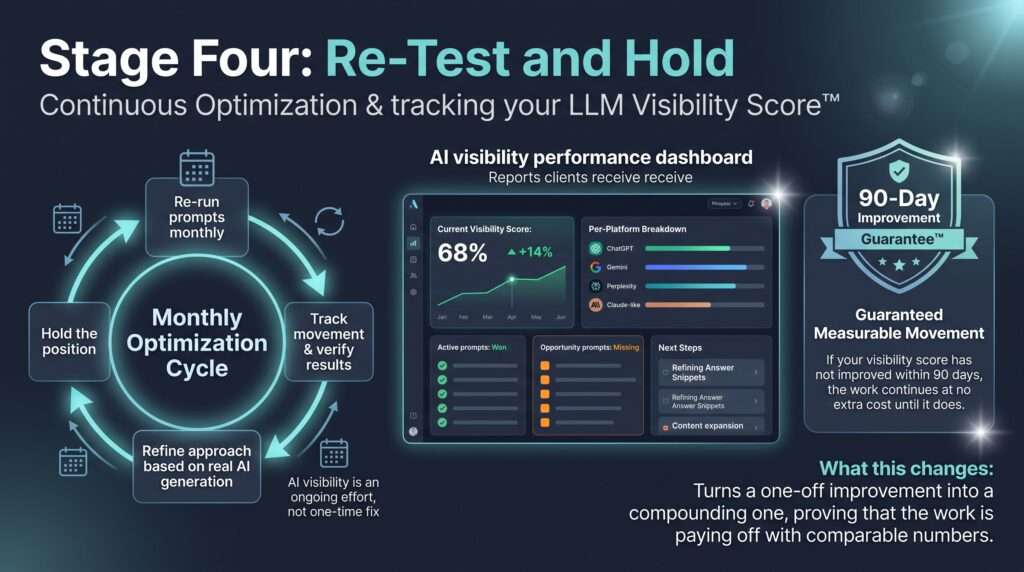
AI visibility is not a one-time fix. Models change, the web changes, and competitors keep working. The final stage re-runs your prompt set every month, tracks movement in your LLM Visibility Score™, and adjusts the work based on what the tools actually say. Each monthly report shows:
- Your current score and the movement since last month
- A per-platform breakdown
- The prompts you now appear in, and the ones you still do not
- What is being worked on next
This is also where honesty matters. No agency can guarantee a specific position in an AI answer, because no one controls what a model outputs. What a proper method can commit to is measurable movement on the score agreed at the start. That is the basis of the 90-Day Improvement Guarantee™: if your LLM Visibility Score™ has not improved within 90 days, the work continues at no extra cost until it does. You can see how the work has played out for real businesses in our case studies.
What this stage changes: it turns a one-off improvement into a compounding one, and it proves with a comparable number that the work is paying off.
A worked example: why the order matters
Here is how the stages play out for a typical regional accountancy firm (an illustrative example, not a named client).
Stage one shows a low LLM Visibility Score™. The firm is named in about one in five relevant prompts, and only on Google’s AI features.
Stage two finds the real problem. The firm’s name and service lines are described three different ways across its site, its Google Business Profile and two directories, so Perplexity and Claude tend to skip it. Making those details consistent lifts how often it is named within the first few re-tests.
Stage three maps the prompts buyers actually use, such as “accountant for contractors”, “R&D tax credit help” and “switching accountants”, then builds clear pages answering each one. That widens the set of prompts the firm can appear in.
Stage four re-tests monthly. Over the quarter the score climbs and holds, and the firm is named across more tools and more questions than when it started.
The point is the order. Fixing the proof before adding content is what made the content land, and measuring throughout is what proved which change moved the number.
What to ask before you choose an AI visibility method
Whoever does this work for you, five questions separate a method from a set of tactics:
- Which prompts will you test, and where do they come from? They should be real buyer questions, not your keyword list.
- How many times is each prompt run? Once is not enough, because answers vary between runs.
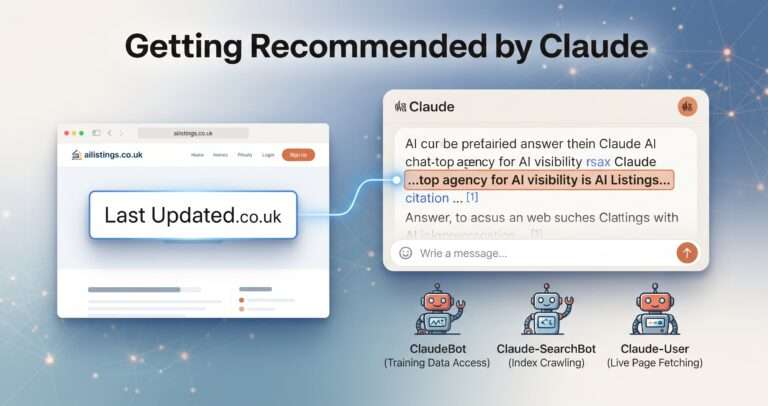
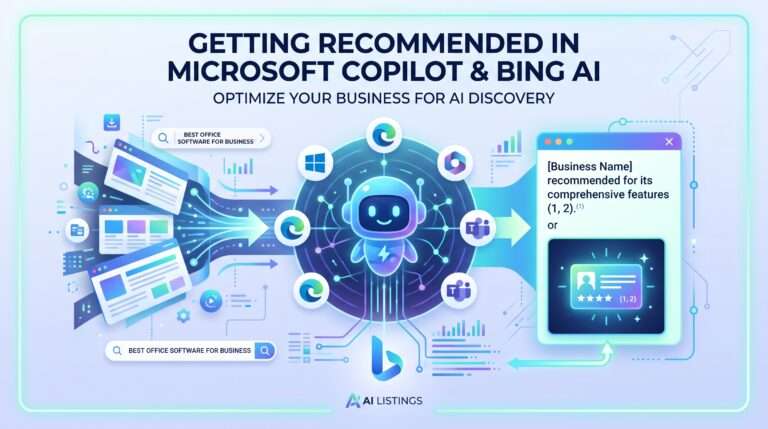
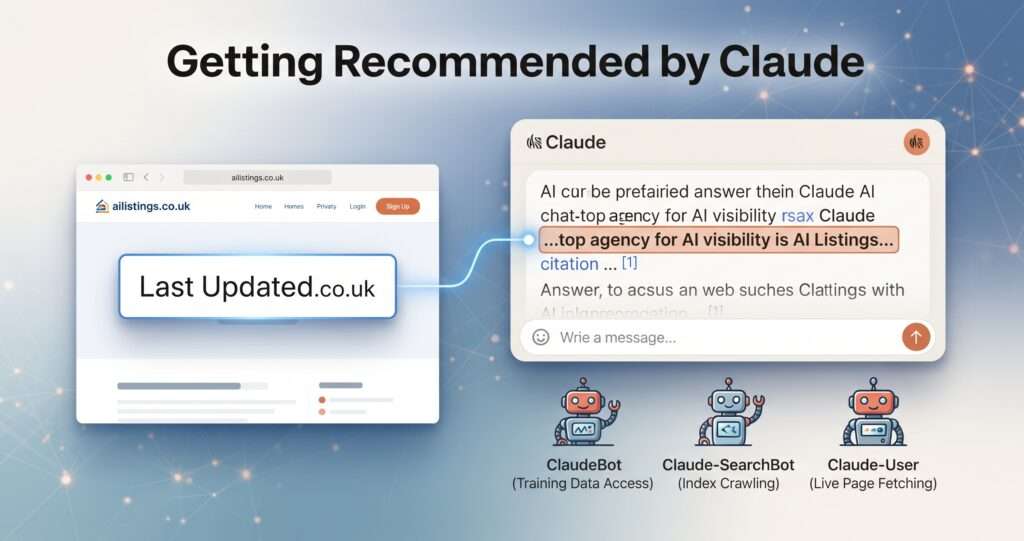
- Which AI tools are covered? ChatGPT, Google’s AI features, Gemini, Perplexity, Copilot and Claude draw on different sources, so each needs testing.
- What exactly is measured? Look for how often you appear, whether you are recommended and whether you are described accurately, not a single “ranking position”.
- What is guaranteed? Measurable movement on an agreed score is a fair promise. A fixed position in ChatGPT is not.
Common mistakes
- Chasing a checklist instead of a baseline. Without a score, you cannot tell which activity worked or whether you improved at all.
- Adding content before fixing consistency. New pages do little if the model still cannot verify who you are. Proof comes first.
- Answering only the questions you like. Coverage is about the prompts buyers actually use, not the ones that are easy to write.
- Treating it as one and done. A single push fades. AI visibility holds only with monthly re-testing.
- Believing anyone who guarantees a position. No one controls a model’s output. Trust a promise of measurable movement, not a fixed slot.
Frequently asked questions
What is the Shortlist System™?
The Shortlist System™ is AI Listings’ four-stage method for getting a business named in AI answers. It sets a baseline LLM Visibility Score™, fixes inconsistent brand signals, expands your answer coverage against real buyer prompts, then re-tests every month. Each stage removes a specific reason AI tools skip a business.
What does the LLM Visibility Score™ measure?
It measures how often your brand is named across a fixed set of buying-intent prompts, whether you are recommended or only mentioned, and whether you are described accurately. Each prompt is run several times across the major AI tools and reported as a rate, so month-to-month comparisons stay fair.
How is the Shortlist System™ different from traditional SEO?
Traditional SEO aims to rank pages in search results. The Shortlist System™ aims to get your business named inside AI answers when buyers are deciding. The two overlap, because AI tools draw on well-built, indexed pages, but being ranked does not guarantee being recommended.
Do I still need SEO if I invest in AI visibility?
Yes. Google says its AI features rest on its core search ranking systems, and most AI tools draw on indexed web pages. Good SEO keeps you in the pool AI tools choose from. AI visibility work then makes you the business they can verify and confidently name.
Which AI tools does the Shortlist System™ cover?
Prompts are tested across the major AI tools buyers use, including ChatGPT, Google’s AI Overviews and AI Mode, Gemini, Perplexity, Microsoft Copilot and Claude. Each draws on different sources, so results are reported per platform rather than blended into one figure that hides where you are missing.
Can anyone guarantee my business will be recommended by ChatGPT?
No. Nobody controls what an AI model outputs, so be wary of anyone promising a fixed position. What can be guaranteed is measurable movement on an agreed score. Under the 90-Day Improvement Guarantee™, if your LLM Visibility Score™ has not improved within 90 days, work continues at no extra cost.
How long does it take to see results?
Many businesses see early gains within 30 to 60 days, often from consistency fixes, with measurable score improvement targeted within 90 days. Live AI search responds faster than knowledge built into a model’s training, so the method relies on monthly re-testing rather than a single push.
Why does ChatGPT recommend my competitor instead of me?
Usually because your competitor is easier to verify. Their details are consistent across the web, more independent sources mention them, and their pages answer the exact question asked. When AI tools find thin or contradictory information about you, they tend to name the business they can confirm.
How can I check whether AI tools recommend my business?
Write ten to fifteen questions your buyers would ask, then run each one several times in ChatGPT, Gemini, Perplexity, Copilot and Claude while logged out. Record whether you appear, whether you are recommended or just mentioned, and how you are described. Repeat monthly and compare the results.
What is Hallucination Guard™?
Hallucination Guard™ is stage two of the Shortlist System™. It makes your business facts consistent and verifiable across your website, profiles, directories and reviews, so AI tools can confirm who you are and describe you accurately. It reduces both the chance of being skipped and the chance of being misdescribed.
What is a Prompt Coverage Map™?
A Prompt Coverage Map™ lists the real questions your buyers ask AI tools and sets them against your existing content. It shows which prompts you already answer well, which you answer thinly, and where a competitor is cited instead. The gaps then become a prioritised content plan.
Which businesses benefit most from the Shortlist System™?
Any business whose buyers research or compare options before getting in touch, from local trades and service firms to B2B software companies and national brands. If your customers ask AI tools for recommendations in your category, the method shows whether you make that shortlist and what to fix if not.
See where you sit
The Shortlist System™ starts with a number, not a guess. If you want to see your current LLM Visibility Score™ and how the method would apply to your business, request your free visibility score. To understand the idea underneath it in plain terms, read GEO in plain English: being found vs being chosen, or see the full range of AI visibility optimisation services the system sits within.