A look under the hood at how Perplexity selects, ranks and cites the sources behind its answers, and what that means for your pages.
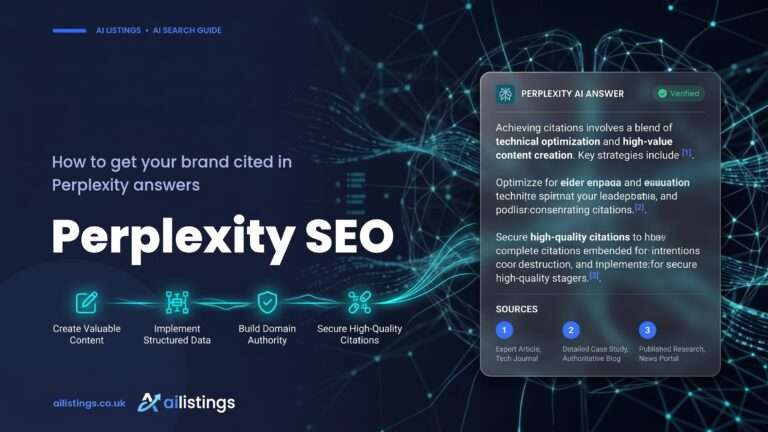
Ask Perplexity a question and you do not get a page of links. You get a written answer with small numbered citations beside each claim, and a list of the sources it used. That transparency is unusual, and it is useful, because it means you can study exactly which pages it rewards and start to work out why. This guide opens the box on how Perplexity chooses its sources and citations, from the moment you press enter to the finished, cited answer.
None of this is guesswork dressed up as certainty. Perplexity does not publish its full ranking formula, and anyone who claims to know the exact weights is overstating it. What follows is the well documented shape of the system, drawn from Perplexity’s own materials and from careful analysis of its answers. If you have ever wondered why you do not appear in AI results even when you rank well on Google, understanding this process is where the answer starts. It sits behind the work we do across AI visibility optimisation.
The one idea to hold on to
Perplexity is built on retrieval augmented generation, usually shortened to RAG. In plain terms, it does not answer purely from memory. It retrieves live information from the web first, then uses a language model to write an answer grounded in what it just found, citing as it goes. If you want the underlying concept in general terms, IBM has a clear explainer of retrieval augmented generation. The practical consequence is simple but important: your visibility is decided by retrieval and ranking on each query, not by a fixed position stored somewhere.
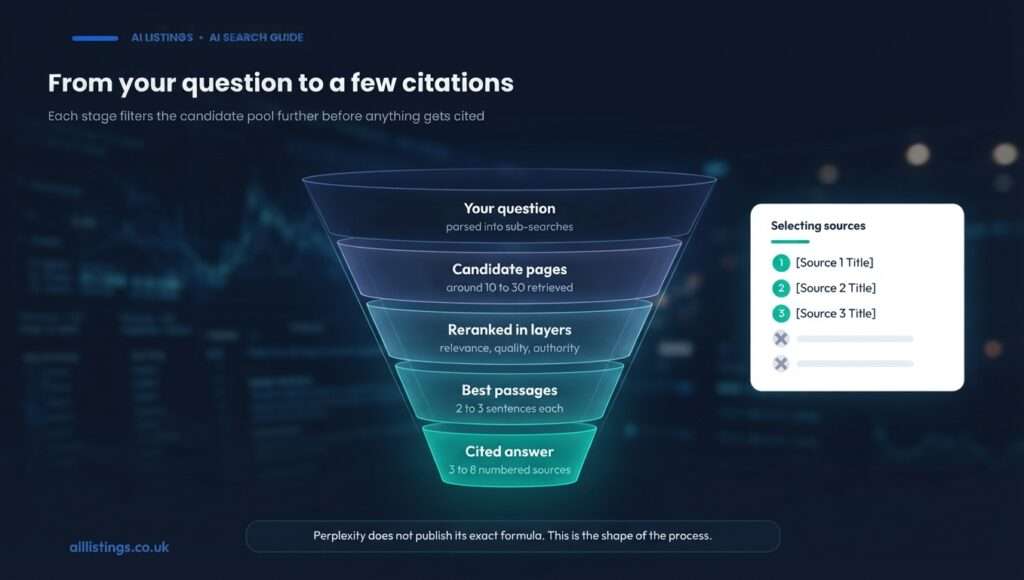
It helps to see the whole journey before we walk through it. Every answer moves through the same broad stages, and each stage filters the pool of possible sources down further, so that only a small number survive to be cited.
Stage one: understanding the question
Before Perplexity searches for anything, it interprets your question. It works out what you are really asking, whether the answer needs fresh information, and what shape the answer should take, be it a definition, a comparison, a list or a current event. A coding question, a news question and a buying question are handled differently from the start.
For anything beyond the simplest query, it also breaks your question into several narrower sub-questions and searches for each one separately. This is worth remembering, because it changes what you are competing for. You are not trying to be the best page on a huge topic. You are trying to be the clearest source for one specific part of the question, and a focused page often wins that on merit.
To make that concrete, a question such as which is the best CRM for a small UK law firm and what it costs might be split into parts: the leading options, how well they suit small law firms, typical UK pricing, and perhaps integrations or support. Perplexity searches for each strand and may cite a different source for each one. A page that nails the pricing strand alone can earn a citation alongside pages that handle the rest.
Stage two: gathering the candidates
Next, Perplexity retrieves candidate pages from the live web. It searches in two complementary ways at once: by matching keywords, and by matching meaning using numerical representations of text, so a page can be pulled in even if it does not use your exact words. Its candidate set is drawn from its own index, built by its crawler, alongside partner web results, and it typically gathers somewhere in the region of ten to thirty pages to consider.
There is a hard gate before this stage that many businesses miss. A page can only be a candidate if Perplexity can actually reach and read it. That means being crawlable and indexable, allowing Perplexity’s crawler in your robots.txt, and loading quickly enough to be fetched while the answer is being built. You can see the current crawler details in Perplexity’s own documentation. This is also where classic technical health pays off, because the same foundations that support strong SEO are what make you eligible here in the first place. If Perplexity cannot fetch your page, nothing else in this guide matters.
Speed deserves a special mention here. Perplexity assembles its answers under a tight time budget, so a page that is slow to respond can be skipped even when its content is ideal. Core technical hygiene, meaning fast responses, clean HTML and content that is present without waiting for scripts to run, is not a nice-to-have on this surface. It is a condition of entry.
Stage three: the reranking layers, where most pages are dropped
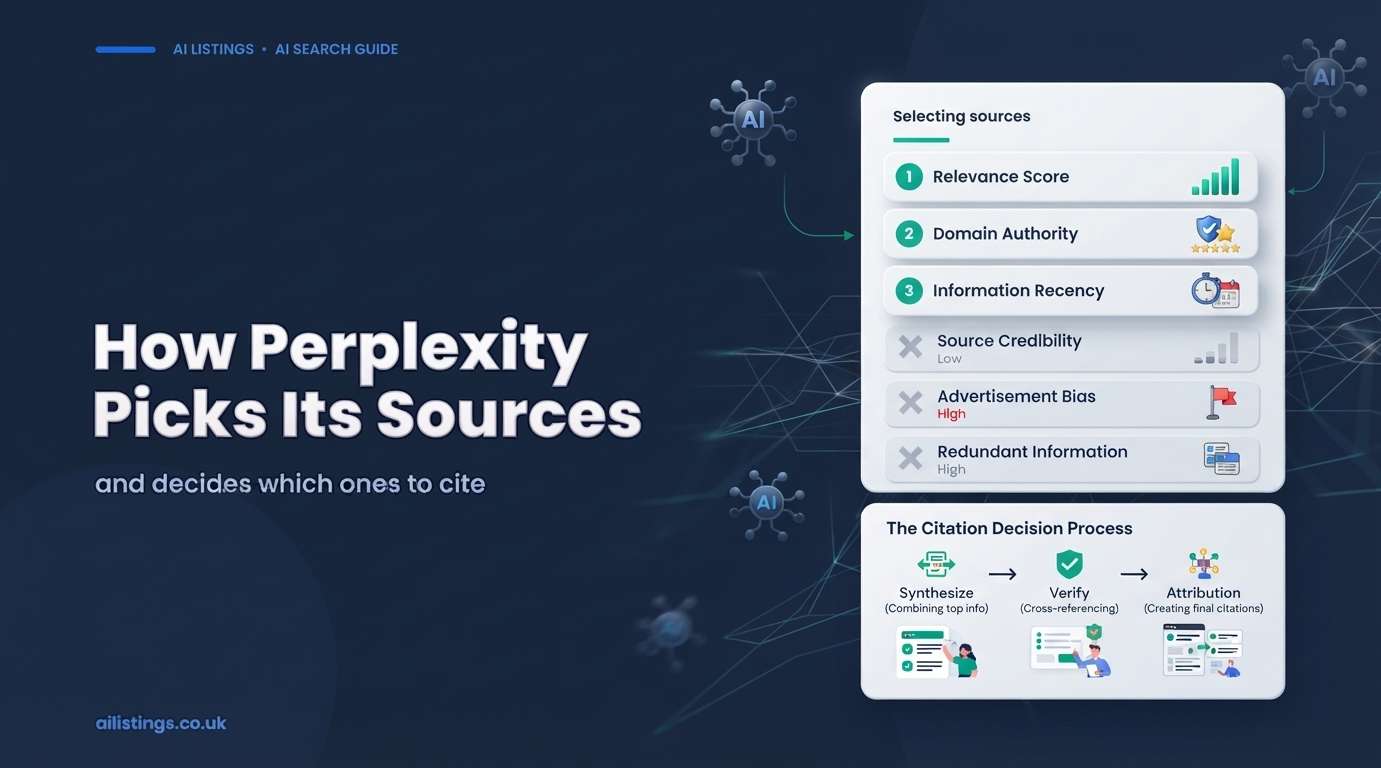
Gathering candidates is the easy part. The reranking stage is where the real selection happens, and where most candidate pages are eliminated. Rather than a single score, Perplexity applies several layers in sequence, each with a different job, and a page has to clear a quality bar to move on.
- Relevance, by meaning. The first pass keeps pages that genuinely address the specific sub-question, judged on meaning rather than keyword overlap alone.
- Quality and structure. A closer pass rewards pages that are clearly written and easy to extract from, and filters out thin, muddled or off-topic content.
- Authority, entity and freshness. A final pass weighs how trustworthy the source is, how confidently it can be tied to a known entity, and how recent it is. Entity clarity and genuine trust signals both do real work here, and Perplexity has one of the strongest preferences for recent content of any AI search tool.
The result is that two pages answering the same question can meet very different fates. The one that states its answer plainly, is up to date and comes from a trusted source is kept. The one that buries its answer, has not been updated in years and reads as a wall of text is dropped, even if it is technically about the same subject.
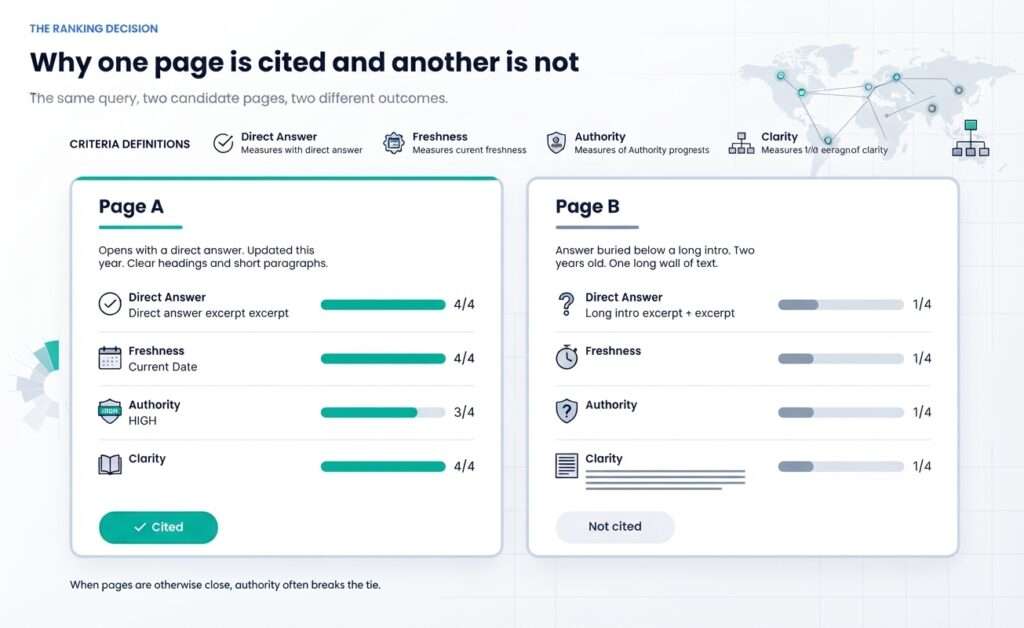
When two pages are otherwise close, authority tends to act as the tie-breaker. That is why the off-site picture, the reviews and mentions that build your credibility, quietly influences on-site outcomes.
It is worth knowing how strict this filtering is. Candidates that fall below a quality bar tend to be dropped rather than simply ranked lower, so a page that is merely adequate often does not appear at all. There is also evidence that Perplexity applies a degree of domain-level weighting, leaning towards sources it has learned to treat as reliable, which is why building a consistent track record on a topic compounds in your favour over time.
Stage four: writing the answer and attaching citations
The surviving sources are handed to a language model along with your question. It writes a coherent answer and attaches a numbered citation to each claim, mapping the statement back to the page it came from. Perplexity runs on a mix of models, and its more capable modes let some users pick between them, but the search and citation layer is the constant.
One detail matters for how you write. Compared with a tool like ChatGPT, Perplexity is more literal. It is more likely to lift a discrete, self-contained passage from a single page when that passage mirrors the question closely, then attribute it. So a clean sentence that answers the question directly has a real chance of being quoted more or less as written. This is the practical heart of answer engine optimisation, and it is why structuring your content for extraction pays off so directly.
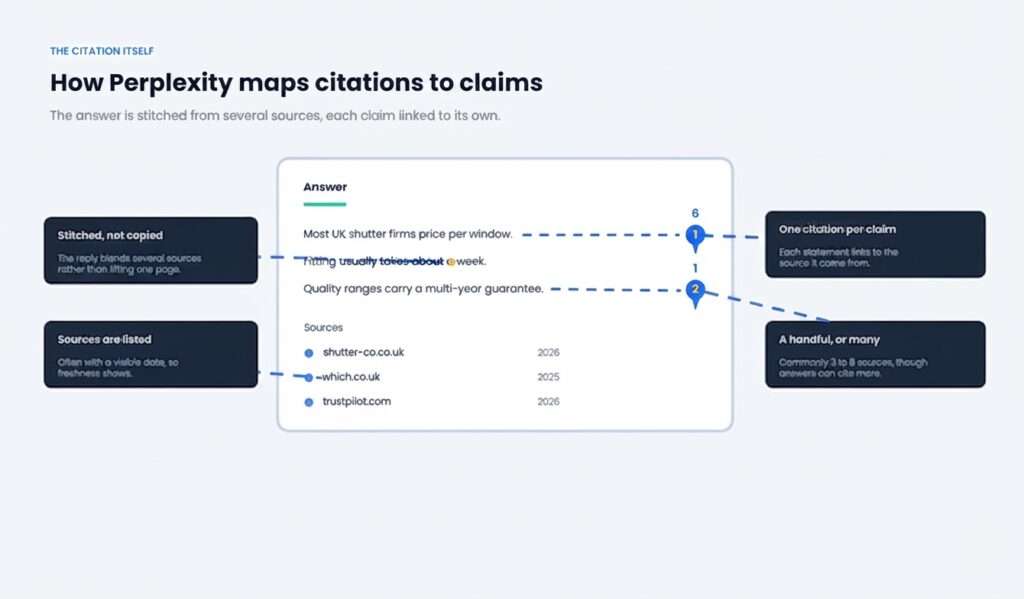
As for how many sources appear, Perplexity leans most on a small set, commonly in the region of three to eight, though a broad question can reference many more. The takeaway is encouraging: because it cites several sources rather than crowning a single winner, there are multiple openings in every answer.
Placement matters too. Information near the top of a page, sitting directly under a clear and relevant heading, is easier for the model to connect to the question, so front-loading your key answer tends to improve not just whether you are cited but how prominently.
Why it cites many sources, and why that helps you
Perplexity is closer to a researcher than a ranking engine. It blends several sources into one answer, which is the essence of generative engine optimisation. Two things follow. First, you do not need to rank first to be cited. Analyses of large numbers of citations have found that most cited pages are not the single top organic result, and plenty are not on the first page at all. Being clearly the best answer to a narrow sub-question is often enough.
Second, corroboration counts. A claim that several independent, trustworthy sources agree on is safer for the model to include, which is part of why some businesses appear again and again in AI answers while others never surface. The goal is not simply to be found. It is to be chosen, and being chosen is a product of clarity, trust and consistency working together.
The kinds of sources it leans on
Not every source has an equal chance, and the mix shifts with the type of question. For factual and definitional queries, Perplexity tends to favour reference sites and established, authoritative publications. For buying and comparison queries, it leans more heavily on trust: review platforms, credible directories and independent roundups, and it draws notably on community discussion, where real people weigh up options in their own words. The lesson for a business is that your presence beyond your own website is part of being cited. Being visible and well regarded on the platforms your buyers already trust, and understanding how customers find businesses through AI search, feeds directly into whether Perplexity treats you as a safe source to name.
Why the same question gives different answers
If you ask Perplexity the same thing twice, you may get two slightly different answers with different sources. That is not a fault. Because it retrieves live on every query rather than reading a cached ranking, small differences in what it fetches and how it composes the reply lead to variation.
This has a clear implication for measurement. Checking a single answer once tells you very little. The reliable approach is to track a set of the questions your customers actually ask, on a schedule, and record how often your brand is cited over time. That is exactly what an LLM visibility score is for, and it turns a noisy signal into something you can manage.
What this means for your pages
Put the mechanics together and a practical picture emerges. To be chosen, a page needs to be reachable, relevant to a specific question, clearly answered up front, backed by extractable facts, trusted and recent. The same picture, read in reverse, explains why good pages get passed over.
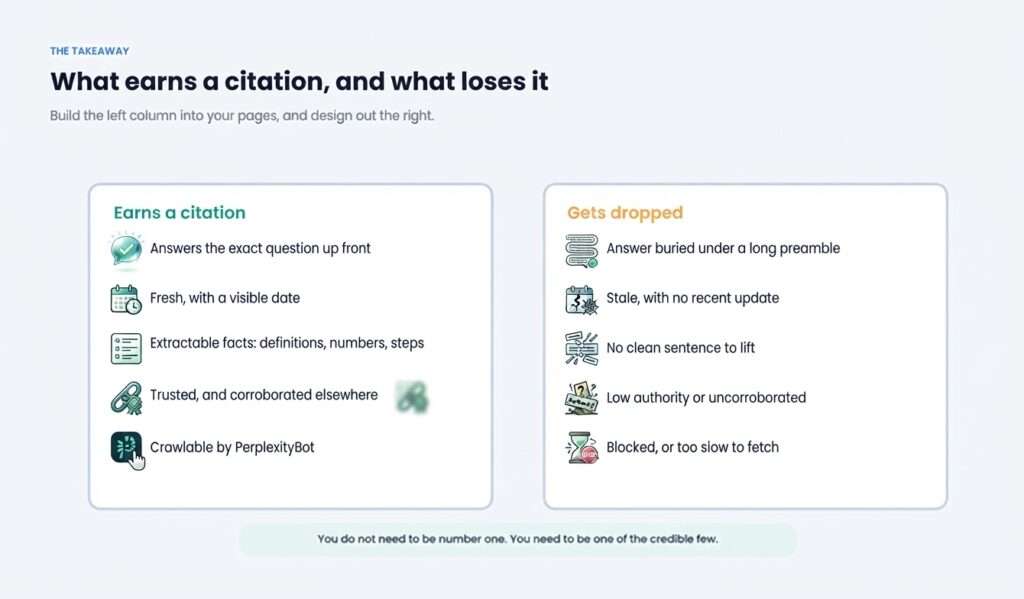
None of this requires tricks. It requires being genuinely the clearest, most trustworthy answer to the questions that matter to your customers, and making that easy for a machine to see. That is the discipline behind our Shortlist System: build the evidence, page by page, until a careful model is comfortable putting you forward.
It also means the work is cumulative rather than a one-off fix. Each page you make clearer, each genuine review you earn and each inconsistency you tidy up raises your odds a little, across many questions at once. Businesses that treat AI visibility as an ongoing habit, checking the questions that matter and improving the weakest pages first, tend to pull steadily ahead of competitors who treat it as a single project.
Common misconceptions
- It is just Google rankings. No. Perplexity runs its own retrieval and reranking. A strong Google position helps, but it is a separate surface with its own rules.
- More words mean more citations. No. Length is not the point. Extractable evidence is: definitions, numbers, comparisons and steps that can be lifted cleanly.
- You must be number one to be cited. No. Perplexity pulls from a wide pool, and a focused page can be cited without ranking at the top.
- Blocking AI crawlers is the safe default. For most businesses it means losing the channel entirely. If you want to be cited, you have to let Perplexity in.
- One check tells you where you stand. No. Answers vary between runs, so a single look is misleading. Track the important questions over time.
Frequently asked questions
How many sources does Perplexity cite in an answer?
It varies with the question. Perplexity leans most heavily on a small set of sources, commonly somewhere in the range of three to eight, but a broad or complex query can reference many more. The useful point is that several sources are cited in every answer, so there is more than one opening on any given question.
Does Perplexity copy my text or rewrite it?
A bit of both, and it leans more literal than some other tools. It tends to lift a clean, self-contained passage that closely matches the question and attribute it, rather than heavily paraphrasing across many pages. That is why a direct, quotable sentence near the top of a relevant page is so valuable: it gives Perplexity something clear to use and credit.
Do I need to rank number one in Google to be cited?
No. Perplexity retrieves and reranks its own candidate pool, drawn from its index and partner results, so a top Google ranking is a helpful tailwind rather than a requirement. A focused page that answers a specific sub-question clearly can be cited even without a leading position.
Why did Perplexity cite me yesterday but not today?
Because it retrieves live on every query, its answers are not fixed. Small differences in what it fetches and how it composes the reply can change which sources appear from one run to the next. This is normal, and it is why you should measure citation frequency over time rather than trusting a single result.
Can I see how Perplexity is choosing in my own case?
Yes, to a degree. Ask it the questions your customers ask and read the sources it cites: you will quickly see the kinds of pages it rewards for your topics. Do that across your priority questions, repeat it on a schedule, and you have a practical, evidence-based picture of where you stand and what to fix first.
See how Perplexity is choosing for your business
Perplexity is one of the most transparent surfaces in AI search, which makes it one of the most improvable. Once you understand that citations are earned through reachability, relevance, clarity, trust and freshness, the path stops being mysterious and starts being a checklist you can work through.
If you would like to see which sources Perplexity is citing for the questions that matter to you, and where your brand is missing, we can map it across Perplexity and the other major tools. That is the starting point for our Perplexity SEO work, and you can book a discovery call whenever you are ready to see your own numbers.