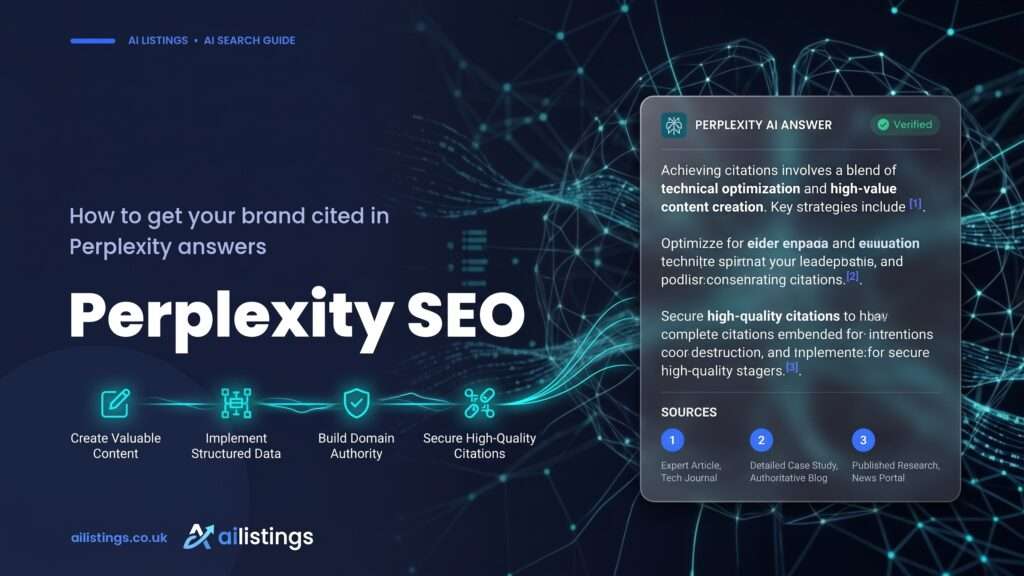

As AI-powered search becomes more common, businesses are starting to realise that visibility is no longer only about ranking on Google. Large Language Models (LLMs) such as ChatGPT, Gemini, Claude, and Perplexity now influence how people discover companies, services, and recommendations online.
These systems rely heavily on something called entity recognition. In simple terms, this is how AI understands that your business is a real, trusted, and identifiable brand connected to certain services, industries, or topics.
If AI systems struggle to recognise your business clearly, your company becomes less likely to appear in AI-generated answers, recommendations, and conversational search results. This is why many UK businesses are now focusing on strengthening their AI visibility and digital authority beyond traditional SEO alone.
Platforms like AI Listings help businesses improve online consistency, structured visibility, and trust signals that support stronger entity recognition across AI systems.
What Is Entity Recognition in LLMs?
Entity recognition refers to the way AI systems identify specific people, brands, organisations, locations, and topics within online content.
For example, when someone searches for “commercial roofing companies in Manchester” or “AI visibility services for UK businesses,” LLMs attempt to identify which brands are most closely connected to those topics.
Rather than relying only on keywords, AI systems analyse relationships between:
-
- Brand names
-
- Services offered
-
- Website content
-
- Reviews and mentions
-
- Industry authority
-
- Consistency across platforms
Research into Named Entity Recognition (NER) explains that AI systems use contextual signals to classify and understand real-world entities within text. Named Entity Recognition research
This means your business needs to send clear and consistent signals online if you want AI systems to understand who you are and what you do.
Why Entity Recognition Matters More in 2026
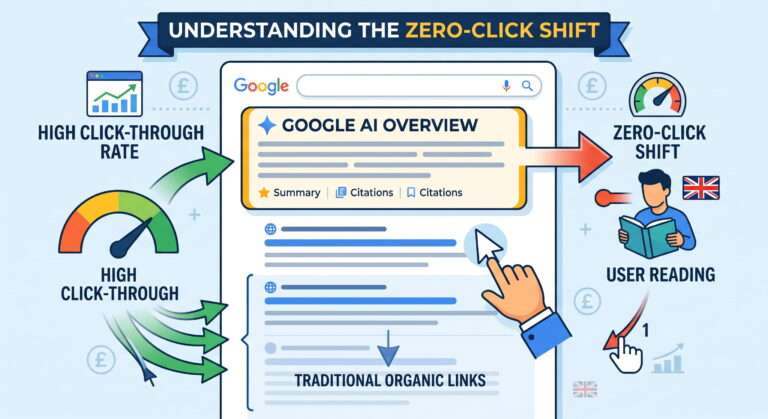
Traditional SEO mainly focused on rankings and clicks. AI-driven search works differently because users increasingly receive direct answers instead of browsing through multiple websites.
When AI systems generate answers, they usually select brands they recognise as trustworthy and authoritative within a topic area. Businesses with weak entity signals are less likely to appear consistently, even if their website is technically well optimised.
This shift is changing digital visibility completely.
| Traditional SEO | AI Visibility & Entity Recognition |
| Focused on keywords | Focused on trust and entities |
| Ranking webpages | Recommending recognised brands |
| Search engine focused | AI and conversational search focused |
| Link-driven authority | Contextual authority and consistency |
As AI-generated search grows, businesses that strengthen entity recognition now may gain a major long-term visibility advantage.
Why Many Businesses Have Weak Entity Signals
A common problem is inconsistency.
Many businesses unknowingly confuse AI systems by using different business descriptions, outdated information, or inconsistent branding across the web. Even small differences can weaken AI confidence.
For example, a company may:
-
- Use different service descriptions on directories
-
- Change branding frequently
-
- Have inconsistent contact information
-
- Publish unclear or generic content
-
- Lack mentions on trusted platforms
When this happens, AI systems struggle to connect all those signals into one strong business entity.
This is one reason why many businesses appear inconsistently in AI-generated search results or are sometimes confused with competitors.
Create Consistent Brand Signals Everywhere
One of the most important ways to improve entity recognition is maintaining consistency across all online platforms.
Your business should use the same:
-
- Brand name
-
- Website URL
-
- Core service descriptions
-
- Contact details
-
- Industry positioning
across your website, directories, business listings, and social platforms.
AI systems compare information from multiple sources. The more consistent those signals are, the easier it becomes for AI to confidently recognise your brand as a trusted entity.
Businesses using structured AI visibility strategies often see stronger recognition because they create unified digital signals rather than fragmented online profiles.
Build Topical Authority Through Content
AI systems strongly associate businesses with topics.
This means your website content should consistently focus on your core expertise rather than publishing random unrelated material. Businesses with stronger topical relevance are easier for AI systems to understand and recommend.
For example, a company specialising in AI visibility should regularly publish content around:
-
- AI search visibility
-
- Generative Engine Optimisation (GEO)
-
- Answer Engine Optimisation (AEO)
-
- Brand trust signals
-
- LLM recommendations
Over time, AI systems begin associating the brand directly with those subjects.
Research into Generative Engine Optimisation suggests that topical depth and contextual consistency significantly influence AI visibility. Generative Engine Optimisation research
Structure Content Clearly for AI Systems
LLMs process structured information more effectively than cluttered or overly complicated content.
This is why modern AI-friendly content often uses:
-
- Clear headings matching user questions
-
- Short readable paragraphs
-
- Direct answer-first explanations
-
- FAQ sections
-
- Logical formatting and tables
Well-structured content helps AI systems extract information more accurately and connect it to your business entity.
Instead of writing only for search engines, businesses now need to write for both humans and AI systems simultaneously.
Third-Party Mentions Increase Trust Signals
AI systems do not rely only on your own website.
They also analyse external signals such as:
-
- Business directories
-
- Industry websites
-
- Reviews and testimonials
-
- News mentions
-
- Partner websites
When your business appears consistently across trusted external platforms, AI systems gain stronger confidence that your company is legitimate and authoritative.
This is one reason why digital PR, citations, and structured business listings are becoming increasingly important in AI-driven search environments.
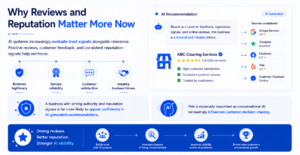
Why Reviews and Reputation Matter More Now
AI systems increasingly evaluate trust signals alongside relevance.
Positive reviews, customer feedback, and consistent reputation signals help reinforce:
-
- Business legitimacy
-
- Service reliability
-
- Customer satisfaction
-
- Industry trustworthiness
A business with strong authority and reputation signals is far more likely to appear confidently in AI-generated recommendations.
This is especially important as conversational AI increasingly influences customer decision-making.
Use Schema Markup and Structured Data
Structured data helps search engines and AI systems understand your website more clearly.
Schema markup can define:
| Structured Data Type | Purpose |
| LocalBusiness Schema | Identifies your business details |
| Service Schema | Explains services offered |
| FAQ Schema | Supports answer extraction |
| Review Schema | Reinforces trust signals |
Google’s structured data documentation highlights how schema improves machine understanding of website content. Google structured data guide
This makes your website easier for AI systems to interpret and associate with relevant topics.
The Future of AI Visibility Is Entity-Based
AI search is moving away from pure keyword matching and towards entity understanding.
Businesses that invest in stronger entity recognition now are likely to benefit through:
-
- Better AI-generated visibility
-
- More consistent recommendations
-
- Improved trust signals
-
- Stronger digital authority
-
- Greater long-term discoverability
This is why AI visibility strategies are becoming an increasingly important part of modern digital marketing.
AI Listings helps businesses strengthen these signals through structured visibility, AI-focused optimisation, and improved online consistency across trusted platforms.
Conclusion
Entity recognition is quickly becoming one of the most important parts of AI-driven visibility.
Large Language Models need clear and trustworthy signals to confidently understand and recommend businesses. Companies with stronger consistency, authority, and structured content are far more likely to appear accurately in AI-generated search results.
As AI-powered discovery continues growing, businesses that strengthen entity recognition today will be in a much stronger position to compete for visibility tomorrow.
Frequently Asked Questions
What is entity recognition in AI?
Entity recognition helps AI systems identify businesses, brands, locations, and services within online content.
Why is entity recognition important for businesses?
It improves the chances of your business appearing accurately in AI-generated answers and recommendations.
How can businesses improve entity recognition?
By building consistent branding, strong topical authority, structured content, and trust signals across multiple platforms.
Does structured data help AI visibility?
Yes. Schema markup helps AI systems and search engines better understand your business information.
Why do some businesses appear more often in AI answers?
Businesses with stronger authority, clearer structure, and better entity recognition are more likely to be recommended consistently by AI systems.