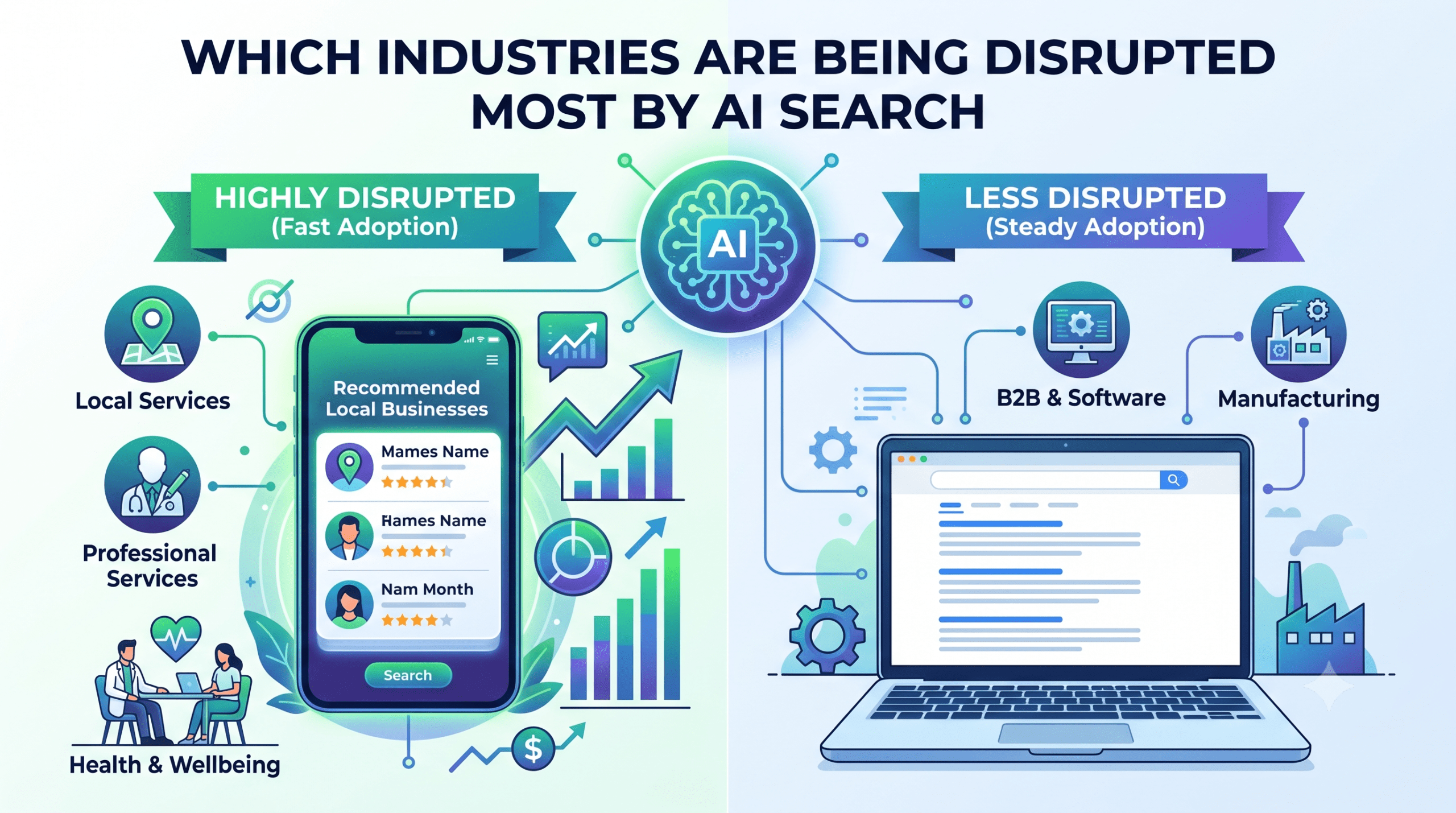
AI search is not arriving everywhere at the same speed. In some industries, customers already ask an AI tool for a recommendation before they do anything else, and the businesses that appear in that answer are quietly winning the work. In others, the old habits still hold, and AI is a distant rumble rather than a present threat. The question worth asking is not whether AI search will affect your industry, but how soon, and how hard.
The pattern is not random. Some sectors have exactly the qualities that make AI answers useful and influential, and those are being reshaped first. Others are more resistant, for reasons that are worth understanding whether you are in a fast-moving sector or a slow one. Knowing where your industry sits tells you how urgent this is, and how much time you have to act before it becomes a problem.
This guide sets out which industries are being disrupted most by AI search, why some are hit harder than others, and what it means for your business. It is a trends piece rather than a how-to, but it ends with practical steps, because understanding the shift is only useful if it changes what you do next.
What disruption by AI search actually means
Disruption here does not mean businesses vanishing overnight. It means a change in how customers discover and choose you, and that change is quiet enough to miss until it has already cost you work.
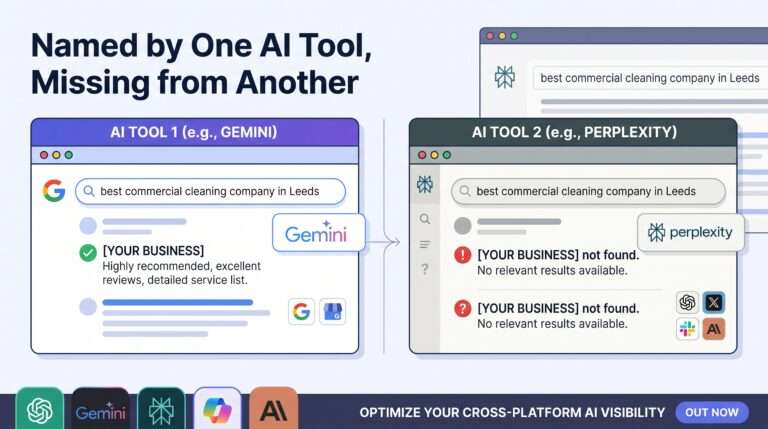
For years, discovery meant search. A customer typed a query, saw a page of options, and chose from them. AI search replaces that with a direct answer, often a short list of named recommendations, and the customer frequently acts on it without ever seeing a traditional results page. We explored this broader change in the shift from search engines to AI answers, and it is the engine behind everything in this article.
The disruption, then, is a move from being one of many links to being either named or invisible. There is no page two to climb back from in an AI answer. Either you are in the recommendation or you are not, which is why AI search is steadily replacing traditional discovery in the sectors where it has taken hold. The industries being disrupted most are simply the ones where this shift is furthest along.
Why some sectors are hit harder than others
Four qualities make an industry ripe for AI disruption. The more of them a sector has, the faster and harder AI search reshapes it.
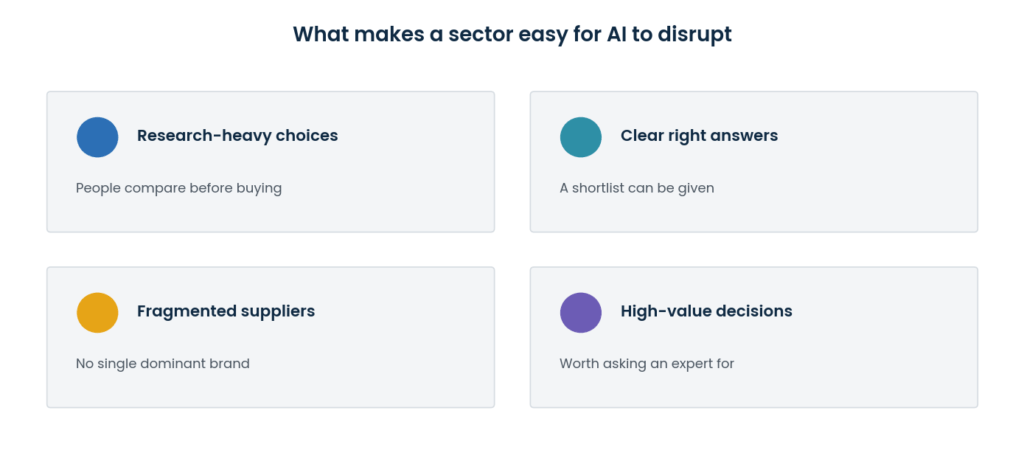
The more of these four qualities a sector has, the faster AI search reshapes it.
Research-heavy choices. Where people compare options carefully before deciding, AI is genuinely useful, because it does the comparing for them. Sectors built on considered decisions are exposed first.
Clear right answers. Where a sensible shortlist can be given, AI will happily give it. If the best options for a need can be named, AI names them, and the businesses left off the list lose out.
Fragmented suppliers. Where no single brand dominates, customers turn to AI to make sense of the choice. Fragmented markets, full of similar small businesses, are exactly where AI recommendations carry the most weight.
High-value decisions. Where the choice matters and the cost of getting it wrong is real, people want a trusted recommendation, and increasingly they ask an AI for one rather than trawling through listings.
Hold these four up against your own industry. The more of them fit, the more urgent AI search is for you, and the less time you have before your competitors work it out.
The shortlist effect
Underlying all of this is a single, powerful change: AI shrinks the shortlist. A search once returned a page of options, and a customer might scroll, compare and click several. An AI answer returns a handful of names, sometimes just three, and the customer often stops there.
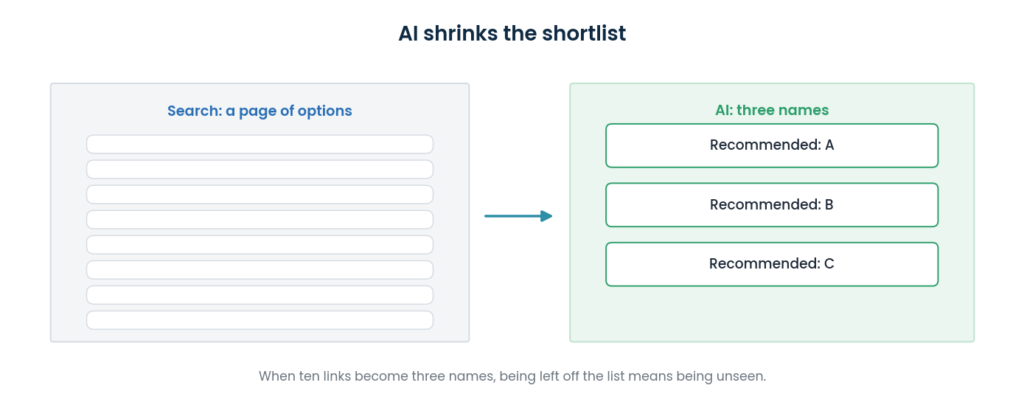
When a page of links becomes three names, being left off the list means being unseen.
This is the mechanism behind the disruption. When ten links become three names, the value of being one of those names rises enormously, and the cost of being left off rises with it. In a search world, ranking sixth still won you some clicks. In an AI answer, being the fourth-best option often means being invisible, because the answer stopped at three.
The sectors being disrupted most are the ones where this shortlist effect bites hardest, because customers there are most willing to accept the AI’s shortlist and act on it. It is a large part of why so many people now say that traditional SEO is no longer enough on its own. Ranking well matters less if the customer never sees the rankings.
How fast this is happening
One reason the disruption catches businesses out is its pace. It does not arrive as a single dramatic event. It creeps, one enquiry at a time, until a meaningful share of your customers are starting with an AI question rather than a search.
Adoption has moved quickly. A behaviour that was a novelty a short time ago is now routine for a growing part of the population, especially for the considered, research-led decisions that matter most to service businesses. The people most likely to ask an AI for a recommendation are often exactly the customers worth having: deliberate, comparison-minded, and ready to act on a trusted answer.
The result is a gap between perception and reality. Because the change is gradual and invisible in headline enquiry numbers, many owners believe their sector is barely affected when it is already well down the path. By the time the disruption is obvious in the figures, the competitors who moved early are entrenched. That lag, between when it starts mattering and when it becomes obvious, is the real risk.
The industries being disrupted most
With those factors in mind, here is a rough ranking of how exposed different sectors are, from most to least. Your own position may vary, but the order holds broadly true.
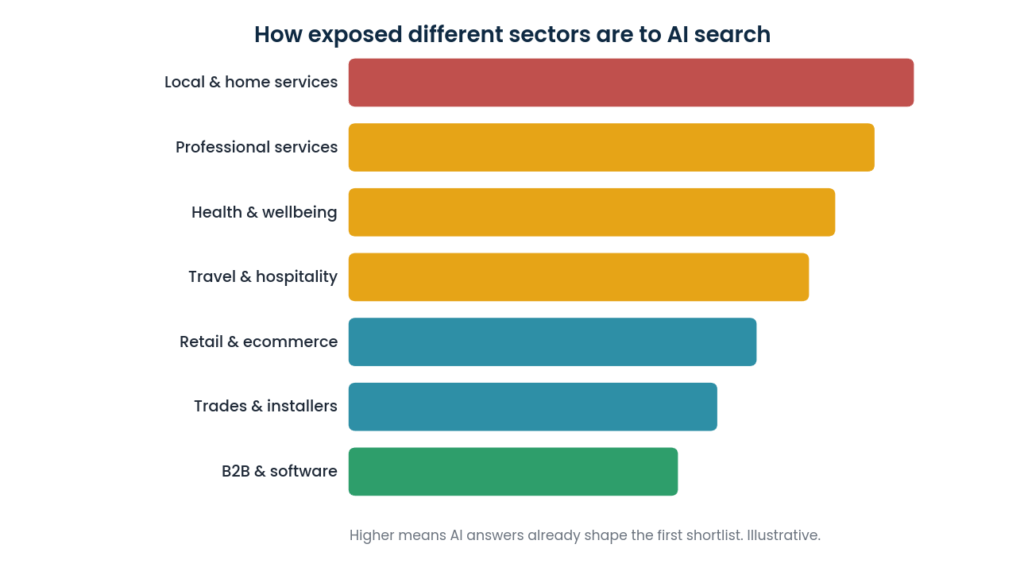
A rough ranking of sector exposure to AI search. Yours may vary, but the order holds broadly.
Local and home services
The most exposed sector, and the one where AI search is already reshaping demand. When someone needs a shutter fitter, a cleaner or a landscaper, they increasingly ask an AI for the best options in their area, and they act on the shortlist. The market is fragmented, the choices are research-led, and no single brand dominates, which is the perfect mix for AI recommendations. If you run a local service business, this shift is not coming, it is here.
Professional services
Accountants, solicitors, consultants and similar firms are being disrupted fast. These are high-value, research-heavy decisions where people want a trusted recommendation, and asking an AI for a shortlist of reputable firms feels natural. Reputation and clear expertise matter enormously here, which favours firms that have made their authority visible and legible to AI.
Health and wellbeing
Clinics, therapists, dentists and wellbeing practitioners sit high on the list. People research carefully, care deeply about trust, and increasingly start with an AI question about who is good and reputable in their area. Trust signals do a great deal of work in this sector, and businesses with strong, visible reputations are pulling ahead.
Travel and hospitality
Hotels, restaurants and travel providers are being reshaped as people ask AI to plan trips and recommend places. The decisions are research-heavy and the options are many, so AI adds obvious value. Being recommended in a travel answer can now drive real bookings, and being absent means missing them quietly.
Retail and ecommerce
Product discovery is shifting as shoppers ask AI what to buy and which brands to consider. The disruption here is real but more mixed, because established brands and marketplaces hold strong positions. Still, for specific product questions and considered purchases, AI recommendations increasingly shape the shortlist before a customer reaches a shop at all.
Trades and installers
Electricians, plumbers, roofers and similar trades are exposed, though slightly less than home services at large, partly because urgent jobs still drive quick local searches. For planned, higher-value work, though, customers increasingly ask AI for reliable options first, and the trades with clear, well-described online presences win those recommendations.
B2B and software
Business software and B2B services are being changed, but more slowly, because buying processes are longer and involve more people. Even so, the early research stage is moving to AI, with buyers asking which tools or providers to consider. The shortlist forms earlier now, often before a salesperson is ever involved, which shifts where influence sits.
The common thread
Look across the most-disrupted sectors and the same picture emerges. They are markets where customers face a considered choice among many similar options, where trust matters, and where a helpful shortlist genuinely saves effort. Those are exactly the conditions in which AI answers are most useful, and usefulness drives adoption.
The reassuring news is that the response is the same across all of them. Whatever your sector, the way to protect and grow your visibility in AI answers follows the same principles, which is why how customers find businesses through AI search matters to every business, not just those in the fastest-moving industries. The difference between sectors is urgency, not method.
There is a hopeful reading of this, too. Because the conditions that make a sector easy to disrupt are the same ones that make AI recommendations valuable, the businesses that adapt are not fighting the tide, they are riding it. A fragmented market with no dominant brand is a threat if you ignore AI and an open opportunity if you move first, because there is no incumbent giant to displace, only a set of similar rivals who have mostly not started.
What it means for your business
Wherever your industry sits on the list, the implication is straightforward. If your sector is highly exposed, this is urgent, and the businesses acting now are building an advantage that will be hard to overturn later. If your sector is less exposed, you have more time, but the direction of travel is the same, and early movers still win.
What you should not do is assume immunity. Almost every industry is somewhere on the curve, and the pace has a habit of surprising people. The shift has been described, fairly, as one that is changing search forever, and while that phrase gets overused, the underlying move from links to named recommendations is real and durable. Even sectors that feel safe today are further along than their owners tend to think.
It is also worth being clear-eyed rather than alarmed. This is not the death of search or of marketing, despite the headlines, and we pushed back on some of that in why people think SEO is dead. It is a shift in where discovery happens and how choices are made, and shifts reward the businesses that adapt early far more than they punish the ones that are simply cautious.
Signs your sector is being disrupted
You do not have to guess whether AI search is reaching your industry. There are tell-tale signs, and once you know them you will start noticing them.
Customers mention AI. Enquiries that begin with “I asked ChatGPT and it suggested…” are the clearest signal of all. Even a handful means the behaviour is established among your customers.
Traffic patterns shift. A quiet decline in clicks from search, without a matching drop in demand, often means customers are getting their answer from AI instead of your listing.
Unfamiliar competitors keep coming up. If businesses you never considered rivals are winning work, they may simply be appearing in AI answers where you are not.
If any of these ring true, your sector is further along than it feels, and the sensible move is to check your actual position rather than wait for the pattern to sharpen.
The honest summary is that exposure cuts both ways. The same forces that put your business at risk in a fast-moving sector also hand you the clearest opening, because your competitors are just as exposed and usually just as slow to react. Disruption does not pick winners on its own. Early action does.
What to do if your sector is exposed
Understanding the trend is only useful if it changes your actions. If your industry sits high on the list, here is where to start. The steps are the same ones that build AI visibility in any sector, just with more urgency.
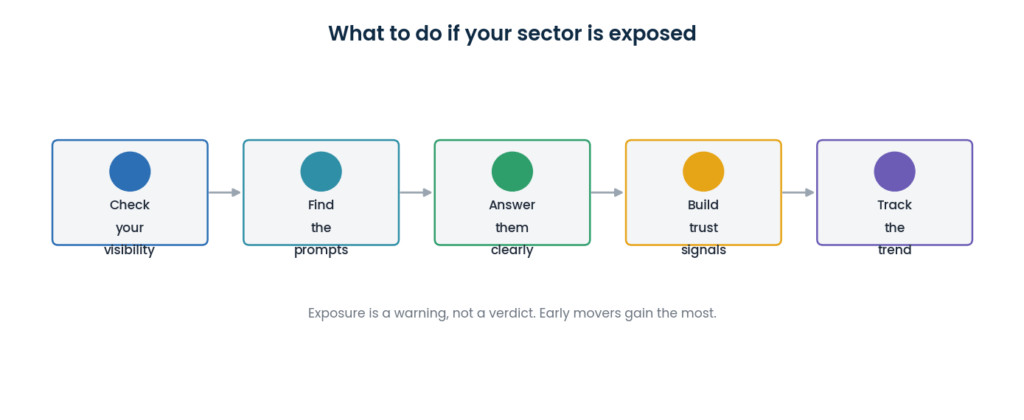
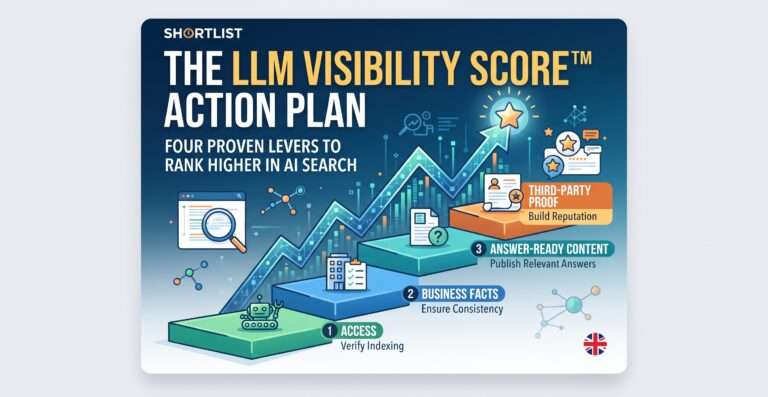
Exposure is a warning, not a verdict. These steps are the response, in any sector.
- Check your visibility. Find out where you actually appear in AI answers today. Run the questions your customers ask across the main platforms and record where you land.
- Find the prompts. Work out the real questions customers in your sector put to AI, in their own words, so you know exactly what to be visible for.
- Answer them clearly. Build clear, direct content that answers those questions plainly, so AI can lift your pages into its recommendations.
- Build trust signals. Strengthen reviews, listings and mentions, because in exposed sectors, trust is often what decides which of several similar businesses gets named.
- Track the trend. Measure your visibility over time, so you can see whether you are gaining or losing ground as your sector shifts.
The natural starting point is to see where you stand, which is what running an AI visibility audit is for. From there, finding the prompts your customers ask tells you what to build, and strengthening your trust signals helps you win the shortlist.
A worked example: a plantation shutters company
Consider a plantation shutters company in West Sussex, squarely in the most-disrupted sector. A few years ago, customers found it by searching and browsing a page of local results. Today, a growing share ask an AI tool who the best shutter companies in the area are, and act on the three names that come back.
For a while, the owner did not notice the change, because overall enquiries held steady. But the mix was shifting underneath. Customers who arrived already mentioning that an AI had recommended a competitor were the ones being lost, quietly, without ever making contact. The disruption was invisible in the headline numbers and very real in the pipeline.
When the company finally checked, it found it appeared in only a third of the relevant AI answers, while two competitors appeared in nearly all of them. The fix was the standard response: clearer content answering the real questions, stronger reviews, and consistent listings, all aimed at getting recommended by AI. Within a couple of quarters, its share of those answers had climbed sharply. The sector’s disruption had been a threat, but acting on it turned into an advantage over the rivals who had not yet noticed.
What is instructive is how ordinary the company’s response was. It did not reinvent itself or outspend anyone. It simply treated AI visibility as a task worth doing, checked where it stood, and fixed the obvious gaps. In a disrupted sector, that modest diligence was enough to turn a threat into a lead, because most of its rivals were still doing nothing at all.
Frequently asked questions
Which industry is most disrupted by AI search?
Local and home services are among the most disrupted, because the market is fragmented, choices are research-led, and customers readily accept an AI’s shortlist of the best local options. Professional services, health and wellbeing, and travel are close behind.
Why are some sectors disrupted more than others?
Sectors with research-heavy, high-value choices, many similar suppliers, and a clear best shortlist are disrupted fastest, because those are the conditions where AI answers are most useful. The more of these qualities a sector has, the sooner AI reshapes it.
Is my industry safe if it isn’t on the list?
Almost no industry is fully safe. Less exposed sectors have more time, but the direction of travel is the same everywhere. The early research stage is moving to AI even in slower-moving markets, so it is wiser to prepare than to assume immunity.
Does this mean traditional SEO is dead?
No. Traditional SEO still matters, but on its own it is no longer enough, because customers increasingly act on AI answers without seeing search rankings. The sensible response is to add AI visibility to your existing search work, not to abandon one for the other.
What should I do first if my sector is exposed?
Start by finding out where you actually appear in AI answers today. A visibility check across the main platforms shows you your real position, and from there you can prioritise the content and trust work that will move you into more recommendations.
Wherever your sector sits, act early
AI search is reshaping industries at different speeds, but the direction is the same everywhere: from a page of links to a short list of named recommendations. The sectors being disrupted most, local services, professional services, health, travel, are simply furthest along a path the rest are following. Knowing where you sit tells you how urgent this is, not whether it applies.
The businesses that win are not the ones in the safest sectors. They are the ones that saw the shift early and acted while their competitors were still watching Google. Whether your industry is being reshaped now or will be soon, the advantage goes to whoever moves first, because being the recommended name is far easier to keep than to win back.
If you would like to know exactly how exposed your business is, and what to do about it, that is what our AI optimisation services are for. Book a discovery call and we will show you where you stand in AI answers today, and how to get ahead of your sector’s shift.