A practical guide to how Gemini chooses what to recommend, and the Google groundwork that puts your brand in its answers.
Someone in your area opens the Gemini app, or asks Google a question in its new conversational way, and types the kind of request your business exists to answer. A moment later Gemini replies with a clear recommendation and a few linked sources. If your brand is named, you have just been put in front of a buyer at the point of decision. If it is not, a competitor has. The good news is that Gemini SEO is more within your control than most business owners expect, because Gemini leans heavily on something you may already be investing in: your presence on Google.
That is the single most important thing to understand about Gemini. It is Google’s own family of models, and when it answers a factual or local question it grounds itself in Google Search in real time, then cites what it used. So the work that earns you visibility in ordinary Google results is the same work that feeds Gemini. If you have ever wondered why you do not appear in AI results on one tool while showing up on another, Gemini is the one where your existing Google foundations count the most.
This guide explains how Gemini builds a recommendation, what Google needs to see before it will put you forward, the technical controls that decide whether you are eligible at all, and the practical steps that make your brand easy to recommend. It maps to the work we do on our Gemini SEO service and sits within our wider AI visibility optimisation approach.
Why Gemini is different, and why that helps you
Perplexity and ChatGPT reach the web through their own crawlers and their own logic. Gemini is woven into Google. That difference shapes everything about how you earn a place in its answers, and most of it works in favour of businesses that have done the fundamentals.
- Your Google SEO is the foundation. Because Gemini grounds in Google Search, the crawlable, well ranked pages you already have are exactly what it draws on. Sound SEO is not separate from Gemini visibility. It is the base it stands on.
- One presence, many surfaces. Gemini is embedded across Google Search, the standalone Gemini app, Workspace tools like Gmail and Docs, Android and Chrome. Earning a citation can mean being seen in several places at once, rather than in a single app.
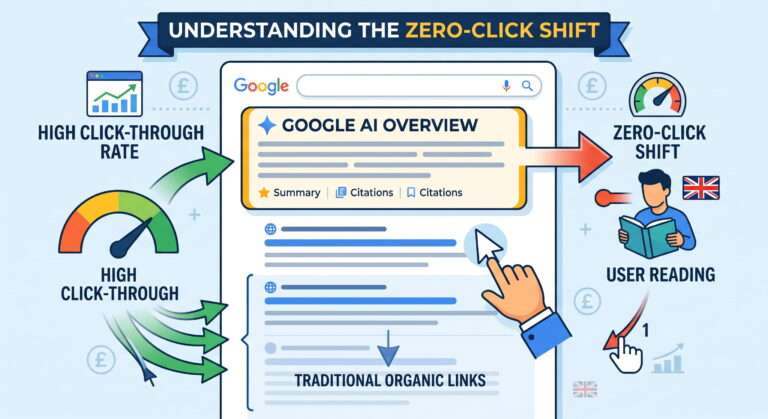
- It powers Google’s AI answers too. The AI Overviews and AI Mode features inside Google Search run on Gemini models, so the same groundwork also improves how you show up there. If that surface matters to you, our Google AI Overviews optimisation service focuses on it directly.
- Local is built in. Gemini can ground in Google Maps as well as Google Search, which means your Google Business Profile is part of the picture for any question with a local flavour.
How Gemini builds a recommendation
Before you can influence Gemini, it helps to picture what happens when someone asks it something current or local. Rather than answering purely from memory, Gemini uses grounding with Google Search: it runs live searches, reads the results, writes an answer and attaches linked source chips so the reader can check where each claim came from.
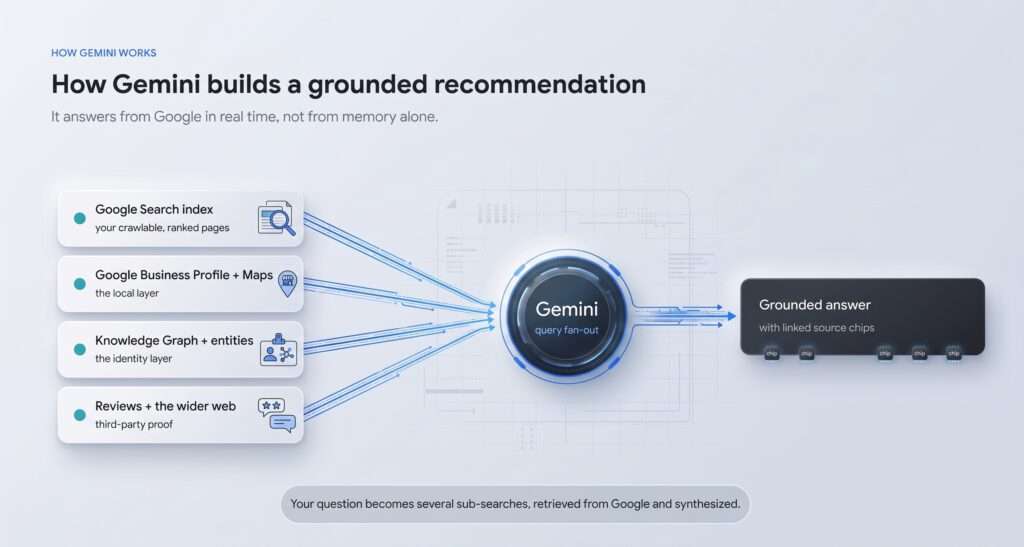
There are two details worth knowing. First, Gemini does not simply read the top result and stop. Like the rest of Google’s AI features, it uses a technique often called query fan-out, breaking your question into several narrower sub-questions and gathering complementary sources for each. A page can be pulled into an answer because it handles one small part of the question well, even if it does not rank first for the main term. You can read Google’s own description of this in its grounding with Google Search documentation.
Second, ranking helps but does not gate you. A 2026 analysis by Ahrefs of several million AI citations found that only around a third of the citations on Google’s AI surfaces came from pages sitting in the top ten, and the large majority of AI citations across tools came from pages that were not in the top one hundred at all. The lesson is encouraging: a strong Google position is a powerful tailwind, but a focused page that answers a specific question cleanly can be cited even without a top ranking.
What Google needs to recommend you
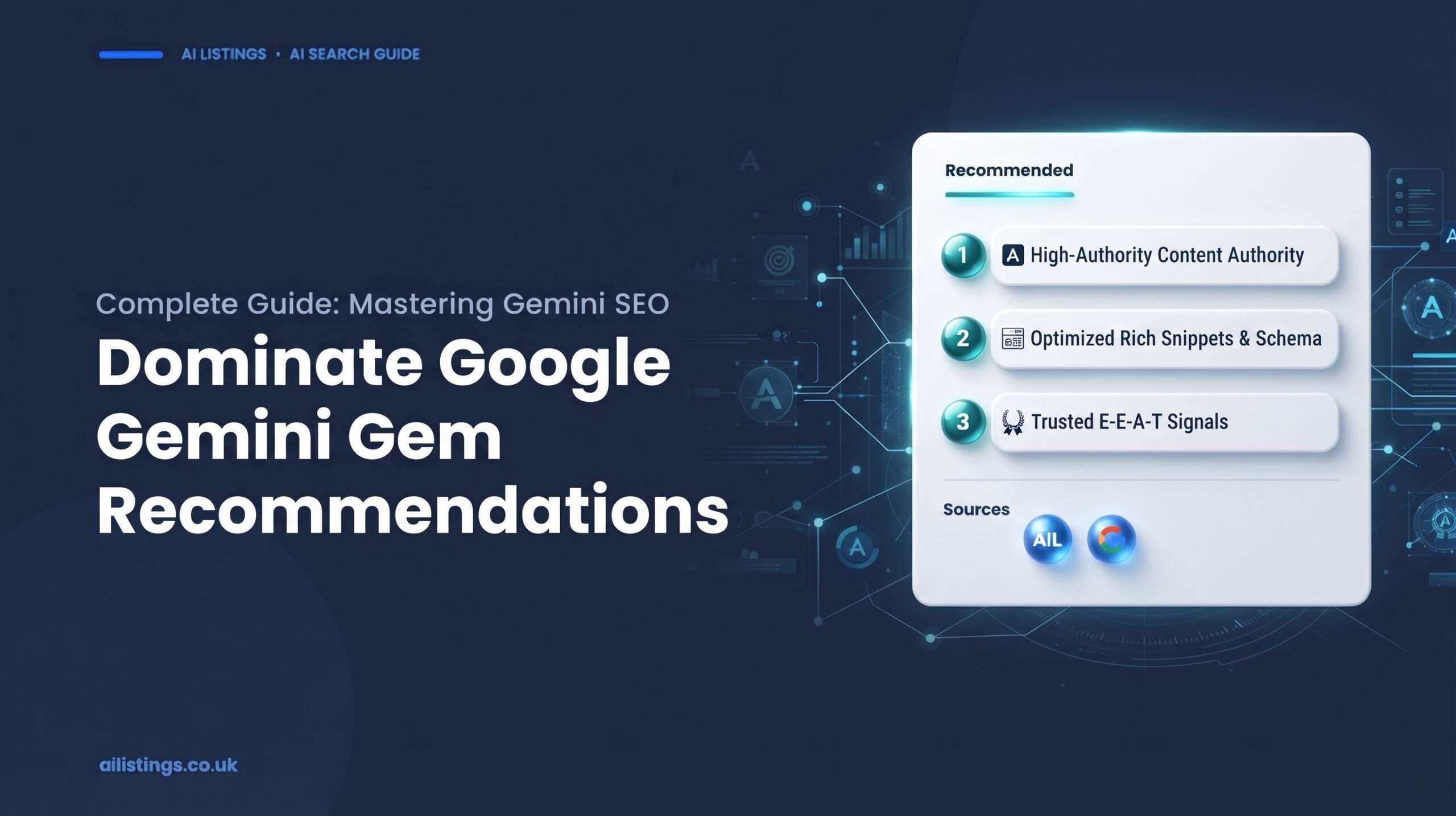
So Gemini grounds in Google. What does that mean you actually have to build? Think of it as five layers, each resting on the one below. Get the base right and the upper layers have something to stand on.
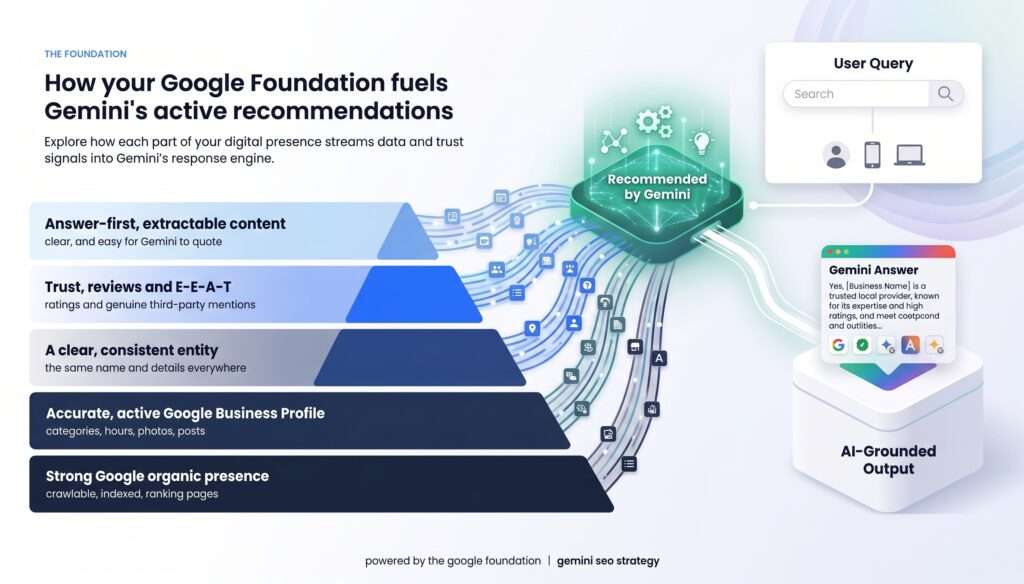
- Strong Google organic presence. The foundation is a site Google can crawl, index and rank. If a page cannot earn ordinary visibility, it is unlikely to be pulled into a grounded answer either.
- An accurate, active Google Business Profile. For anything local, your profile is a primary source. Complete categories, correct hours, real photos and the occasional post all tell Google you are a live, legitimate business.
- A clear, consistent entity. Google has to be confident about who you are before it will recommend you. Using the same business name, address and details everywhere strengthens your entity, which is why entity SEO does quiet, heavy lifting for AI visibility.
- Trust, reviews and E-E-A-T. Experience, expertise, authoritativeness and trust are the signals Google leans on. Genuine reviews and honest third-party mentions are part of the trust signals that make AI tools comfortable recommending you.
- Answer-first, extractable content. At the top sits content that states its answer plainly and can be quoted in a sentence. This is what turns a solid page into a cited one.
The local layer: Google Business Profile and Maps
For local questions, where someone asks Gemini to recommend a provider in a particular town or nearby, your Google Business Profile does a lot of the work. Because Gemini can ground in Google Maps, the accuracy and completeness of that profile feed directly into whether you are a candidate. Treat it as a live asset rather than a set and forget listing.
The essentials are unglamorous but they matter. Pick the most accurate categories, keep your name, address and phone number identical to your website and your other listings, add real photos, keep your opening hours current, gather reviews steadily and reply to them, and post the occasional update. Every one of those is a signal that helps Google understand and trust your business, and consistent details across the web are what help Google recognise your entity reliably. A vague or contradictory local footprint is one of the most common reasons a good business is passed over for a competitor with a tidier profile.
The technical bit: Googlebot versus Google-Extended
This is where a lot of businesses get confused, and where a well meaning setting can quietly cost you visibility. Google gives site owners two separate controls, and they do different things.
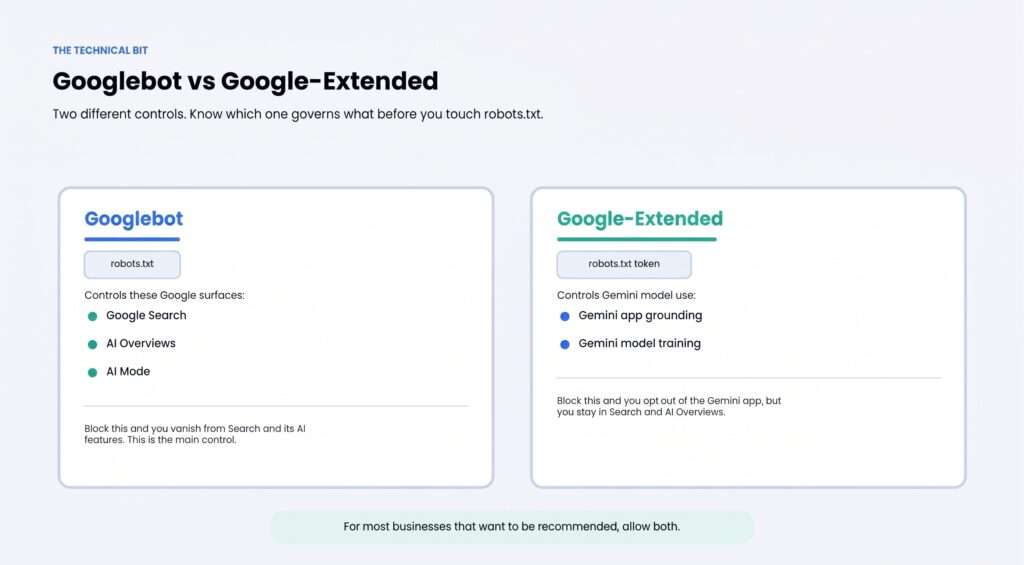
Googlebot is the crawler behind Google Search, and because AI Overviews and AI Mode are part of Search, your standard robots.txt rules for Googlebot govern whether you appear in them. Google-Extended is a separate control that governs whether your content is used for Gemini’s model training and for grounding in the Gemini app and Vertex AI. The important nuance is that Google-Extended does not affect Google Search. So blocking Google-Extended removes you from the Gemini app’s grounded answers while leaving your presence in Search and its AI features intact. For most businesses that want to be recommended, the answer is to allow both.
One myth is worth clearing up. Google’s own guidance is refreshingly blunt: there are no special requirements, no special markup and no AI-specific files that you must add to appear in AI Overviews or AI Mode. The same fundamentals that earn organic visibility are what surface in these features. You can read this directly in Google’s guidance on AI features and your website. Structured data still helps Google understand your pages in general, so it remains worthwhile, but you do not need to chase a secret AI format. Make sure crawling is allowed, keep your internal links sensible so pages are easy to find, and focus your energy on quality.
Write content Gemini can lift
Grounding gets Gemini to your page. Clear writing gets your words into the answer. The habit that matters most is the same one that helps every AI search tool: answer first. Open a page or section with the conclusion in a plain sentence, then explain and support it. Gemini tends to lift the cleanest, most self-contained statement it can attribute, so a page that gets to the point is far easier to quote than one that meanders. This is the heart of answer engine optimisation.
Around that, a few habits make a page genuinely extractable. Use descriptive headings that match the questions people actually ask. Keep paragraphs short and self-contained so a single one can stand on its own. Put the supporting fact, figure or definition next to the claim it backs up. Make your expertise and freshness visible by showing who is responsible for the content and when it was last updated. None of this means writing in a robotic question and answer style. It means being clear. Our guide on how to structure content for AI search walks through the specifics.
A worked example
Picture a UK example. A homeowner in Milton Keynes asks Gemini to recommend a reliable company to fit plantation shutters nearby, and roughly what it costs. Gemini fans that out into parts: trusted local providers, and typical pricing.
Here is what decides whether you are named. Gemini grounds in Google Search and Maps. If your site has a clear Milton Keynes page that ranks, states the area in plain words, answers the cost question with real figures near the top, and is backed by a complete Google Business Profile with strong, recent reviews, you are a genuinely strong candidate to be recommended on both halves of that question. If instead your location is only implied, your pricing hides behind a form, your profile is thin and your last review was eighteen months ago, a competitor with a cleaner, better verified presence is recommended in your place.
The pattern rewards focused, honest local businesses rather than only the biggest names, because Gemini is assembling an answer from evidence it can see. It helps to understand how customers actually find businesses through AI search, because for a growing number of buyers the journey now begins with a question like this one.
Common mistakes to avoid
Most missed Gemini recommendations trace back to a handful of avoidable errors. If your brand is not appearing, rule these out first.
- Blocking Google-Extended by accident. A cautious robots.txt rule can quietly remove you from the Gemini app’s grounded answers.
- Assuming that control affects Search. The reverse mistake also happens. Google-Extended does not change your presence in Search or AI Overviews, so do not rely on it as a Search control.
- Neglecting your Google Business Profile. For local questions, an incomplete or inactive profile is often the single biggest reason you are passed over.
- An inconsistent entity. Different names, addresses or details across the web make Google unsure who you are, and an unsure Google recommends someone else.
- Content that ranks but cannot be extracted. If a page has no clean, quotable sentence, there is nothing for Gemini to lift, however well it ranks.
- Chasing special AI markup. Google says plainly that no secret schema or AI file is required. Time spent hunting for one is time not spent on quality and trust.
- Measuring one platform in isolation. Being named by Gemini but absent from ChatGPT or Perplexity is a per platform gap. A single LLM visibility score across the tools that matter turns guesswork into something you can track.
Your Gemini visibility checklist
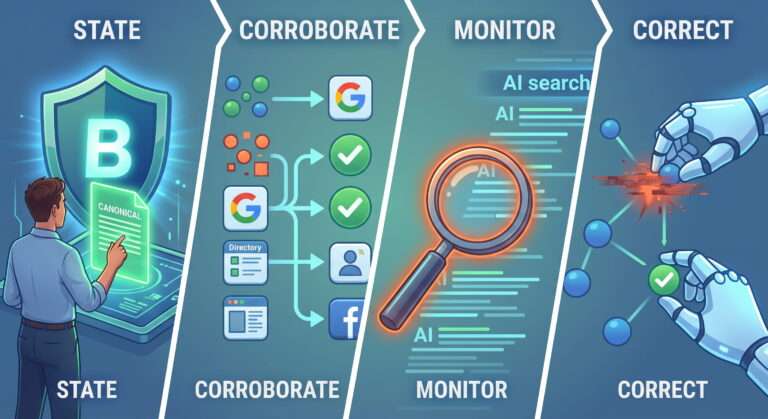
If you take one thing away, work through the following. It is the same checklist we run against a client site before we start, and it is summarised in the diagram below.

- Win the Google basics. Make sure your key pages are crawlable, indexed and ranking. This is the foundation everything else rests on.
- Complete your Business Profile. Accurate categories, hours, photos, steady reviews and the occasional post.
- Make your entity consistent. Use the same business name and details on your site, your profile and every listing.
- Earn trust and reviews. Build the E-E-A-T signals and genuine ratings that make Google comfortable recommending you.
- Answer first, in clear chunks. Write content Gemini can lift and attribute, with the point up front.
- Do not block the crawlers. Allow Googlebot for Search and its AI features, and Google-Extended for the Gemini app.
Then track where Gemini names you, fix the weakest layer first, and repeat. This is the same evidence-building discipline behind our Shortlist System: you are not optimising a single page, you are becoming the option a careful model is happy to put forward.
Frequently asked questions
Is Gemini SEO just Google SEO?
It is built on it, but it is not identical. Because Gemini grounds in Google Search, strong Google SEO is the foundation, and no amount of AI-specific tactics will make up for a site Google cannot crawl or trust. On top of that foundation, Gemini rewards answer-first, extractable writing, a complete local profile and a clear entity a little more than a classic ranking does. Think of it as Google SEO plus a focus on being quotable and verifiable.
Do I need special schema or AI files to appear in Gemini and AI Overviews?
No. Google states directly that there are no special requirements, no special markup and no AI-specific files needed to appear in AI Overviews or AI Mode. Standard structured data still helps Google understand your pages in general, so it is worth having, but you do not need to invent a new format to be eligible. The fundamentals of a clear, crawlable, trustworthy site are what matter.
What is Google-Extended, and should I block it?
Google-Extended is a robots.txt control that governs whether your content is used for Gemini’s model training and for grounding in the Gemini app. Blocking it opts you out of the Gemini app’s grounded answers, but it does not affect Google Search or AI Overviews, which are controlled by Googlebot. For most businesses that want to be recommended, the sensible choice is to allow it, and to restrict only genuinely sensitive areas through standard controls.
How is appearing in the Gemini app different from appearing in AI Overviews?
They share the same Gemini technology and the same Google foundations, but they are reached through different controls. AI Overviews and AI Mode live inside Google Search and are governed by Googlebot, so your normal Search visibility drives them. The standalone Gemini app also relies on grounding, but its use of your content is additionally governed by Google-Extended. Get your Google fundamentals right and allow both crawlers, and you are eligible across the board.
How do I know if Gemini is already recommending me?
Ask it. Put the questions your customers ask into the Gemini app and Google’s AI features and see which businesses it names and links. Because answers vary between runs and surfaces, check the important questions more than once and track the results over time rather than trusting a single search. A visibility score measured across the questions that matter, and across the major tools, gives you a benchmark you can actually improve against.
Turn Gemini into a source of recommendations
Gemini rewards the businesses that have done the Google groundwork and made themselves easy to quote and verify. That is good news, because it means the path is clear rather than mysterious: a strong organic presence, a complete and consistent profile, real trust signals, and content that answers first.
If you would like to know where you currently stand, we can run the exact questions your customers are asking across Gemini and the other major tools, then show you where your brand is already recommended and where it is missing. That is the starting point for our Gemini SEO work, and you can book a discovery call whenever you are ready to see your own numbers.