
Every business already knows the questions its customers ask before they buy. What most have not done is answer those questions in a form an AI can lift cleanly and repeat. That is the whole opportunity here. Writing FAQ content for answer engines means taking the real questions buyers ask and answering them so clearly and directly that when someone puts that question to an AI, your answer is the one it uses. Done well, it turns your everyday customer questions into a steady source of AI visibility.
This is one of the most practical corners of answer engine optimisation, because answer engines are, at heart, built to answer questions, and question-and-answer content speaks their language directly. A well-written FAQ is not padding at the bottom of a page. It is a set of ready-made answers, each matched to a real query, laid out in exactly the shape an AI finds easiest to quote.
This guide explains why Q&A content works so well for answer engines, how to write it so it actually gets lifted, how to turn a dense services page into clean, quotable answers, and the honest truth about FAQ schema, which is useful but widely misunderstood. It is written for any business that wants its answers, rather than a competitor’s, to be the ones customers hear.
Why Q&A content suits answer engines so well
Start with why this format has such an advantage. An answer engine is trying to do one thing: take a person’s question and give them a clear answer. Content already written as a clear answer to a clear question is, almost by definition, the easiest thing for it to use.
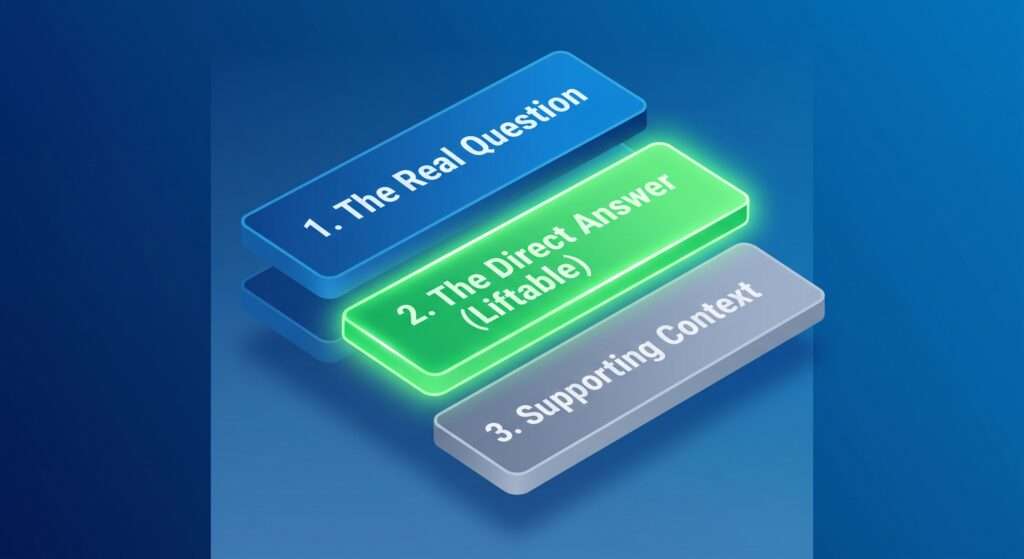
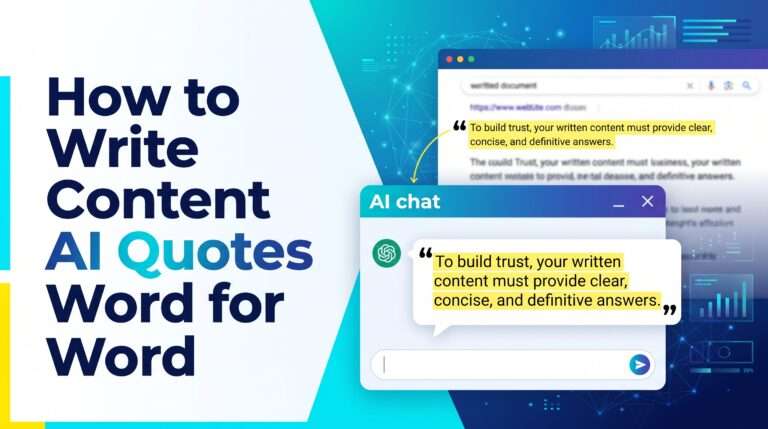
A clean, answer-first Q&A is the easiest thing for an answer engine to pick up and repeat.
When a customer asks an AI a question, the AI looks for the clearest, most reliable answer it can find and repeats it, ideally crediting the source. If you have already answered that exact question plainly on your site, you have handed the AI its job on a plate. This is what it means to become the answer rather than merely a result: your words become the response the customer hears, with your business attached to them.
Compare that with a typical marketing page, where the answer to a customer’s question is buried inside paragraphs of description, or implied but never stated plainly. The AI has to work to extract it, and may give up and use a competitor who made it easy. Q&A content removes that friction. It says, in effect, here is the question, and here is the answer, which is precisely the transaction the answer engine exists to perform.
Match your questions to the ones people actually ask
The first rule of FAQ content that works is that the questions must be the real ones your customers ask, phrased the way they ask them. An FAQ full of questions no one poses, or worded in stiff corporate language, helps nobody.
So begin with genuine questions. Draw on what customers actually ask you: on the phone, by email, in the first five minutes of a meeting. Supplement that with prompt research to find how people phrase these questions to an AI, because the wording matters. Match your questions to real queries, in real language, and your answers line up with what people are genuinely asking. Invent questions in a vacuum, and your content answers queries no one is making.
Focus especially on the questions that come up on the way to a decision: what something costs, how long it takes, how it works, whether it suits a particular situation, what the alternatives are. These are the questions an AI is most often asked about a purchase, and the ones where being the source of the answer puts you directly in front of a buyer. The mundane, practical questions are usually far more valuable than clever ones.
Anatomy of an answer engines can lift
Knowing which questions to answer is half the job. The other half is writing the answers so they can actually be lifted. There is a clear shape to an answer that works, and it is worth following deliberately.
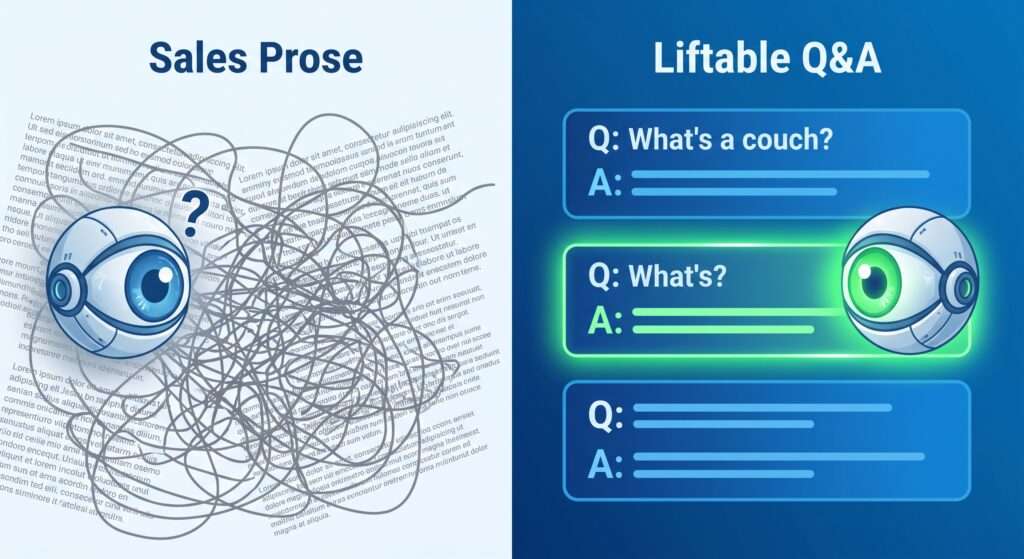
The shape of a liftable answer: a real question, answered first, plainly and self-contained.
A real question, in plain words. Phrase the question as a customer would actually ask it, not as a marketer would write a heading. The closer it is to a real query, the better it matches what people ask.
The answer first. Give the direct answer in the opening sentence, before any context. Answer engines favour the answer-first shape, because they can lift the opening line and have a complete response. Do not make them wait.
Self-contained. Write each answer so it makes sense on its own, lifted away from the page around it. An answer that only makes sense in context is hard for an AI to quote cleanly.
Concise and plain. Keep answers short, clear and free of sales talk. Plain, factual answers are more quotable than promotional ones, and they read as more trustworthy, which matters for the way you structure content for AI generally.
Then the detail. After the direct answer, add any useful context or nuance for the human reader. This serves people without getting in the way of the liftable answer at the top.
Turning a services page into liftable Q&A
A common and high-value move is to take an existing services page, dense with description, and recast the key information as clear questions and answers. Most services pages are written to impress rather than to answer, and that makes them hard for an AI to use.

Recasting sales prose as answer-first Q&A makes the same information easy for AI to lift.
The typical services page describes an offering in flowing, promotional prose: proud to offer, market-leading, bespoke, tailored. A customer wanting to know what it costs or how long it takes has to hunt, and an AI has nothing clean to lift. Recasting the same information as answer-first Q&A fixes both problems at once. The customer gets their answer instantly, and the AI gets a quotable one.
You do not have to throw away the descriptive page. Add a clear Q&A section that answers the practical questions the prose skirts around, or rewrite the key points in answer-first form. The information is often already there; it just needs to be surfaced as direct answers to direct questions. This small shift is one of the most effective things you can do to be recommended by AI, because it converts content you already have into content an answer engine can actually use.
How many questions, and where to put them
Two practical questions come up once you start: how many questions to answer, and where to put them. Both have sensible, simple answers.
On quantity, answer the questions that genuinely matter rather than padding to a number. Ten to a dozen real, well-answered questions on a topic beat thirty thin ones, and a bloated FAQ of invented questions can read as filler. Quality and genuineness matter more than length, exactly as they do everywhere else in AI visibility.
On placement, put each answer where it is most relevant rather than dumping everything in one distant FAQ page. Questions about a specific service belong on that service page, near the information they concern, so both the reader and the AI find the answer in context. A general FAQ page has its place for broad questions, but the most liftable answers usually sit right beside the thing they are about. Think in terms of answering the question at the point it arises, not filing all questions away in one corner.
The honest truth about FAQ schema
No discussion of FAQ content is complete without addressing FAQ schema, because it is widely misunderstood, and the ground has shifted recently. Here is the honest position, because getting this wrong wastes effort.
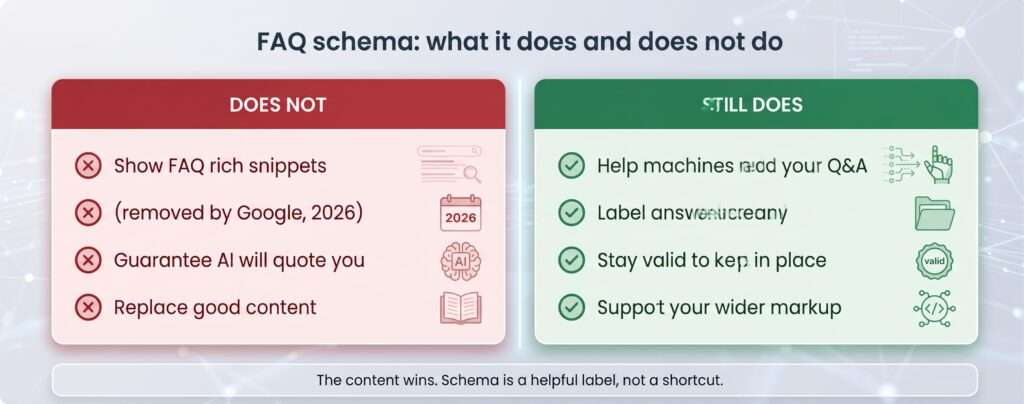
FAQ schema still helps machines read your answers, but no longer produces rich results.
FAQPage schema, using the schema.org FAQPage vocabulary, marks up your questions and answers so machines can read them cleanly. For years it also produced an expandable FAQ box in Google results, and that is what most people associate it with. That visible result is gone. Google restricted it to a handful of authoritative sites in 2023 and, as its FAQ structured data documentation now confirms, removed it entirely in 2026. So FAQ schema no longer earns you a rich snippet, and you should not add it expecting one.
What FAQ schema still does is help machines read your Q&A content as clearly labelled questions and answers. It remains a valid type, Google says there is no need to remove it, and it can make your answers a little easier for systems to interpret. But it is a helpful label, not a shortcut. It does not make weak content quotable, and it does not guarantee an AI will use you. The content is what wins; the schema, at most, tidies it for machines. Write the answers well first, and treat the markup as an optional finishing touch, not the point.
Do not forget your Google Business Profile questions
One Q&A surface that businesses routinely neglect sits on their Google Business Profile, which has its own questions and answers section. It is worth a moment, because it is easy and often overlooked.
Anyone can post a question there, and anyone can answer, which means your profile may carry questions answered incorrectly by strangers, or left unanswered entirely. You can seed the common questions yourself and provide proper, owner-verified answers, and you can correct any wrong answers already there. Because this content sits on a source AI treats as authoritative for your business, getting it right is a genuine, low-effort win, especially for local and service businesses.
Common mistakes
A few habits stop FAQ content from working. They are easy to avoid once you know them.
Inventing questions no one asks. An FAQ built on imagined questions helps nobody. Base it on the real questions customers actually ask you.
Burying the answer. Starting with waffle or context before the answer makes it hard to lift. Give the direct answer first, then elaborate.
Answering in sales language. Promotional, vague answers are less quotable and less trusted. Answer plainly and factually.
Chasing FAQ schema for rich results. Adding markup expecting a rich snippet is now pointless, since Google removed the feature. Use schema markup to help machines read your content, not to win a result that no longer exists.
Answers that need the page around them. An answer that only makes sense in context cannot be lifted cleanly. Write each one to stand on its own.
A worked example: a physiotherapy clinic
A physiotherapy clinic had a polished website that described its treatments in warm, professional prose. Yet when prospective patients asked an AI the practical questions they had before booking, the clinic was rarely the source of the answer, and it could not understand why, given how much it had written.
The problem was that its content answered almost none of those practical questions directly. Patients wanted to know simple things: whether they needed a referral, how many sessions they might need, whether a first appointment would hurt, how much it cost. The website implied some of these somewhere in its flowing descriptions, but never stated them plainly as answers to plain questions. So the AI, unable to extract a clean answer, went elsewhere for one.
The fix was to write a proper Q&A section built on the real questions patients asked at reception every week, each answered first and plainly: no, you do not need a referral; most people need between four and six sessions; the first appointment is an assessment and is not painful. The clinic phrased the questions the way patients actually asked them, kept the answers concise and self-contained, and added the softer detail afterwards. Within a couple of months it was regularly the source when an AI answered those questions, because it had finally made its answers easy to lift. It was a clear illustration of the difference between search and answer engines: the same knowledge, simply reshaped into answers, changed everything.
What is worth noting about the clinic is that it did not write a single new fact. Every answer was something the team said out loud to patients every day. The knowledge had always been there; it had simply never been written down in the plain, answerable form the AI needed. For most businesses, the raw material for a strong FAQ is already in their heads and their inboxes, waiting to be typed out.
Frequently asked questions
Why is Q&A content good for answer engines?
Because answer engines exist to answer questions, and content already written as a clear answer to a clear question is the easiest thing for them to lift and repeat. A good FAQ is a set of ready-made answers, each matched to a real query, in exactly the shape an AI finds simplest to quote.
How should I choose which questions to answer?
Use the real questions your customers ask, phrased the way they ask them, especially the practical ones on the way to a decision: cost, timing, process, suitability. Prompt research helps you see how people put these questions to an AI, so your content matches genuine queries rather than invented ones.
How do I write an answer that gets lifted?
Give the direct answer in the first sentence, keep it concise and plain, and make it self-contained so it makes sense on its own. Add context and nuance afterwards for the human reader. Answer-first, quotable answers are what engines pick up.
Does FAQ schema still matter?
It no longer earns a rich result in Google, which removed that feature in 2026, so do not add it expecting one. FAQPage schema remains valid and can help machines read your questions and answers cleanly, but it is a helpful label, not a shortcut. Good answer-first content is what actually wins.
Can I just convert my existing pages?
Often, yes. Much of the information an FAQ needs is already sitting in your services pages, written as description. Recasting the key points as answer-first questions and answers surfaces the same knowledge in a form an answer engine can use, and it is one of the highest-value quick wins available.
Answer the question, win the answer
Your customers are asking questions, and answer engines are answering them. FAQ and Q&A content is how you make sure the answers they give come from you: real questions, answered first, plainly and self-contained, matched to what people actually ask. It is one of the most direct and practical ways to earn AI visibility, because it speaks the answer engine’s language exactly.
Start with the questions you already hear every week. Write each one out as a customer would ask it, answer it directly in a sentence, then add any detail underneath. Do that for your ten most common questions and you will have built something answer engines can genuinely use, without waiting on any schema or trick to do the work for you.
If you would like help turning your customers’ questions into content that answer engines lift, that is part of our AI optimisation services. Book a discovery call and we will help you make your answers the ones customers hear.