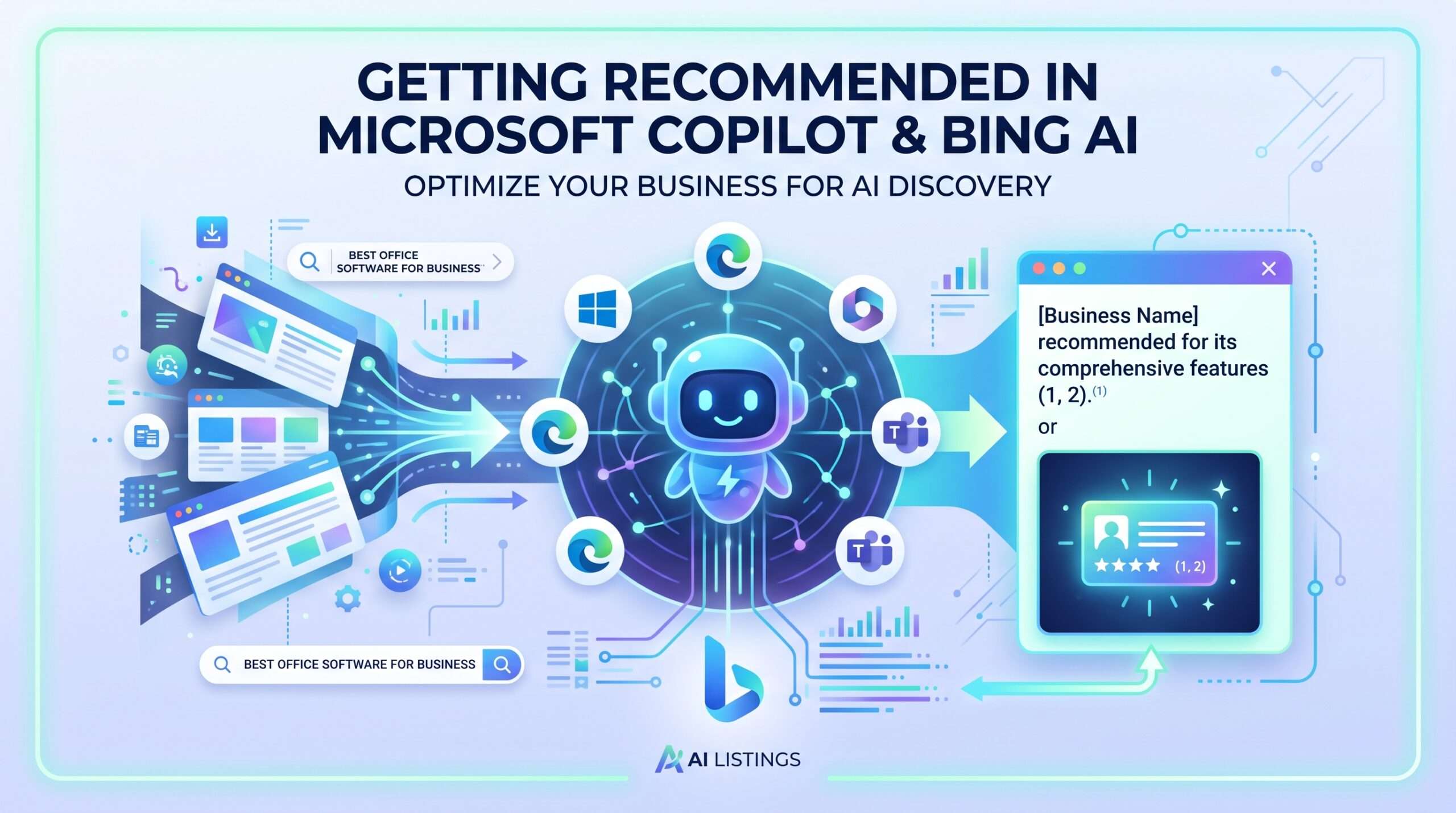
Most businesses optimise for Google and stop there. Microsoft Copilot does not run on Google. It runs on Bing, and it sits inside Windows, Edge, Microsoft 365, and Teams, in front of a very large and commercially serious audience. If a buyer asks Copilot for a recommendation in your field and your competitor is named instead, that is a sale happening on a surface you were not even watching.
The good news is that Copilot is one of the most reachable AI tools to appear in, precisely because so few businesses work on it. This guide explains how Copilot chooses its sources, why Bing is the key that unlocks several platforms at once, and the practical steps to be named when it matters.
How Copilot picks its sources
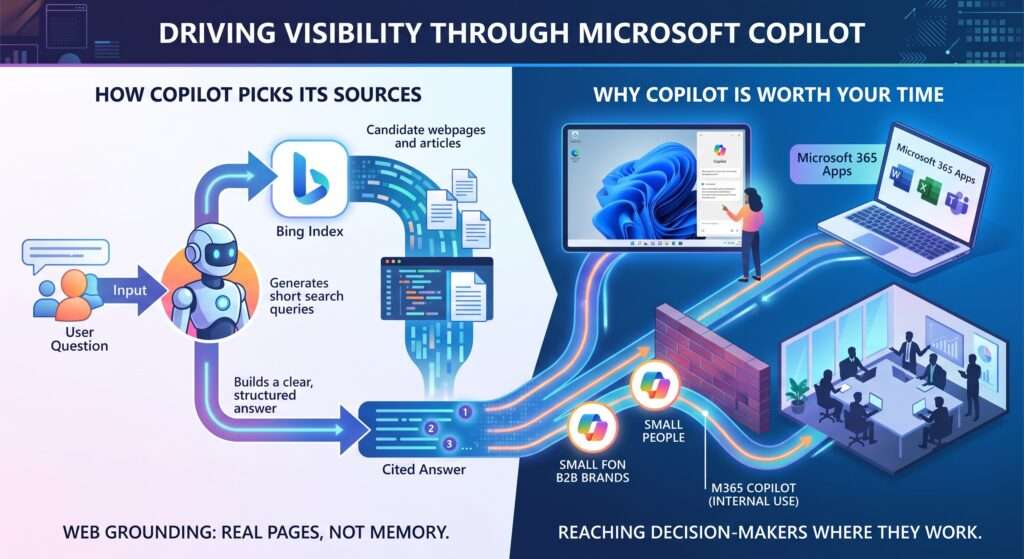
Copilot does not answer from training data alone. When a question needs current information, it composes a short search query, sends it to Bing, pulls candidate pages from the Bing index, and builds an answer with numbered citations. Microsoft calls this web grounding: the assistant anchors what it says in real, retrievable pages rather than guessing from memory.
The practical consequence is simple. Only pages that Bing has crawled and indexed are eligible. What Bing does not know does not exist for Copilot at that moment. So your Bing visibility, not your Google visibility, is what decides whether you get cited. Ranking well in Google does not carry over, because the two search engines have separate indexes.
There is a bonus here worth naming. A large share of ChatGPT’s search citations also match Bing’s top results, so the work you do for Bing tends to pay off across Copilot, ChatGPT search, and traditional Bing at the same time. One surface, several wins.
Why Copilot is worth your time
Bing’s slice of the global search market is small, holding at roughly four per cent through 2026. Taken on its own, that is easy to dismiss. Copilot changes the maths, because it rides on that same Bing index and reaches people who never open a search engine at all.
Copilot is built into Windows, so it reaches around a billion devices. It sits in Edge, in the Microsoft 365 apps, and in Teams, woven into the daily tools where business decisions get made. Its audience skews towards office, IT, finance, and operations, which is exactly the crowd many B2B brands struggle to reach through consumer channels. For a professional services firm, a software vendor, or a supplier selling into businesses, that audience is often more valuable than raw volume suggests.
There is also a side to Copilot that goes beyond public web search, and it is one of the most underused openings in AI visibility. Microsoft 365 Copilot is used inside a large share of big companies. When staff there ask it to help with research, documents, or procurement, it can draw on your public web content inside their workflow, behind the company firewall. For a B2B brand, that is a direct line to decision-makers who never typed your name into a search bar, and it runs on the same Bing-indexed content you are already improving. You will not see this activity in your traffic reports, which is part of why so few businesses account for it. The point is not to chase it directly, but to recognise that clean, well-structured public content works harder on this surface than Bing’s raw market share implies.
The steps that get you cited
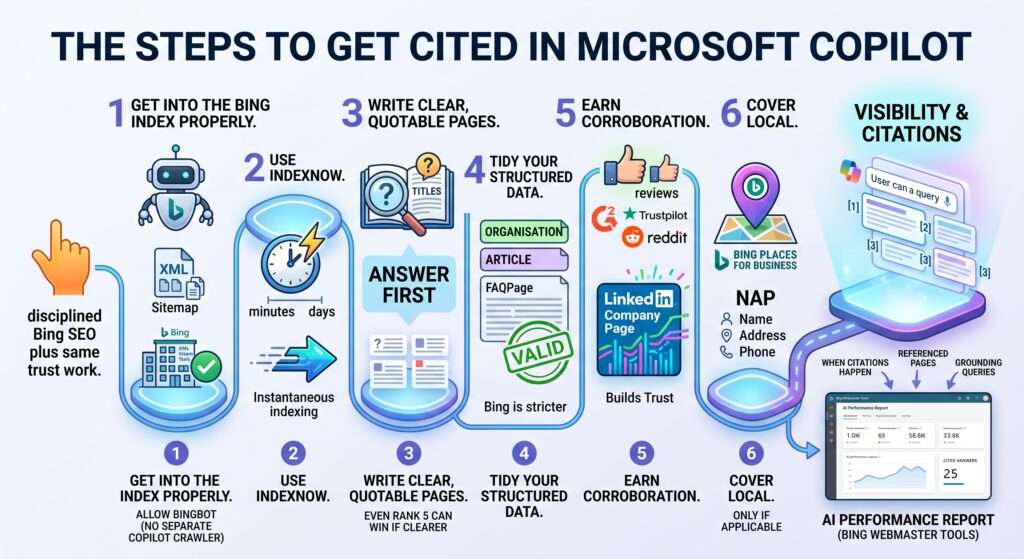
Getting named in Copilot is mostly disciplined Bing SEO plus the same trust work that helps across every AI tool.
Get into the Bing index properly. Register in Bing Webmaster Tools, submit an XML sitemap, and make sure the site is technically sound and crawlable by Bingbot. There is no separate Copilot crawler for web content, so allowing Bingbot is what matters. Check your robots file is not blocking it.
Use IndexNow. Without it, Bing can take days to pick up changes. With it, new and updated pages can be discovered in minutes. It is quick to implement and gives a real speed advantage on getting fresh content into the pool Copilot draws from.
Write clear, quotable pages. Copilot prefers sources that are recent, authoritative, clearly structured, and easy to parse. Lead with the answer, use question-style headings, and keep paragraphs short. A page that ranks fifth can still be cited if it answers the exact question more cleanly than the pages above it.
Tidy your structured data. Schema does not force Copilot to cite you, but it removes ambiguity about what your business is, and ambiguity is what gets a candidate dropped. Organisation, Article, and FAQPage markup are the useful ones. One warning: Bing is stricter than Google about schema errors, so validate your markup rather than assuming it works.
Earn corroboration. Copilot, like the others, trusts claims it can see confirmed elsewhere. Reviews and genuine discussion on sites Bing already indexes, such as Reddit, G2, and Trustpilot, give it more material to draw on for comparison and recommendation questions. For B2B specifically, an active LinkedIn Company Page adds useful context.
Cover local if it applies. If you serve a location, complete your Bing Places for Business listing and keep your name, address, and phone number consistent across the web, the same way a Google Business Profile helps on Google. This matters only if you have a genuine local angle, so do not force it.
You can also measure this now, which was not true a year ago. The AI Performance report in Bing Webmaster Tools, in public preview since early 2026, shows when your content is cited across Copilot and Bing’s AI answers, which pages are referenced, and the grounding queries behind those citations. It is the most direct first-party view of AI visibility any major provider currently offers, and a sensible place to see whether your work is landing.
A worked example
A finance manager asks Copilot, “who offers outsourced payroll for small UK companies?”
Copilot turns that into a short Bing query, pulls the pages Bing has indexed, and builds an answer from the ones it can quote and verify. A provider with a clear “outsourced payroll for small businesses” page, a working presence in Bing Webmaster Tools, consistent company details, a few solid reviews on sites Bing indexes, and an active LinkedIn page is easy to name. Everything checks out and can be read cleanly.
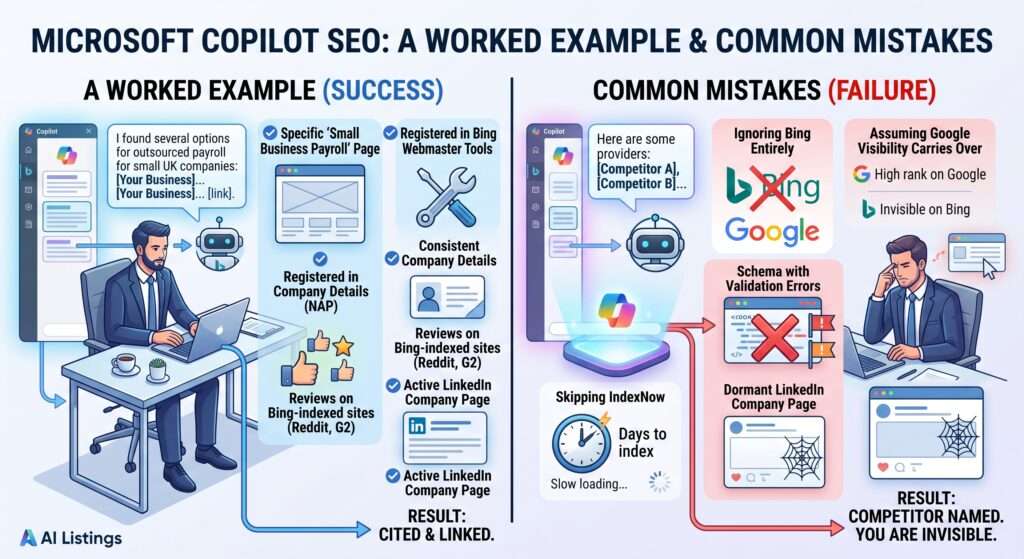
A provider that is strong on Google but has never touched Bing is not in the index Copilot searches, so it does not appear at all. Same service, same quality, but invisible on this surface for want of some straightforward technical work.
Common mistakes
- Ignoring Bing entirely. “Nobody uses Bing” misses the point. Copilot routes a very large Windows, Edge, and Microsoft 365 audience through Bing’s index. Bing SEO is now table stakes for B2B.
- Assuming Google visibility carries over. The indexes are separate. You have to earn Bing visibility on its own terms.
- Schema with validation errors. Bing skips markup with errors that Google would quietly ignore. Validate it.
- Skipping IndexNow. Without it you accept a multi-day indexing lag on every change, which slows down everything else you do.
- A dormant LinkedIn Company Page. For B2B questions, Copilot leans on LinkedIn for brand context. An empty page is a weak signal.
Frequently asked questions
Does Microsoft Copilot use Google’s index? No. Copilot grounds its web answers in the Bing index, crawled by Bingbot. Your visibility in Google does not carry over, so being cited in Copilot depends on being indexed and visible in Bing specifically.
Do I need a special crawler setting for Copilot? No separate Copilot crawler handles web content. Copilot uses pages from the Bing index, so the requirement is to let Bingbot crawl your site and to verify the site in Bing Webmaster Tools.
Will optimising for Bing help me anywhere else? Yes. A large share of ChatGPT’s search citations also match Bing’s top results, so strong Bing visibility tends to help across Copilot, ChatGPT search, and traditional Bing at once.
Does schema markup get me cited in Copilot? It helps by removing ambiguity about what your business is, which keeps you in contention. It does not force a citation. Use Organisation, Article, and FAQPage markup, and validate it, because Bing is stricter than Google about errors.
How do I know if Copilot is citing me? Use the AI Performance report in Bing Webmaster Tools. It shows citation activity across Copilot and Bing’s AI answers, which of your pages are referenced, and the grounding queries behind them, all from Microsoft directly.
Get a read on your Copilot visibility
If you are not sure whether Copilot names your business or a competitor for the questions your buyers ask, that is worth checking before you invest. Our AI visibility optimisation services test real prompts across Copilot and the other major tools, show where you are missing, and map the fixes in order. You can see how the platforms differ in our guide to running an AI competitor analysis.