Imagine a customer asks an AI about your business and is told, with complete confidence, something that is simply not true: that you have closed down, that you do not offer a service you do offer, that your prices are double what they are. The customer believes it, because the AI sounded certain, and quietly goes elsewhere. This is the risk AI hallucinations pose to your brand, and it is one most businesses do not even know they are running. Learning to defend your brand against AI hallucinations, to spot them, correct them and reduce the odds of them happening, is fast becoming a basic piece of reputation hygiene.
An AI hallucination, as IBM describes it, is when an AI system produces an output that sounds plausible but is factually wrong or fabricated, including incorrect details about real entities. It is not lying; it has no intent. It is confidently filling a gap in what it knows with a plausible guess. When that guess is about your business, the result can be a false but authoritative statement reaching your customers, and the calm certainty with which it is delivered is exactly what makes it dangerous.
This guide explains why AI hallucinates facts about businesses, the damage it can do, and a simple, repeatable framework, the Hallucination Guard, for defending against it. The good news is that you are far from powerless. With the right groundwork, you can make hallucinations about your brand much less likely, and catch and correct the ones that slip through.
What an AI hallucination about your business looks like
Let us make this concrete, because it is easy to underrate until you see it. A hallucination about your business is a confident, wrong statement of fact, delivered as though it were certain.
A hallucination carries all the confidence of a correct answer. That is what makes it harmful.
It might be an AI telling a customer you are closed when you are open, that you do not cover their area when you do, that you charge more than you do, or that you no longer offer a service that is your main line of work. In each case the AI is not malicious; it simply did not have the right facts to hand and produced a plausible-sounding answer instead. But the customer cannot tell a confident guess from a confident fact, and acts on what they are told.
The harm is real precisely because of that confidence. A tentative, hedged answer invites the customer to check. A crisp, certain, wrong one does not. So a hallucination can quietly cost you a customer who never contacts you to verify, and never tells you why they did not come. It is a leak you cannot see unless you go looking, which is the first reason to take it seriously.
Why AI hallucinates facts about businesses
To defend against hallucinations, it helps to understand why they happen to a business specifically. They are not random; they cluster around a few conditions you can actually influence.

Hallucinations grow in the gaps. Fill the gaps and the AI has less need to guess.
Thin information is the first cause. When there is little clear, authoritative information about your business, the AI has to fill the gaps, and filling gaps is where it invents. Inconsistent details are the second: when your facts differ across sources, the AI may latch onto the wrong version, so weak NAP consistency directly raises your hallucination risk. Outdated information is the third, where old facts linger online and get repeated as current. And underlying all of them is the absence of a clear source of truth: nothing authoritative for the AI to anchor to.
The common thread is uncertainty. Hallucinations grow in the gaps and contradictions in what the web says about you. Where your facts are clear, consistent, current and well established, the AI has no gap to fill and little reason to invent. Where they are thin or contradictory, it guesses, and sometimes guesses wrong. This is closely tied to entity recognition: the better the AI knows exactly who you are, the less it hallucinates about you.
Introducing the Hallucination Guard
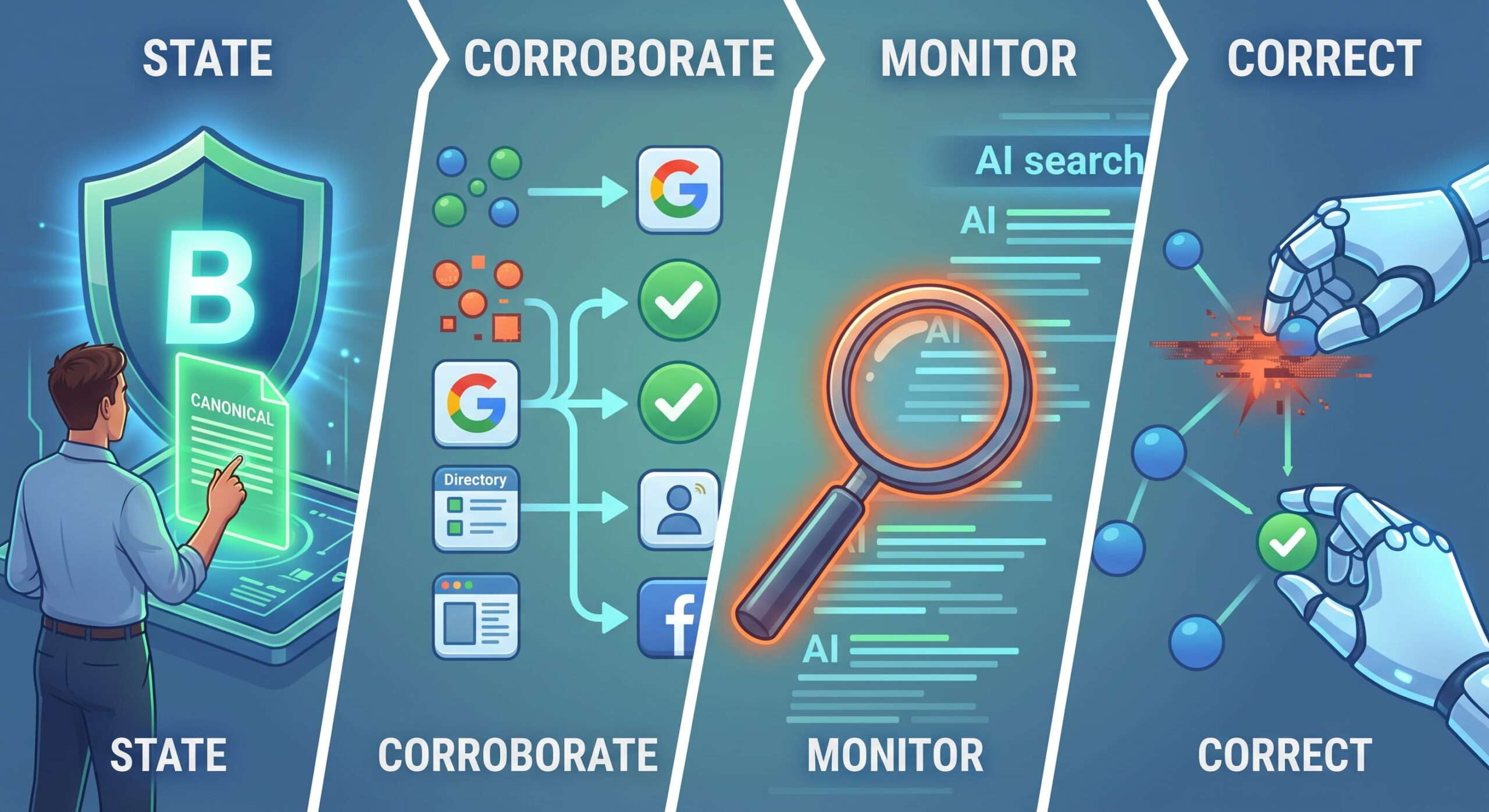
Defending your brand does not need to be complicated. It comes down to a simple, repeatable routine we call the Hallucination Guard: four steps that together make hallucinations much less likely and much easier to catch. State, corroborate, monitor, correct.
The Hallucination Guard: a four-step routine to keep AI telling the truth about you.
The logic is straightforward. The first two steps are prevention: give the AI clear, consistent facts so it has no gap to fill. The second two are defence: watch what it actually says, and correct the record when it goes wrong. Run all four as a habit, and you both reduce the odds of a hallucination and shrink the time any error survives. Let us take each step in turn.
Step 1: State your facts clearly
Set out the key facts about your business, plainly and unmistakably, in an authoritative place you control. Your core details, what you do, where, your hours, your services, your prices where appropriate, should be clearly stated and marked up so machines can read them, as covered in our guide to schema markup for AI search. This is your canonical source of truth, and it gives the AI something solid to rely on instead of guessing.
Step 2: Corroborate them everywhere
Make sure those same facts are stated consistently across every place your business appears: your Google Business Profile, your directory listings, your social profiles. When every source agrees, the AI is confident about your facts and has no conflicting version to pick up. Consistency is the single most powerful defence against hallucination, because it removes the contradictions that cause it.
Step 3: Monitor what AI says about you
Regularly ask the AI tools about your business and check what they say. You cannot correct a hallucination you do not know about, and because customers rarely report them, you have to go looking. A citation audit is a structured way to see what AI currently states about you and to catch errors before they cost you.
Step 4: Correct the record at its source
When you find a hallucination, do not just note it. Trace it back and fix the underlying information: update the outdated listing, correct the inconsistent detail, strengthen the thin area that let the AI guess. Because the AI draws on what is out there, correcting the sources is what makes the false statement fade and the true one take its place. You are not editing the AI directly; you are fixing the evidence it reads.
Prevention beats correction
Of the four steps, the first two matter most, because preventing a hallucination is far easier than chasing one down after the fact. A false statement, once it is circulating, can be stubborn, so the real goal is to leave no gap for it to grow in.
A business with clear, consistent, current facts everywhere it appears is a difficult target for hallucination. There is simply nothing for the AI to get wrong, because the correct answer is unambiguous wherever it looks. This is the same groundwork that builds your trust signals and helps you get recommended in the first place, so it pays off twice: fewer hallucinations, and a stronger presence. The best defence, in other words, is the same solid foundation that good AI visibility rests on anyway.
This is why the Hallucination Guard is worth running as a steady habit rather than a panic response. The prevention steps, done consistently, mean you rarely need the correction ones. And when you do, a business that already keeps its facts straight can fix an error quickly, because it knows exactly what the truth is and where it should be stated.
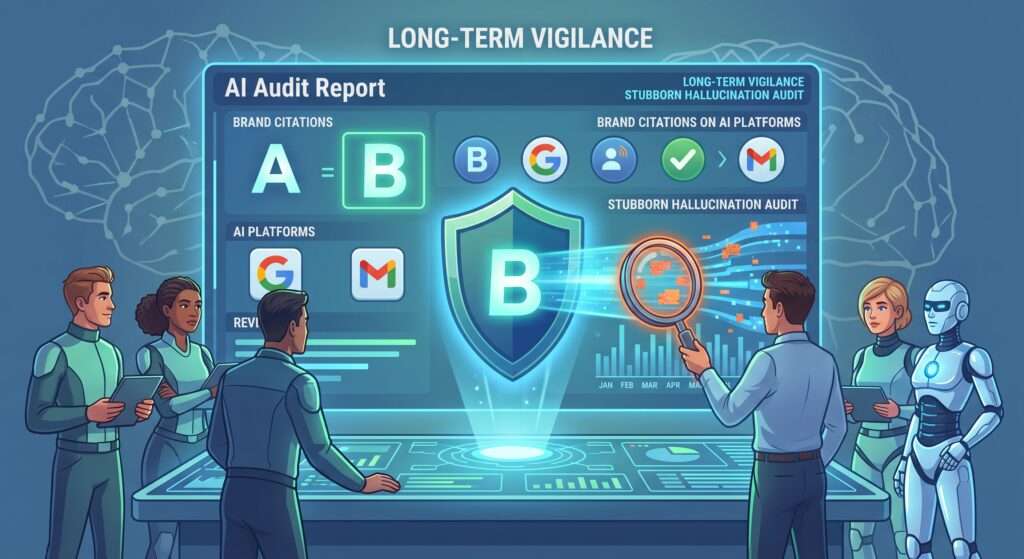
When a hallucination is stubborn
Sometimes a false fact persists even after you have corrected the obvious sources. This is frustrating but manageable, and it usually means the incorrect information is still present somewhere the AI trusts.
The approach is patient detective work: find every place the wrong fact still appears and correct each one, strengthen the correct fact so it clearly outweighs the error, and give it time, because AI systems update their picture gradually rather than instantly. Persistence pays off. As the balance of evidence shifts decisively towards the truth, the hallucination loses its footing and fades. What you are doing is making the correct answer so clear and well corroborated that the wrong one can no longer compete.
It also helps to keep a record of any hallucination you find and what you did about it. If the same error recurs, your notes show where it came from last time, which makes it far quicker to stamp out again. Treat stubborn hallucinations as a source to be traced, not a mystery to be feared.
Why this is worth your attention now
It is reasonable to ask whether this is really worth worrying about, or a fringe risk. The honest answer is that it is becoming less fringe by the month, as more customers ask AI about businesses before contacting them. Every one of those conversations is a chance for a confident wrong fact to reach someone, unseen by you.
What makes it particularly worth your attention is the asymmetry. The cost of prevention is low: an afternoon getting your facts straight and consistent, then an occasional check. The cost of an uncorrected hallucination is a slow, invisible loss of customers who were told something untrue and simply went elsewhere. A small, cheap habit guards against a real, if hidden, loss.
There is also a first-mover advantage, as there so often is with AI visibility. Most businesses are not checking what AI says about them at all, which means a stale or wrong fact can sit uncorrected for a long time. The business that simply looks, and keeps its facts clean, is already ahead of competitors who have never thought to.
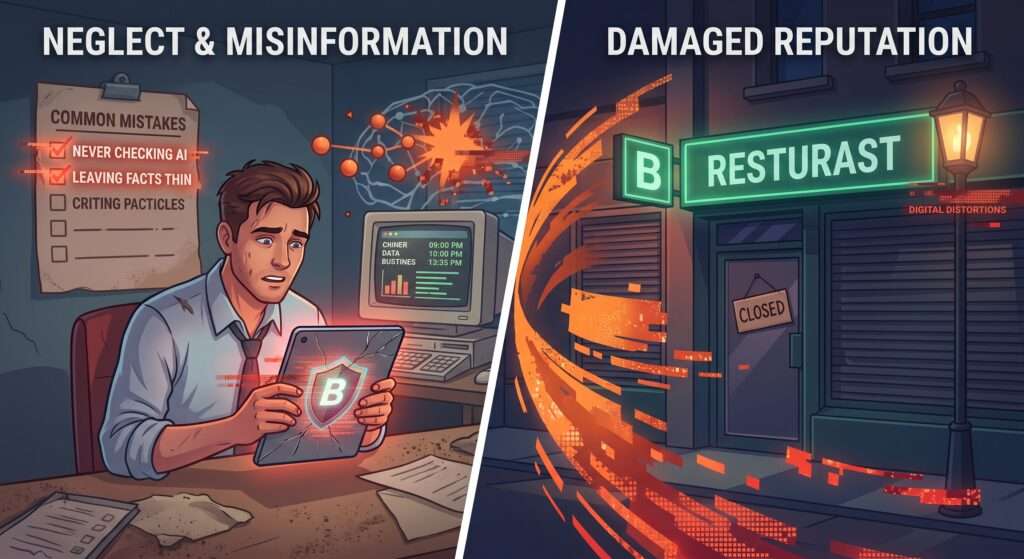
Common mistakes
A few habits leave a brand needlessly exposed to hallucinations. They are easy to fix once you see them.
Never checking. Not monitoring what AI says about you means hallucinations go unnoticed and uncorrected. Check regularly; customers will not tell you.
Leaving facts thin. Sparse, unclear information invites the AI to fill gaps with guesses. State your key facts clearly and fully.
Tolerating inconsistency. Different details across sources are a direct cause of hallucination. Make your facts agree everywhere.
Letting old facts linger. Outdated information left online gets repeated as current. Keep every source up to date, especially after a change.
Correcting the symptom, not the source. Noting an error without fixing the underlying information lets it persist. Trace it back and correct the record at its origin.
A worked example: a local restaurant
A family-run restaurant noticed a puzzling dip in Sunday bookings. Sundays had always been busy, and nothing had changed in the food or the service. It was a regular customer who eventually solved the mystery: they mentioned that when they had asked an AI assistant about the restaurant, it had told them, quite confidently, that the place had closed down.
It had not, of course. But when the owners looked into it, they found the cause. An old third-party listing, left over from a brief refurbishment closure years earlier, still described the restaurant as permanently closed. That single stale, authoritative-looking source was enough for the AI to state as fact that the restaurant no longer existed. There was no clear, consistent source of truth strongly saying otherwise, so the AI had latched onto the outdated one. It was a textbook hallucination, grown in the gap left by inconsistent information.
The fix followed the Hallucination Guard exactly. The owners corrected the stale listing and every other source, stated the restaurant’s current details clearly on their own site with proper markup, made sure every listing agreed, and then monitored the AI answers until they came right. Within a few weeks the AI was correctly describing the restaurant as open and busy, and the Sunday bookings recovered. Nothing had been wrong with the restaurant; a single uncorrected fact had been quietly turning customers away, and getting the record straightened out was all it took. The lesson: what an AI says about you is not fixed, and it is your job to make sure it is true.
The detail worth dwelling on is how long the error had been quietly working. The refurbishment closure was years old, yet its ghost was still turning away Sunday customers. Nobody had thought to check, because nobody imagined the AI would be repeating something so out of date. That is the nature of these errors: they are invisible until you go looking, and they can persist for as long as you do not.
Frequently asked questions
What is an AI hallucination?
It is when an AI confidently states something that is false or fabricated, including wrong details about a real business. The AI is not lying; it is filling a gap in what it knows with a plausible-sounding guess. When that guess concerns your business, it can mislead customers who take it as fact.
Why would AI get facts about my business wrong?
Usually because of gaps or contradictions in the information available: thin details, inconsistent facts across sources, or outdated information that lingers. Where your facts are unclear or disagree, the AI fills the gap, sometimes wrongly. Clear, consistent, current information removes the gap.
How do I know if AI is hallucinating about my business?
You have to check, because customers rarely report it. Regularly ask the AI tools about your business, your hours, services, prices and status, and see whether the answers are correct. A structured review of what AI says about you catches errors you would otherwise miss.
How do I correct an AI hallucination?
Not by editing the AI directly, but by fixing the information it draws on. Trace the false fact to its source, correct every place it appears, and strengthen the true fact so it clearly outweighs the error. AI updates its picture gradually, so persistence and time are part of the fix.
Can I prevent hallucinations entirely?
Not with total certainty, but you can make them far less likely. Clear, consistent, current facts everywhere your business appears leave little for the AI to get wrong. Prevention through good groundwork is much easier than correcting errors after they spread.
Keep AI honest about you
AI hallucinations are a genuine and often invisible risk to your brand, because a confident, wrong statement about your business can turn customers away before you ever know it happened. But you are not powerless. By keeping your facts clear, consistent and current, watching what AI says, and correcting the record when it goes wrong, you can defend your brand effectively. That is the whole of the Hallucination Guard: state, corroborate, monitor, correct.
Start with the two prevention steps, because they do most of the work. State your key facts clearly on your own site, and make sure every listing and profile agrees. Then check, every so often, what the AI actually says about you. Those habits alone will spare you most hallucinations and catch the rest early.
If you would like help protecting your brand from AI hallucinations, that is part of our AI optimisation services, and it pairs naturally with wider reputation management work. Book a discovery call and we will help you keep AI telling the truth about your business.