
The Insight That Changes How You Should Write Content
Google ranks pages. AI systems extract passages. That one sentence should change how you write every piece of content from this point forward.
Think about what happens when someone asks ChatGPT or Perplexity a question. The system does not go through a ranked list of websites and decide which one wins. It retrieves documents, scans them for relevant passages, and synthesises those passages into an answer. If your content does not contain clear, self-contained, extractable passages, it gets skipped. Full stop.
Here is the uncomfortable truth: a page that ranks number one on Google might never be cited by a single AI system, because it was written for crawlers rather than for extraction. Meanwhile, a page sitting on page two of Google could be cited constantly, because its structure makes it trivially easy for an AI to pull a clean, confident answer.
Content structure is the single biggest lever you can pull to improve your AI visibility. This post gives you the exact principles, with practical examples, that you can apply today.
Why Content Structure Matters for AI Search
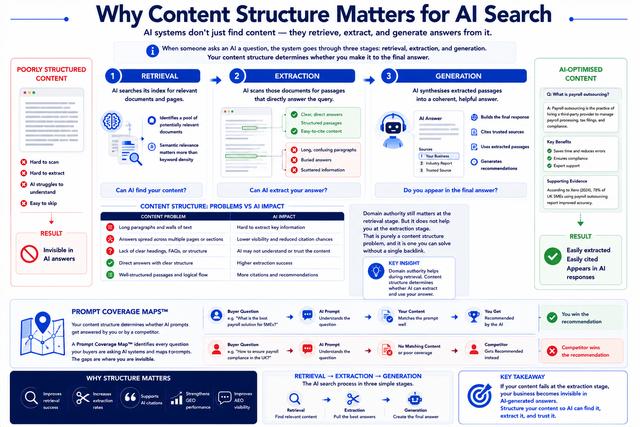
To understand why structure matters so much, you need to understand what happens behind the scenes when someone asks an AI a question. The process has three stages.
First, retrieval. The AI system identifies a pool of potentially relevant documents from its index. This stage is similar to traditional search, but the signals are different. Semantic relevance matters more than keyword density.
Second, extraction. The system scans those documents for passages that directly answer the query. This is where most content fails. If your answer is buried inside a long paragraph, wrapped in qualifications, or split across multiple sections, the AI cannot cleanly extract it. It moves on.
Third, generation. The system synthesises the extracted passages into a coherent answer. If your content was extracted, your brand, your statistics, or your recommendations may appear in the final output. If it was not, you are invisible.
This is the core principle behind both Generative Engine Optimisation (GEO) and Answer Engine Optimisation (AEO). Both disciplines recognise that AI systems operate on a retrieval-extraction-generation model, and both demand that your content be structured to survive the extraction stage.
Domain authority still matters at the retrieval stage. But it does not help you at the extraction stage. That is purely a content structure problem, and it is one you can solve without a single backlink.
Prompt Coverage Maps™ Your content structure determines whether AI prompts get answered by you or by a competitor. A Prompt Coverage Map™ identifies every question your buyers are asking AI systems and maps your current content against those prompts. The gaps are where you are invisible.
The 6 Content Structure Principles for AI Search
These six principles work together. Apply all six to a page and you transform it from a traditional SEO asset into an AI-ready content asset.
1. Use Direct-Answer Formatting
State the answer first. Then expand. This is the inverted pyramid structure, borrowed from journalism, and it is perfectly suited to AI extraction.
Traditional content buries the answer. It builds context, explores nuance, and arrives at the conclusion at the end of a section. That approach made sense for human readers who wanted to understand the journey. AI systems do not want the journey. They want the destination, stated clearly in the first sentence.
Weak (traditional structure): There are many factors to consider when thinking about how frequently you should publish content. Some experts recommend daily publishing, while others argue for quality over quantity. Ultimately, the best publishing frequency depends on your resources, your audience, and your goals. For most businesses, two to four posts per week is a reasonable starting point.
Strong (AI-ready structure): The ideal content publishing frequency for most businesses is two to four posts per week. This balances consistency with quality, maintains your team’s capacity, and signals regular activity to both search engines and AI indexing systems. If resources are limited, one high-quality post per week consistently outperforms sporadic bursts of activity.
Notice how the strong version leads with the answer. Everything after it supports and expands. The AI can extract the first sentence alone and have a usable, accurate response.
2. Write AI-Extractable Headings
Your H2 and H3 headings should function as standalone questions or direct statements. When an AI scans a document, it uses headings as navigation. A vague heading like “Our Approach” gives the AI no information. A heading like “How to Choose the Right Publishing Frequency” tells the AI exactly what the section covers.
The rule is simple: read your heading in isolation. If a person could tell what question it answers, it is AI-extractable. If it requires context from the rest of the page, rewrite it.
Weak headings:
- Introduction
- Our Services
- The Process
- Why It Matters
Strong, AI-extractable headings:
- How Does AI Search Differ from Google Search?
- What Are the Most Common AI Visibility Mistakes?
- How to Write Content That ChatGPT Will Cite
- Why Content Structure Determines AI Citation
3. Use the 40 to 60 Word Answer Format for FAQ Sections
This is the AI-citation sweet spot. Answers between 40 and 60 words are long enough to be substantive and short enough to be extracted as a single, clean passage. Shorter than 40 words and you risk being too thin to be useful. Longer than 60 and you risk the AI extracting only part of your answer, potentially out of context.
Every FAQ section on your site should be built to this specification. Write the question as a user would phrase it. Answer it in 40 to 60 words. Do not include preamble. Do not repeat the question in the answer. Get straight to the point.
Example of a 40 to 60 word answer: Passage-level optimisation is the practice of structuring individual sections of content so that AI systems can extract and use them as standalone answers. Rather than optimising a full page for a single keyword, you optimise each passage for a specific question or query. Each passage should be 40 to 60 words, self-contained, and begin with the direct answer.
4. Break Up Dense Paragraphs
Set a firm rule: three to four sentences per paragraph, maximum. AI systems struggle with dense walls of text. When a passage runs to seven or eight sentences, the system cannot easily identify where the relevant information starts and ends. Short paragraphs create natural extraction points.
This also benefits human readers. Long paragraphs are harder to scan, harder to read on mobile, and more likely to cause people to bounce. In this case, what is good for AI extraction is also good for user experience.
If you have a paragraph that exceeds four sentences, ask: can this be split into two separate points? In most cases, the answer is yes. Split it.
5. Use Tables and Bullet Lists for Comparisons and Lists
Tables and bullet lists are among the most extractable formats in existence. When an AI encounters a table, it can parse the structure and present the comparison cleanly. When it encounters a bulleted list, it can extract individual items or the full list as a self-contained unit.
Any time you are comparing two or more things, use a table. Any time you are presenting a list of items, steps, or recommendations, use a bulleted or numbered list. Do not write these things as prose paragraphs if there is a structured alternative.
| Element | Traditional SEO | AI-Optimised Content |
| Heading style | Keyword-rich phrases | Questions or direct statements |
| Paragraph length | Up to 8-10 sentences | 3-4 sentences maximum |
| Answer placement | Conclusion of section | First sentence of section |
| FAQ answers | 100-200+ words | 40-60 words, self-contained |
| Key terms | Used naturally in context | Defined explicitly on first use |
| Lists and tables | Used for readability | Prioritised for extractability |
6. Define Key Terms Explicitly
AI systems prioritise content that contains clear, authoritative definitions. When you define a term explicitly, you create a passage that can be extracted as a definitional answer. When you assume the reader knows what a term means and skip the definition, you miss an extraction opportunity.
The format is simple: introduce the term, define it directly, then use it. Do not bury definitions in the middle of a paragraph. Flag them with phrases like “X is defined as…” or “X refers to the practice of…” These signals help AI systems identify definitional passages.
This principle connects directly to entity-based SEO. Entity recognition is how AI systems categorise and understand your content. Clear, explicit definitions make it easier for AI to associate your content with the right entities and topics.
The FAQ Section: Your Most Powerful AI Visibility Tool
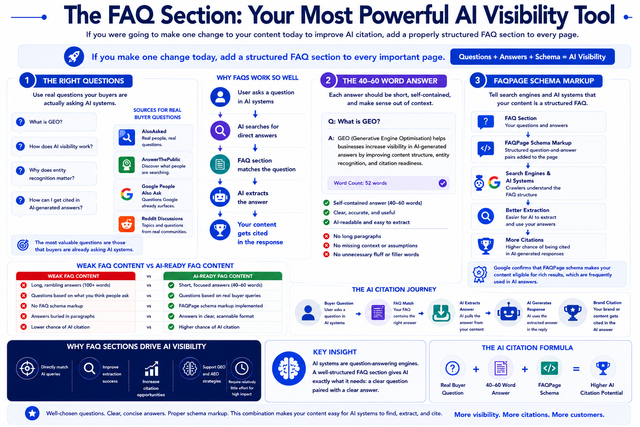
If you were going to make one change to your content today to improve AI citation, add a properly structured FAQ section to every page. Nothing else comes close to the return on effort.
Here is why FAQ sections work so well. AI systems are, at their core, question-answering engines. When a user asks a question, the system looks for content that answers it. A well-structured FAQ section is a direct map of questions to answers. You are essentially pre-answering the queries that your buyers are putting into AI systems.
The structure of an effective FAQ section has three components.
The right questions. Do not write FAQ questions based on what you think buyers ask. Find out what they actually ask. Tools like AlsoAsked,AnswerThePublic, and Reddit searches surface real user questions. Google’s People Also Ask feature is another reliable source. The most valuable questions are those that buyers are already asking AI systems directly.
The 40 to 60 word answer. Each answer should be self-contained. Imagine the answer appearing completely out of context, with no page title, no surrounding text. Does it still make sense? Does it give a useful, accurate response to the question? If yes, it is AI-ready. If not, revise it.
FAQPage schema markup. FAQPage schema markup tells Google and other crawlers that your page contains a structured set of question-and-answer pairs. This amplifies the extractability of your FAQ content significantly. Google’s own documentation on structured data for FAQ pages confirms that FAQPage schema makes your content eligible for rich results, which are also frequently cited by AI systems.
The combination of well-chosen questions, 40 to 60 word answers, and FAQPage schema markup is the single most reliable content pattern for AI citation.
What to Avoid: Content Patterns That Block AI Extraction
Knowing what to fix is useful. Knowing what to stop doing is equally valuable. These are the content patterns that actively prevent AI systems from extracting your content.
Jargon-heavy introductions that bury the answer. If your section opens with industry jargon, brand language, or a lengthy setup before getting to the point, an AI will likely skip it. State the answer in the first sentence.
Paragraphs longer than four sentences. Dense blocks of text do not have clean extraction boundaries. AI systems cannot easily identify where the relevant information begins and ends. Four sentences maximum.
PDFs and image-heavy pages without text equivalents. Critical information locked inside PDFs or embedded in images is invisible to AI systems. If your pricing, specifications, or key data live in a PDF, bring them into the page as text.
JavaScript-rendered content. If your content only appears after JavaScript has loaded, many AI crawlers will not see it. Technical AI SEO requires that your core content is available in the initial HTML response. Server-side rendering is the safest approach.
Missing or generic H1 and H2 structure. If your page lacks a clear H1 or uses vague headings that do not signal what each section covers, AI systems cannot navigate your content. Every page needs a descriptive H1 and every major section needs a descriptive H2.
Passive voice and hedged language. Phrases like “it could be argued that” or “some might suggest” undermine confidence. AI systems prefer direct, assertive statements. Write in active voice and state answers with authority.
Quick checklist: content patterns to eliminate Jargon-heavy opening paragraphs / Paragraphs over 4 sentences / Key information in PDFs or images / JavaScript-dependent content / Vague or generic headings / Passive voice and hedged language
A Practical Content Audit Checklist
Use this 10-point checklist to audit any existing page on your site. Run through it section by section. Every item you fix is an improvement to your AI visibility.
- Does the page have a clear, descriptive H1 that states what the page covers?
- Does each H2 section answer a specific question or make a direct statement?
- Does each section open with the direct answer rather than building to it?
- Are all paragraphs three to four sentences or fewer?
- Does the page include an FAQ section with questions your buyers actually ask AI?
- Are all FAQ answers between 40 and 60 words and self-contained?
- Is key information presented in tables or lists rather than dense prose where applicable?
- Are key terms defined explicitly on first use?
- Is all critical content available as text in the HTML, not locked in PDFs or images?
- Does the page include FAQPage, Article, or HowTo schema markup?
Beyond the structure of individual pages, there is a bigger question: do you know which questions your buyers are asking AI systems right now? This is the concept behind Prompt Coverage Maps™. A Prompt Coverage Map™ maps every relevant prompt in your market against your current content, identifying exactly where you are visible and where competitors are being cited instead. It is the strategic layer that sits above individual page optimisation.
If you want to understand the full picture of how AI visibility differs from traditional search performance, the shift from search engines to AI answers is essential reading.
Schema Markup: The Technical Layer That Amplifies Structure
Content structure handles the human-readable layer of AI extractability. Schema markup handles the machine-readable layer. Together, they make your content significantly more likely to be cited.
FAQPage schema. Applied to your FAQ sections, this tells crawlers the exact question-and-answer pairs on your page. It makes your FAQ content eligible for rich results in Google and increases the confidence with which AI systems can extract your answers.
Article schema. Applied to blog posts and editorial content, Article schema signals authorship, publish date, and topic. These signals support AI systems in assessing the authority and recency of your content.
HowTo schema. Applied to step-by-step instructional content, HowTo schema structures your process content in a way that AI systems can parse and reproduce accurately. If your content includes numbered steps, HowTo schema should be on the page.
Schema markup alone will not rescue poorly structured content. But when applied on top of well-structured content, it acts as a multiplier. For the full picture of how technical implementation affects AI visibility, see our guide to AI SEO and ranking in AI search results.
Frequently Asked Questions
Q: How should I structure content for AI search? Structure content using the inverted pyramid: state the answer first, then expand. Use descriptive H2 and H3 headings that function as standalone questions. Keep paragraphs to three or four sentences. Include FAQ sections with 40 to 60 word self-contained answers. Define key terms explicitly. Use tables and bullet lists for comparisons and step-by-step information.
Q: What is passage-level optimisation? Passage-level optimisation is the practice of structuring individual sections of content so that AI systems can extract and use them as standalone answers. Rather than optimising a full page for a single keyword, you structure each passage to answer a specific question clearly and concisely, typically in 40 to 60 words per passage.
Q: How long should FAQ answers be for AI visibility? The optimal FAQ answer length for AI visibility is 40 to 60 words. This is long enough to provide a substantive, useful answer and short enough to be extracted as a single, clean passage. Answers shorter than 40 words risk being too thin. Answers longer than 60 words risk being partially extracted and presented out of context.
Q: Does content structure affect Google AI Overviews? Yes. Google AI Overviews draw on the same retrieval-extraction-generation pipeline that other AI systems use. Pages with clear H2 headings, short paragraphs, direct-answer formatting, and FAQPage schema are significantly more likely to appear in AI Overviews than pages structured for traditional SEO. Structure is a primary factor, not a secondary one.
Q: How do I know if AI systems are extracting my content? Test directly by asking ChatGPT, Perplexity, and Google AI Overviews questions your content answers. Check whether your brand, statistics, or recommendations appear in the responses. For a systematic approach, a Prompt Coverage Map™ maps every relevant buyer prompt against your content to identify exactly where you are visible and where competitors are cited instead.
About the Author
AI Listings Team
AI Listings is a UK-based AI visibility agency helping businesses become visible, trusted, and recommended across AI search platforms including ChatGPT, Perplexity, Gemini, and Google AI Overviews. The team specialises in GEO, AEO, and the full stack of AI visibility optimisation disciplines that determine whether a business is cited by AI or overlooked by it.
AI Listings operates as a trading name of Primrose Point Ltd and is the creator of the Shortlist System™, LLM Visibility Score™, Prompt Coverage Maps™, and Hallucination Guard™ frameworks for measuring and improving AI visibility.