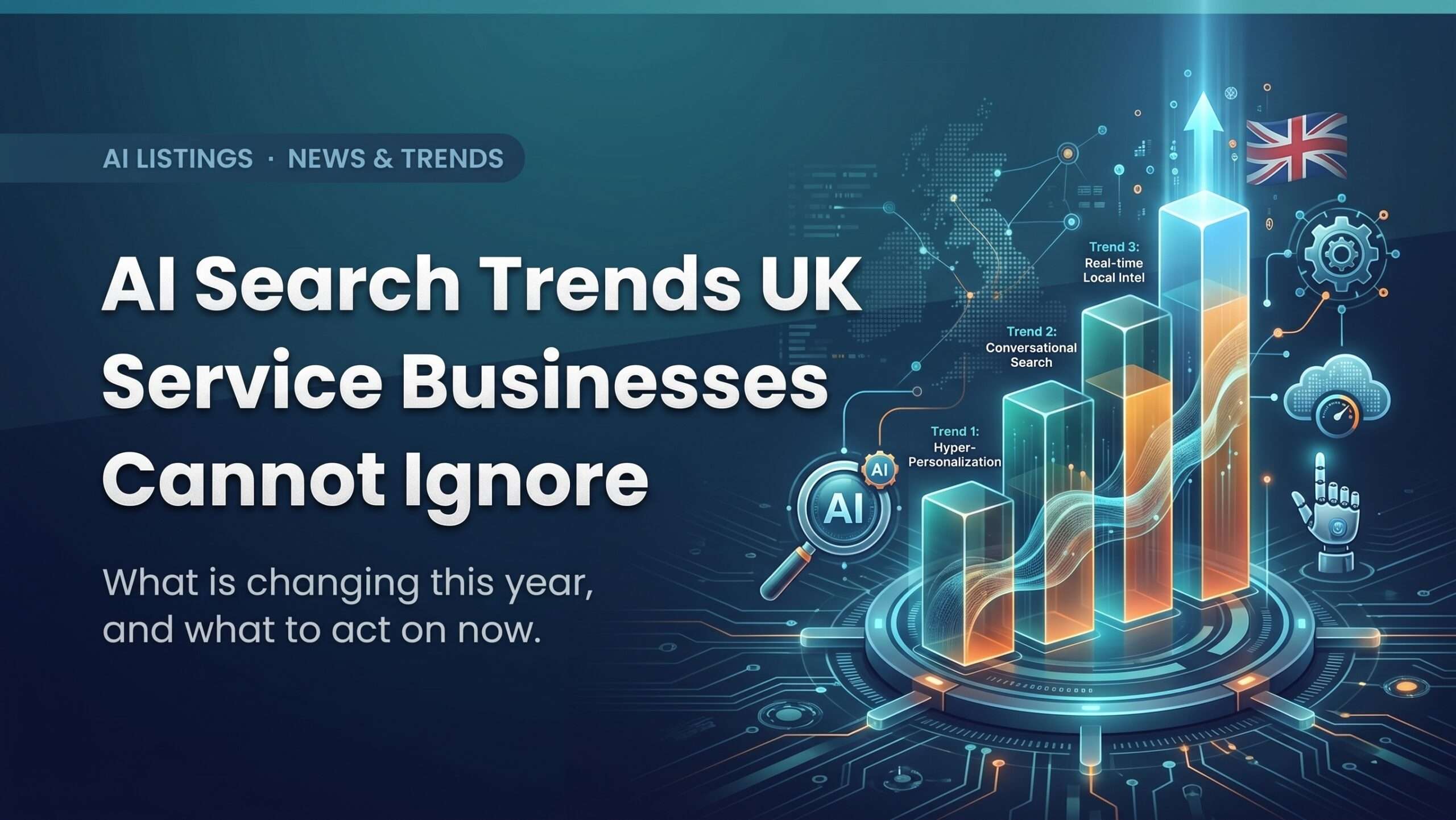
The way people find and choose businesses is changing faster than most owners realise, and the pace has picked up sharply this year. These are the AI search trends UK service businesses genuinely cannot ignore in 2026: not distant predictions, but shifts already underway in how your customers look for what you offer. The encouraging part is that most of your competitors have not yet acted on any of them, which turns a daunting change into a real opportunity for the businesses that move first.
The headline is simple. A large and growing share of UK customers now use AI tools, whether ChatGPT and similar assistants or Google’s own AI Overviews, as part of finding local services, and yet very few UK businesses have done anything to be visible in those answers. Demand has moved ahead of supply. Surveys through 2026 suggest around half of UK adults have used AI-powered search, while other audits find that fewer than one in twenty UK smaller businesses has taken any deliberate step on AI visibility. That gap is the whole story.
This guide rounds up the seven trends that matter most for a UK service business this year, with a plain note on what to do about each. It is deliberately practical, and it links out to fuller guides on every point, so you can go deeper wherever a trend applies to you. Treat it as a map of the change, and a starting checklist.
A snapshot of where things stand
Before the trends themselves, a quick picture of the landscape, because the numbers make the case better than any argument. The exact figures vary by source and method, but the direction is not in doubt.
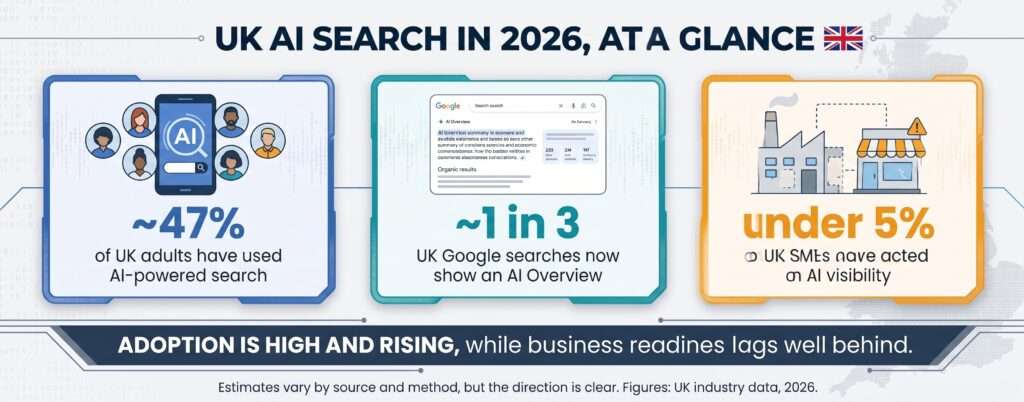
The UK picture in 2026: adoption is high and rising, while business readiness lags well behind.
By 2026, AI assistants had become mainstream: ChatGPT alone reached around a billion weekly users worldwide, and Google’s AI Overviews now reach billions of people a month. In the UK specifically, roughly half of adults report having used AI-powered search, and something like one in three Google searches here now shows an AI Overview, up from around one in five at the start of 2025. It is worth keeping perspective, though: research from Bain and others still finds most people begin more searches with a traditional engine than with a chatbot. Traditional search has not vanished; it is being layered with AI, and that layer is growing fast.
Against that adoption sits a striking readiness gap. Audits of UK businesses in 2026 repeatedly find that the large majority have done nothing specific for AI visibility, many have no structured data at all, and only a small minority track how they appear in AI answers. So while customers are increasingly asking AI, most businesses are not yet answering. That imbalance is exactly why acting now carries a first-mover advantage that will not last for ever.
Trend 1: AI search has gone mainstream
The first trend is the foundational one: using AI to find things is no longer an early-adopter habit. It has crossed into ordinary behaviour across ages and income groups, including for finding local services.
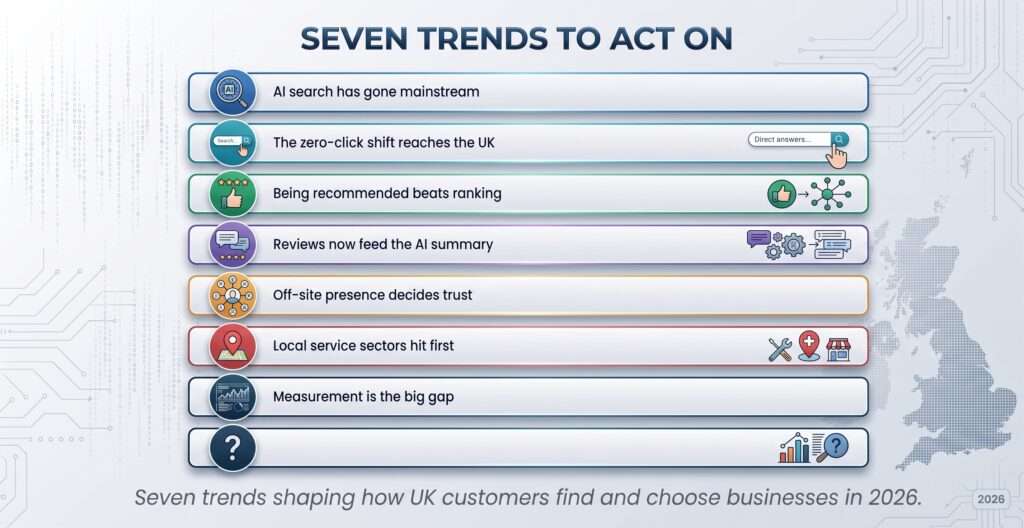
Seven trends shaping how UK customers find and choose businesses in 2026.
For a service business, this means a meaningful and rising share of your potential customers now form an impression, or a shortlist, on an AI tool before they ever reach a search results page or your website. If you are not present in those answers, you are simply absent from part of the market, and you will not see it happening in your analytics. Understanding how customers now find businesses through AI is the starting point for everything that follows.
What to do: stop treating AI search as a novelty and start assuming your customers use it. That single shift in mindset is what moves AI visibility from something to consider one day to something to act on this quarter.
Trend 2: the zero-click shift has reached the UK
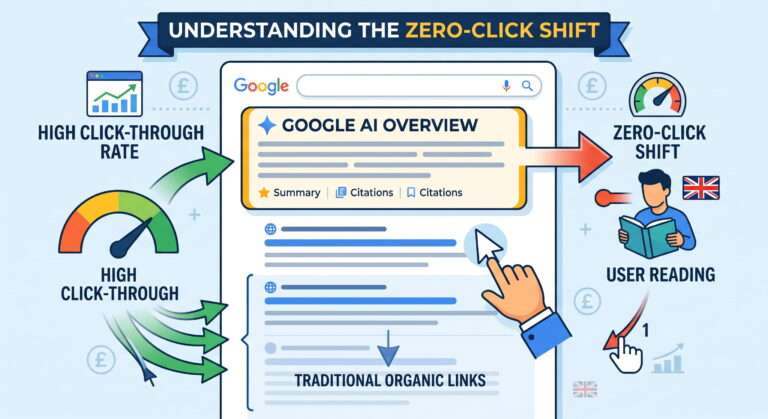
The second trend is the rise of the answer on the page. As a Pew Research analysis of real browsing found, when an AI summary appears people click through to a website far less often, close to half as often in that study, and broader analysis of zero-click search in 2026 points the same way. UK searches increasingly show an AI Overview that answers the query directly, and even local, near-me searches are more often served by an AI answer than by the old list of results.
For UK service businesses, this is the shift from search engines to AI answers arriving on home ground. The click you once relied on is, for many queries, no longer guaranteed, because the customer gets their answer without it. That is unsettling, but it points straight to the response.
What to do: aim to become the answer rather than mourn the click. When the answer is on the page, being the source it draws from and names is the new way to be seen.
Trend 3: being recommended beats ranking
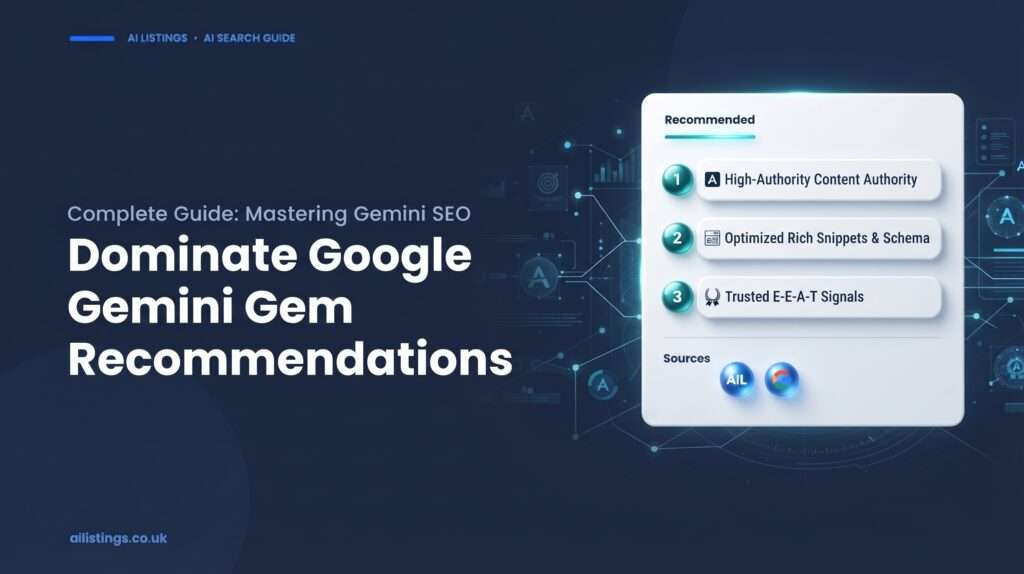
The third trend follows directly: the goal has shifted from ranking a link to being the business the AI recommends. And encouragingly, the old hierarchy of search has loosened in the process.
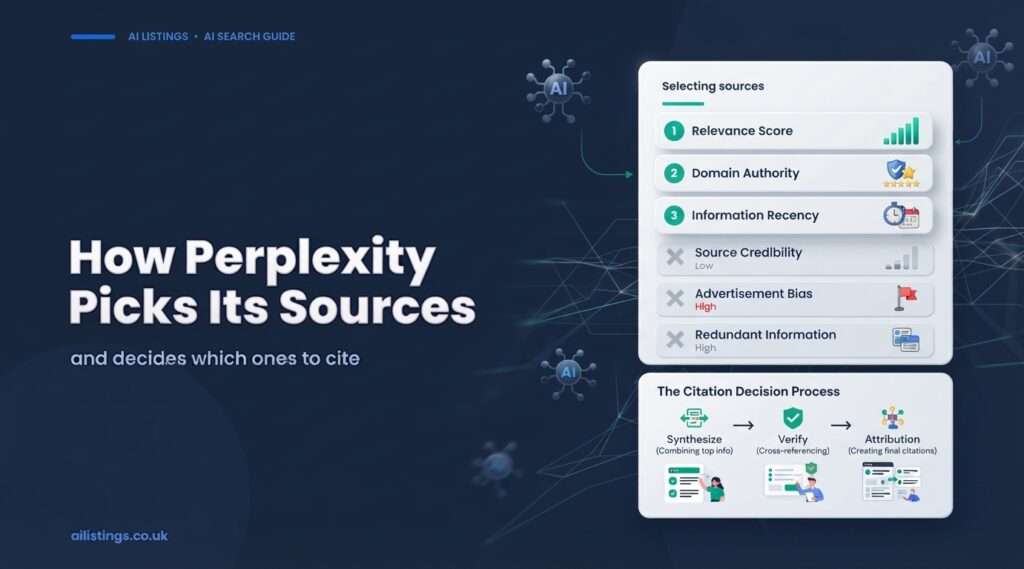
Analyses of AI Overviews in 2026 find that a large share of the sources they cite come from outside the traditional top three organic positions. In plain terms, businesses that never ranked on page one of Google can now be cited and recommended by AI, because the AI chooses sources on relevance and trust, not only on old rankings. This levels the field, and it is the essence of how businesses now get recommended by AI.
What to do: stop measuring yourself only by rankings and start asking whether AI recommends you. The businesses that win here are the ones that are genuinely useful and trustworthy, not necessarily the ones that were already top of Google.
There is a deeper implication here worth sitting with. For years, businesses that could not crack the top of Google were effectively locked out of search visibility. AI has quietly reopened that door. A smaller, newer or less established business that is genuinely useful and well regarded can now be named in an answer beside firms that outrank it, which is a fairer contest than the one search used to offer.
Trend 4: reviews now feed the AI summary
The fourth trend is that your reputation has become an input to what AI tells people about you. When a customer asks an AI whether you are any good, it answers from your reviews, mentions and the sentiment around your name.
This makes reviews and reputation more consequential than ever, because they now shape a summary delivered before the customer reaches you. It is worth noting a UK legal dimension too: since April 2025, faking reviews has been illegal here, so the only sustainable route is genuine. Getting ahead of the summary, honestly, is what AI reputation management is about.
What to do: build a steady flow of genuine reviews, respond to feedback, and keep an eye on what AI says about you. A strong, current, honest reputation is now a visibility asset, not just a sales one.
Trend 5: off-site presence decides trust
The fifth trend surprises many owners: your own website is only a small part of what AI relies on. Studies in 2026 find that a company’s own site accounts for a modest fraction of AI-cited sources, with most citations coming from third-party places: publishers, directories, reviews and other independent mentions.
This means what others say about you off-site increasingly decides whether AI trusts you, which is the digital PR side of AI visibility. It also depends on the AI recognising you clearly as a distinct business, which is a matter of entity recognition. Optimising only your own website, and neglecting your wider presence, now leaves most of the picture untended.
What to do: build genuine off-site presence: consistent listings, honest mentions in relevant places, and a clear, corroborated identity across the web. The businesses AI trusts are the ones the wider web agrees on, not just the ones with a nice website.
Trend 6: local service sectors are being hit first
The sixth trend is about who is feeling this soonest. The disruption is not evenly spread, and several local service sectors are among the earliest and most affected.
UK data through 2026 points to professional services such as accountants, solicitors and financial advisers, to healthcare including private clinics and dental practices, and to home services such as builders, plumbers and electricians, as sectors where customers now routinely research on AI before making contact. In several of these, a majority of people have used AI to look into a question before approaching a business. For these sectors, local AI visibility is no longer optional, and the whole local service business playbook for AI search applies with particular force.
What to do: if you are in one of these sectors, treat AI visibility as a priority for this year rather than a someday project. Your customers are already using AI to vet you, whether or not you are ready for it.
Trend 7: measurement is the biggest gap
The seventh and final trend is a gap rather than a movement, and it may be the most important. Almost nobody is measuring their AI visibility, which means almost nobody knows where they stand.
Research in 2026 suggests only a small minority of brands track how they perform in AI search at all. Most businesses have no idea whether AI recommends them, what it says about them, or whether it is accurate, because they have never looked. This is where a structured AI visibility audit and an ongoing AI citation audit change everything, by turning a blind spot into something you can see and improve.
What to do: find out what AI currently says about you. You cannot manage what you do not measure, and simply looking puts you ahead of the majority who never have. This is the single cheapest, highest-value step available.
The reason this gap persists is simple: what happens inside an AI conversation is invisible in ordinary analytics. You will not see a chart showing the customers who asked an AI, heard a competitor recommended, and never came. That invisibility is precisely why so few businesses have noticed the shift, and precisely why looking, deliberately, is such an advantage.
What to do this quarter
Seven trends can feel like a lot, so here is the whole thing distilled into a short, ordered plan you can actually start on. None of it requires a big budget, only a decision to begin.
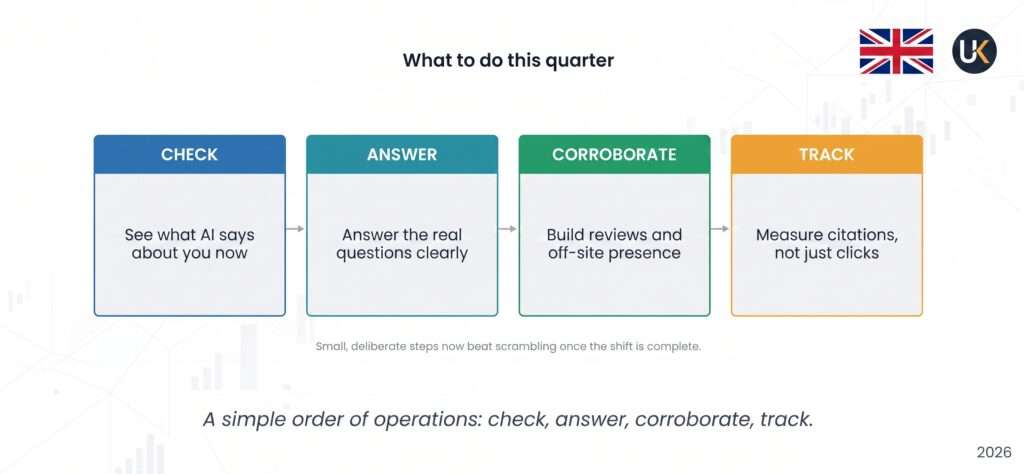
A simple order of operations: check, answer, corroborate, track.
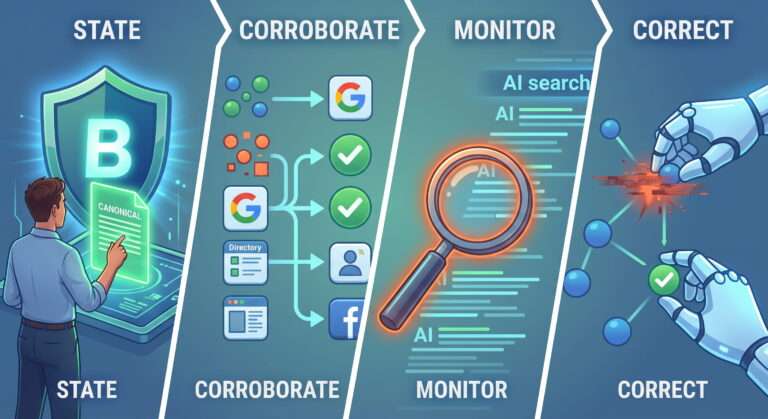
- Check where you stand. Ask the main AI tools about your business and note what they say, whether they recommend you, and whether it is accurate. This is your baseline.
- Answer the real questions. Make sure your content clearly answers the practical questions your customers ask, in a form AI can lift and cite.
- Corroborate off-site. Build genuine reviews and consistent, honest mentions across the web, so what others say about you supports what you say about yourself.
- Track it over time. Keep measuring whether you appear and are cited in AI answers, so you can see progress rather than guess at it.
Why the readiness gap is your opportunity
It is worth ending on the gap, because it reframes the whole picture from threat to opportunity. Customers have moved to AI faster than businesses have. Demand is here; the supply of AI-visible businesses is not.
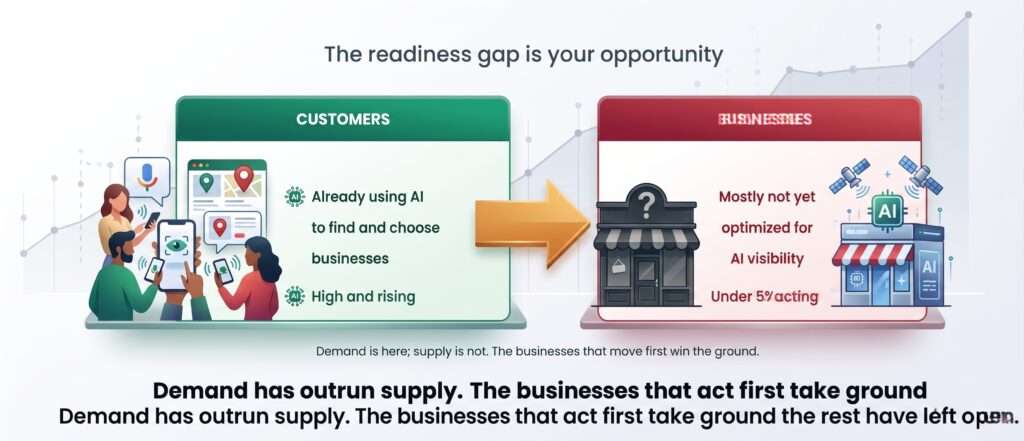
Demand has outrun supply. The businesses that act first take ground the rest have left open.
That imbalance will not last. As more businesses wake up to AI visibility, the field will crowd and the easy wins will close. Right now, though, a service business that acts, that makes itself clearly useful, well reviewed, consistently present and genuinely visible in AI answers, can establish itself as the recommended choice while most competitors are still doing nothing. The trends above are not reasons to panic. They are a map of where the ground is shifting, and an invitation to plant your feet before everyone else notices.
The businesses that come out of this period strongest will not be the biggest or the ones with the largest marketing budgets. They will be the ones that understood the change early and acted on it steadily, one practical step at a time, while it was still an advantage rather than a scramble.
Frequently asked questions
Are these AI search trends really affecting UK businesses now?
Yes. Around half of UK adults report using AI-powered search, and roughly one in three UK Google searches now shows an AI Overview, so a growing share of customers use AI to find and vet businesses today. It is a present reality, not a future prediction, even though traditional search is still widely used alongside it.
Which UK sectors are most affected?
Professional services such as accountants, solicitors and financial advisers, healthcare including clinics and dental practices, and home services such as builders, plumbers and electricians are among the earliest hit, because customers in these fields increasingly research on AI before making contact. If you are in one of these, treating AI visibility as a priority is well justified.
My website looks great. Is that enough for AI?
Not on its own. Studies find your own website is only a small part of what AI cites; most references come from third-party sources like directories, reviews and mentions. So off-site presence and a clear, corroborated identity matter as much as your site, and optimising the website alone leaves most of the picture untended.
What is the single most useful first step?
Find out what AI currently says about you. Ask the main AI tools about your business and note whether they recommend you and whether it is accurate. Almost no one does this, so simply looking gives you a baseline and puts you ahead of most competitors.
Is it too late to get ahead?
No, the opposite. Because fewer than one in twenty UK smaller businesses has acted on AI visibility, there is still a clear first-mover advantage. Acting steadily now, while customer demand has outrun business readiness, lets you establish yourself before the field crowds and the easy wins close.
Act before everyone else notices
The trends are clear and they point one way: AI has become part of how UK customers find and choose service businesses, and it is only growing. From the zero-click shift to the primacy of reviews, off-site presence and being recommended over ranking, the rules of visibility are being rewritten in real time. The businesses that read the change and respond will be the ones AI recommends tomorrow.
The best news is the readiness gap. Because so few businesses have acted, a steady, deliberate effort now still buys a genuine head start. Begin by finding out what AI says about you, then work through the practical steps above at whatever pace you can sustain. If you would like help acting on these trends, that is exactly what our AI optimisation services are for. Book a discovery call and we will help you turn these shifts into an advantage while it still is one.