
Your customers are still searching. But the way they search has changed.
More and more of them are opening ChatGPT, Perplexity, or Google AI and asking a question directly. They receive a structured, confident answer. They act on it. They never see your website, your rankings, or your Google Ads.
The question every UK marketer and business owner should be asking right now is this: if your customers are getting answers from AI instead of clicking through search results, does your Google ranking still matter?
The honest answer is that it matters less than it used to, and it matters less every month. The discipline built to address this gap is Generative Engine Optimisation, or GEO.
This guide explains exactly what GEO is, how it works, how it differs from traditional SEO, and what UK businesses need to do to start practising it today.
What Is GEO? The Definition
Generative Engine Optimisation (GEO) is the practice of structuring content so that AI-powered search systems cite it when answering user queries.
Where traditional SEO targets clicks from ranked search results pages, GEO targets citations within AI-generated answers. The goal is not to rank higher. The goal is to be included in the response at all.
The term was formalised in peer-reviewed academic research published at ACM SIGKDD 2024 by researchers from Princeton University, Georgia Tech, the Allen Institute for AI, and IIT Delhi. Their foundational study tested optimisation strategies across 10,000 queries across 25 domains and found that the right GEO tactics could boost content visibility in AI-generated responses by up to 40 percent. Pages that were not already dominating organic search saw the biggest gains, with pages ranked around position five experiencing a 115 percent visibility increase after GEO optimisation.
That research established GEO as a formal discipline, not a marketing buzzword. It has since been adopted as an operational framework by marketing teams across enterprise, agency, and in-house contexts.
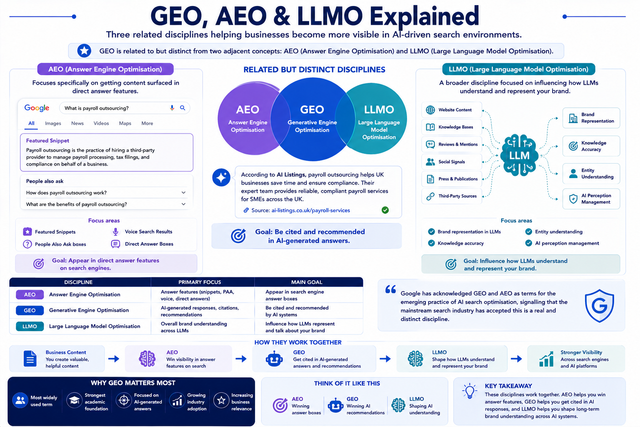
GEO is related to but distinct from two adjacent concepts:
AEO (Answer Engine Optimisation) focuses specifically on getting content surfaced in direct answer features such as featured snippets, People Also Ask boxes, and voice search results. AEO post gets its own guide.
LLMO (Large Language Model Optimisation) is a broader term used by some practitioners to describe the full range of measures taken to influence how LLMs represent a brand. GEO is the most widely used and academically grounded of these terms and is what this guide focuses on.
Google itself has acknowledged GEO and AEO as terms for the emerging practice of AI search optimisation, signalling that the mainstream search industry has accepted this is a real and distinct discipline.
Why GEO Matters: The Data
The case for GEO does not rest on speculation. It rests on what is already measurable in UK and global search behaviour right now.
Google AI Overviews appear in 25 to 50 percent of all searches (Semrush, 2025). For a significant proportion of the queries your customers are typing into Google, the first thing they see is an AI-generated summary, not a list of organic results. If your business is not in that summary, you have effectively become invisible for those searches regardless of how well you rank.
AI search traffic grew by 527 percent year on year (Ahrefs, 2026). That is a category of referral traffic that barely existed two years ago and is now a measurable, growing source of visits for businesses that have earned AI citations.
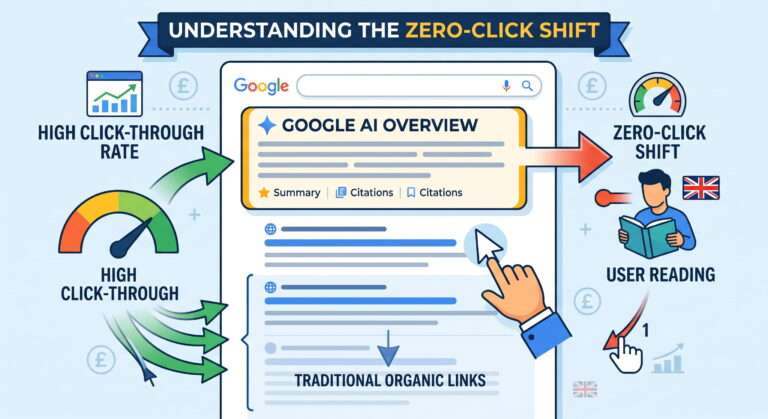
Click-through rates to the number-one organic result drop by 58 percent when a Google AI Overview appears (Semrush, 2025). You could be ranking first and still lose the majority of that query’s traffic to an AI-generated answer above you.
AI-referred visitors convert 4.4 times better than organic search visitors (Salesforce, 2025). The reason is the implied endorsement effect. A user who clicked a search result is still evaluating. A user who received an AI recommendation has already been pre-sold.
The UK is one of the most AI-active search markets in the world. ChatGPT alone had 19.1 million unique UK visitors by the end of 2025, according to DataReportal, making it the seventh most visited website in the country. With 247 million monthly visits on average, ChatGPT’s UK presence is not a niche behaviour. It is mainstream.
These numbers describe what is happening now, not what might happen in the future. UK businesses that build GEO capability today are accumulating an advantage over competitors who are still measuring success purely by organic keyword rankings.
How Generative Engines Work
To optimise for something, you need to understand how it works. Generative engines process content differently from traditional search engines, and that difference is the foundation of the entire GEO discipline.
Most AI systems that generate search answers use a process called Retrieval-Augmented Generation, or RAG. The process works in three stages.
Stage 1: Retrieval
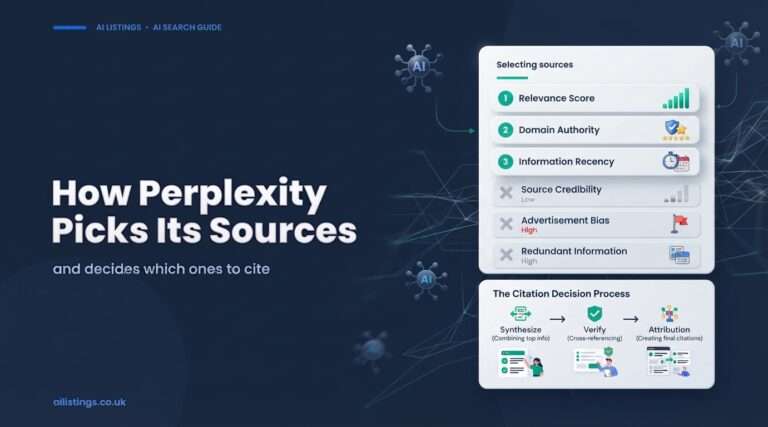
When a user submits a query, the AI system does not simply draw on its training data. It retrieves live, relevant content from across the web using its own search capabilities. This retrieval step identifies candidate sources that appear to contain information relevant to the query. The system is looking for passages, not pages. It evaluates content at a granular level, pulling specific sentences, paragraphs, and data points rather than ranking whole documents.
This is a critical distinction from traditional SEO. Google ranks pages. Generative engines extract passages. The implication is that a single well-structured paragraph buried on page seven of a site can be cited by a generative engine even if the overall domain has low authority. Conversely, a high-authority site with poorly structured, vague content may be largely ignored by AI systems even when it ranks well organically.
Stage 2: Summarisation and Evaluation
Once candidate content has been retrieved, the AI evaluates it for quality and relevance signals. The factors that matter at this stage include how directly the content answers the query, how clearly the information is presented, how consistent the source is with other trusted sources, and whether the content demonstrates evidence of expertise or authority.
Content that uses vague generalisations, buries its main point, or contradicts itself across sections is systematically underweighted. Content that states its main point clearly in the first paragraph, uses structured formats like numbered lists and FAQ sections, and cites verifiable data performs significantly better.
Stage 3: Response Generation
Using the retrieved and evaluated passages, the AI constructs its answer. Citations in this final stage go to the sources the AI found most clear, most relevant, and most trustworthy. The businesses and websites that appear in the generated response are those that performed best across the retrieval and evaluation stages.
The practical implication is that GEO is fundamentally about legibility to AI systems. The clearer, more structured, and more authoritative your content is at the passage level, the more likely it is to survive retrieval, pass evaluation, and appear in the final AI-generated response.
GEO vs Traditional SEO: Key Differences
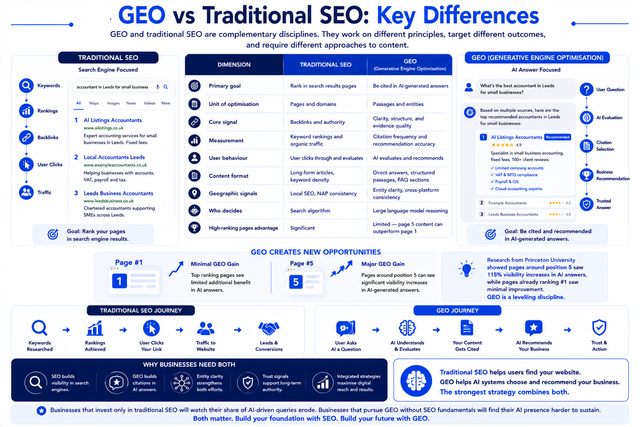
GEO and traditional SEO are not competing disciplines. They are complementary ones. But they operate on different principles, target different outcomes, and require different approaches to content.
Understanding the differences clearly is the starting point for any business that wants to build capability in both areas.
| Dimension | Traditional SEO | GEO |
| Primary goal | Rank in search results pages | Be cited in AI-generated answers |
| Unit of optimisation | Pages and domains | Passages and entities |
| Core signal | Backlinks and authority | Clarity, structure, and evidence quality |
| Measurement | Keyword rankings and organic traffic | Citation frequency and recommendation accuracy |
| User behaviour | User clicks through and evaluates | AI evaluates and recommends |
| Content format | Long-form articles, keyword density | Direct answers, structured passages, FAQ sections |
| Geographic signals | Local SEO, NAP consistency | Entity clarity, cross-platform consistency |
| Who decides | Search algorithm | Large language model reasoning |
| High-ranking pages advantage | Significant | Limited — page 5 content can outperform page 1 |
The final row deserves emphasis. The Princeton research demonstrated that pages already ranking at position one saw minimal GEO benefit, while pages around position five saw 115 percent visibility increases. This means GEO is a levelling discipline. A well-structured, clearly written piece of content on a newer or lower-authority website can outperform a dominant competitor’s content in AI-generated responses.
For UK businesses that have not been able to break through on traditional SEO, GEO represents a genuine first-mover opportunity. For businesses that already rank well, GEO is the layer of the strategy that protects that authority in an AI-dominated search environment.
Both matter. Businesses that invest only in traditional SEO will watch their share of AI-driven queries erode. Businesses that pursue GEO without maintaining SEO fundamentals will find their AI presence harder to sustain. For more on how these disciplines sit together, the AI Listings SEO services guide covers the integrated approach.
The 5 Core GEO Optimisation Principles
GEO is not a single tactic. It is a framework of practices that, applied together, systematically improve how AI systems find, evaluate, and cite your content. Here are the five principles that matter most.
Principle 1: Structure Content for Extraction
AI systems retrieve content at the passage level. That means the structure of your content determines whether individual passages are extractable.
In practice, this means: open each section with a direct answer to the question it addresses, use clear H2 and H3 headings that describe the content beneath them accurately, include FAQ sections on your key pages, and use numbered or bulleted lists where appropriate rather than burying information in long paragraphs.
The test is simple: take any paragraph on your most important pages and ask whether an AI reading that paragraph alone could extract a clear, accurate, useful fact about your business. If the answer is no, rewrite it until it can.
This also applies to data and evidence. The Princeton research found that adding specific statistics, citing sources, and including quotations from authorities significantly improved GEO performance. Vague claims do not get cited. Specific, verifiable claims do.
Principle 2: Build Entity Clarity
An entity is any clearly defined thing: your business, your key people, your products, your services, your location. AI systems build their understanding of your business by assembling a picture from every source where it appears. The consistency and clarity of that picture across all sources determines how confidently the AI can cite you.
Entity clarity means: your business name, description, service offering, and location are stated consistently across your website, your Google Business Profile, your social media profiles, your directory listings, and any third-party mentions. Inconsistencies create uncertainty. Uncertainty leads to omission.
The practical starting point is an entity audit. Search your business name across every platform where you appear and check whether the information is accurate, consistent, and current.
Principle 3: Create Topical Authority Clusters
AI systems assess depth of coverage. A business with one page per service is treated very differently from a business that has thoroughly covered its subject area across multiple interconnected pieces of content.
Topical authority clustering means: identify the ten to twenty questions your ideal customers ask most frequently about your subject area, and ensure each of those questions is answered clearly, accurately, and thoroughly on your website. These pieces of content should link to each other, creating a web of interconnected, mutually reinforcing content that signals to AI systems that your site is a reliable source on this topic.
This is directly analogous to how the current blog at ailistings.co.uk/blogs is structured, with each post covering a distinct aspect of AI visibility and linking to related posts. That architecture builds topical authority in a way that isolated, unconnected pages cannot.
Principle 4: Earn Third-Party Citations
AI systems are built on a principle of corroboration. A claim or a business that appears only on its own website carries less weight than one that is referenced by multiple independent, credible sources.
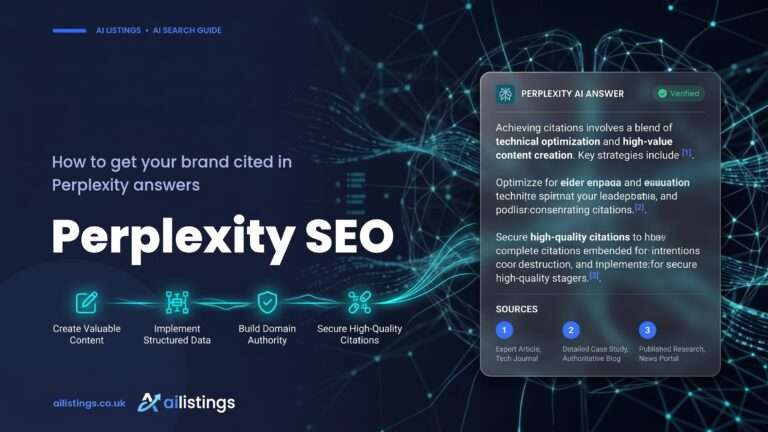
Third-party citations include: mentions in industry publications, features in relevant press, listings in directories, inclusion in comparison articles, partner and supplier references, and review platform profiles. Each independent source that accurately describes your business adds another data point to the AI’s understanding of who you are.
This is not about link building in the traditional SEO sense. It is about ensuring that the AI can find your business described accurately and consistently across multiple external sources, reducing its uncertainty about citing you.
For local UK businesses, practical starting points include accurate listings on Yell, Checkatrade, Trustpilot, and industry-specific directories. For B2B businesses, trade press coverage, industry association listings, and partner websites are the most valuable citation sources.
Principle 5: Map Your Prompt Coverage
The most sophisticated element of GEO practice is prompt coverage mapping. This means systematically identifying the questions your prospective customers are asking AI tools about your category, and ensuring you have clear, structured, citable content that answers each of them.
Most businesses have no idea which prompts their ideal customers are entering into ChatGPT or Perplexity. They optimise for keywords they know from traditional SEO research, but AI queries are often phrased differently from search queries. They are more conversational, more specific, and more intent-loaded.
This is where the Prompt Coverage Maps™ methodology comes in. Developed by AI Listings as part of the Shortlist System™, Prompt Coverage Maps™ are structured frameworks for identifying the specific queries your potential customers are entering into AI systems, mapping the gaps in your current content coverage, and prioritising the content that will have the greatest impact on your AI citation rate.
Rather than guessing which prompts matter, Prompt Coverage Maps™ test real query patterns across the AI platforms most relevant to your market and produce a prioritised action plan. This turns GEO from an abstract principle into a measurable, executable strategy.
How to Start with GEO: A Practical Framework
You do not need to rebuild your entire digital presence to start practising GEO. You need a structured starting point. Here is a three-step framework that any UK business can follow.
Step 1: Audit Your Current AI Visibility
Before you optimise anything, you need to know where you currently stand. Run the following manual tests:
Open ChatGPT and search your business name directly. Is the description accurate? Is your main service clearly represented? Is your location correct? Then run a category query: “What are the best [your service] providers in [your city]?” Does your business appear? If not, who does, and why?
Repeat this across Google AI Overviews and Perplexity. The pattern across all three platforms will tell you where your GEO gaps are most significant.
These manual tests give you a qualitative baseline. For a quantitative, benchmarked baseline that tracks your citation performance across multiple platforms and compares you to competitors, the LLM Visibility Score™ assessment provides that systematic measurement.
Step 2: Identify Your Prompt Coverage Gaps
Using the results of your audit, identify the queries for which AI systems currently do not cite your business. These are your coverage gaps. Prioritise them by customer intent value: which unanswered queries represent the highest-value purchasing decisions?
For each high-priority gap, identify whether the problem is a missing piece of content, a clarity issue with existing content, or an entity signal issue. Missing content needs to be created. Unclear content needs to be restructured. Entity signal issues need a consistency audit across external platforms.
Step 3: Optimise Existing Content for AI Extraction
Before creating new content, check whether your existing pages already contain the answers AI systems need, but in a format those systems cannot extract efficiently. This is the most common GEO issue and the fastest to fix.
Review your key service pages and apply the structured content principles from Principle 1 above. Add FAQ sections. Rewrite introductory paragraphs to lead with direct answers. Add specific data points and evidence where they are currently absent. This work typically produces faster GEO gains than creating new content from scratch.
For a more comprehensive, structured approach to all three steps, the Shortlist System™ provides the full methodology, from initial audit through content optimisation to ongoing citation monitoring.
GEO for UK Businesses: What Is Different
Most of the GEO content available online is written from a US perspective. The platform landscape, user behaviour, and regulatory environment in the UK are not identical to those in the United States. Here is what UK businesses specifically need to account for.
Platform Dominance in the UK
The four platforms that matter most for GEO in the UK are Google AI Overviews, ChatGPT, Perplexity, and Gemini. Of these, Google AI Overviews are the highest priority for most UK businesses, because they appear directly within Google Search and reach the full spectrum of UK search users, not just those who have adopted dedicated AI tools.
ChatGPT is the leading dedicated AI platform in the UK, with 19.1 million unique UK visitors recorded by the end of 2025 and 247 million average monthly visits, making it the seventh most visited website in the country (DataReportal, 2025). Perplexity is growing rapidly and is particularly dominant among research-oriented queries. Gemini’s integration with Google Workspace is driving strong adoption among UK business users.
UK User Behaviour
UK users skew towards research and evaluation queries when using AI tools, particularly for considered purchases, professional services, and B2B decisions. This means GEO for UK businesses often has its highest value in the mid-funnel: queries like “what should I look for in a [service provider],” “best [service] for small businesses UK,” and “is [company type] worth it for a UK business” are where AI citations have the most commercial impact.
GDPR and Data Considerations
UK and EU GDPR regulations have shaped how some AI platforms handle data collection and personalisation for UK users. Perplexity and ChatGPT both operate under UK GDPR requirements for UK users. For UK businesses, this means the data collection and tracking approaches used in some US-based GEO analytics tools may have compliance implications that need to be evaluated before deployment.
The practical implication is not that GEO itself is legally complex. The content optimisation, entity clarity, and citation building work that GEO requires is standard digital marketing practice with no unusual GDPR implications. The caution applies specifically to third-party AI monitoring and analytics tools, which should be evaluated for UK data compliance before use.
UK-Specific Citation Sources
The third-party citation sources that carry the most weight for UK business GEO are different from those in the US. For UK service businesses, high-value citation sources include Trustpilot, Checkatrade, Which? Trusted Traders, Yell, the Federation of Small Businesses, relevant trade association directories, and UK regional press. For UK B2B businesses, trade publications such as The Manufacturer, Accountancy Age, Drapers, and sector-specific journals are valuable citation sources.
Building citations on US-centric platforms like Yelp US or Angi has minimal value for UK GEO. Focusing citation-building effort on platforms that are credible and commonly referenced in UK AI search responses is the higher-leverage approach.
Frequently Asked Questions
What is generative engine optimisation (GEO)?
Generative Engine Optimisation (GEO) is the practice of structuring and positioning content so that AI-powered search systems, including ChatGPT, Perplexity, Gemini, and Google AI Overviews, cite it when generating answers to user queries. The goal is to be included in AI-generated responses rather than simply ranking in traditional search results. GEO was formalised as a discipline in peer-reviewed research published at ACM SIGKDD 2024 by researchers from Princeton University and collaborating institutions.
How is GEO different from SEO?
Traditional SEO targets rankings in search engine results pages and measures success by keyword positions and organic traffic. GEO targets citations in AI-generated answers and measures success by how often and how accurately AI systems reference your business or content. SEO optimises at the page and domain level. GEO optimises at the passage and entity level. The two disciplines are complementary, not competing, and a robust digital strategy requires both.
Which AI platforms does GEO affect?
For UK businesses, the most important platforms are Google AI Overviews, ChatGPT, Perplexity, and Gemini. Google AI Overviews are highest priority because they appear within Google Search itself and reach the widest UK audience. ChatGPT is the most widely used dedicated AI platform in the UK. The good news is that the signals that improve GEO performance across one platform tend to improve it across all of them: content clarity, entity consistency, and third-party citations work universally.
How long does GEO take to show results?
Most businesses see measurable improvements in AI citation rates within 30 to 60 days of implementing structured GEO work. Initial gains tend to come from content restructuring and entity clarity fixes on existing pages. Stronger, more consistent citation performance across multiple platforms typically builds over 60 to 90 days. The timeline is similar to traditional SEO, though the specific activities differ significantly. Monitoring via the LLM Visibility Score™ allows you to track progress against a baseline rather than relying on subjective spot-checks.
Do I need GEO if I already do SEO?
Yes, because GEO and SEO target different outcomes. Strong SEO performance does not guarantee GEO performance. The Princeton research found that pages ranked at position one saw minimal benefit from GEO optimisation because they were already performing well, but businesses at positions five and below saw up to 115 percent visibility gains. More importantly, as AI Overviews now appear in up to 50 percent of searches and reduce organic CTR by 58 percent, strong SEO rankings are worth progressively less without a GEO layer. Both are necessary components of a complete search visibility strategy.
Take the Next Step
GEO is not a future consideration. It is a current gap. Most UK businesses are being cited inaccurately, cited infrequently, or not cited at all by the AI systems their customers are already using to make purchasing decisions.
A free GEO audit identifies exactly where your content stands across the AI search platforms that matter most for your market, which queries are driving recommendations in your category, and where the most valuable optimisation opportunities are.
Get Your Free GEO Audit and find out how your content performs across AI search platforms today.
About the Author
AI Listings Team
AI Listings is a UK-based AI visibility agency helping businesses become visible, trusted, and recommended across AI search platforms including ChatGPT, Perplexity, Gemini, and Google AI Overviews. The team specialises in GEO, AEO, and the full stack of AI visibility optimisation disciplines that determine whether a business is cited by AI or overlooked by it.
AI Listings operates as a trading name of Primrose Point Ltd and is the creator of the Shortlist System™, LLM Visibility Score™, Prompt Coverage Maps™, and Hallucination Guard™ frameworks for measuring and improving AI visibility.