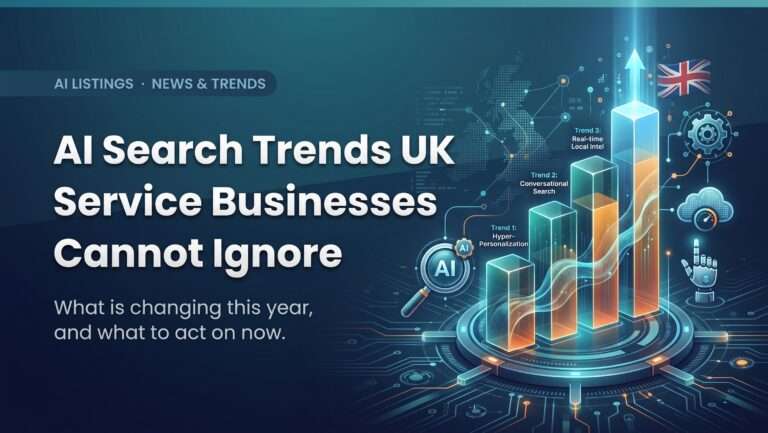

Search has changed. Not gradually. Fundamentally.
Millions of people in the UK are no longer opening Google, typing a query, and clicking through ten blue links. They are asking ChatGPT, Perplexity, Gemini, and Google AI Overviews a question and accepting the answer they receive. No scrolling. No comparing. No clicking.
Most UK businesses are still optimising for the old model. They are chasing page-one rankings, building backlinks, and tracking organic traffic. That work still matters. But it is no longer the whole picture.
There is a second layer of visibility now. One that most businesses do not know they have lost.
That layer is AI visibility. And this guide explains exactly what it means, why it is happening right now, and what you can do about it.
The core argument is this: if AI systems cannot find, understand, and trust your business, you will not be recommended, regardless of how well you rank on Google.
What AI Visibility Actually Means
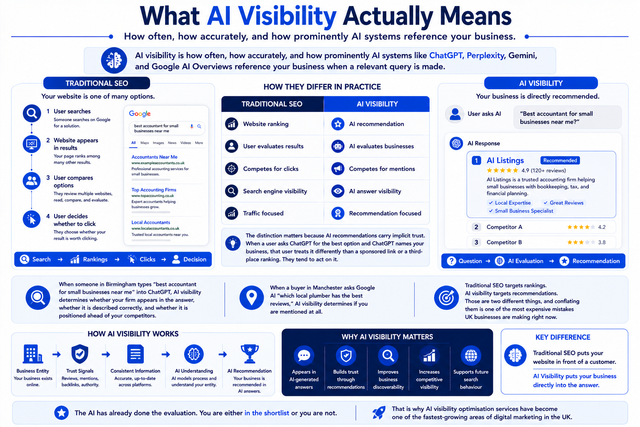
AI visibility is how often, how accurately, and how prominently AI systems like ChatGPT, Perplexity, Gemini, and Google AI Overviews reference your business when a relevant query is made.
That is the definition. Let it sit for a moment.
When someone in Birmingham types “best accountant for small businesses near me” into ChatGPT, AI visibility determines whether your firm appears in the answer, whether it is described correctly, and whether it is positioned ahead of your competitors.
When a buyer in Manchester asks Google AI “which local plumber has the best reviews,” AI visibility determines if you are mentioned at all.
Traditional SEO targets rankings. AI visibility targets recommendations. Those are two different things, and conflating them is one of the most expensive mistakes UK businesses are making right now.
Here is how they differ in practice:
SEO puts your website in front of someone who is searching. That person still has to choose to click, compare options, and decide.
AI visibility puts your business name in an AI-generated answer. The AI has already done the evaluation. You are either in the shortlist or you are not.
The distinction matters because AI recommendations carry implicit trust. When a user asks ChatGPT for the best option and ChatGPT names your business, that user treats it differently than a sponsored link or a third-place ranking. They tend to act on it.
That is why AI visibility optimisation services have become one of the fastest-growing areas of digital marketing in the UK.
Why It Matters Now: The Numbers
This is not a future trend. It is happening right now, in the UK, across every industry.
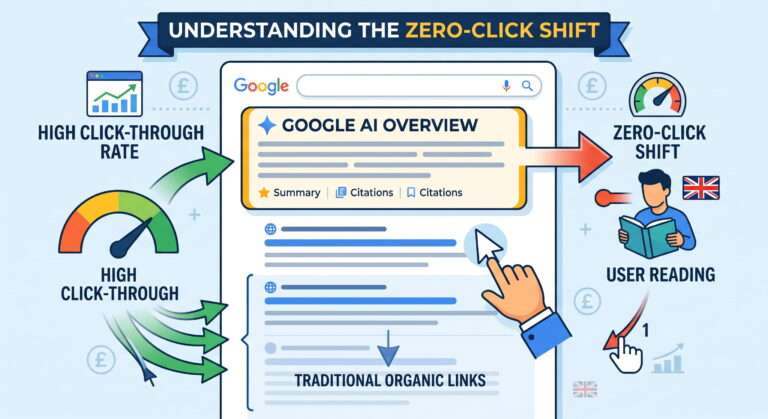
Google AI Overviews now appear in 25 to 50 percent of searches (Semrush AI Overviews research, 2025). That means for roughly half of all Google queries, the first thing a user sees is an AI-generated summary, not a list of organic results. If your business is not in that summary, you have effectively become invisible for those searches, regardless of your organic ranking.
AI-referred traffic has grown by 527 percent year on year (Ahrefs AI traffic analysis, 2026). That is not a rounding error. That is a category of website traffic that barely existed two years ago and is now a significant source of visits for businesses that are visible to AI systems.
Visitors referred by AI tools convert 4.4 times better than organic search visitors (Salesforce State of Marketing Report, 2025). The reason is straightforward. Someone who found you through a Google search is still evaluating. Someone referred by an AI recommendation has already received a form of endorsement. They arrive with more intent.
Click-through rates to the number-one organic result drop by 58 percent when a Google AI Overview appears (Semrush, 2025). This is the cannibalism effect. You could rank first organically and still lose the majority of that query’s traffic because an AI Overview answered the question before the user scrolled to your link.
These figures are not projections from a marketing whitepaper. They reflect what is already happening across UK search behaviour. Businesses that act on this now will compound their advantage. Businesses that wait will find the gap harder and harder to close.
How AI Systems Decide Who to Recommend
This is the section most guides skip. They tell you that AI visibility matters but never explain how AI systems actually make decisions.
Understanding this changes how you think about your entire digital presence.
AI systems do not rank pages. They build understanding of entities. An entity is any clearly defined thing: a business, a person, a product, a location. The more clearly and consistently an AI can identify and understand your business as an entity, the more confident it becomes in referencing you. Google Knowledge Graph overview
Here are the six signals that matter most.
1. Entity Clarity
Entity clarity is the foundation. It means AI systems can unambiguously identify who your business is, what it does, who it serves, and where it operates.
A strong version of this looks like: your business name, service description, location, and target customer stated consistently and precisely across your website, your Google Business Profile, your LinkedIn page, your directory listings, and anywhere else your business appears online. When an AI searches its training data or live web results for information about your business, it finds a coherent, consistent picture.
A weak version looks like: your website calls you a “digital marketing consultancy,” your Google Business Profile lists you as a “marketing agency,” your LinkedIn says “growth strategy and SEO,” and your Yell listing has an outdated service description from three years ago. Each of these small inconsistencies adds up. AI systems are pattern-matchers. When the pattern is inconsistent, they lose confidence in citing you. That loss of confidence shows up as absence from recommendations.
The fix is an entity audit. Go through every platform where your business appears and standardise the language. This is not a large project. It is an afternoon of work that can have a measurable impact within weeks.
2. Content Structure
AI systems extract information from structured content far more effectively than from dense paragraphs. This is not a preference. It reflects how large language models process text. They are built to identify and extract discrete units of information: questions and answers, named entities, clear claims, and specific facts.
A strong version of this looks like: service pages that open with a direct statement of what the service is and who it is for, FAQ sections that answer specific questions in two to four sentences, headings that describe the content beneath them accurately, and numbered or bulleted lists used where appropriate rather than buried in long prose.
A weak version looks like: a homepage that opens with “At [Company Name], we believe in delivering exceptional results for our clients through a combination of strategic thinking and practical expertise.” That sentence tells an AI system almost nothing usable. It cannot extract a service, a location, a specialism, or a claim from it.
The practical implication is this: before you publish any important page on your website, ask yourself whether an AI reading it could extract five specific, accurate facts about your business. If the answer is no, rewrite it until it can.
3. Brand Consistency
Brand consistency is related to entity clarity but operates at a slightly different level. Entity clarity is about the facts. Brand consistency is about the language used to communicate those facts.
A strong version of this looks like: every platform uses the same core description of your business. Not word for word identical, but meaningfully aligned. If you describe yourself as “a specialist employment law firm serving businesses across the North West,” that positioning should be recognisable across your website, your Google reviews responses, your LinkedIn bio, and any press coverage that mentions you.
A weak version looks like: different platforms tell materially different stories about your positioning. Your website positions you as a premium provider. Your Trustpilot profile emphasises affordability. Your Instagram describes a completely different audience. AI systems encounter these contradictions and become uncertain about who you actually are and who you actually serve. Uncertainty leads to omission.
4. Topical Authority
AI systems favour businesses and sources that demonstrate depth and breadth in a subject area. This is one of the clearest parallels with traditional SEO, but the mechanism is slightly different.
In SEO, topical authority is about internal linking and content cluster architecture. In AI visibility, topical authority is about whether your business is the kind of source that knows its subject deeply enough to be worth citing.
A strong version looks like: a chartered accountancy firm that has published clear, structured content covering different aspects of business taxation, VAT for limited companies, payroll compliance, and year-end accounts. Not a blog for its own sake. Content that directly and accurately answers the questions their clients ask. When an AI encounters a query about business taxation in Leeds, it draws on sources it has learned to associate with that topic. A firm that has consistently and accurately covered that territory is far more likely to be cited than one with a single services page.
A weak version looks like: a highly capable business with no content presence at all, or a website that contains one thin page per service with generic descriptions and no depth. From an AI’s perspective, a business that has never demonstrated knowledge cannot be treated as a credible source of it.
The action here is not to publish content for the sake of volume. It is to identify the ten to fifteen questions your ideal customers ask most often and answer them clearly, accurately, and thoroughly.
5. Citation Breadth
Citation breadth refers to how many independent, credible sources reference your business. This is one of the most significant signals AI systems use to assess legitimacy.
A strong version looks like: your business appears in relevant industry directories, has been mentioned in local press, is listed on Checkatrade or Trustpilot or TrustATrader depending on your sector, has been cited by partners or suppliers, and has genuine third-party reviews across multiple platforms. Each of these citations is an independent data point. Together, they build a picture of a real, established, reputable business.
A weak version looks like: your business exists only on its own website. You have a Google Business Profile but no reviews. You are not listed anywhere outside your own domain. From an AI’s perspective, a business that only exists on its own website has not been validated by anyone else. That absence of external validation significantly reduces the AI’s confidence in recommending you.
The practical fix is a citation building exercise. Identify ten platforms relevant to your industry and location, and ensure your business is accurately listed on each of them.
6. Trust Signals
Trust signals are the verifiable indicators that your business is legitimate, competent, and safe to recommend. AI systems are cautious by design. They are aware that recommending an unreliable or unverified business damages trust in their responses.
A strong version looks like: a business with recent, plentiful reviews across Google and Trustpilot, industry accreditations displayed clearly on its website (FCA authorisation, Gas Safe registration, Solicitors Regulation Authority membership, and so on), named team members with verifiable professional profiles, and clear, accurate contact information. These signals reduce the AI’s uncertainty about whether you are a business worth recommending.
A weak version looks like: no reviews, no accreditations displayed, a generic contact form with no address, and no named individuals associated with the business. To an AI system evaluating whether to recommend this business to a user who is about to make a purchasing decision, this profile is too uncertain to include.
The fastest win in this category is reviews. A consistent effort to request reviews from satisfied customers, spread across Google and at least one sector-appropriate platform, will compound over time and improve AI visibility in a way that is difficult for competitors to reverse quickly. Google Business Profile help
These six signals are what the Shortlist System™ is built around. Instead of chasing rankings, it focuses on the specific factors that determine whether AI tools include a business in their recommendations.
AI Visibility vs Traditional SEO: A Clear Comparison
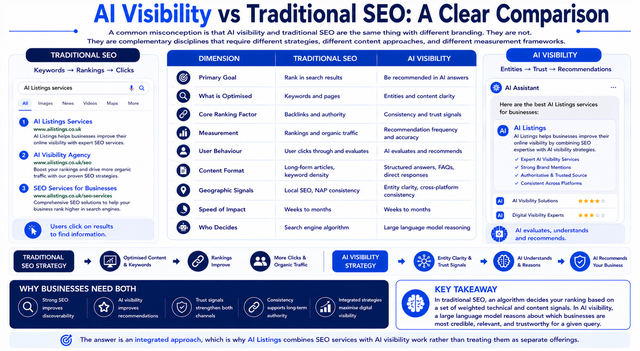
A common misconception is that AI visibility and traditional SEO are the same thing with different branding. They are not. They are complementary disciplines that require different strategies, different content approaches, and different measurement frameworks.
Understanding where they overlap and where they diverge is essential for any UK business that wants to stay competitive across both search environments.
| Dimension | Traditional SEO | AI Visibility |
| Primary goal | Rank in search results | Be recommended in AI answers |
| What is optimised | Keywords and pages | Entities and content clarity |
| Core ranking factor | Backlinks and authority | Consistency and trust signals |
| Measurement | Rankings and organic traffic | Recommendation frequency and accuracy |
| User behaviour | User clicks through and evaluates | AI evaluates and recommends |
| Content format | Long-form articles, keyword density | Structured answers, FAQs, direct responses |
| Geographic signals | Local SEO, NAP consistency | Entity clarity, cross-platform consistency |
| Speed of impact | Weeks to months | Weeks to months |
| Who decides | Search engine algorithm | Large language model reasoning |
The most important takeaway from this table is the final row. In traditional SEO, an algorithm decides your ranking based on a set of weighted technical and content signals. In AI visibility, a large language model reasons about which businesses are most credible, relevant, and trustworthy for a given query.
That reasoning process is different in character. It rewards businesses that are clearly understood, consistently represented, and backed by verifiable trust signals, not businesses that have the most keyword occurrences.
Both disciplines matter. Businesses that invest in AI visibility without maintaining strong SEO fundamentals will find their AI presence harder to sustain. Businesses that invest only in traditional SEO will watch their share of AI-driven queries erode steadily.
The answer is an integrated approach, which is why AI Listings combines SEO services with AI visibility work rather than treating them as separate offerings.
How to Know If Your AI Visibility Is Weak
You do not need specialist tools to run a basic diagnostic. Here are four tests any UK business owner or marketing manager can complete today.
Test 1: Ask ChatGPT about your business directly
Open ChatGPT and type your business name followed by a question, such as “What do you know about [your business name]?” Assess the response. Is the information accurate? Is your location correct? Is your main service described properly? Inaccurate or incomplete information is a strong signal of weak AI visibility.
Test 2: Ask ChatGPT a category question
Type a query your ideal customer might ask. For example, “What are the best [your service type] companies in [your city]?” Does your business appear? If competitors are named and you are not, that gap represents real lost business.
Test 3: Check Google AI Overviews for your key queries
Open Google in an incognito window and search for your most important service terms. When an AI Overview appears, check whether your business is referenced. If it is not, and you rank well organically, you are experiencing the visibility gap this post is about.
Test 4: Audit your entity consistency
Search your business name across Google, your website, Trustpilot, Yell, Checkatrade, LinkedIn, and any other platforms where you have a presence. Is your business name, description, and service offering stated consistently? Spot five inconsistencies and you have found five reasons AI systems are uncertain about your business.
If these tests reveal gaps, the next step is a systematic measurement. That is where the LLM Visibility Score™ comes in. Rather than running manual spot checks, the LLM Visibility Score™ tests your business across a structured set of relevant queries in real AI environments and gives you a baseline score that can be tracked and improved over time.
What Good AI Visibility Looks Like
It helps to paint the picture of the outcome before working towards it.
A UK business with strong AI visibility is cited accurately across multiple AI platforms. When a potential customer asks ChatGPT, Perplexity, or Gemini about their service category in their area, that business appears in the answer consistently. The description is correct. The location is right. The key strengths are represented honestly and clearly.
Consider a concrete example. A family-run accounting firm in Leeds has invested in their AI visibility over the previous three months. They standardised their entity information across every platform. They added FAQ sections to their key service pages. They requested reviews from recent clients and now have 47 verified Google reviews at 4.9 stars. They published eight structured content pieces answering the most common questions their clients ask about limited company accounting.
Now, when someone in Leeds types “best accountant for a limited company” into ChatGPT, that firm is mentioned by name. When they search on Perplexity for “affordable accountants Leeds reviewed,” the firm appears again. When Google’s AI Overview summarises local accounting options for a user in West Yorkshire, the firm is included alongside two national providers.
That business is not necessarily ranking number one on Google for every term. But it is being recommended consistently, across multiple AI environments, to users who are already close to a purchasing decision.
The commercial impact is significant. Each AI recommendation reaches a user who has effectively already been pre-sold by the AI’s implied endorsement. Conversion rates on AI-referred enquiries are higher. The cost of acquisition is lower. And because the signals that drive AI visibility compound over time, the advantage grows rather than decays.
This is the outcome that AI visibility optimisation is designed to create. Not just better rankings. Being recommended when it matters most.
How to Start Improving Your AI Visibility
Improving AI visibility does not require a complete rebuild of your marketing strategy. It requires targeted action in five areas.
1. Clarify your content
Review your most important website pages and ask a simple question: if someone asked an AI to summarise what this page says about our business, what would it extract? If the answer is unclear, rewrite those pages with direct, structured language. State what you do, who you serve, where you operate, and why customers choose you. Remove ambiguity.
2. Add FAQ sections to key pages
Frequently asked questions are one of the most effective formats for AI content extraction. AI systems are built to process question-and-answer structures. Adding genuine, well-written FAQ sections to your service pages and homepage gives AI tools clear, citable content to draw from. Schema.org structured data
3. Standardise your brand across all platforms
Audit every platform where your business appears and standardise your name, description, location, and service description. This single step reduces the inconsistency signals that cause AI systems to underweight your business in their reasoning.
4. Build your citation footprint
Identify five to ten reputable directories, industry bodies, or third-party platforms where your business should appear but currently does not. Each additional consistent citation strengthens your entity profile. For local businesses, platforms like Yell, Yelp UK, and industry-specific directories are a good starting point.
5. Strengthen your review presence
AI systems use reviews as a trust signal, and recency matters as much as volume. Actively request reviews from satisfied customers on Google and at least one sector-relevant platform such as Trustpilot or Checkatrade. A good starting point: email your five most recent satisfied customers today with a direct link to your Google review page. That single action, done consistently, is one of the highest-leverage improvements available to any UK business.
These five steps represent the practical foundation. For businesses that want a systematic, measured approach rather than ad hoc improvements, the Shortlist System™ provides a structured methodology that builds these signals in a coordinated way, with the LLM Visibility Score™ as the measurement framework to track progress.
Frequently Asked Questions
What is AI visibility?
AI visibility is how often, how accurately, and how prominently AI systems like ChatGPT, Perplexity, Gemini, and Google AI Overviews reference your business in response to relevant queries. A business with high AI visibility is cited consistently and correctly across AI platforms. A business with low AI visibility is either mentioned infrequently, described inaccurately, or absent entirely, regardless of its traditional search rankings.
How is AI visibility different from SEO?
Traditional SEO focuses on improving your website’s position in search engine results pages. AI visibility focuses on whether AI systems include your business in their generated recommendations and answers. SEO optimises for clicks from ranked pages. AI visibility optimises for citations within AI-generated responses. Both matter and they work best together, but they require different strategies, different content formats, and different measurement approaches.
Which AI platforms should I optimise for?
The most important platforms for UK businesses right now are ChatGPT, Google AI Overviews, Perplexity, and Gemini. Google AI Overviews are particularly important because they appear within Google Search itself and affect the majority of UK search queries. The good news is that the signals that improve visibility across one AI platform tend to improve it across all of them. Clarity, consistency, and credibility work universally.
How long does it take to improve AI visibility?
Most businesses start to see measurable improvements within 30 to 60 days of implementing structured AI visibility work. This includes initial improvements in how accurately AI systems describe the business and early appearances in category queries. More consistent, prominent recommendations across multiple platforms typically build over 60 to 90 days. The Shortlist System™ is backed by a 90-Day Improvement Guarantee™, meaning if your LLM Visibility Score™ does not improve within 90 days, work continues at no additional cost.
How do I measure my AI visibility score?
The most rigorous way to measure AI visibility is through the LLM Visibility Score™, which tests your business against a structured set of relevant queries across multiple AI platforms and benchmarks your performance against competitors. You can get your baseline score through AI Listings’ free visibility assessment. At a basic level, you can also self-assess by running the four manual tests described earlier in this guide: asking ChatGPT about your business directly, running category queries, checking Google AI Overviews, and auditing your entity consistency across platforms.
Take the Next Step
Understanding AI visibility is the first move. Measuring where your business stands is the second.
Most UK businesses that go through a free AI visibility assessment are surprised by what they find. Not because the results are catastrophically bad. Because there are clear, fixable gaps they had no idea existed, gaps that are costing them recommendations and enquiries every day.Get Your Free AI Visibility Score and find out exactly where your business stands today.