
You would not go to a general practitioner for spinal surgery.
You would ask for a specialist. Someone who has spent years focused on exactly your problem, not someone who treats everything from common colds to broken bones competently but without depth in any one area.
AI systems think the same way.
When a buyer asks ChatGPT, Perplexity, or Google AI for a recommendation in your category, the system is not looking for the business that does the most things. It is looking for the business that has demonstrated the deepest, most consistent expertise in that specific area.
That depth has a name: topical authority. And most UK businesses do not have it yet, even when they think they do.
This guide explains exactly what topical authority means, why AI systems weight it so heavily, and how to build it deliberately rather than hoping it accumulates by accident.
What Is Topical Authority?
Topical authority is the degree to which your website, brand, and content are recognised as a trusted, comprehensive source on a specific subject.
In traditional SEO, topical authority is measured primarily by the depth and breadth of content on your own website. How many pages do you have covering a topic? How thoroughly do they cover the sub-questions within that topic? How well do they link to and reinforce each other?
In AI search, the concept extends significantly further. AI systems do not just look at how much content you have published. They evaluate whether your business is consistently described, cited, and referenced as an authority on that subject across the entire web, not just your own domain.
This matters because of how generative AI systems build their understanding of who to trust. They draw on multiple sources to form a picture of your business. If your own website demonstrates deep expertise in employment law, but no other source on the internet ever mentions your firm in connection with employment law, the AI has only one data point to work from. If your website’s expertise is reinforced by industry directory listings, press mentions, client testimonials, and third-party citations that all consistently describe you the same way, the AI has a much stronger, corroborated signal to act on.
Topical authority, in the context of AI visibility, is therefore not simply “having a lot of content.” It is being recognised, consistently and from multiple directions, as the specialist in a defined area. That recognition is what gives an AI system the confidence to recommend you over a competitor.
Why AI Systems Prioritise Topical Authority
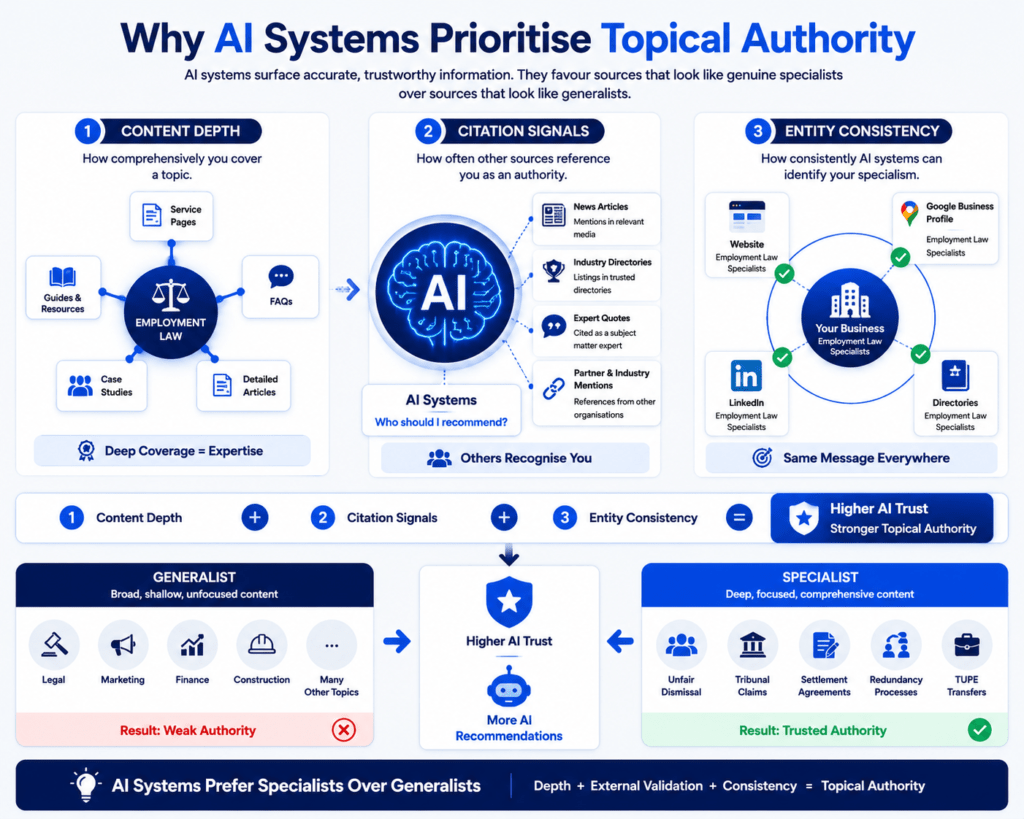
AI systems are built to surface accurate, trustworthy information to the people asking them questions. Getting that wrong carries real reputational cost for the platform itself. This is why AI systems are cautious, and why they default to favouring sources that look like genuine specialists over sources that look like generalists.
A business with broad, shallow content spread across dozens of unrelated topics looks like a generalist. A business with deep, consistent, well-structured content focused on a specific topic looks like an authority. Faced with a choice between the two, AI systems consistently favour the latter, because the depth of coverage signals genuine expertise rather than content produced simply to exist.
This preference plays out across three distinct dimensions.
Content depth is the most visible dimension. This is how comprehensively you have covered a topic, not just the existence of one or two pages mentioning it. A law firm with a single generic “employment law” service page demonstrates far less depth than a firm with content covering unfair dismissal, redundancy processes, settlement agreements, employment tribunal procedure, and TUPE transfers. The second firm has built a body of evidence that it genuinely understands the subject from multiple angles, not just enough to list it as a service.
Citation signals are the second dimension, and the one most businesses underestimate. This is how often other sources reference you specifically as the authority on a subject. A mention in a trade publication, a quote in a local news article about a relevant legal change, a listing in an industry-specific directory, or a citation from a partner organisation all function as external validation. AI systems weight these signals heavily because they represent independent corroboration rather than self-description. Anyone can claim expertise on their own website. Far fewer businesses are referenced as the expert by others.
Entity consistency is the third dimension. This is how reliably AI systems can identify what your business actually specialises in, based on how consistently that specialism is described across every platform where you appear. If your website says “employment law specialists,” your Google Business Profile says “general legal services,” and your LinkedIn says “commercial and employment law,” the AI receives a blurred signal rather than a clear one. Consistency across platforms removes that ambiguity and reinforces the specific area in which you are the authority.
Together, these three dimensions explain why two businesses with similar website content can have very different topical authority in the eyes of an AI system. Depth, external validation, and consistency compound. Any one alone is weaker than all three working together.
Topical Authority in AI Search vs Traditional SEO
The concept of topical authority existed in SEO long before AI search made it relevant to a wider audience, but the mechanics differ meaningfully between the two contexts.
In traditional SEO, topical authority is largely an on-site concern. Search engines evaluate how many pages your website has on a topic, how those pages interlink, and whether your overall site architecture demonstrates comprehensive coverage of a subject area. The classic SEO advice to build a pillar page with supporting cluster content is a direct response to this mechanic. Most of the work happens within your own domain.
In AI search, topical authority extends to the entire web. AI systems are evaluating not just what your website says about your expertise, but what the rest of the internet says about it too. Backlinks and citations from genuinely relevant, credible sources matter more in this context than they typically do for ranking purposes alone, because they function as corroboration of the claims your own content makes.
Being referenced in industry articles, mentioned in relevant online forums and discussion communities, cited in comparison content, or featured in trade press all builds the kind of authority signal that AI systems specifically look for when deciding whom to trust on a given subject. A business that has built strong on-site topical authority but has no external footprint will struggle to convert that into AI visibility, because the AI has no independent confirmation of the claims being made.
The practical implication is that UK businesses who already invested in traditional SEO topical authority, building out comprehensive content clusters, have a head start. But that head start only converts into AI visibility if the external citation layer is built alongside it. On-site depth and off-site corroboration now need to be pursued together, not treated as separate workstreams from separate eras of search strategy.
How to Build Topical Authority for AI Visibility
Building topical authority is a deliberate, structured process. Here are five practical steps any UK business can follow.
Step 1: Choose a Specific Focus Area Rather Than Going Broad
The single most important decision is scope. Define the specific area in which you want to be recognised as the authority, and resist the temptation to spread that effort across every service you offer. A firm offering ten different legal services will build stronger AI visibility by becoming the clear authority on one or two of them first, rather than producing thin coverage across all ten simultaneously.
Choose the focus area based on where you have genuine expertise, where commercial value is highest, and where competition for topical authority is currently weakest. This is a strategic decision, not just a content decision.
Step 2: Build Content Clusters
Once your focus area is chosen, build a structured content cluster around it: one comprehensive pillar piece covering the topic broadly, supported by multiple in-depth pieces covering specific sub-questions within that topic. Each supporting piece should link back to the pillar and to relevant sibling pieces, creating a genuinely interconnected body of content rather than a scattered collection of standalone posts.
This structure does double duty. It demonstrates depth to both traditional search engines and AI systems, and it gives readers, and AI systems extracting information for those readers, a clear, navigable map of your expertise.
Step 3: Get Cited
Content alone is not enough. Actively pursue citation from relevant third-party sources. This might mean contributing expert commentary to trade publications, ensuring accurate and complete listings on industry-specific directories, building relationships with complementary businesses who might reference your expertise, or simply ensuring that any existing press mentions and partner relationships are reflected accurately online.
This is the dimension most UK businesses neglect, because it requires effort beyond their own website. It is also the dimension that most reliably differentiates businesses with genuine AI-recognised authority from businesses that simply have a lot of content.
Step 4: Ensure Entity Consistency
Your specialisation should be described in the same way, using consistent language, across your website, your Google Business Profile, your industry directory listings, and your social media profiles. This is a straightforward audit task: search your own business name and check whether every platform tells the same story about what you specialise in.
Inconsistency here actively undermines the work done in the previous three steps. A business with deep content and strong citations but contradictory self-description across platforms gives AI systems a confused signal that weakens the overall authority picture.
Step 5: Demonstrate Depth Over Time
Topical authority is not built through a single comprehensive piece of content, however good. It is built through sustained, consistent coverage that develops over months. A business that publishes one excellent pillar page and then stops has started the process but not completed it. A business that continues to add depth, address emerging sub-questions, and refresh existing content as the subject evolves demonstrates the kind of ongoing expertise that AI systems learn to trust over time.
This five-step framework is the practical foundation of what we treat as Stage 1 within the Shortlist System™: establishing topical authority as one of the core signals that determines whether AI systems shortlist a business for recommendation in the first place.
The Topical Authority Trap: What Most Businesses Get Wrong
The most common mistake UK businesses make is trying to cover too many topics and achieving authority in none of them.
This usually happens with good intentions. A business decides to “do more content” and starts publishing on whatever feels relevant that week: a post about a recent industry news story, a generic explainer on a tangential topic, a roundup piece with no specific angle. Twenty posts later, the business has more content than it started with, but no clearer claim to being the authority on anything specific.
AI systems do not reward breadth. They reward depth. A business that publishes twenty posts on vaguely related topics looks, from an AI’s perspective, like a business that produces content rather than a business with genuine, defined expertise. A business that publishes five deeply researched, thoroughly structured, interconnected posts on a single, specific topic looks like a specialist worth recommending.
This is a difficult discipline to maintain, particularly for businesses used to thinking about content production in terms of volume and frequency. The shift required is from “how much can we publish” to “how completely have we covered this specific area, and does every piece reinforce the others.”
It is also worth being honest about timeframe. Genuine topical authority is not built in a single content sprint. It typically takes three to six months of consistent, focused effort to establish a recognisable, AI-detectable position as the authority in a chosen area. Businesses expecting overnight results from a handful of new blog posts are setting themselves up for disappointment. Businesses prepared to commit to a focused, sustained build are the ones who eventually see their specialism reflected back to them in AI-generated answers.
Topical Authority Self-Assessment
Before investing further effort, it helps to honestly assess where your business currently stands. Work through these five questions.
Do you have a clear, consistent specialism stated across your website, Google Business Profile, and social profiles? If a stranger reviewed all three simultaneously, would they describe your specialism identically, or would they come away with three slightly different impressions?
Do you have five or more pieces of content that go genuinely deep on your core topic? Not five pages that mention the topic in passing, but five pieces that meaningfully address different facets of it in real depth.
Are you cited by other sources in your niche? Search for your business name alongside your specialism and see whether independent sources, beyond your own website, reference you in that context.
Does a search of your brand name in ChatGPT produce an accurate description of your specialism? This is a direct test of whether the authority you believe you have built is actually visible to AI systems right now.
Are your internal links organised around topic clusters, or scattered without clear structure? Review your site architecture and check whether content on your core topic reinforces itself through deliberate internal linking, or sits disconnected from related pieces.
If you answered no to two or more of these, you have a clear, actionable starting point. For a more rigorous, benchmarked view of where your topical authority and broader AI visibility currently stand, the LLM Visibility Score™ measures this systematically across multiple AI platforms rather than relying on manual spot-checks.
Frequently Asked Questions
What is topical authority?
Topical authority is the degree to which your website, brand, and content are recognised as a trusted, comprehensive source on a specific subject. In AI search specifically, it extends beyond your own website to include how consistently other sources across the web describe, cite, and reference your business as an authority in that area. It is built through content depth, external citation, and consistent entity description.
How is topical authority different for AI search vs traditional SEO?
Traditional SEO topical authority is primarily an on-site concern, measured by how much content you have on a topic and how well it interlinks on your own domain. AI search topical authority extends to the entire web, weighing how often independent third-party sources corroborate your expertise through citations, mentions, and consistent description. On-site depth alone is not enough for AI visibility without external validation.
How long does it take to build topical authority?
Genuine topical authority typically takes three to six months of consistent, focused effort to establish. It is not built through a single piece of content, however comprehensive, but through sustained content depth, ongoing citation building, and consistent entity description maintained over time. Businesses expecting results from a short content sprint are usually disappointed; the businesses that succeed are the ones prepared to commit to a sustained build.
How do I know if my business has topical authority?
Run a direct test by asking ChatGPT or Perplexity to describe your business and its specialism, and check the accuracy against how you actually want to be positioned. Then check whether your specialism is described consistently across your website, Google Business Profile, and social profiles, and whether independent third-party sources reference you in connection with that specialism. A clear, consistent answer across all of these checks indicates genuine topical authority.
Does topical authority help with Google AI Overviews?
Yes. Google AI Overviews draw on sources the underlying system judges to be authoritative and trustworthy on the specific query being answered. A business with strong, demonstrable topical authority in a subject area is significantly more likely to be referenced when an AI Overview answers a query within that subject, compared to a business with thin, generalist content covering the same ground.
Take the Next Step
Topical authority is one of the core signals we assess in every AI visibility audit, alongside entity clarity, citation breadth, and brand consistency.
Get Your Free AI Visibility Score and see how your topical authority compares, and what to fix first.
About the Author
AI Listings Team
AI Listings is a UK-based AI visibility agency helping businesses become visible, trusted, and recommended across AI search platforms including ChatGPT, Perplexity, Gemini, and Google AI Overviews. The team specialises in topical authority building, entity clarity, and the full stack of AI visibility optimisation disciplines that determine whether a business is cited by AI or overlooked by it.
AI Listings operates as a trading name of Primrose Point Ltd and is the creator of the Shortlist System™, LLM Visibility Score™, Prompt Coverage Maps™, and Hallucination Guard™ frameworks for measuring and improving AI visibility.